


A Buyer's Guide to Finding Buildable Land for Sale
Ross AmatoWhen you see a listing for buildable land for sale, what does that term actually mean? For a first-time land buyer, it’s important to know that "buildable" is more than just a description—it’s a status that a property must earn. A truly buildable parcel is one that has been evaluated for key factors like zoning, access, and utility availability, making it legally and physically suitable for construction.
Understanding these fundamentals is the first step toward making a smart purchase and turning your vision of a new home or cabin into a reality.
Defining What Makes Land Buildable
Before you begin your search, it's crucial to understand that "buildable" is not a marketing term. It is a factual determination based on a property's characteristics and local regulations. While many listings may use the term, a first-time buyer must learn to verify the details for themselves. A genuinely buildable property is one that meets several critical requirements, transforming it from a simple patch of dirt into a viable site for a home.
Learning these basics is the most important step in your land-buying journey. As the demand for rural and lifestyle properties grows, it has become essential for buyers to perform their own research. According to ResearchAndMarkets.com, the global land planning and development market is expected to continue its upward trend from USD 225.6 billion in 2025. This growth creates opportunities, but it also highlights the need for buyers to be well-informed.
Core Components of Buildability
For a piece of land to be considered buildable, several non-negotiable elements must be in place. These factors determine whether you can legally and practically begin construction.
- Zoning and Land Use: The property must be zoned for your intended use. County planning departments establish these rules, which dictate whether a parcel can be used for a single-family home, agricultural buildings, or other structures.
- Legal and Physical Access: You must have a legally recorded right to access your property. This can be via a public road or a deeded easement that crosses a neighbor's land. Physical access—the ability to drive a vehicle onto the property—is equally important.
- Utility Availability: A buildable lot must have a clear plan for essential services. This includes options for water (such as a public connection or a private well), power (access to the electrical grid), and waste disposal (a sewer connection or a septic system).
- Favorable Topography and Soil: The physical characteristics of the land are critical. Steep slopes can make construction difficult and expensive, while unsuitable soil may not support a foundation or a septic system.
The table below breaks down the essential checks every land buyer should perform.
Core Factors That Determine Buildability
| Factor | What to Investigate | Where to Find Information |
|---|---|---|
| Zoning & Land Use | Is residential construction permitted? What are the setbacks and building restrictions? | County Planning & Zoning Department |
| Legal & Physical Access | Is there a recorded road or deeded easement? Is the road physically passable year-round? | County Recorder’s Office, deeds, plat maps |
| Utility Access | Where are the nearest power lines? Can you connect to public water/sewer, or will you need a well/septic? | Local utility companies, County Health Department |
| Soil & Topography | Is the ground stable enough for a foundation? Will the soil pass a percolation ("perc") test for septic? | Soil survey maps (NRCS), percolation test, geotechnical engineer |
| Floodplain & Hazards | Is the property in a designated floodplain or other hazard zone (like wildfire risk)? | FEMA Flood Maps, county GIS maps |
Getting clear answers on these points is what separates a sound investment from a costly problem.
A common mistake new buyers make is assuming a property is buildable just because it’s near a road. You must personally verify zoning, easements, and utility availability directly with the relevant local authorities.
Ultimately, buildability is where legal permission meets physical reality. Investigating each of these components is the most critical part of the land-buying process. To learn more, check out this detailed guide on what to look for when buying land.
Your Practical Due Diligence Checklist
Due diligence is the process of verifying the facts about a property before you buy. For a first-time buyer, this is the most important phase of the entire transaction. It involves contacting county officials, asking specific questions, and understanding how the answers will impact your plans. A structured approach is key to ensuring you uncover all necessary information before committing financially.
While a general real estate due diligence checklist is a helpful start, the steps below are tailored for the unique challenges of buying raw land.
First Things First: Verify Zoning and Land Use
Your first call should always be to the county Planning and Zoning Department. Never rely solely on a seller's listing description for this information. The county has the final authority on what you can and cannot build.
Here are the essential questions to ask:
- What is the exact zoning classification for this parcel? (e.g., Residential, Agricultural, Recreational)
- Is a single-family home a permitted use? If not, what uses are allowed?
- What are the setback requirements? This tells you how far from property lines, roads, or water you must build.
- Are there any overlays or special restrictions, such as a scenic preservation zone or a temporary building moratorium?
These questions provide the foundational answers for determining if a property is buildable.
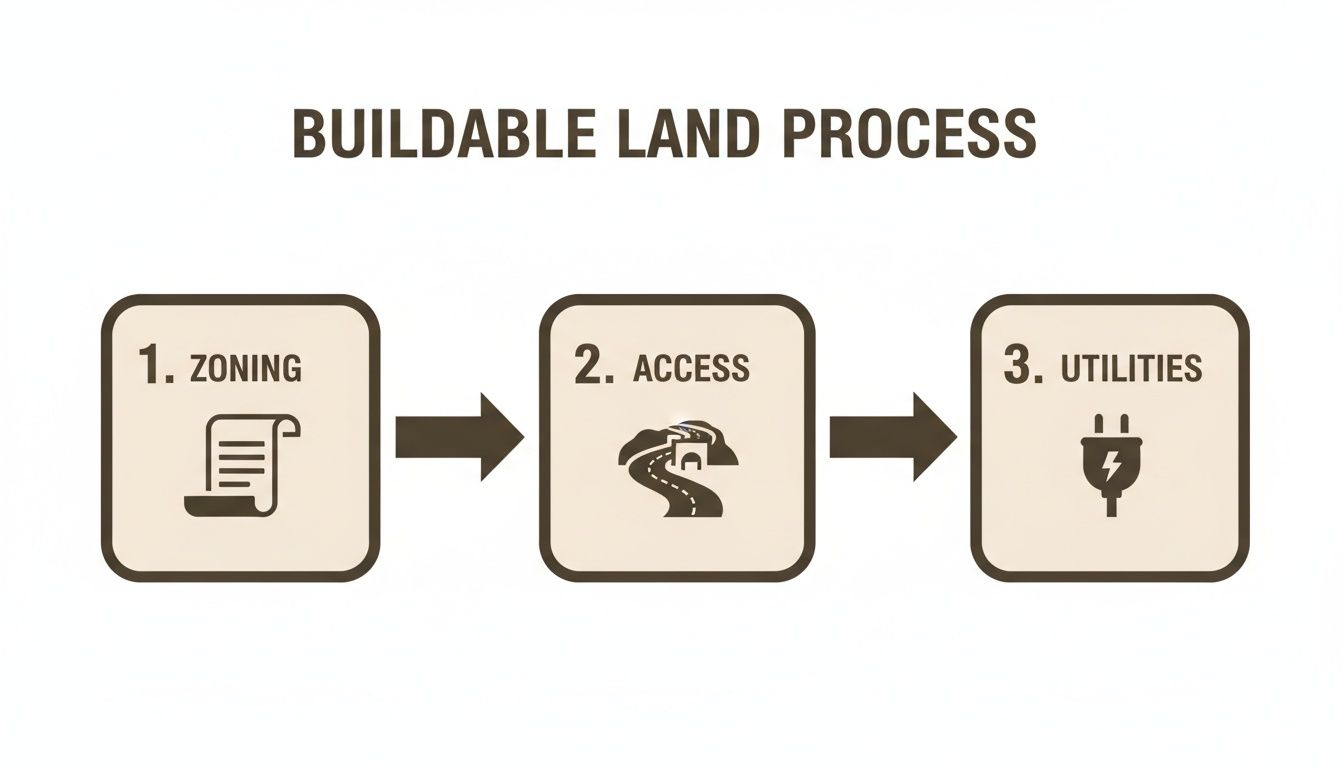
As the diagram shows, a property is only viable if zoning, access, and utility options are confirmed. Each step is essential.
Next Up: Confirming Access and Easements
It's important to distinguish between physical and legal access. A visible dirt path is not the same as a legal right to use it. You must confirm access by reviewing official deeds and plat maps at the County Recorder's office.
Your goal is to determine:
- Does a publicly maintained road provide access to the property? This is the ideal scenario.
- If access is via a private road, is there a legally recorded easement? An easement is a formal document granting permanent right-of-way across another person's land.
- Are there any easements on the property itself? A utility company or neighbor may have rights to use a portion of your land, which could interfere with your building plans.
Verifying legal access is a critical, non-negotiable step. A "landlocked" parcel—one with no legal access—has very limited value, regardless of its price. You can learn more in our guide on how to be a smart land investor.
Finally: Sizing Up Utility Availability
On rural land, utilities are rarely available at the property line. Your due diligence must include investigating what is possible and what it will cost.
Start by contacting the local power cooperative. Ask if they serve the property and request an estimate for the "line extension" cost to bring poles and wires to your build site. This expense can range from a few thousand to tens of thousands of dollars.
For water and sewer, your primary contact is the County Health Department. They can tell you if wells and septic systems are typical in the area and explain the permitting process. This almost always requires a "percolation test," which determines if the soil can adequately absorb septic effluent. If a property fails a perc test, you likely cannot install a septic system, and therefore cannot build a home.
Budgeting For Costs Beyond The Land Price
The purchase price of a parcel is only the beginning. A common mistake for first-time buyers is to acquire an affordable piece of land, only to be surprised by the high cost of developing it into a homesite. Understanding these additional costs upfront is essential for keeping your project on budget.
These are not minor details; they are fundamental and often expensive parts of the development process. Let's break down what you need to plan for.
Site Preparation and Earthwork
Before construction can begin, the land must be prepared. This phase, often called earthwork, involves getting the build site stable, level, and ready for a foundation.
Key budget items include:
- Land Clearing: Removing trees, stumps, boulders, and other vegetation. Costs vary significantly based on the density of the land.
- Grading and Excavation: Leveling the home site, digging for the foundation, and ensuring proper drainage away from the structure.
- Driveway Installation: Creating a solid path for vehicle access, which may involve clearing, grading, and adding a surface like gravel.
A flat, clear parcel will cost significantly less to prepare than a sloped, heavily wooded lot.
Essential Utility Connections
For most rural properties, installing utilities is one of the largest budget items. You are responsible for bringing these services to your home.
A critical mistake is underestimating the cost of water. Drilling a well can be a major expense, with the final cost determined by the depth required to reach a reliable water source.
The three main utilities to budget for are:
- Well Drilling: The primary method for obtaining water on rural land. You can learn more about the factors that influence water well drilling cost per foot.
- Septic System Installation: If there is no public sewer, you will need an on-site septic system. This requires a successful soil test and can be a substantial investment.
- Power Connection: The local utility will extend power lines to your property for a fee, often calculated per foot. The farther your homesite is from the nearest power pole, the higher the cost.
Estimated Development Costs for Raw Land
The costs to develop raw land extend far beyond the purchase price. This table provides hypothetical cost ranges to help you build a more realistic project budget. Please note that actual costs vary widely by location.
| Expense Category | Common Cost Range (Hypothetical) | Key Considerations |
|---|---|---|
| Site Preparation | $3,000 - $15,000+ | Heavily wooded or sloped lots cost more. Includes clearing, grading, and basic excavation. |
| Driveway | $2,500 - $10,000 | Depends on length, material (gravel vs. paved), and terrain. A long, winding driveway adds up. |
| Well Drilling | $5,000 - $25,000+ | Cost is based on depth. A 100-foot well is much cheaper than a 500-foot one. |
| Septic System | $8,000 - $20,000 | Varies with system type (conventional vs. engineered) and local soil conditions. |
| Power Hookup | $2,000 - $30,000+ | Price is often per-foot from the nearest pole. Long distances can get very expensive. |
| Permits & Fees | $1,500 - $5,000 | Includes building, septic, and well permits, plus fees for soil tests and surveys. |
These are estimates. The only way to get accurate figures is to obtain quotes from local contractors in your specific area.
Administrative and Professional Fees
Finally, remember to budget for the necessary paperwork and professional services required to ensure your project complies with local regulations.
Plan for expenses such as:
- Surveys: A licensed surveyor may be needed to mark property lines and stake the build site.
- Permits: Counties require permits for building, septic installation, and well drilling.
- Soil and Perk Tests: Professional tests are often mandatory to confirm the soil can support a foundation and septic system.
By researching these costs early, you can approach a land purchase with financial clarity and confidence.
How to Finance Your Land Purchase
Financing raw land is different from getting a mortgage for a house. Many traditional banks view undeveloped land as a higher-risk investment because there is no existing home to serve as collateral. This can be a significant hurdle for first-time buyers looking for buildable land for sale.
While some local credit unions may offer "lot loans," they often come with strict terms, such as a large down payment of 20% to 50%, higher interest rates, and shorter repayment periods. For many buyers, these requirements can make land ownership feel out of reach.
This is where seller financing offers a practical alternative. It provides a more direct and accessible path to purchasing land.
Understanding Seller Financing
Seller financing, also known as owner financing, is a simple arrangement where the seller of the property also provides the loan. Instead of applying for a loan from a bank, the buyer makes payments directly to the seller based on agreed-upon terms. The seller acts as the lender, holding the property title until the loan is paid in full.
This approach is common in the raw land market because it offers practical benefits for buyers who may not meet the strict criteria of traditional lenders. The process is typically simpler and faster than dealing with a large financial institution.
Key Takeaway: Seller financing removes the bank from the transaction. This creates a direct relationship between the buyer and seller, simplifying the purchase and making land ownership accessible to more people.
The demand for land remains strong. According to IBISWorld.com, the land development market is projected to reach $22.9 billion in revenue in 2025. This steady growth underscores the importance of flexible financing options like seller financing.
The Advantages of This Approach
For a first-time land buyer, the benefits of seller financing can be significant. The terms are often designed to lower the barriers that typically prevent people from buying land.
- No Credit Checks: Many sellers offering this type of financing do not require a formal credit check, making it a viable option for those with a less-than-perfect credit history.
- Low Down Payments: Instead of needing a 20% down payment or more, seller financing often allows buyers to get started with a much smaller initial payment.
- Faster Closing Process: Without the delays associated with bank underwriting, a land purchase can often be completed in a matter of days instead of weeks or months.
- Transparent Terms: The agreement is a straightforward contract between the buyer and seller. All terms, including the interest rate and payment schedule, are clearly defined from the start.
This method provides a practical solution for many first-time land buyers. To learn more, read our detailed guide on how to finance a land purchase.
What This Means for Buyers
Finding a truly buildable piece of land is an active investigation, not a passive search. Your success depends on your willingness to verify every detail yourself.
This means you are in control of your investment. You are the one responsible for calling the county to confirm zoning, researching access, and understanding what it will take to install utilities. An affordable price is appealing, but it reveals nothing about the total project cost.
The most important skill a land buyer can develop is mastering the due diligence process. This knowledge protects you from costly mistakes and ensures the property you buy aligns with your goals.
Real residential property prices have seen a significant jump, with the United States alone experiencing a 20% increase since the pandemic, according to global real estate price trends from the Bank for International Settlements. This trend reinforces why a careful, informed strategy is so critical. Instead of being intimidated by the process, view it as your roadmap to a successful purchase.
Why Consider Dollar Land Store?
The traditional land buying process can be complicated, involving real estate agents, bank loans, and extensive paperwork. For first-time buyers, it can feel overwhelming.
Dollar Land Store was founded to offer a clear, straightforward path to land ownership. We are not agents or brokers; we own every parcel we sell. This means you work directly with us from start to finish, with no middlemen.
Our approach is built on making land accessible. We focus on providing affordable rural and recreational land with a transparent seller-financing process.
- Affordable Land with Low Monthly Payments: We specialize in rural land across several states that fits a variety of budgets.
- Simple Seller-Financing with No Credit Checks: Our financing is designed for accessibility, with clear terms and no formal credit checks.
- Transparent Terms and Disclosures: We provide all property information upfront so you can make an informed decision.
- Fast Contract Setup: Because you are buying directly from us, the entire process is handled online and can be completed quickly.
By removing the usual roadblocks, we help make finding and buying your ideal parcel a simple and confident experience.
Buyer Guidance / Next Steps
You now have the foundational knowledge to identify a piece of land that is truly buildable. The next step is to apply this knowledge and move from learning to doing. As you explore properties, keep your due diligence checklist handy. Evaluate each parcel not just on its price or appearance, but on its real-world potential.
- Browse available parcels in areas that interest you.
- Contact us with questions about a specific property or our buying process.
- Learn more about our seller financing and how it makes land ownership achievable.
- Evaluate land independently using the framework provided in this guide.
Conclusion
Finding buildable land for sale requires more than just browsing listings—it requires research and verification. By understanding zoning, confirming legal access, investigating utility options, and budgeting for all development costs, you empower yourself to make a confident and informed decision. The due diligence process is your greatest asset, protecting your investment and ensuring the land you choose is the right foundation for your future.
Ready to start exploring? Browse available land at DollarLandStore.com.