


A First-Time Buyer's Guide to CO Land for Sale
Ross AmatoSearching for CO land for sale is more than a property hunt—it’s the first step toward owning a piece of the American West. Colorado's stunning mix of mountains, plains, and high-desert mesas makes it a prime destination for aspiring landowners. However, buying raw land here is different from buying a house, and understanding the unique market is essential for making a confident purchase.
Your Guide to Buying Land in Colorado
Owning a piece of the Centennial State is an achievable goal, but it requires learning the landscape—both physically and legally. This guide is designed for first-time buyers and provides a practical roadmap for navigating the process. We will cover everything from market prices to due diligence, helping you ask the right questions and evaluate properties effectively.
What Makes Colorado Unique for Land Buyers
Colorado’s land ownership laws have several distinct features that new buyers should understand. Grasping these concepts early can save time and prevent costly mistakes.
Before looking at listings, consider these key factors:
- Complex Water Rights: In Colorado, owning land does not automatically grant you the right to use the water on or under it. The state follows a "first in time, first in right" system, which we will explain in more detail.
- County-Specific Zoning: Building, camping, and land use regulations vary significantly between counties. For example, rules in Costilla County may differ greatly from those in Park County.
- Diverse Property Types: The market for CO land for sale includes small recreational lots, larger homestead acreages, and investment tracts. Your intended use for the land will guide your search.
- Legal and Physical Access: It is critical to verify that a property has both legal and physical access. Not all parcels have guaranteed, year-round road access.
This guide provides the foundational knowledge you need to assess a property and set realistic expectations for your land-buying journey.
Understanding the Colorado Land Market
Before diving into listings for CO land for sale, it’s helpful to understand the market. Colorado is not a single entity; it's a collection of distinct regions where the price per acre can vary dramatically. A small lot near a Front Range city is entirely different from a 40-acre parcel on the Eastern Plains.
What Drives Land Prices in Colorado
A property's value depends on several interconnected factors. Understanding these components will help you recognize why prices differ.
- Location and Access: Proximity to towns and the quality of road access are primary value drivers. Land with year-round, county-maintained road access is typically more valuable than land reached by a rough dirt track.
- Utilities on Site (or Nearby): The cost of bringing power, water, and septic systems to raw land can be substantial. Parcels with utilities already at the property line command higher prices. A lower price often reflects the investment required to add these services.
- Topography and Features: Natural features add value. A property with a creek, mature trees, or mountain views will generally be priced higher than a flat, featureless parcel.
- Zoning (Permitted Uses): Each county has specific land-use regulations. A parcel zoned for residential construction is usually more valuable than one designated solely for agriculture or recreation.
This is why two five-acre parcels can have very different price tags. One might be a build-ready lot with utilities, while the other is a remote, off-grid property best suited for recreational use.
A Quick Look at Market Stability
The Colorado land market has demonstrated stability, supported by strong demand and a limited supply of available land. Nationally, agricultural real estate values have seen steady growth. According to the American Farm Bureau Federation, this trend points to a predictable and balanced market, which is advantageous for new buyers.
This stability allows you to search for CO land for sale with confidence, knowing that values are supported by real demand rather than speculation.
Common Types of Land for Sale
As you browse listings, you'll encounter several common property types. Identifying your goal will help narrow your search.
- Recreational Lots: Often smaller parcels, from 1 to 10 acres, ideal for camping, hunting, or a private retreat. They are typically in more remote locations and may have seasonal access.
- Homestead or Residential Acreage: Ranging from 5 to 40+ acres, these properties are suitable for building a home, starting a small farm, or establishing an off-grid homestead. This is a common property type offered by Dollar Land Store.
- Investment Tracts: Usually large, raw acreage purchased for long-term appreciation. They may lack developed roads or utilities and are often located in areas of potential future growth.
Navigating Colorado Land Laws
Purchasing land anywhere requires research, but Colorado has specific legal considerations that every buyer must understand. These factors can significantly impact what you can do with your property. When you buy land, you are acquiring a "bundle of rights." In Colorado, these rights can be separated, so it's crucial to know exactly what you are getting. The three most important areas to investigate are water rights, legal access, and mineral rights.
Colorado Water Rights Explained
Colorado's water laws are unique. The state operates under the doctrine of prior appropriation, summarized by the principle: “first in time, first in right.” This is different from the riparian rights common in the eastern U.S., where owning land next to a river typically grants water usage rights. In Colorado, water rights are a separate form of property. Owning land with a stream on it does not automatically give you the right to use that water.
Here’s a brief overview:
- Senior vs. Junior Rights: The first person to divert water for a "beneficial use" (like agriculture) established a senior water right. Later users have junior rights.
- Priority in Scarcity: During dry periods, senior water right holders receive their full allocation first. Junior rights holders may receive a reduced amount or none at all.
- Water Courts: Water rights are legally decreed and managed by a special court system.
For a first-time buyer, this means you must verify water availability. If you plan to drill a well, you need to contact the Colorado Division of Water Resources to inquire about well permits in that specific area.
The Importance of Legal Access
Next, you must confirm that you can legally get to your property. A visible dirt path does not guarantee permanent, legal access. There are different types of access:
- Public Road Frontage: This is the ideal scenario, where the property borders a road owned and maintained by the county or state.
- Deeded Easement: This is a formal, legal right to cross another person’s property to reach yours. A recorded easement is part of the property's title and transfers to future owners.
- Landlocked Parcels: A landlocked property has no public road frontage and no deeded easement. While a neighbor might grant informal permission to cross their land, this can be revoked, leaving you with no way to reach your property.
Buyer's Note: Always verify legal access by checking official county records. A landlocked parcel is difficult to develop, finance, or sell.
Understanding Mineral Rights
Finally, consider what lies beneath the surface. In Colorado, it is common for surface rights to be "severed" from the mineral rights (oil, gas, etc.) below. This means another party could own the right to explore for and extract resources from under your property.
This information is found in the property's title history. If mineral rights have been sold, their owner generally has a legal right to use the surface as reasonably necessary to access them. While state regulations provide some protection for surface owners, it is a critical factor to be aware of before purchasing.
Key Due Diligence Areas for Colorado Land
This table provides a checklist of critical legal and physical aspects to verify before purchasing land in Colorado.
| Diligence Area | What to Verify | Where to Check |
|---|---|---|
| Water Rights | Does the property come with water rights? If not, can you obtain a well permit for domestic use? | County records for decreed water rights; Colorado Division of Water Resources for well permit information and regulations in the specific water basin. |
| Legal Access | Is there public road frontage or a legally recorded, permanent easement? | County Clerk and Recorder’s Office for deeds and plat maps; a title search will reveal recorded easements. You can also review maps from the County Assessor's office. |
| Mineral Rights | Have the mineral rights been severed from the surface rights? | The property's title history, which can be researched through the County Clerk and Recorder’s Office or a title company. |
| Zoning | What is the property zoned for (e.g., residential, agricultural)? Are there building restrictions? | The County Planning and Zoning Department. They can provide zoning maps and land-use codes that dictate what's allowed. |
| Utilities | Is there access to electricity, septic/sewer, and other utilities? What are the costs to connect? | Local utility providers (electric co-op, water district) and the County Health Department for septic system requirements. |
| Surveys/Plats | Are the property boundaries clearly marked and legally recorded? | A licensed surveyor can perform a new survey. Existing survey plats may be on file at the County Clerk and Recorder's Office. |
Your Essential Due Diligence Checklist
Due diligence is the research you conduct to verify all important details about a property before you buy it. It is the most critical step in protecting your investment. This checklist breaks the process into manageable steps. By making a few calls and asking the right questions, you can identify potential issues and move forward with confidence.
Step 1: Verify Zoning and Permitted Uses
Your first call should be to the County Planning and Zoning Department for the county where the property is located. This office establishes the rules for land use. Always verify information directly with the source.
Have the property's parcel number (APN) or legal description ready and ask:
- What is this property's official zoning? (e.g., Agricultural, Residential)
- What uses are permitted under this zoning? Can I build a home? Can I camp, and for how long? Is RV living allowed?
- Are there specific building requirements or setbacks? (e.g., minimum square footage, distance from property lines)
- Are there any overlays or special districts that affect this parcel?
Request these answers in writing (e.g., via email) to ensure clarity and maintain a record.
Step 2: Confirm Access and Property Taxes
Next, contact the County Road Department and the County Treasurer’s Office. These calls confirm how you can get to your land and ensure it has no outstanding financial obligations.
For the Road Department (or Public Works), verify that the roads leading to the property are county-maintained, which is important for year-round access.
For the County Treasurer’s Office, check the property's tax status:
- Are the property taxes current?
- Are there any outstanding taxes or liens on the parcel?
- What is the annual tax amount?
Unpaid taxes can become a lien against the property, which would become your responsibility after the sale.
This infographic summarizes the three legal pillars to investigate in Colorado.
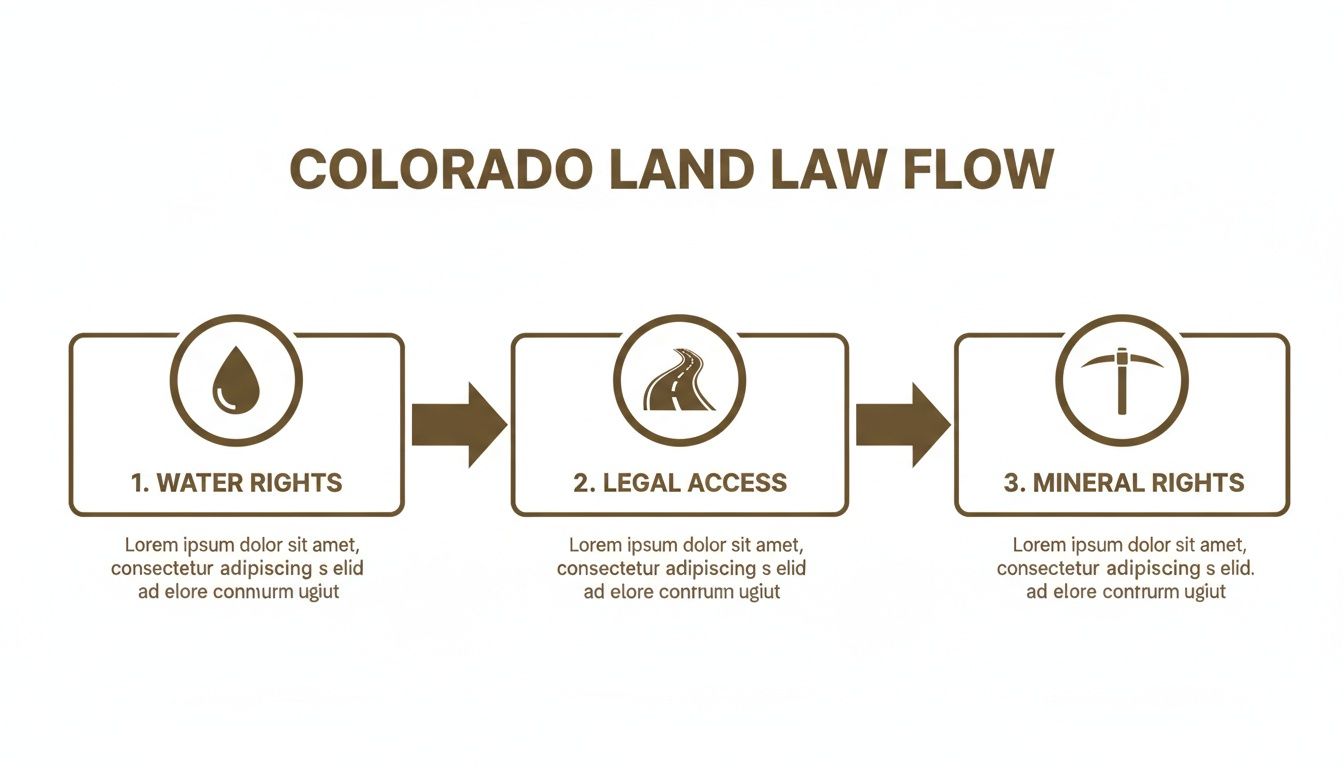
This visual guide emphasizes that water, access, and mineral rights are separate issues that each require specific verification.
Step 3: Investigate Water and Utilities
For most rural properties, water is a major consideration. Contact the Colorado Division of Water Resources to ask about well permits and water availability in the area. Find out if the property is in a basin where new domestic well permits are being issued.
Next, contact the local electric cooperative to determine the distance to the nearest power lines and get an estimated cost to extend service. Bringing electricity to a remote lot can be a significant expense. For more details, see our guide on what to look for when buying land.
Legal Guardrail: Always perform your own independent due diligence. While a seller may provide information, it is the buyer's responsibility to verify every detail with the appropriate county and state authorities. This empowers you to make a fully informed decision.
How to Finance Your Colorado Land Purchase
Financing a raw land purchase is different from financing a house. Traditional banks often view undeveloped land as a risky investment, making it challenging to secure a loan. For many people looking at CO land for sale, the most practical path to ownership is seller financing. This approach removes the bank from the transaction.
Understanding Seller Financing
With seller financing, the property owner acts as the lender. The buyer and seller agree on a purchase price, down payment, interest rate, and monthly payment schedule. The buyer makes payments directly to the seller until the loan is paid off. This method is common in the rural land market because it addresses the primary obstacle for many buyers: obtaining traditional bank approval.
Seller financing is a straightforward agreement based on clear terms. It opens the door to land ownership for individuals who may not qualify for a conventional loan due to credit history or the undeveloped nature of the property.
Key Benefits of Seller Financing
For new land buyers, this approach offers several advantages:
- Simple Qualification: Companies specializing in seller financing, such as Dollar Land Store, often have a direct and simple approval process. Many do not require credit checks, focusing instead on the buyer's ability to make the down payment and monthly payments.
- Lower Upfront Costs: Down payments are typically much lower than what a bank would require for a land loan, making ownership more attainable.
- Faster Closing Process: Without the delays of bank underwriting, the transaction can close much more quickly, often within a few days.
You can learn more in our article on how to finance a land purchase.
Hypothetical Payment Example
To illustrate how seller financing works, consider a hypothetical parcel of land in Colorado listed for $10,000.
A typical arrangement could be:
- Purchase Price: $10,000
- Down Payment: $250
- Loan Amount: $9,750
- Interest Rate: 9%
- Loan Term: 10 years (120 months)
Based on these terms, the estimated monthly payment would be around $123.50. This predictable payment allows you to build equity over time without the strict requirements of a traditional mortgage.
What This Means for Buyers
Understanding Colorado's land laws regarding water, access, and zoning gives you a significant advantage. It transforms you from a passive browser into an informed buyer who can identify opportunities and avoid potential problems. A small amount of research can make a big difference. The state's unique rules are not roadblocks but part of a process you can navigate with confidence.
Turning Knowledge into Action
For example, now that you know water rights are a separate property right in Colorado, you can ask, "Does this land come with a legal right to water, or can I get a well permit?" for any rural property you consider. Similarly, knowing that some parcels are landlocked, you will always verify legal, year-round access with the county. These are not insider secrets; they are practical steps that protect your investment.
The goal of this guide is to build your confidence. Every complexity of the Colorado land market can be managed with research. Your best tools are your phone, a list of county departments, and the commitment to verify details for yourself. This proactive approach prevents future surprises and empowers you to make a sound decision that aligns with your goals.
Why Consider Dollar Land Store?
Navigating the process of buying land in Colorado can be challenging. Many aspiring landowners find that traditional financing for raw land is difficult to obtain, creating a frustrating barrier to entry. Dollar Land Store was created to address this problem. We are not real estate agents or brokers; we are direct sellers. This allows us to remove middlemen and streamline the purchase process, creating a more direct path to land ownership.
Our model is built on making land affordable and accessible. We acquire properties and offer them with low monthly payments and our own financing. This approach helps people buy their own piece of Colorado without needing a large upfront cash investment.
A Simple Path to Ownership
We have simplified the land-buying process. Here is what that means for our buyers:
- No Credit Checks: We do not require credit checks. If you can make the down payment and the monthly payments, you can purchase land from us.
- Transparent Information: Each property listing includes key details like GPS coordinates, available zoning information, and clear payment terms so you can begin your research with the facts.
- A Fast, Direct Process: Because you are dealing directly with the owner, there are no agent commissions or lengthy bank approval processes. We can often prepare a contract for you within a few days.
This is how we connect people with CO land for sale without the usual complexities. Explore our current Colorado land with seller financing to see how straightforward the process can be.
Buyer Guidance / Next Steps
You are now equipped with foundational knowledge about buying CO land for sale. You've learned about market factors, legal considerations, and the due diligence process. The next step is to apply this information.
Start by defining your goal. Are you looking for a weekend campsite, an off-grid homestead, or a long-term investment? A clear objective will help you focus your search on properties that fit your vision.
A Path Forward
With a clear goal, you can begin evaluating properties with a critical eye.
- Create Your Checklist: Use the due diligence steps from this guide to create a personal checklist for every property you consider.
- Make the Calls: This step is essential. Contact the relevant county departments to independently verify zoning, access, and tax information.
- Evaluate Financing: Consider whether seller financing is the right option for you. For many raw land buyers, it is the most direct path to ownership.
This step-by-step approach breaks a large process into manageable tasks. You can learn more about our simple purchase process by reading our guide on how to buy land with us.
Conclusion
Owning a piece of Colorado is an achievable goal, not just a dream. By conducting thorough due diligence and understanding the state's unique land laws, you can make a smart, confident decision. Remember that every expert was once a beginner. With the right information and a clear plan, your slice of the Centennial State is well within reach.
Ready to find your property?