


How to Access a Landlocked Property: A Buyer's Guide
Ross AmatoA cheap parcel without road frontage can be either a smart buy or a long, expensive fight. The difference usually comes down to one issue: whether you can prove, negotiate, or legally establish access.
You’re looking at a landlocked property. That sounds dramatic, but in practice it means one thing: you do not have a clear legal path from the parcel to a public road. The good news is that access problems are often solvable through an existing recorded easement, a negotiated easement with a neighbor, or a court-recognized easement when the facts support it.
How We Evaluate Access Options for Landlocked Property
Before we treat any access problem as solvable, we look for evidence in a specific order: recorded documents first, then survey evidence, then county and planning records, then practical road-building reality. In our review of land-buyer due diligence, the biggest mistakes happen when buyers rely on aerial imagery or a seller's verbal explanation instead of recorded rights.
What we’d verify first is simple: whether legal access already exists on paper, whether the parcel can be reached on the ground, and whether the intended use would satisfy county access standards for permits or construction. We also weigh negotiation feasibility, because a friendly adjoining owner can save months of legal expense, while an entrenched dispute can erase the price discount fast.
A final screen is practicality. Even if a route can be documented, it still has to work as a driveway or private road. Grade, drainage, culverts, gates, utility placement, and maintenance obligations matter just as much as the legal theory.
What Is a Landlocked Property?
A landlocked parcel is land with no legal route to a public road. That definition is about access rights, not scenery or convenience. A property can look reachable on a map and still be landlocked if the only road to it crosses someone else's land without a recorded right to use it, which matches the basic legal meaning described in this landlocked property overview.

The first distinction to understand is physical access versus legal access. Physical access means there is a visible path, ranch road, trail, or driveway you could use to get there. Legal access means you have the recorded right to use that route. If you have one without the other, you still have an access problem.
If you're trying to figure out how to access landlocked property, the usual paths are straightforward: confirm an existing recorded easement, negotiate a new easement with an adjoining owner, or pursue a court-recognized easement if state law supports it. In practice, that means title work, a current survey, and an honest look at whether a driveway route is legally defensible and physically buildable.
One thing I look for immediately is whether the parcel is cut off or just poorly documented. I’ve seen buyers assume a dirt lane solved the problem, only to learn later that the lane crossed private land with no ingress/egress rights in the deed.
How properties become landlocked
Most landlocked parcels were not created by mystery. They usually result from one of three situations:
- Subdivision of a larger tract: a farm, ranch, or timber parcel gets split over time, and an interior lot is sold without a recorded access easement.
- Bad deed drafting: an old deed references access vaguely, or leaves out the legal description of the route entirely.
- Informal historic use: families, neighbors, or prior owners used the same road for years by permission, but nobody recorded the arrangement.
That pattern is common enough that access problems are a known feature of rural land markets. One source often cited in this discussion notes that roughly 15% to 20% of rural parcels created through later subdivision became landlocked, largely because access was not formalized when larger tracts were split apart, as discussed in this explanation of landlocked subdivisions.
A common example buyers miss
Imagine a 10-acre parcel sitting 300 feet behind a county road. On satellite view, it looks easy: there is already a gravel driveway running from the road to the lot. The problem is that the driveway belongs to the front parcel, and the back parcel's deed says nothing about crossing it. You have visible road access, but not legal road access. That is still a landlocked property.
Many first-time land buyers see a landlocked parcel and immediately ask: is this deal too good to be true? The answer isn't a simple yes or no. These properties almost always come with a much lower price tag, but that discount exists for a reason—you're trading upfront savings for the time, money, and effort it will take to secure legal access.
Balancing Opportunity and Challenge
The appeal of a landlocked property is easy to understand. The lower purchase price is a huge advantage, especially for buyers who are using seller financing. It frees up cash you can put toward negotiating an easement, paying for legal fees, or even building your road. And, of course, these parcels offer incredible privacy and seclusion, far from the noise of a busy road.
But the challenges are just as real. Getting access isn't a guarantee. It can involve some tricky negotiations with neighbors or, in some cases, legal action. The process demands patience, a solid strategy, and a realistic budget.
This situation is made more complex because land rights can be a sensitive issue. According to the 2024 Prindex Report from the Global Land Alliance, a massive 1.1 billion adults—or 23% of the adult population across 108 countries—feel insecure about their property rights. This global uncertainty highlights why landlocked parcels are so tricky; you're asking to formalize access across someone else's land at a time when many people already feel their ownership is on shaky ground.
Your Initial Assessment Framework
Before you get too far down the road, you have to weigh the pros and cons. Think of it as your first due diligence step. You need to decide if the payoff, privacy and a lower price, is worth the investment required to solve the access puzzle. A successful outcome can turn an undervalued, hard-to-reach lot into a usable and valuable piece of land.
To help you get started, here’s a quick-glance table to frame your thinking.
Initial Assessment of a Landlocked Parcel
| Key Challenge | Potential Solution | First Step for Buyers |
|---|---|---|
| No Legal Access | Negotiate an easement with a neighbor, or pursue a legal remedy like an "easement by necessity." | Pull the property deeds and county plat maps to identify all adjoining landowners. |
| Physical Access Issues | Building a road or driveway, which may require grading, gravel, and culverts. | Get a rough estimate from a local excavation or road-building contractor. |
| Neighbor Relations | Neighbors may be unwilling to grant access or may demand a high price for an easement. | Start with a friendly, informal conversation to gauge their willingness to talk. |
This table should help you quickly identify the major hurdles and the first moves you need to make.
Key Takeaway: A landlocked property isn't a dead end—it's a project. With the right approach and thorough due diligence, you can absolutely secure the access you need. You just have to go into it with your eyes wide open.
Approaching these properties with a clear understanding of the steps involved is the best way to make a smart decision in 2026. The path to access might be surprisingly straightforward, or it might get complicated. Either way, it all starts with knowing what you're up against.
Your First Move: Uncovering the Facts

Before making an offer on a landlocked property, your most important job is to become a detective. That discounted listing price is only a good deal if you can find a viable path to access it. This initial due diligence phase is where you gather the hard facts that will shape your entire strategy.
Approaching this with a clear plan saves time and prevents costly mistakes. Your goal is to uncover any existing rights, identify potential roadblocks, and build a factual foundation for any negotiations to come. Every document you find and every boundary line you verify becomes a powerful tool.
Start with a Professional Title Search
The very first thing you need to do is order a professional title search. While you can look up some public records yourself, a title company has the tools and expertise to dig deep into the property’s history. They trace the chain of ownership and hunt for any recorded documents related to access.
Sometimes, the solution to your access problem is already hiding in plain sight within old paperwork. It's not uncommon to find an easement that was granted decades ago and forgotten over time.
A title search will uncover critical documents, including:
- Recorded Easements: These are your best-case scenario—legally documented rights of way that grant access across a neighboring property.
- Deed Restrictions or Covenants: These could limit how the property can be accessed or used. It's vital to know about them upfront.
- Liens or Encumbrances: While not directly about access, these financial claims can complicate a purchase and must be addressed.
Title work is also where buyers should think about risk management, not just ownership history. If you want a plain-English overview of why title issues matter before closing, this short piece on the advantages of title insurance from Low Doc Lender is a useful companion to the title search discussion.
A Land Survey Is Non-Negotiable
If the title search is about the property’s legal past, a land survey is about its physical reality. You absolutely must get a new survey from a licensed surveyor. Don't rely on old maps, satellite images, or what the seller thinks the property lines are.
A professional survey provides an official, legally recognized map of the parcel, confirming its precise boundaries, dimensions, and total acreage. For a landlocked property, its most important job is to visually define the problem. The surveyor will identify the exact location of all adjoining properties and mark the corners, giving you an indispensable document for any future negotiation or legal action.
Expert Insight: An accurate survey is the cornerstone of any access negotiation. It replaces assumptions with facts, showing a neighbor exactly where a proposed easement would run and proving you're a serious, professional buyer.
Visit the County Recorder’s Office
With your title report and survey in hand, your next stop should be the county recorder's office (sometimes called the county clerk or registrar of deeds). All official land records for the area are stored there. Even though the title company already did a search, visiting yourself can sometimes provide additional context or uncover older documents they might have missed.
Ask to see historical plat maps of the area. These maps show how larger tracts of land were originally subdivided. You might discover that your parcel was once part of a larger property that had road frontage—this is often the key piece of evidence needed to prove the need for an "easement by necessity," a legal remedy we'll cover later.
This kind of investigative work is fundamental for any land purchase. For a more detailed guide on this process, you can explore our article on what to look for when buying land. Doing your homework now empowers you to make a smart, informed decision on how to get access to your landlocked property.
How to Negotiate an Easement with a Neighbor
Before considering lawyers and courtrooms, the best way to get access to your landlocked property is often a documented agreement with the adjoining owner. In our experience reviewing rural parcels, buyers get farther when they approach this as a defined property-rights transaction rather than an emotional plea. The goal is not “permission to use the road for now.” The goal is a signed, recordable right of access that survives a future sale.
Step 1: Contact the right owner first
Start with the parcel that offers the shortest, least disruptive, and most realistic route to a public road. Then confirm ownership through the tax assessor, title report, or deed records before making contact. If a trust, LLC, or multiple heirs own the tract, you need the actual decision-makers involved early.
I would not start with a broad ask to every neighbor at once. That can create confusion, inflate expectations, and make later negotiations harder. Pick the strongest route first and prepare a professional package before reaching out.
Step 2: Bring a route map, not just a question
Don't ask, "Can I cross your land?" Show exactly what you mean. Bring a survey, an aerial map, and a marked proposed route that follows an existing fence line, field edge, old farm road, or property boundary when possible. That makes the impact easier to visualize and usually gives the neighbor fewer reasons to object.
A good proposal explains:
- the starting and ending points of the route
- the approximate width needed for a driveway or private road
- whether the route is for seasonal recreation, residential access, or heavier use
- whether utilities may need to follow the same corridor later
- who will build and maintain the route
Step 3: Explain the type of agreement you actually need
Many buyers make that mistake. A neighbor saying, "Sure, you can drive through for now," is not the same as legal access.
- Temporary permission is usually revocable. It may end when the neighbor changes their mind or sells.
- A recorded ingress/egress easement creates a documented right to enter and exit over a defined strip of land.
- A road maintenance agreement handles who pays for grading, gravel, drainage work, snow removal, gates, and repairs. It often accompanies an easement but does not replace it.
If you may eventually need power, water, or communications infrastructure, ask your attorney whether the access document should also include utility rights or whether a separate utility easement is cleaner. What we’d verify first is whether one recorded corridor can handle both access and utility installation without creating future disputes.
Step 4: Negotiate the business terms clearly
Most workable easement deals come down to a handful of terms. The more specific you are, the less likely you are to revisit the same conflict after closing.
Terms that belong in a driveway or access agreement
- Exact route: tied to a survey exhibit or legal description
- Width: enough for the intended use, turnarounds, drainage, and emergency access if required locally
- Allowed uses: pedestrian, passenger vehicles, farm equipment, contractors, guests, emergency vehicles, and delivery access as applicable
- Improvement rights: grading, gravel, culverts, ditching, gates, cattle guards, signage, or widening rules
- Utilities: whether electric, water, sewer, propane lines, or communications can be installed in the corridor
- Maintenance: who pays, who performs work, and how disputes are handled
- Liability and insurance: damage, indemnity, and accident expectations
- Transferability: whether the easement benefits future owners of your parcel automatically
Step 5: Handle compensation realistically
Compensation is usually easier to discuss when the route is specific. Some owners focus on the square footage affected; others care more about privacy, fencing changes, disruption, gate control, or future development limits. Common approaches include a one-time payment, paying the neighbor's legal fees, paying for fencing or gate upgrades, or agreeing to maintain the road at your cost.
In my view, buyers should budget for more than the land value under the easement strip. A route that crosses a front yard, cuts through an active pasture, or affects the neighbor's own building plans may command a premium because you're buying convenience and certainty, not just dirt.
Step 6: If the neighbor says no, narrow the dispute
A refusal is not always final. Sometimes the objection is to the route, the width, the traffic level, or the lack of maintenance terms. Ask whether a different alignment, narrower width, seasonal limitation, gate standard, or higher compensation would solve the issue.
If the neighbor wants unreasonable terms, stop negotiating casually and involve a local real estate attorney. At that point, you need to compare the cost of the demanded deal against your likely legal route. A lawyer can also send a formal proposal that signals you are serious without escalating into a lawsuit immediately.
Final recording checklist for your attorney
Once terms are agreed, the document should be drafted, signed, notarized, and recorded against both properties. Ask your attorney to confirm that the recorded easement includes:
- legal description of the burdened and benefited parcels
- survey exhibit showing the route
- easement width and location
- ingress and egress rights
- utility rights if needed
- construction and maintenance obligations
- gate and access-control rules
- liability and insurance language
- assignment and transferability to future owners
As you finalize the deal, understanding the basics of drafting effective legal contracts is invaluable. A well-written agreement clearly defines everything from maintenance duties to liability, protecting you both from headaches down the road and setting the stage for a great relationship with your new neighbor.
Legal Paths to Access When Talks Break Down

When a friendly conversation with a neighbor doesn't get you the access you need, it’s easy to feel like you've hit a dead end. But don’t give up just yet. The law often provides a remedy for landowners who have no other way to reach their property.
At this stage, you’ll need a real estate attorney in your corner. These are not DIY projects. The legal concepts are complex, and every state has its own nuances. Prepare a list of questions to bring to your attorney so you can get clear guidance.
Understanding an Easement by Necessity
The most common legal route is often an Easement by Necessity. This isn’t a favor from the court; it’s a legal principle built on the idea that land shouldn't be left useless just because it's cut off from a public road.
However, specific conditions must be met. To get one, you typically must prove historical severance. This means you have to show that your landlocked parcel was once part of a larger property that did have road access. The problem was created when that larger tract was subdivided and a piece was sold off without an easement.
To build your case, your attorney will need to:
- Trace the property's title history through old deeds and maps to prove there was once a "unity of title."
- Pinpoint the exact moment of the split to show that your parcel became landlocked at the very instant it was severed from the parent property.
- Demonstrate "strict necessity," meaning there are no other reasonable or practical ways to get to your land.
If you can prove your case, the court can grant the easement and decide on the exact location and width of the access road. The goal is always to provide reasonable access while impacting the neighboring property as little as possible.
Exploring a Prescriptive Easement
Another option—though usually a much tougher climb—is a Prescriptive Easement. You can think of it as being similar to "squatter's rights," but for access instead of ownership. You aren't trying to own the road, just the legal right to use it based on a long, uninterrupted history of doing so.
Winning a prescriptive easement case requires proving the historical use was:
- Open and Notorious: Everyone could see the road or path was being used. It wasn't a secret.
- Continuous: The access was used consistently for a long time, as defined by state law. This is often 10 to 20 years.
- Adverse or Hostile: This is the key. The use must have been without the neighbor’s permission. If your neighbor was kind enough to let you use the road, you can't later claim a right to it.
This route is challenging because it hinges on old evidence. You might need to track down previous owners for testimony, find old aerial photos, or uncover other historical records to make your argument. That broader pattern also helps explain why landlocked parcels are so often created through subdivision in the first place, a point explored in this Nature study on land fragmentation and parcel formation.
Legal access problems also exist at a much larger scale than most buyers realize. A widely cited review of U.S. public land access found 16.43 million acres of public land effectively landlocked from ordinary use, underscoring how common legal and practical access barriers can be even when land plainly exists on the map, as discussed in the Texas Law Review analysis.
Disclaimer: This information is for educational purposes only and is not legal advice. State laws regarding easements vary significantly. Always consult with a qualified real estate attorney in your area to discuss your specific situation.
Comparing Your Legal Options
Deciding which legal path to take is a major decision. The process, cost, and chances of success are completely different for an easement by necessity versus a prescriptive easement. Getting clear on these differences is the first step in building a strategy with your lawyer.
This table breaks down the basics to give you a clearer picture.
Comparison of Legal Easement Types
| Easement Type | Basis for Claim | Common Requirements | Typical Complexity |
|---|---|---|---|
| Easement by Necessity | The property was severed from a larger parcel, leaving it without road access. | Proving historical unity of title and that the severance created the landlocked status. | Moderate to High. Success depends on clear historical records and title evidence. |
| Prescriptive Easement | Long-term, uninterrupted, and non-permissive use of an access route across another's property. | Meeting the state's statutory period for use (e.g., 10-20 years) and proving the use was open and hostile. | High. Requires substantial historical evidence, often including witness testimony. |
Ultimately, going to court should be your last resort. It’s expensive, stressful, and time-consuming. But for a completely landlocked property, it may be the only way to make your land usable and realize its full value.
What This Means for Buyers
For buyers, the key question is not whether a landlocked parcel is cheap. It is whether the access problem is fixable at a cost and timeline that still makes the purchase worthwhile. Typically, buyers who evaluate access before they fall in love with the property are the ones who prevail.
A practical go/no-go checklist
Before you buy, work through these points in order:
- Title evidence: Is there any recorded ingress/egress easement already in the chain of title?
- Survey evidence: Can a surveyor identify a realistic corridor to a public road?
- Negotiation odds: Is an adjoining owner likely to cooperate for a reasonable payment?
- Legal route: If negotiation fails, does the title history support an easement by necessity or another state-law remedy?
- Road cost: What will it take to build a usable driveway or private road? Even a short route may require clearing, grading, gravel, drainage work, culverts, and gate installation.
- Lender and insurer limits: Will a lender finance it, and will title insurance, homeowner's insurance, or a builder's policy be available once you improve the property?
- Use feasibility: Can you legally use the land for your intended purpose before access is secured?
If several of those answers are uncertain, treat the parcel as a high-risk speculation, not a normal buildable lot.
Buildability and financing risk
This is the part buyers often underestimate. Without legal ingress and egress, you may not be able to pull building permits, finance construction, insure a home or cabin, satisfy fire-access rules, or meet county standards for a legal homesite. Some counties and lenders are strict about documented access because emergency services, utility work, and resale all depend on it.
I would be especially cautious if your plan is to build right away. A parcel can be physically reachable with a truck and still fail the legal or planning review needed for a residence, septic permit, utility connection, or construction loan.
Estimating the real cost of access
The purchase price is only one line item. Buyers should build a separate access budget that includes title work, surveying, attorney fees, compensation for an easement, recording costs, and actual road construction. For road-building, local conditions matter more than generic averages: a short flat gravel drive can be manageable, while a longer route with drainage crossings or heavy grading can change the economics quickly.
What we’d verify first is whether the probable access corridor is easy ground or expensive ground. A cheap parcel with a difficult crossing, steep slope, or recurring washout problem can end up costing more than a parcel that already has legal frontage.
When buying landlocked property can still make sense
Not every landlocked parcel is a bad buy. It can make sense when the intended use is recreational, when the purchase is a long-term hold instead of an immediate build, or when an obvious access corridor already exists and the title history suggests a strong legal route. It can also work when the discount is deep enough to leave room for professional help and road work.
The key is matching the parcel to the use case. If you want a hunting tract, privacy parcel, or longer-term investment and you understand the access work ahead, the risk may be acceptable. If you need a fast, financeable, buildable homesite, unresolved access is usually a reason to pause.
Long-Term Value and Usability
Securing a permanent, deeded easement does more than just make your property usable. It dramatically boosts its market value. All of a sudden, that discounted parcel transforms into a real, functional asset. Once you solve the access puzzle, you can start thinking about other proven strategies to increase property value and ROI to maximize your investment.
On the other hand, failing to secure access leaves you stuck with a piece of land that will be almost impossible to sell. You’d just be passing the same problem on to the next person, which shrinks your pool of potential buyers to almost zero and puts a hard ceiling on the property's value. Your goal should always be to solve the access problem, not just inherit it.
Why Consider Dollar Land Store?
Finding a piece of land you can afford is exciting, but for a first-time buyer, navigating the purchase process can be daunting, especially when a property might be landlocked. A trustworthy partner can make all the difference.
At Dollar Land Store, we built our company to make land ownership straightforward and accessible. Our entire process is designed to provide clarity and support, positioning you for success from day one.
Transparency and No Surprises
We believe you deserve to know exactly what you’re buying. Our property listings lay out all the known information about a parcel, including its access situation. If a property has access hurdles, we state it clearly. This transparency allows you to do your own research and make an informed decision with all the facts on the table.
Because we own every property we sell, we cut out middlemen and real estate agent commissions. This direct model means the savings are passed on to you, making your investment that much more affordable.
Financial Flexibility to Get the Job Done
Our simple, no-nonsense owner financing provides significant benefits for buyers. We offer:
- Low down payments
- Affordable monthly payments
- No credit checks
- A fast, simple contract process
This approach frees up your cash. Instead of tying up all your money in the initial purchase, you can allocate it where it really counts: hiring a real estate attorney, paying for a professional survey, negotiating an easement, or covering the cost of building an access road. This financial flexibility empowers you to tackle the access issue head-on and turn a challenging property into a valuable asset.
Next Steps: A Buyer's Path Forward
Information is powerful, but it’s action that secures access to your land. Put that knowledge to work with a clear, practical plan. The journey from finding a great landlocked deal to unlocking its full potential is all about taking careful, deliberate steps.
Your first move should always be to get the facts straight. A professional survey and a thorough title search are essential. These documents form the foundation for every decision you’ll make next. Once you have those in hand, you can start researching the adjoining property owners and preparing for a professional, friendly conversation. And before you make any offers, it’s wise to touch base with a local real estate attorney to fully understand your options.
This visual helps show how our transparent process at Dollar Land Store fits into your journey.
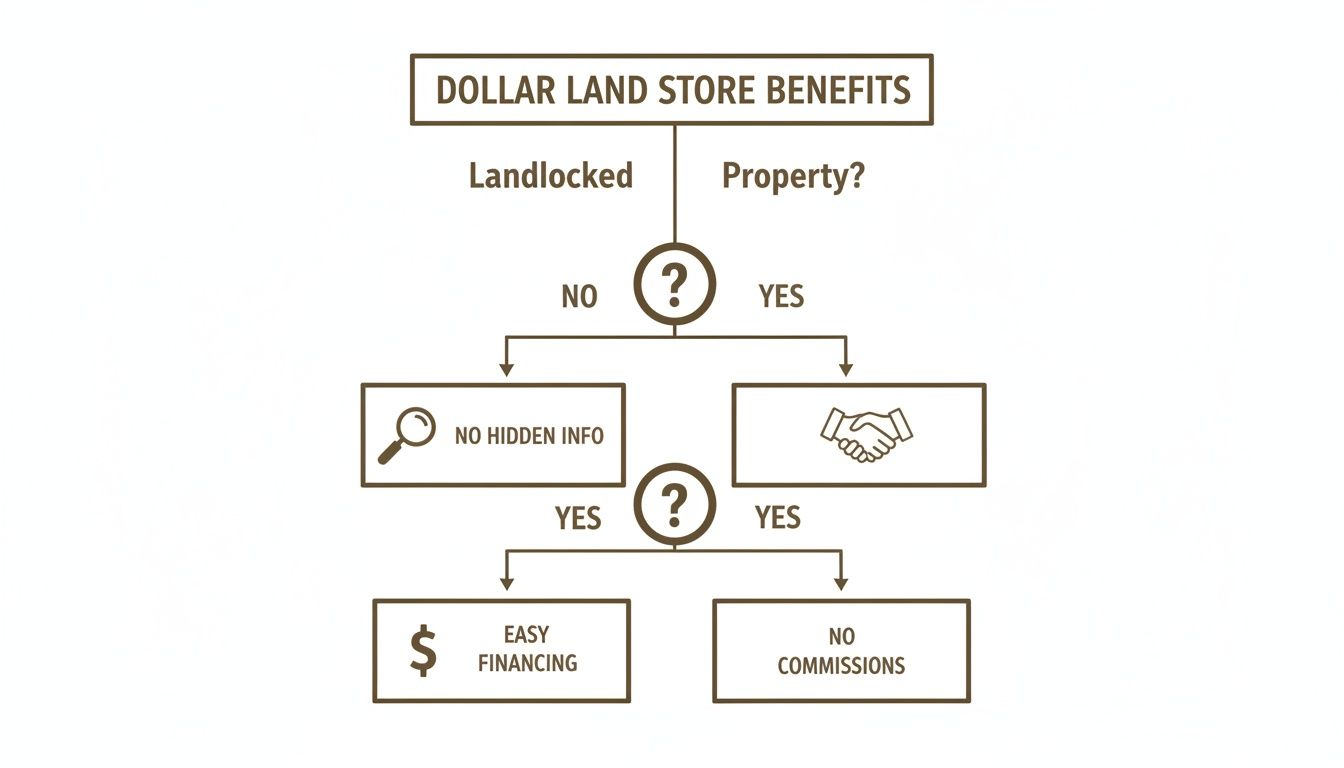
Our straightforward approach—including clear information and flexible owner financing—empowers you to focus your time and money on what matters most: solving the access puzzle.
You can apply this knowledge right away as you browse our available parcels. We provide a transparent starting point for your research. For more tips on evaluating properties, be sure to check out our guide on how to be a smart land investor.
Frequently Asked Questions
What happens if my property is landlocked?
If your property is landlocked, you do not automatically lose ownership, but you may not have a legal way to reach or use it as intended. The next step is usually to confirm whether any recorded easement already exists, then evaluate negotiation or legal remedies with a surveyor and local real estate attorney.
Can you build on landlocked land?
Sometimes, but not safely to assume. Even if the terrain is suitable, you may be unable to get permits, financing, insurance, utility service, or county approval for a homesite until legal ingress and egress are secured.
Why would someone buy landlocked property?
Buyers usually consider it because the price is lower than comparable accessible land. It can make sense for recreation, privacy, long-term holding, or value-add investing when the buyer believes access can be negotiated or legally established at a reasonable cost.
What kind of easement is usually needed for driveway access?
The most common solution is a recorded ingress and egress easement that gives the benefited parcel the right to enter and exit over a defined route. If utilities will follow the same corridor, the document may also need utility rights or a separate utility easement.
Is a verbal agreement with a neighbor enough?
No. A casual permission arrangement can usually be revoked and may not bind a future owner of the neighboring parcel. For reliable access, the agreement should be drafted properly, signed, notarized, and recorded in county land records.
Can landlocked property still be sold?
Yes, but sellability is usually weaker until access is solved. Cash buyers may still buy it, but unresolved access can reduce market value, narrow the buyer pool, and complicate title review, financing, and future development.
Conclusion: Turning a Challenge into an Opportunity
A landlocked property can be an incredible investment or a frustrating dead end—the difference lies in due diligence, strategy, and patience. By understanding the legal pathways to access, from friendly negotiation to court-ordered easements, you can confidently evaluate these unique opportunities. The lower entry price of a landlocked parcel offers significant upside, but only if you are prepared to invest the time and resources needed to secure legal and physical access.
Remember to start with the facts: a title search and a land survey are your most critical first steps. From there, a professional and respectful approach with neighbors can often yield the fastest and most affordable solution. If that fails, the law provides remedies, but always with the guidance of a qualified real estate attorney. With the right preparation, you can reveal the hidden value in a landlocked property and turn a perceived obstacle into a rewarding asset.
If you have questions about buying raw land or our seller-financing options, please reach out. We are here to be a helpful, trustworthy partner as you start your land ownership journey.
Ready to find your perfect piece of land? Take a look at our available land at DollarLandStore.com.