


How to Buy Land Cheap: A Practical Guide for Beginners
Ross AmatoLet's kill a myth right now: you do not need a mountain of cash or a perfect credit score to buy your own land. That belief keeps most people on the sidelines, but it’s flat-out wrong.
The real secret to buying land cheaply is learning the strategies that bypass the traditional gatekeepers. We're talking about owner financing, finding overlooked parcels the mainstream market ignores, and skipping the banks entirely. This guide isn't about theory; it’s your step-by-step playbook to make it happen.
Your Path to Affordable Land Ownership
The idea of buying land feels intimidating. It sounds expensive, complicated, and full of legal traps. It’s easy to assume it’s a game reserved for wealthy developers, but that’s one of the biggest misconceptions in real estate. The truth is, there are thousands of affordable properties out there, but you have to know where—and how—to look.
This guide cuts through the noise. We're skipping the complex jargon and focusing on the exact, actionable steps required to find and secure a piece of land you can actually afford.
Who This Guide Is For (and Who It's Not For)
This is not your typical real estate manual. It's a practical roadmap built for a specific type of buyer. If this sounds like you, you’re in the right place.
- You're an Aspiring Homesteader: Seeking a spot to grow food, raise animals, and live more self-sufficiently.
- You're a Recreational User: You want a private basecamp for camping, hunting, or weekend escapes.
- You're a Small-Scale Investor: You see the long-term value in holding a tangible asset and want to start without a huge down payment.
- You're an Off-Grid Enthusiast: Your dream is a tiny home or a quiet cabin far from the city grind.
However, if you're looking to develop a suburban subdivision, need a bank loan for a multi-million dollar commercial plot, or aren't willing to do your own research, this guide is not for you. This is for the self-starter ready to find a deal.
The most important thing to remember is this: you don’t need a bank to become a landowner. Your most powerful tools are creative financing and knowing how to find the deals no one else sees.
Overcoming the Price Barrier
It's no secret that land values are on the rise. Recent USDA data shows U.S. farm real estate values climbed 4.3%, hitting an average of $4,350 per acre. You can get more details on what's driving these trends from the American Farm Bureau Federation.
Don't let that number scare you. It's an irrelevant average. That statistic just proves why trying to compete in overheated markets is a losing game. We're not playing there. We're going to show you how to find undervalued markets and uncover hidden gems the masses overlook.
The Four Pillars of Buying Land Cheap
To get started, you need to understand the core strategies. We've broken them down into four key pillars. This is your high-level game plan.
| Strategy Pillar | What It Means | Why It Works |
|---|---|---|
| Find Overlooked Markets | Looking in rural or less-developed areas that aren't on most buyers' radars. | Less competition means lower prices and more motivated sellers. This is where the real deals are made. |
| Embrace Owner Financing | The seller acts as the bank, letting you pay them directly in monthly installments. No credit checks. | It opens up land ownership to everyone, regardless of credit history, and typically requires a low down payment. |
| Do Your Own Homework | Learning to perform due diligence yourself—checking for access, zoning, utilities, and title issues. | You save thousands in fees and become a smarter, more confident buyer who can spot red flags a mile away. |
| Negotiate Creatively | It's not just about the final price. You can negotiate the down payment, interest rate, and payment terms. | A flexible seller is often more willing to work with you on terms that fit your budget, making the deal possible. |
Mastering these four pillars is the key. They give you the confidence and the know-how to find and close a deal on a property that truly fits your budget and your dreams.
How to Find Hidden and Undervalued Land Deals
If you're only scrolling through Zillow or Trulia, you’re missing 90% of the real opportunities. The best deals on cheap land are almost never found on mainstream websites. They're hidden in plain sight, waiting for a buyer who knows where—and how—to look.
Finding these properties means thinking like a deal hunter, not a typical homebuyer. It's about exploring unconventional channels and learning to spot the subtle clues of a motivated seller. This isn’t about luck; it's a repeatable strategy.
Look Beyond Conventional Listings
The secret to finding undervalued land is to go where other buyers aren't. While everyone else fights over the same overpriced listings, you can find incredible deals by tapping into these sources.
- Specialized Land Marketplaces: Websites focused only on rural and undeveloped land are gold mines. They connect you directly with sellers, many of whom offer owner financing. This is the fastest way to find something that fits your budget.
- Government Surplus Auctions: Federal, state, and local governments sell surplus land they no longer need. These properties can range from small lots to massive rural tracts and are frequently sold at a serious discount.
- Tax Deed or Tax Lien Sales: When a property owner fails to pay their taxes, the county can seize the property and auction it off. You can find incredibly cheap land this way, but be warned: this route requires significant due diligence to ensure the title is clear and is not for beginners.
Identify and Target Motivated Sellers
The key to a great price is finding a seller who needs to sell more than you need to buy. These individuals value a quick, simple sale over squeezing out every last dollar. Learning to spot them will save you thousands.
A motivated seller isn’t desperate; they just have a problem that selling the land can solve.
Your goal isn't to take advantage of anyone. It's to find a situation where your offer is a clean, fast solution to a problem they no longer want, creating a true win-win.
Common signs of a motivated seller include:
- Absentee Owners: People who inherited land or live out of state. For them, the property is often just a yearly tax bill for a piece of dirt they never see.
- Heirs of an Estate: When someone inherits land, they often have no emotional connection to it and would rather have a quick cash sale to split among the family.
- Long-Time Owners: Someone who has owned a property for 20+ years might be tired of the upkeep or simply ready to cash out and simplify their life.
Spotting the Signs of a Hidden Gem
Undervalued properties often have terrible marketing. A bad listing is your best friend because it scares away less-experienced buyers. Look for these tell-tale signs of a potential bargain:
- Bad Photos: Listings with blurry, dark, or just plain awful photos get ignored.
- Vague Descriptions: A lazy or short description often means the seller isn't putting much effort into the sale.
- "For Sale By Owner" (FSBO) Signs: Many owners who sell land themselves are not fully aware of its market value and can be more open to negotiation.
- Old Listings: A property that has been on the market for months signals a seller who may be very ready to make a deal.
When you find a listing like this, don't be put off. See it for what it is: a sign that there's less competition and a much better chance to negotiate a fantastic price.
Creative Financing When a Bank Loan Is Not an Option
One of the biggest myths about buying land is that you need a perfect credit score and a big bank loan. That couldn't be further from the truth, especially for raw, rural land.
Traditional banks often refuse to lend on undeveloped properties, viewing them as too risky. This isn't a dead end—it’s an opportunity to get creative and find a much better path to ownership.
The reality is that most affordable land deals happen completely outside the banking system. By bypassing big lenders, you open up a world of flexible, common-sense options that put land ownership within reach for almost anyone. This is where thinking differently becomes your greatest asset.
Understanding Owner Financing
Owner financing, or seller financing, is the single most powerful tool for buying land on a budget. The concept is simple: the person selling the land acts as the bank. You send your monthly payments directly to the seller based on terms you both agree upon.
This setup is a win-win. The seller gets a reliable stream of income, and you, the buyer, get to purchase land with incredible advantages:
- No credit check is required. Sellers care about your ability to make the monthly payment, not your financial past.
- Low down payments are common. Many sellers only ask for a few hundred dollars down, and some even offer $1 down deals.
- Flexible terms. You can negotiate everything from the interest rate to the payment amount directly with the seller.
The key to a great owner financing deal is to treat it with the same respect as any other professional transaction. Always get everything in writing with a clear, legally binding contract that outlines every detail—the purchase price, the payment schedule, and what happens if there’s a default.
For a deeper look into how this works, our guide on how seller financing paves the road to land ownership breaks it down even further. This approach is what truly makes land affordable for everyday people.
Your Essential Due Diligence Checklist
A cheap price tag is exciting, but it can also hide a world of expensive, deal-breaking problems. This is the most critical part of your journey: the due diligence phase. It’s where you shift from being a hopeful buyer to a savvy investigator, protecting yourself from costly mistakes before you sign a single document.
Following a thorough checklist builds confidence. It gives you the power to tell a genuine bargain from a landmine and the clarity to walk away from a bad deal without a second thought. This isn't about being negative—it's about being smart, safe, and certain.
Confirm Legal and Physical Access
The single biggest mistake new land buyers make is assuming a road leading to a property means they have the legal right to use it. This is a catastrophic error that can render your land completely worthless.
You must verify two things: legal access and physical access. Legal access means a deeded, recorded easement allows you to cross any necessary neighboring properties. Physical access means you can actually drive or walk onto the property yourself.
- How to Verify: The county recorder's or clerk's office is your first stop. Ask to see the official plat maps, which show recorded easements and public roads. Never, ever take a seller's word for it.
- Real-World Scenario: A buyer in Arizona found a beautiful five-acre parcel for a steal. He saw a dirt road leading to it and assumed all was well. After closing, a neighbor put up a gate, informing him the road was on private property and there was no legal easement. The buyer was officially landlocked, owning a property he could no longer reach.
Decipher Zoning and Land Use Restrictions
Just because you own the land doesn't mean you can do whatever you want with it. Every county has zoning regulations that dictate exactly what land can—and can't—be used for. A cheap price is no bargain if you can't build your cabin, park your RV, or camp under the stars.
Before you get attached, you need a clear "yes" or "no" on your plans. Can you camp on it? Live in an RV? Build a tiny home? The county planning and zoning department has all the answers.
Don't rely on the listing description for zoning details. Call the county's planning department directly, provide them with the Assessor’s Parcel Number (APN), and ask specific questions about what you want to do. Get it straight from the source.
Globally, land values show huge variations that can help guide your search. For instance, the National Association of Realtors (NAR) reported that the total land value in the U.S. recently hit $18.6 trillion. This data highlights that finding cheap land often means looking in less-developed regions where zoning might be more relaxed, but it's crucial to read the full research about land market trends from NAR and then verify the local rules yourself.
This is especially true when buying cheap land, where traditional financing is often off the table. You'll likely be looking at creative options instead.
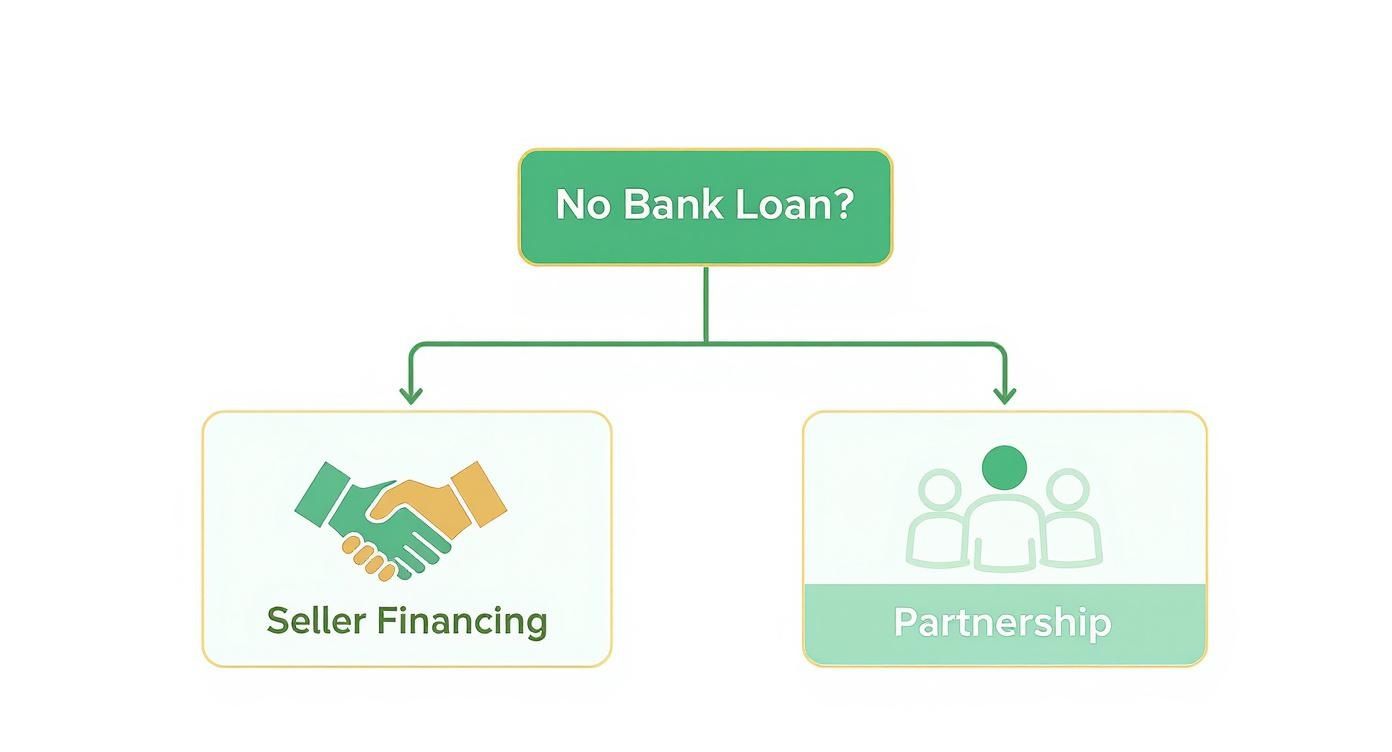
As you can see, seller financing and partnerships are the two main paths forward, putting the focus on direct negotiation rather than jumping through hoops for a bank.
Investigate Utilities and Essential Services
"Off-grid" sounds romantic, but the reality of bringing in utilities can be shockingly expensive. Finding out it will cost $30,000 to run power lines to your property after you’ve bought it is a financial nightmare.
Your due diligence must include calling the local utility providers.
- Electricity: Contact the local power company. Give them the APN and ask how close the nearest power lines are and what the estimated cost would be to extend service.
- Water: Is there access to a municipal water line? If not, you’ll need a well. Call local well-drilling companies and ask about the average depth and cost for wells in that specific area.
- Sewer: If city sewer isn't available, you'll need a septic system. This requires a "perc test" (percolation test) to see if the soil can absorb wastewater. No perc means no septic, which means no building permit.
Understanding these steps is a core part of being a smart buyer. For a deeper dive, check out our guide on doing your homework before buying raw land, which covers these topics in much greater detail.
Check the Title and Property Taxes
Finally, you need to ensure the person selling the land actually has the legal right to sell it and that there are no hidden claims or debts attached. This is called ensuring a "clear title." A title search uncovers any liens, back taxes, or other messy surprises.
While you can do a preliminary search yourself at the county recorder’s office, using a title company or real estate attorney for the final transaction is non-negotiable for most buyers. They can provide title insurance, which protects you from any future claims. Don't forget to call the county treasurer to verify that property taxes are current and to find out what the annual tax bill will be.
Here's a handy checklist to keep all these moving parts organized. Tackling these items one by one is the best way to protect your investment and buy with confidence.
Land Buyer's Due Diligence Checklist
| Checklist Item | What to Look For | Where to Find Information |
|---|---|---|
| Title Search | Clear title, no liens, no ownership disputes, no outstanding debts. | County Recorder's Office, Title Company, or Real Estate Attorney. |
| Legal & Physical Access | Recorded easements, public road access, and a physically passable route. | County Recorder's Office (for plat maps) and a physical visit. |
| Zoning Regulations | Confirmation that your intended use (camping, RV, building) is allowed. | County Planning and Zoning Department. |
| Utilities Availability | Proximity and cost for electricity, water source (well/municipal), and sewer/septic. | Local utility companies, well drillers, and county health department. |
| Property Taxes | Confirmation that taxes are current and knowledge of the annual tax amount. | County Treasurer or Tax Assessor's Office. |
| Surveys & Boundaries | Clearly marked property lines to avoid disputes with neighbors. | A licensed surveyor; check for existing survey pins during your visit. |
| HOA/POA Covenants | Any restrictions or fees from a Homeowners' or Property Owners' Association. | The association itself or from the property's title report. |
| Environmental Hazards | Flood zones, soil stability, or contamination issues. | FEMA flood maps, County Environmental Health Department. |
Working through this list isn't just paperwork; it’s the foundation of a good investment. It ensures the piece of land you've been dreaming of doesn't turn into a costly headache down the road.
Understanding Market Cycles and Timing
Your ability to find cheap land is also tied to the broader economy. Historically, farmland values in the U.S. have followed clear cycles. Between 2011 and 2013, for example, farmland values in some Midwest states shot up by as much as 64%. But then, they dropped by around 16-18% through 2017.
This volatility shows that timing your purchase during a market dip can lead to serious savings. You can discover more insights about these historical benchmark trends on Compeer.com.
Don't Forget the Closing Costs
The final hurdle is closing the deal, where first-time buyers often get hit with surprise fees. These costs are separate from your down payment and must be factored into your budget.
While closing is simpler in an owner-financed deal, some costs are both unavoidable and essential for your protection.
- Document Preparation Fee: Many sellers charge a one-time fee, usually $100 - $300, to draft the legal paperwork like the promissory note and land contract.
- County Recording Fees: This is what the county charges to officially record the deed and make your ownership part of the public record. This is a critical step.
- Title Insurance (Optional but Recommended): While not always required in cash or owner-financed deals, title insurance protects you from past ownership claims or liens. It’s a one-time cost that buys you long-term peace of mind.
- Property Tax Proration: You will pay your share of the annual property taxes for the remainder of the year at closing.
Always ask the seller for a list of all closing costs upfront. Knowing what to expect lets you close on your new property with total confidence, knowing your budget is solid and your investment is protected.
Got Questions? We've Got Answers
Stepping into the world of land buying, especially when you're looking for a deal, brings up last-minute "what-ifs." It’s normal. This is a big decision, but a few questions shouldn't stand in your way.
Here are clear, straight answers to the most common concerns.
Is Buying Land with Owner Financing Safe?
Yes, but only if you do it right. When structured correctly, owner financing is every bit as secure as a traditional bank loan. The key is to treat it like a professional transaction, not a casual handshake deal.
You absolutely need a legally binding contract, typically a promissory note and a deed of trust or land contract. That document must be officially recorded with the county clerk or recorder’s office. This makes it part of the public record and protects your interest in the property.
Think of it this way: the contract is your shield. A solid agreement protects both you and the seller by clearly laying out every detail—the price, interest rate, payment schedule, and what happens if someone defaults. Using a title company or a real estate attorney to handle the closing is the best way to make sure it's all buttoned up correctly.
What Are the Biggest Red Flags to Watch For?
When hunting for cheap land, knowing how to spot a bad deal is just as important as finding a good one. These red flags are so serious they should make you walk away on the spot.
- No Guaranteed Legal Access: If a property is landlocked without a recorded easement, it's practically useless. Do not trust a dirt path on a map—verify legal access in the county records.
- A Cloudy Title: Never buy a property with existing liens or ownership disputes. A professional title search isn't optional; it's essential.
- A Seller in a Hurry: If a seller pressures you to close fast and discourages you from doing your homework, they are hiding something. Run.
- Vague Zoning Rules: Can you use the land for what you want (camping, building, RV)? If you can't get a straight "yes" from the county planning and zoning department, it's a "no" for you.
- Failed or Missing Perc Test: For any property that needs a septic system, a failed percolation (perc) test means the ground can't absorb wastewater. In many areas, this makes the land unbuildable.
Always do your own research on these points. A seller’s word is never enough.
Can I Really Buy Land for Less Than a Car Payment?
Yes, absolutely. This isn't a marketing gimmick; it’s a reality for thousands of people. Monthly payments under $200 are incredibly common with owner financing, especially for raw, rural land in states like Arizona, Colorado, and Nevada.
Here's a real-world example: A $7,000 parcel with a $500 down payment, financed over five years at 9% interest, works out to a monthly payment of just $136.
You won't find these deals on mainstream real estate sites. They’re on specialized land-listing websites or by working directly with land investors. The trick is to be flexible on location and focus on smaller or more remote parcels.
What Ongoing Costs Should I Budget For?
Your monthly payment is just one part of the picture. To avoid surprise bills, you must budget for the ongoing costs of land ownership.
The main costs to plan for are:
- Annual Property Taxes: This is your biggest ongoing expense. It varies dramatically by county, so call the county treasurer's office to get the exact annual tax bill before you buy.
- POA/HOA Dues: If your land is in a Property Owners Association (POA) or Homeowners Association (HOA), you'll have annual dues. Find out the amount and get a copy of the rules they enforce.
- Basic Maintenance: Depending on the property, you might have small costs for things like mowing a path or clearing brush from an access road.
When you factor these costs into your budget from day one, your dream property remains an affordable asset instead of becoming a financial burden.
Ready to stop dreaming and start owning? At Dollar Land Store, we make buying land simple and accessible. Browse our listings of affordable rural properties with easy owner financing, no credit checks, and checkout online. Find your perfect piece of land today!
Article created using Outrank