


Off Grid Living for Beginners: A Practical Guide to Self-Sufficiency
Ross AmatoLiving off the grid is fundamentally about one thing: self-reliance. It’s about taking charge of your own power, water, and waste systems to build a life on your own terms. For anyone exploring this lifestyle, the primary question is, "Can I actually do this?" The answer is absolutely yes, but success depends on smart, practical planning from the very beginning. This guide will walk you through the essential steps, from finding the right land to setting up your core systems, ensuring your off-grid dream is built on a solid foundation.
Defining Your Off Grid Living Dream
The romantic idea of total isolation in a remote cabin isn’t the whole story. Real-world off-grid living is less about escaping society and more about gaining control over your essential resources. It's a hugely rewarding journey, but it must start with an honest assessment of what "off-grid" actually means to you.
Before you start looking at land parcels or pricing out solar panels, you need a clear, practical vision.
The Pillars of a Practical Plan
Your dream needs a solid foundation. Transitioning from a conventional lifestyle to an independent one is a massive undertaking that touches every part of your life. A successful plan is built on a few key pillars.
Defining these pillars first will put you on the right track:
- Finding the Right Land: This is the most important decision you will make. The property must legally allow for off-grid homes and possess the necessary natural resources—like good sun exposure and a viable water source—to make your vision a reality.
- Creating Your Own Utilities: You are about to become your own utility provider. This requires a solid plan for a reliable power source (typically solar), a clean water supply (such as a well or rainwater harvesting), and an effective waste system (septic or composting toilets).
- Establishing a Realistic Budget: The financial aspect requires a real-world breakdown. You must account for the cost of the land, infrastructure, your shelter, and—critically—a contingency fund for unexpected expenses.
- Navigating Local Regulations: Living off-grid does not mean living without rules. You must understand and adhere to county zoning laws, building codes, and permit requirements. This is non-negotiable.
An honest plan is your most valuable tool. It transforms the broad dream of self-sufficiency into a series of achievable steps and helps you avoid being blindsided by unforeseen challenges.
Thinking through these pillars helps you move from a vague idea to a concrete strategy. It’s all about asking the right questions upfront to ensure the path you choose is sustainable for the long term. By exploring the joys of living off the grid, you can start to align your expectations with reality. This guide is here to help you turn that dream into your future.
Finding the Right Land for Your Homestead
Your land is the foundation of your entire off-grid life. That makes choosing the right parcel the single most important decision you will make. It’s about much more than a beautiful view—the property itself must have the right ingredients for self-sufficiency.
Think of it as interviewing the land to see if it’s a good fit for your vision. This requires a practical, boots-on-the-ground approach to evaluating a raw, undeveloped lot before you commit.
Assessing the Big Three: Water, Sun, and Access
Before you fall in love with a piece of property, you have to confirm its potential for the three most critical resources: water, sun, and access. Without these, even the most beautiful land is just a scenic spot for a picnic, not a functional homestead.
Water Availability
Water is non-negotiable. You must investigate your options for a sustainable, year-round water source.
- Well Potential: Start by contacting local well-drilling companies. Ask them about the average depth and cost for wells in that specific area. They possess a wealth of data on groundwater availability.
- Rainwater Harvesting: How much precipitation does the area receive? A parcel in Oregon might be perfect for a large-scale rainwater catchment system, while a desert lot in Arizona will demand a completely different strategy.
- Water Rights: This is a major consideration. In many Western states, you do not automatically own the water under or on your land. Always verify water rights with the county, as this determines your legal ability to drill a well or use surface water.
Solar Potential
Your power will most likely come from the sun, so good solar access is a top priority. Walk the property at different times of day to analyze tree cover and terrain. A heavily wooded, north-facing slope will generate significantly less power than an open, south-facing meadow. The goal is finding a balance between shade for comfort and direct sun for your solar array.
Legal and Physical Access
You need to be able to legally and physically get to your land year-round. This may seem obvious, but it is a common pitfall.
Never assume a visible road means you have legal access. Confirm that the property has deeded access or a legal easement recorded with the county. Without it, you could be completely landlocked by your neighbors.
Due Diligence Is Your Best Friend
Foresight is everything when you're looking for land for off grid living for beginners. Taking the time now to perform thorough due diligence ensures your plans are both legally and practically possible. This is the step that prevents costly, heartbreaking surprises down the road.
Before you consider making an offer, contact the county’s planning and zoning department. They are your best source of official, no-nonsense information.
Key Questions for the County
- Zoning and Land Use: What is the property zoned for? Critically, does this zoning permit full-time residential use? What about camping, or specific structures like tiny homes or yurts?
- Building Codes: Are there minimum square footage requirements for dwellings? What building codes, if any, apply to off-grid structures? Some counties are notoriously strict, while others are far more lenient.
- Septic and Waste: What are the local regulations for installing a septic system? What about alternative systems like composting toilets? You’ll need to understand the requirements for a percolation (perc) test to make sure the soil is suitable.
For a deeper dive into evaluating a property, our guide on what to look for when buying land provides an even more detailed checklist.
Asking these tough questions upfront ensures the land truly aligns with your off-grid ambitions. It’s the best way to save yourself from major headaches later on.
Setting Up Your Essential Off Grid Systems
Once you’ve found your land, the real work begins. It's time to build the three pillars of self-sufficiency: power, water, and waste. These systems are the absolute lifeblood of your homestead. Getting them right from the start is what makes off-grid living comfortable and sustainable instead of a constant struggle.
Do not let this intimidate you. You do not need an engineering degree—just a practical understanding of the options available so you can make smart choices that fit your property, lifestyle, and budget. Modern technology has made these systems more accessible and affordable than ever, and you can always start small and expand later.
Powering Your Homestead with Solar
For most beginners, solar power is the most practical and cost-effective solution. The technology has improved dramatically in recent years.
Before buying any equipment, perform a simple energy audit. Calculate your expected daily power usage by measuring what your essential appliances draw—things like a small refrigerator, lights, phone chargers, and a water pump. This single step will prevent you from overspending on an oversized system or underspending on one that cannot meet your needs.
A standard beginner's solar setup has four key components:
- Solar Panels: These capture sunlight and convert it into DC electricity. Monocrystalline panels are the most efficient and are a popular choice.
- Charge Controller: This crucial device regulates the power flowing from the panels to your batteries, preventing overcharging and extending battery life.
- Battery Bank: This is the heart of your power system, storing energy for use at night or on cloudy days. Lithium-ion batteries have a higher upfront cost but offer a longer lifespan and superior performance.
- Inverter: This converts the DC power from your batteries into the standard AC power that your everyday appliances use.
The market for off-grid solar has exploded, sized at USD 3.11 billion in 2024 and expected to hit USD 10.11 billion by 2035. This growth, driven by demand in rural areas, means better and more affordable equipment. A basic 100W panel kit that might have cost over $1,000 a decade ago can now be found for under $200, providing enough power for basic lighting and device charging.
Securing a Reliable Water Source
Water is life. For an off-grid homestead, it is non-negotiable. Your plan for a dependable water source will depend entirely on your land and local regulations.
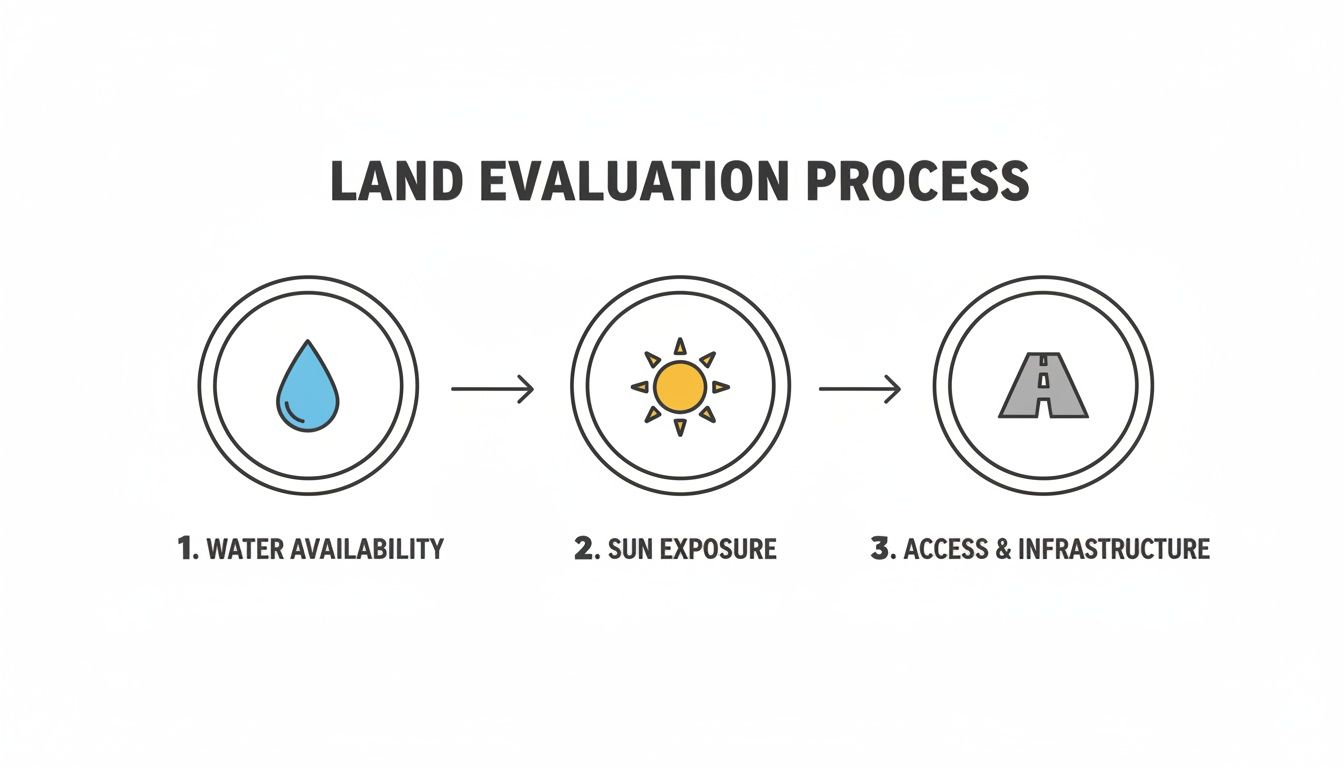
As you can see, securing your water source is a foundational step that should come before planning solar placement or road access.
Here are the most common solutions:
- Drilling a Well: This is the gold standard for a reliable, long-term supply of clean groundwater. It is a significant upfront expense, with costs depending on how deep the well must be drilled to reach the water table.
- Rainwater Harvesting: In areas with adequate rainfall, a catchment system can be an excellent primary or backup source. It involves collecting runoff from a roof and storing it in large tanks.
- Natural Springs: If your property has a natural spring, you have a valuable resource. Just be sure to verify your water rights before tapping into it.
No matter where your water comes from, you need to know how to make it safe to drink. Brushing up on a few reliable water purification methods is a crucial skill for any off-gridder.
Managing Waste Responsibly
Finally, you need a plan for human waste. This is not the most glamorous part of homesteading, but it is a critical one that must comply with local health codes.
Your two primary choices are a conventional septic system or a composting toilet. The right one for you depends on your county's regulations, soil type, and personal preference.
A septic system is the traditional underground setup used by most rural homes. It is often required to obtain a building permit for a permanent dwelling. The main challenge is that you need a successful "perc test" to prove your soil can absorb the wastewater, and the installation can be expensive.
A composting toilet, on the other hand, is a waterless or low-water system that breaks down waste into a safe, soil-like compost. It is perfect for conserving water and is a popular choice for tiny homes, cabins, or any situation where a full septic system is not practical. Always check with your local health department first, as some areas have strict rules about their use in full-time residences.
To help you weigh these critical infrastructure choices, here’s a simple breakdown of the most common systems for beginners.
Comparison of Off Grid Utility Systems for Beginners
This table gives you a quick look at the costs, maintenance, and best-use cases for the power, water, and waste systems we've covered.
| System Type | Utility | Estimated Initial Cost | Maintenance Level | Best For |
|---|---|---|---|---|
| Solar Power System | Power | $2,000 - $15,000+ | Low | Powering everything from small cabins to full-sized homes with reliable sun exposure. |
| Drilled Well | Water | $5,000 - $20,000+ | Low | Properties with accessible groundwater tables for a consistent, long-term water supply. |
| Rainwater Harvesting | Water | $1,000 - $8,000 | Medium | Areas with consistent rainfall; excellent as a primary or backup water source. |
| Septic System | Waste | $6,000 - $15,000 | Low | Permanent residences where county regulations require it and soil conditions are suitable. |
| Composting Toilet | Waste | $500 - $2,500 | Medium | Water conservation, tiny homes, cabins, or situations where a septic system is not feasible. |
Choosing the right systems is a balancing act between your budget, your land's characteristics, and your long-term goals. Start with what you need, and remember that you can always upgrade as your homestead grows.
Budgeting and Financing Your Off-Grid Journey
This is where the dream of wide-open spaces meets the reality of dollars and cents. A solid, well-thought-out budget is arguably the most important tool for turning your vision into a reality. Without one, even the best plans can become bogged down by stress and incomplete projects.
Let's get practical about the numbers. Identifying the main costs upfront allows you to plan with confidence, sidestep unpleasant surprises, and maintain momentum on your path to self-sufficiency.
Creating a Realistic Budget Framework
Your budget must cover more than just the purchase price of the land. It is everything that comes after the purchase that truly shapes your financial picture. Thinking through each category from day one is key.
Here are the major items you will need to account for:
- The Land Itself: This is your foundation. The cost can vary dramatically depending on the state, acreage, and existing features.
- Site Preparation: Raw land is rarely build-ready. You will need to budget for clearing trees, creating a driveway, and leveling a site for your shelter.
- Utility Systems: Your power, water, and waste systems are significant one-time expenses. Plan for solar panels and batteries, a well or water storage tanks, and a septic system or composting toilet.
- Your Shelter: Whether you plan a tiny home, a yurt, a traditional cabin, or another structure, this will be one of your largest costs.
- The Contingency Fund: This is non-negotiable. Plan to set aside an extra 15-20% of your total project cost for the unexpected. Issues will arise, and a contingency fund turns a potential crisis into a manageable problem.
Exploring Accessible Financing Options
A common roadblock for aspiring homesteaders is that traditional banks are often hesitant to lend money for raw, undeveloped land. This can stop many people in their tracks, but fortunately, it is not the only path to ownership.
For many people starting their off grid living for beginners journey, a conventional bank loan is not a viable option. That’s where creative, more accessible financing becomes essential for making land ownership happen.
One of the best alternatives is seller financing, sometimes called owner financing. This model is simple: you remove the bank from the equation entirely. Instead of applying for a loan, you make payments directly to the entity selling the land.
This process is built for accessibility. Sellers offering this option typically provide clear terms, low down payments, and manageable monthly payments. Furthermore, it is almost always faster than a traditional real estate transaction.
A significant advantage is that seller financing often comes with no credit checks, making it ideal for individuals with a less-than-perfect credit history or those who simply wish to avoid bank bureaucracy. This direct-to-seller model breaks down the biggest barriers, putting land ownership within reach for many more people. To better understand how it works, you can learn more about how seller financing paves the road to land ownership. It’s a powerful tool that makes the first big step—buying the land—possible for almost anyone.
Navigating Permits and Legal Requirements
Going off-grid is about freedom, but it is not a free-for-all. This lifestyle still exists within the real world of county rules and regulations. Understanding the legal landscape is one of the most important first steps.
If you skip this step, you could face significant fines, stop-work orders, or—worst of all—being forced to dismantle something you have invested your time and money into building.
Every county has its own set of rules. What is perfectly acceptable in a remote part of Arizona might be completely prohibited one county over in California. These regulations cover everything from the type of shelter you can build to how you manage your water and waste.
Get Answers from the Source
Your most valuable resource in this process is the county’s Planning and Zoning department. Do not rely on information from online forums or even what a seller tells you. You must go directly to the source. A single phone call can save you immense trouble and thousands of dollars down the road.
Before you call, have the Assessor's Parcel Number (APN) for the property you are interested in. This number allows officials to pull up the exact rules for that specific piece of land.
Here’s what you need to ask:
- Zoning: What is the official zoning for this parcel? Does it permit a full-time, year-round residence?
- Building Codes: Is there a minimum square footage requirement for a dwelling? What are the rules regarding alternative structures like yurts, tiny homes, or container homes?
- Camping/RV Living: Can I live in an RV on my land while I build? Are there time limits on how long I can camp here?
- Septic and Waste: What is required to install a septic system? Are composting toilets or other off-grid systems permitted for a primary residence?
- Water Rights: What are the rules for drilling a well? Can I legally harvest rainwater for household use?
A word of caution: if you see land advertised as "unrestricted," be skeptical. This term is often a marketing tool that simply means there is no HOA. It almost never means there are no county regulations. Always verify directly with the county.
Don't Forget About Property Taxes
Even on a parcel of raw, undeveloped land, you are still responsible for annual property taxes. The county assesses your land's value and sends you a bill every year. If you fail to pay, the county can place a lien on your property and eventually foreclose on it.
Before you buy, look up the property’s tax history on the county assessor’s website. This will give you a clear picture of what you will owe each year, so there are no surprises.
Understanding these legal and financial responsibilities from the start is non-negotiable. It ensures your dream of self-sufficiency is built on a solid, legal foundation, allowing you to focus on the enjoyable aspects of your new lifestyle instead of fighting with the local authorities.
What This Means for First-Time Land Buyers
The idea of living off-grid often conjures images of extreme survivalists or individuals with unlimited budgets, which can be intimidating for beginners. The truth is, modern off-grid living is far more practical and attainable than most people realize.
This journey is a marathon, not a sprint. The key to success for beginners is to start small and scale up. You do not need to build a self-sufficient empire overnight.
The Power of Starting Small
One of the smartest approaches is to first purchase an affordable, undeveloped piece of land. This simple step lays the foundation for everything else without depleting your savings.
- Learn Your Land: Start by using your property for weekend camping trips. This is the best way to get a true feel for the place—where the sun rises and sets, how water flows during rain, and what each season is really like—before you commit to building.
- Plan and Save: While you enjoy your land, you can save money and develop solid plans for major infrastructure like water, power, and septic systems. This removes the pressure of trying to accomplish everything at once.
- Grow Into the Lifestyle: This approach allows you to ease into the realities of off-grid life. You will build skills and confidence at your own pace, turning a huge, overwhelming project into an exciting, manageable adventure.
Accessibility is the new reality of off-grid living. It is no longer a fringe concept but a viable, growing lifestyle made possible by affordable land and flexible financing options that put ownership within reach for everyday people.
This shift is evident in the market. The global off-grid housing sector was valued at USD 2.4 billion in 2023 and is projected to reach USD 4.76 billion by 2032, driven by individuals seeking alternatives to rising utility costs. For beginners, this trend is also fueling a boom in smaller, more affordable shelters like tiny homes. You can read more about the growth of the off-grid market to see where things are headed.
Why Consider Dollar Land Store?
For many people dreaming of an off-grid life, the first and biggest hurdle is finding and acquiring the right piece of land. The process can feel complex and overwhelming, but it doesn't have to be. We founded Dollar Land Store to solve this exact problem by making land ownership as straightforward, transparent, and accessible as possible.
We specialize in raw, undeveloped land in states well-suited for off-grid living, like Arizona, Colorado, and Nevada. Our entire process is designed to eliminate the common barriers and complexities associated with buying land. We are not real estate agents; we own all the parcels we sell, which allows us to offer a direct and simplified path to ownership.
A Simple Path to Owning Your Land
Our approach is built on transparency and accessibility—exactly what first-time land buyers need. We achieve this through our seller-financing model, which makes land ownership possible for nearly everyone:
- No Credit Checks: We believe a credit score should not stand between you and your goal of owning land.
- Affordable Land with Low Payments: We keep down payments and monthly payments low. This allows you to secure your parcel while preserving capital for developing your property.
- Transparent Terms: All terms are clearly stated upfront, with no hidden fees or surprises.
- Fast Contract Setup: We handle all the paperwork, making the process quick and efficient, often completing contracts in just a few days.
- No Middlemen: Because you buy directly from us, you avoid agent commissions and the delays of a traditional real estate transaction.
By providing a direct, no-hassle path to land ownership, Dollar Land Store has become a trusted starting point for countless individuals building their off grid living for beginners dream from the ground up.
Your Next Steps Toward Off Grid Independence
This is where the real work—and the real fun—begins. The dream of living off the grid isn't just about escaping the hustle; it's about building a life of self-reliance from the ground up. You now have a roadmap covering everything from selecting the right land and establishing essential systems to creating a workable budget. It's time to put that knowledge into action.
The journey to independence is built one smart decision at a time, not with a single giant leap. It starts by turning daydreams into a solid plan and taking that first, crucial step.
Start Your Search with a Clear Vision
The single most important thing you can do today is to begin searching for the right piece of land. Now that you know what to look for in an off-grid parcel, you can browse listings with a clear purpose.
Use this as your personal checklist:
- Water and Sun are Everything: Look for properties with good well potential or sufficient annual rainfall for a catchment system. Don't forget to assess sun exposure for your future solar setup.
- Check Access and Zoning: Ensure the property has clear, legal access. It's also vital to confirm that local zoning laws will not interfere with your plans, whether you're building a cabin or a yurt.
- Stick to Your Budget: Focus on what you can genuinely afford. Remember, buying the land is just the first expense on this adventure.
The goal here is progress, not perfection. That first piece of land becomes the canvas for your off-grid dream. It gives you a real, tangible place to focus your energy and planning.
Powering Your Future
One of the biggest reasons this lifestyle is more achievable than ever is the incredible progress in renewable energy. Off-grid power is booming worldwide, and solar is leading the charge. In 2023, 84% of the 670 million people without power were in rural areas, making solar the most practical path to energy freedom.
With solar panel costs dropping by a massive 89% since 2010, going off-grid isn't just for a select few anymore. Beginners can now build a self-reliant system and expect to save 30-50% on energy costs over the long haul compared to remaining on the grid. This isn't just a trend; it's a fundamental shift that makes off-grid living a realistic, scalable option. You can see the full story in the report on record-breaking growth in renewable power.
This solar revolution means powering your homestead is more affordable and efficient than you probably imagined.
The dream of off-grid living is absolutely within your reach, and the journey starts now. At Dollar Land Store, our mission is to help you take that first critical step with confidence. We encourage you to browse our available parcels and see what's possible, even on a modest budget.
Explore seller-financed land options through Dollar Land Store.