


Raw Land Explained: What “Raw Land for Sale” Really Means (Part 1 of 3)
Ross AmatoWhen you see a listing for "raw land for sale," what does that actually mean? Think of it as a completely blank canvas. It's property in its most natural state—no public water, sewer, or electricity hooked up, and certainly no existing structures. Its simplicity is its greatest strength, making it one of the most accessible and affordable ways to own a piece of America.
For first-time buyers, understanding raw land is the first step toward achieving a dream that might have seemed out of reach. This guide breaks down exactly what raw land is, how to evaluate it, and how you can purchase it with a simple, straightforward process.
What Is Raw Land and Why Is It a Smart Investment?
Raw land, sometimes called undeveloped land, is a property defined only by its legal boundaries. It hasn't been graded, cleared, or improved in any significant way. This is different from "unimproved land," which might have some basic infrastructure nearby, like a road or utility lines at the edge of the property.
But that lack of development is precisely what makes it such a powerful opportunity. For many people, it represents total freedom and pure potential, without being tied down by someone else's old choices or buildings.
The Appeal of a Blank Slate
The number one reason people buy raw land is simple: it's affordable. Without the massive costs of buildings, wells, or septic systems already factored in, the entry price is dramatically lower than a traditional house or cabin. This opens the door to property ownership for individuals and families who thought they were priced out of the market.
Beyond the low cost, raw land offers something priceless: total control. You get to decide everything about the property’s future.
- For Investors: It’s a tangible, real asset that tends to grow in value, especially in up-and-coming rural areas. You can buy it, hold it with minimal costs (often just low property taxes), and sell it later as the area becomes more popular.
- For Future Homebuilders: It’s your chance to design a homestead exactly the way you want it. You pick the perfect spot for your home, decide on off-grid solutions that fit your lifestyle, and build from the ground up.
- For Recreational Users: It can be your own private campsite, a basecamp for hunting and fishing, or a weekend getaway for dirt bikes and ATVs—all without the rules and crowds of public lands.
Raw land is an investment in potential. You're not just buying dirt; you're securing a piece of the American landscape that you can shape to your specific vision, whether for financial growth, personal freedom, or family recreation.
At Dollar Land Store, our mission is to make this kind of ownership easy and accessible. We specialize in finding parcels that offer a straightforward way to enter the market, allowing you to secure your own piece of land with a simple, transparent process. Once you understand what raw land truly is—a foundation for your dreams—you can see the incredible opportunity it represents.
How to Properly Evaluate Raw Land Before You Buy
Buying land is exciting, but a smart purchase comes down to doing your homework before you sign anything. A great view is wonderful, but it’s less valuable if you can’t legally build, access your property, or afford to bring in utilities. This research process is called due diligence.
Think of it as a pre-purchase checklist for your land-buying journey. By methodically investigating these four key areas, you’ll avoid the common and costly mistakes that catch new buyers by surprise and can move forward with total confidence.
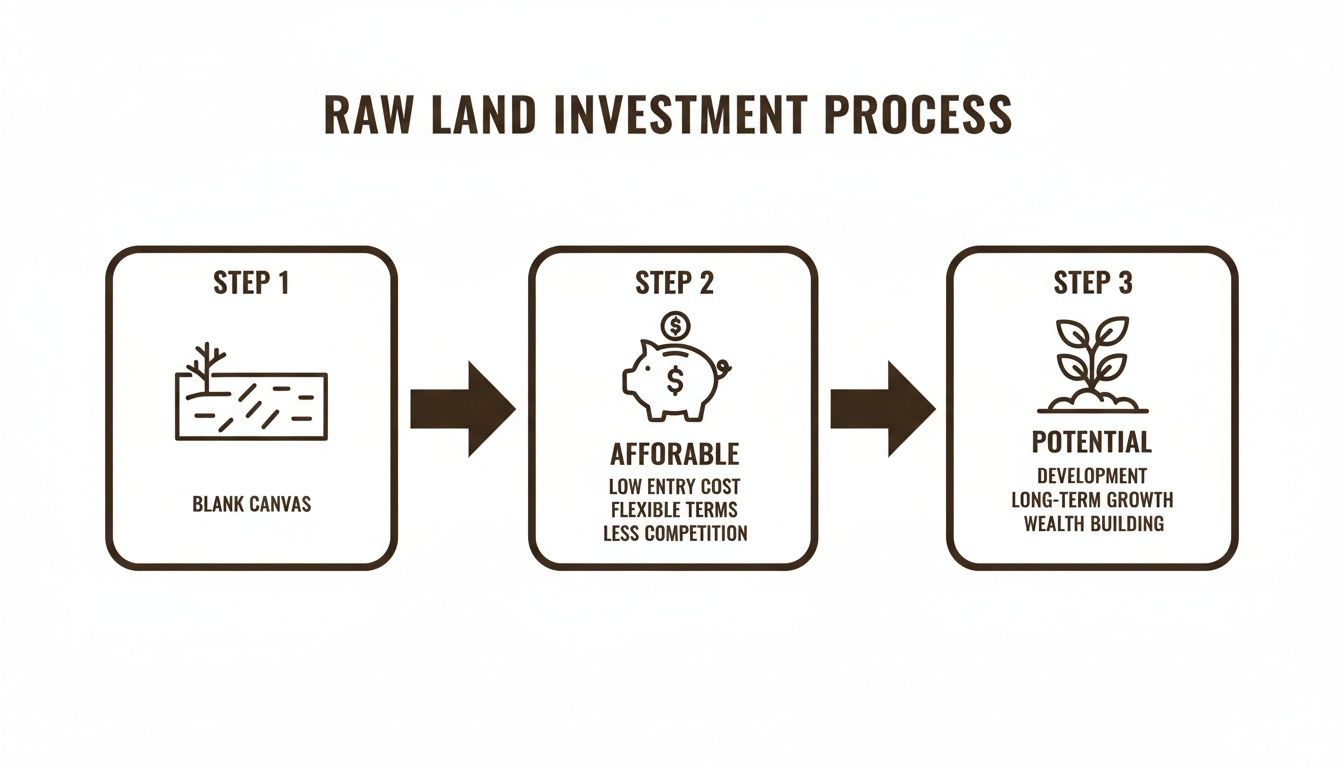
As the diagram shows, raw land starts as an affordable blank canvas. Its undeveloped nature is exactly where the opportunity for building real value lies.
Zoning and Land Use Restrictions
The very first question you need to ask is simple: “Can I do what I want to do on this land?” The answer lies in the county’s zoning regulations.
Zoning is a set of local rules that dictates how land can be used—common categories include residential, agricultural, commercial, or recreational. You can’t assume that just because a property is vacant, you can build a house on it. If it’s zoned strictly for agriculture, a home might not be permitted.
Always verify with the source. Call the county planning and zoning department where the property is located and ask them directly. Get specific with your questions:
- Can I camp on my property? If so, are there time limits (e.g., 14 days at a time)?
- Am I allowed to live in an RV while I build a home?
- Is there a minimum square footage for a new home?
- Can I have a few chickens or a small farm here?
Buyer Insight: Keep an eye out for properties in rural areas with flexible or mixed-use zoning. They give you far more freedom and tend to hold their value better because they appeal to a wider range of future buyers—from weekend campers to full-time homesteaders.
Physical and Legal Access
This is a critical point that trips up many new buyers. You need two kinds of access, and both are non-negotiable.
Physical access is exactly what it sounds like: can you actually drive or walk onto your property? You need to know if there's a county-maintained road leading to it or just a rough dirt track that becomes impassable after rain. Some of the most beautiful, remote parcels are only reachable with a 4x4, which might be a dealbreaker for you.
Legal access is your right to get there. Just because you see a road doesn’t mean you have the legal right to use it. If the only path to your land crosses a neighbor’s property, you absolutely must have a legally recorded easement. Without one, that neighbor could put up a gate tomorrow and leave your property completely “landlocked” and inaccessible. For a deeper look at this and other key checks, our guide on what to look for when buying land breaks it all down.
Utility Availability and Costs
Raw land means no utilities are hooked up. Figuring out the cost and effort to bring them in is a critical step, because the price tag can be a real shock.
- Water: Your most likely option is drilling a well. This can run anywhere from $5,000 to over $15,000, depending on depth and geology. An alternative is a cistern, which requires paying for water delivery.
- Sewer: For waste, you’ll probably need a septic system. A standard installation can cost between $10,000 and $25,000. Before you can even get a permit, the soil has to pass a “perc test” to prove it can drain properly.
- Electricity: If power lines don’t run to the edge of your property, getting them extended can cost thousands of dollars per pole. This is why so many rural landowners choose to go off-grid with a solar power system instead.
Environmental and Physical Checks
Last but not least, take a hard look at the land itself. A few environmental factors can make or break your plans.
First, check the FEMA Flood Map Service Center online. If the land is in a designated flood zone, you’ll face building restrictions and have to carry expensive flood insurance.
Next, think about the topography. A steep hillside looks amazing, but it can make building a foundation incredibly difficult and costly. Heavily wooded land needs to be cleared, and rocky soil can be a nightmare for digging a foundation or installing a septic system. In the Western U.S., you also need to think about wildfire risk. Many counties have specific fire-resistant building codes you’ll have to follow.
To help you keep track of everything, we've put together a simple checklist. Use it as your guide to make sure you cover all the bases before making a final decision.
Raw Land Due Diligence Checklist
| Check | What to Look For | Where to Find Information |
|---|---|---|
| Zoning | Confirm permitted uses (residential, camping, RV, farming). | County Planning & Zoning Department website or phone call. |
| Legal Access | Verify a recorded easement if access crosses private land. | County Recorder’s Office or a title company report. |
| Physical Access | Check road conditions, maintenance, and seasonal accessibility. | A physical visit to the property; Google Maps (Satellite View). |
| Utilities | Get quotes for well drilling, septic installation, and power hookup. | Local well drillers, septic installers, and the local power company. |
| Flood Zone | Determine if the property is in a FEMA-designated flood zone. | FEMA Flood Map Service Center (online and free). |
| Topography | Assess slopes, soil type, and vegetation. | Google Earth (for elevation), a physical visit. |
| Property Taxes | Find out the annual property tax amount and if they are current. | County Treasurer or Assessor’s Office. |
| Title | Ensure the title is "free and clear" of liens or other claims. | A title company or the County Recorder's Office. |
Doing your due diligence isn’t about finding problems—it’s about finding clarity. Once you’ve checked these boxes, you can move forward knowing the land you love is truly ready for your vision.
What This Means for Buyers
For a first-time land buyer, this due diligence process is your most important tool. It transforms you from a hopeful browser into an informed purchaser. Understanding zoning, access, and utility costs prevents you from buying a property that doesn’t fit your dreams or your budget.
For instance, knowing the cost of a well and septic system upfront helps you calculate the true total investment, not just the purchase price. Confirming camping is allowed before you buy ensures your weekend getaway plans are secure. This research empowers you to make a confident decision, knowing there won't be costly surprises down the road.
Financing Your Purchase with Accessible Options
So, how do you actually pay for a piece of raw land? This is where many first-time buyers get nervous, but the reality is much simpler and more encouraging than you might think. Traditional banks often avoid lending money for undeveloped land because they see it as a higher risk than a house.
For most people, that’s actually great news. It pushes aside complicated mortgage applications and opens up a far more direct and accessible path to ownership: owner financing.
Think of it as a direct payment plan with the seller. Instead of jumping through hoops at a bank, you and the seller agree on a price, a down payment, and a monthly payment plan that you pay straight to them. Owner financing for raw land works the same way—it's a straightforward agreement between you and the seller.
Understanding Owner Financing
Owner financing, also called seller financing, simply cuts out the middleman. The seller—in this case, a reputable company like Dollar Land Store—acts as the lender. The entire arrangement is built on simplicity, making land ownership a real possibility for many people who might not qualify for a conventional loan.
The process is refreshingly clear. You and the seller agree on three key things:
- Purchase Price: The total cost of the property.
- Down Payment: A small, initial amount you pay upfront.
- Monthly Payments: A fixed amount you’ll pay each month until the land is paid off.
Because the seller owns the property outright, they have the freedom to set flexible terms. This lets them create financing options designed to help people succeed, not find reasons to turn them away.
Why Owner Financing Is a Game-Changer for Buyers
For anyone looking for raw land for sale, owner financing smashes the biggest financial barriers that stop most people before they even start. It levels the playing field, shifting the focus from your credit history to your ability to make a small, consistent monthly payment.
The advantages are huge, especially for first-time buyers:
- No Credit Checks: Your credit score is not a factor. Approval is based on your ability to handle the down payment and the monthly payments that follow.
- Low Down Payments: Forget needing 20% to 50% down like a traditional lender might demand. Owner financing often starts with just a few hundred dollars.
- Fast Approval: There are no long, drawn-out applications or underwriting processes. If you can make the down payment, you can secure the property quickly.
- Simple, Clear Terms: The contracts are easy to understand. You know your interest rate, payment amount, and loan term right from the start.
Owner financing isn't just a different way to buy land; it's a different mindset. It's built on the idea that everyone deserves a fair shot at owning their own piece of property, no matter their financial past.
Owner Financing vs. Paying Cash
While paying with cash is the simplest route, it means you need a large sum of money ready to go. That’s not realistic for the average person hoping to secure a piece of land for their future.
Owner financing offers a powerful alternative. It lets you lock in a valuable asset today with a small initial investment, allowing you to pay for it over time with manageable monthly payments. This approach keeps your savings available for other things while your land has the opportunity to appreciate in value.
At Dollar Land Store, our entire business is built around this accessible model. To see exactly how it works, our guide on how seller financing paves the road to land ownership breaks down the entire process. We believe the financial side of buying land should be the easiest part, clearing the way for you to focus on bringing your dreams for the property to life.
Why Consider Dollar Land Store?
Finding the right piece of land is only half the battle. You also need a partner you can trust to make the process simple, transparent, and secure. We founded Dollar Land Store to be that partner for buyers across the country. Our entire model is designed to cut through the confusion of the traditional real estate market, making land ownership straightforward and affordable for everyone.
We sell quality raw land for sale directly to you, which means no middlemen. That means no real estate agents, no banks, and no surprise commissions. You work directly with us, an experienced seller, which keeps things simple and the costs down.
An Approach Built for Accessibility
Our mission is to make land ownership a reality for more people. To do that, we focus on a few key principles:
- Affordable Land with Low Payments: We specialize in sourcing affordable rural land and offer owner financing with low down payments and manageable monthly payments.
- Simple Owner Financing with No Credit Checks: We believe your financial past shouldn't prevent you from building a better future. That’s why we offer financing with no credit checks, ever.
- Transparent Terms: Our contracts are written in plain English, so you know exactly what you're agreeing to. The price you see is the price you pay—no games or hidden fees.
- Fast Contract Setup: Our electronic closing process is fast and simple. You can review and sign documents from anywhere, allowing you to secure your land in days, not weeks.
- Broad Inventory Across Several States: We offer a wide selection of parcels in states like Arizona, Colorado, Nevada, Oregon, and more, giving you plenty of options to find your perfect spot.
We personally vet every property in our inventory, ensuring it has clear title and legal access. By combining accessible financing with a serious commitment to transparency, we offer a logical, trustworthy path to owning your own piece of land.
Your Next Steps to Owning Raw Land
You've done the reading, and now you’re ready to move from dreaming about land to owning it. This is the exciting part. With a simple roadmap, you can turn your research into action and find the perfect piece of raw land for sale without feeling overwhelmed.
Follow this clear, step-by-step approach to guide you through the final stretch of the journey.
Step 1: Define Your Goals and Budget
Before you browse a single listing, get clear on two things: what you want to do with the land and what you can comfortably afford.
Is this going to be a weekend campsite for the family? A long-term investment? Or the future spot for your off-grid homestead? Your goal shapes every decision that follows. Then, set a realistic budget. With owner financing, think about the down payment you have ready and a monthly payment that won’t stretch you thin.
Step 2: Browse Listings and Identify a Parcel
Now for the fun part. Head over to the Dollar Land Store website and start exploring. Use filters for state, county, and price to narrow down the options. This is where you’ll find properties that line up with the goals and budget you just set.
As you look at each listing, pay close attention to the details provided:
- Acreage and Dimensions: Get a real feel for the size and shape of the lot.
- Access Information: Is it off a paved road, a maintained gravel road, or something more rugged?
- Zoning Details: We provide the county’s designated use to get you started.
- GPS Coordinates: Plug these into a map to see exactly where the property is and what surrounds it.
Step 3: Conduct Your Final Due Diligence
Once you find a property that catches your eye, it’s time to put your newfound knowledge to work. Go back to the due diligence checklist and start making a few phone calls.
The most important call is to the county planning and zoning department. You need to confirm directly with them that your specific plans for the land are allowed under their regulations.
This step is non-negotiable. A couple of quick conversations provide the final green light you need, turning a hopeful prospect into a confident decision. Taking this extra time now prevents surprises down the road.
Step 4: Complete the Purchase
With your research done and your confidence high, you’re ready to buy.
At Dollar Land Store, we’ve made this last step as simple as possible. The entire process is handled online, from your initial down payment to e-signing the documents. Our team is always here to answer your questions and walk you through our straightforward contract, ensuring you’re comfortable from start to finish.
Conclusion
Buying raw land is one of the most rewarding and accessible ways to invest in your future. It offers a unique combination of affordability, freedom, and potential, whether you plan to use it for recreation, homesteading, or long-term financial growth. By understanding what raw land is, performing thorough due diligence, and utilizing accessible options like owner financing, you can confidently take the leap into land ownership. The key is to start with clear goals and partner with a trusted seller who makes the process transparent and simple.
Ready to find your piece of America? Browse available land at DollarLandStore.com or contact us with any questions about buying raw land.