


A Buyer's Guide to Cheap Land for Sale with Owner Financing
Ross AmatoEver dream of owning a slice of land but dread the thought of dealing with banks? Finding cheap land for sale with owner financing cuts through the red tape. It's a straightforward path to property ownership, making that rural escape you've been thinking about a genuine possibility. For first-time buyers especially, this approach removes many of the traditional barriers to entry.
Your Path to Land Ownership, No Banks Required

Owner financing, also known as seller financing, is a simple concept: the person selling you the land is also the one lending you the money. Instead of jumping through hoops for a bank loan, you make payments directly to the owner. This single difference is a game-changer for many aspiring landowners.
This approach opens doors that traditional lending often slams shut, sidestepping common hurdles like needing a perfect credit score or a massive down payment. It’s an incredibly popular way to buy raw land for various purposes:
- A recreational spot for camping, hunting, or parking an RV.
- The start of a future homestead for off-grid living or building a cabin.
- A smart long-term investment in a tangible, physical asset.
Why More People Are Seeking Rural Land
The pull towards open space and self-sufficiency is strong. The homeownership rate in rural areas is a staggering 81.1%, far higher than the 59.8% seen in urban centers. This trend is particularly visible in Western states like Nevada and Arizona, where vast stretches of public land create amazing opportunities to buy affordable private parcels.
This guide provides a clear, no-nonsense roadmap for your land-buying journey. We’ll cover everything from finding the right property to understanding the financing terms and closing the deal. To get started, it helps to understand the mechanics. Our guide on what seller financing is in real estate is a great place to begin. By the time you’re done here, you’ll have the confidence to turn your dream of owning land into a reality.
Owner Financing vs. Traditional Bank Loan: A Quick Comparison
For anyone new to buying land, it can be tough to see how these two options stack up. Here’s a side-by-side look to clarify the differences.
| Feature | Owner Financing | Traditional Bank Loan |
|---|---|---|
| Approval Process | Fast and simple, often with no credit check. | Slow and complex, requires extensive paperwork. |
| Credit Requirement | Flexible; poor or no credit is often okay. | Strict; requires a good-to-excellent score. |
| Down Payment | Low, sometimes as little as a few hundred dollars. | High, typically 10-20% or more of the price. |
| Closing Time | Can be as quick as a few days. | Usually takes 30-60 days or longer. |
| Flexibility | Terms are often negotiable with the seller. | Rigid terms set by the bank's policies. |
| Best For | Buyers with less-than-perfect credit or cash. | Buyers with strong credit and substantial savings. |
As you can see, owner financing fundamentally changes the game. It removes the traditional gatekeepers and puts you in direct contact with the seller, creating a simpler, more accessible path to owning your own piece of land.
How to Find Legitimate Owner-Financed Land Deals
Knowing that cheap land for sale with owner financing exists is one thing; finding it is another. The good news is that these deals are more accessible than most people realize—you just have to know where to look. The key is to focus your search on sellers and platforms that specialize in this exact niche.
Your most efficient starting point is a dedicated online land marketplace. Companies like Dollar Land Store build their entire business around offering affordable raw land with direct seller financing. This approach saves you a ton of time. Every listing is a potential owner-financed deal, so you don't have to waste time asking, "Is financing an option?"
Going this route also adds a layer of confidence. Established land sellers have a reputation to protect and a streamlined process for contracts and payments, which brings a level of professionalism that can be a gamble with one-off private sellers.
Where to Focus Your Search
While specialized marketplaces are your best bet, it's smart to cast a wider net to get a better feel for market prices and ensure you don’t overlook a hidden gem.
- Local Classifieds and Community Boards: Websites like Craigslist or local online forums can sometimes have for-sale-by-owner (FSBO) land parcels. You'll need to do more due diligence here, but you might connect with a motivated local seller.
- Social Media Groups: Look for Facebook groups dedicated to "land for sale," "off-grid living," or "homesteading" in the states you're interested in. Sellers often post properties directly to these communities.
- Niche Real Estate Agents: While most agents focus on houses, a few specialize in vacant land. Search for realtors in rural counties who market themselves as "land specialists." They often have connections with local landowners who may be open to seller financing.
Buyer's Tip: When searching online, get specific. Instead of just "land for sale," try phrases like "owner financed land in [County Name]," "no credit check acreage," or "low down payment lots." This will help you cut through the noise.
How to Spot a Legitimate Seller
Learning how to tell a credible seller from a potential scammer is your most important skill. A legitimate seller, whether a company or an individual, will always operate with professionalism and transparency.
Keep an eye out for these green flags:
- Clear and Detailed Listings: The listing should provide essentials like the Assessor's Parcel Number (APN), GPS coordinates, property size, annual taxes, and basic zoning information. Vague listings are a major red flag.
- Professional Communication: The seller should be easy to reach, answer your questions directly, and willingly provide documents. Be wary of anyone using high-pressure sales tactics or avoiding straightforward questions.
- Verifiable Ownership: A legitimate seller will have no problem proving they own the land. You can (and should) independently verify this by contacting the county recorder's office with the property’s APN.
Finding a great deal is about more than just browsing—it's about active research. For a deeper dive, explore our guide on how to find cheap land. By combining smart search tactics with careful vetting, you can confidently find a property that fits both your vision and your budget.
Evaluating the Land and the Financing Terms
Finding a property you like online is the easy part. Now comes the real work: due diligence. This is a two-sided coin: you have to dig into the details of the land itself while also putting the financing terms under a microscope.
Getting either of these wrong can lead to regret. But get them both right, and you’re setting yourself up for a smart, satisfying purchase. One side is about access, zoning, and utilities; the other is about numbers, contracts, and legal commitments. Let's walk through how to handle both.
The Land Due Diligence Checklist
Before you sign anything, you must become an expert on that specific piece of land. Due diligence is non-negotiable, especially with raw, undeveloped property. Your mission is to uncover any hidden surprises that could disrupt your plans.
It helps to know what's happening in the broader market. A massive amount of property is changing hands; around 40% of America's agricultural land—a staggering 370 million acres—is expected to be sold in the coming years. This is creating incredible opportunities for new buyers.
With that in mind, here's what to check on your specific parcel:
- Legal and Physical Access: Can you legally and physically get to your property? A parcel without a guaranteed legal way in (an easement) is considered "landlocked," which dramatically cuts its value. Find out if access is via a county-maintained road, a private dirt road, or just an unbuilt line on a map.
- Zoning and Land Use Rules: What are you allowed to do with the land? Call the county’s Planning and Zoning department with the APN. Ask them directly about its zoning (e.g., Residential, Agricultural, Recreational) and any rules on camping, RV living, or building requirements.
- Utilities and Water: For an off-grid property, what's the water situation? Research well depths and drilling costs in the area. Water hauling is another option. If the land is closer to town, check the distance to the nearest power lines.
- Property Boundaries: Is there a recent survey? If not, you may need to rely on GPS apps or hire a surveyor to know exactly where your property lines are. Never assume a fence marks the legal boundary.
- HOA/POA and Covenants: Is the property part of a Homeowners' or Property Owners' Association? If so, you must read the CC&Rs (covenants, conditions, and restrictions). These documents can control everything from what you can build to whether you can have livestock.
For a deeper dive, our guide on what to look for when buying land has a more detailed checklist.
The process boils down to three simple phases: search for a property, verify the details, and connect with the seller to make it yours.
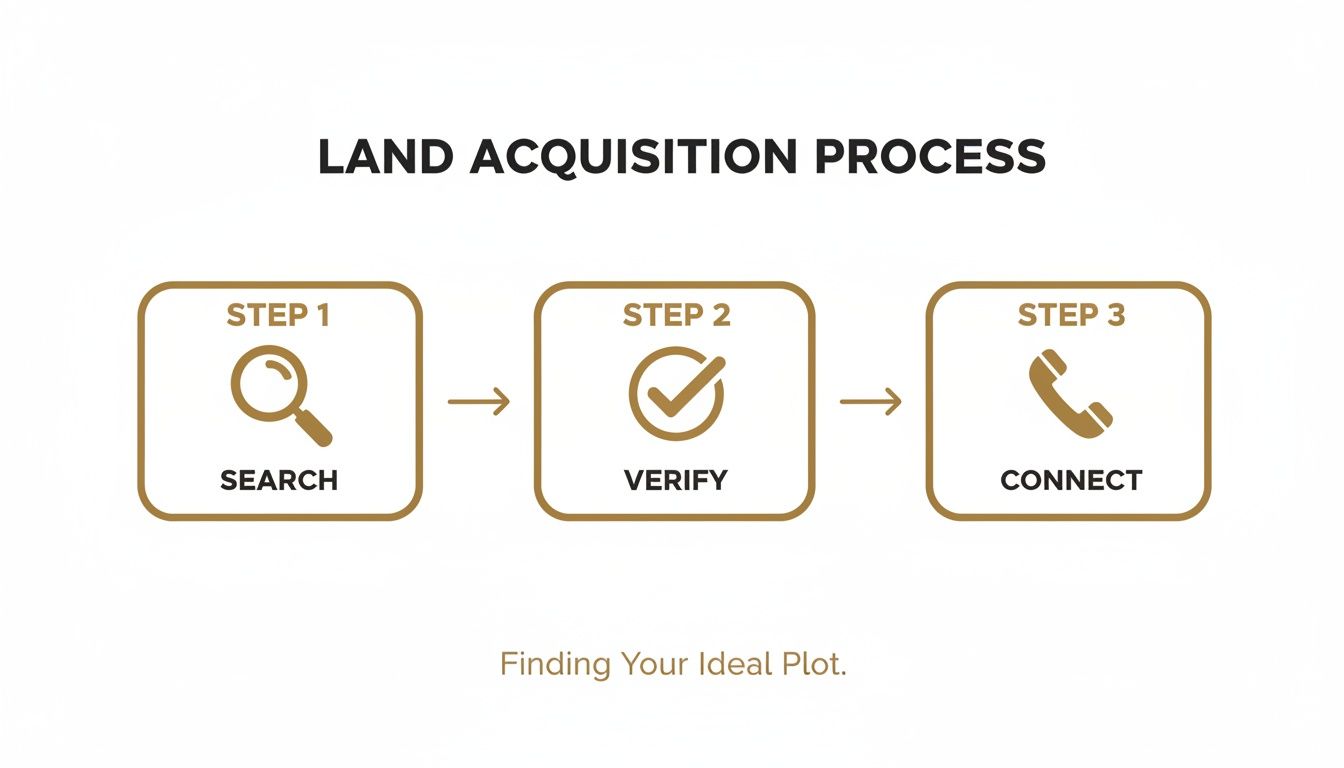
Think of it this way: finding the land is just the start. The verification step is where you protect your investment and ensure you're getting exactly what you think you are.
Due Diligence Checklist for Raw Land
| Checklist Item | What to Look For | Where to Verify |
|---|---|---|
| Legal Access | Confirmed easement or public road frontage. Avoid landlocked parcels. | County Recorder's Office (deeds, plats), County Roads Department. |
| Zoning & Use | Zoning classification (residential, agricultural, etc.) and specific restrictions. | County Planning & Zoning Department. |
| Utilities | Proximity to power, water, and septic feasibility (perk test). | Local utility companies, well drillers, septic installers. |
| Property Taxes | Current tax status (paid up to date) and annual tax amount. | County Tax Assessor or Treasurer's Office. |
| Title Status | A "free and clear" title with no liens or encumbrances. | A title company or the County Recorder's Office. |
| HOA/POA | Presence of an association and any associated fees or restrictions (CC&Rs). | The HOA/POA directly, or check recorded documents at the county. |
| Flood Zone/Hazards | Location within a flood plain, fire hazard zone, or other natural risk areas. | FEMA Flood Map Service Center, County GIS mapping tools. |
Using this checklist helps ensure you don't miss critical details that could impact your land's value or your ability to use it as planned.
Decoding the Financing Agreement
Once you’re confident the land is a winner, it's time to analyze the financing deal. A low monthly payment looks great, but you have to understand the entire financial commitment. Reputable sellers, like Dollar Land Store, lay this out clearly in the contract—no surprises.
Here are the key numbers to focus on:
- Purchase Price: The total cost of the land. Is it a fair market price for the area?
- Down Payment: The cash you pay upfront. With owner financing, this is often kept very low to make getting started easy.
- Interest Rate (APR): The cost of borrowing the money. Owner financing rates may be slightly higher than a bank's to offset the seller's risk, but they should still be reasonable.
- Loan Term: How long you have to pay it off, usually in months. A longer term means a lower monthly payment, but you'll pay more in total interest.
- Additional Fees: Always ask about one-time costs like a document preparation fee or county recording fees. A transparent seller will list these for you.
Let's look at a real-world example:
You find a 5-acre parcel listed for $10,000. The seller offers terms of $250 down, an interest rate of 9%, and a 10-year (120 month) loan.Your monthly payment would be about $123. Over the full 10 years, your total payout would be $14,760. Knowing these figures upfront lets you see if the deal truly fits your long-term budget.
Navigating the Closing Process
Finalizing your purchase of cheap land for sale with owner financing is one of the most exciting parts of the journey. It's almost always simpler and faster than a traditional real estate closing. With no banks involved, the process is straightforward—just you, the seller, and a few key documents that make it official.
Once you've done your due diligence and agreed on terms, the last step is the legal paperwork that transfers ownership to you.
The Key Legal Documents Explained
In a typical owner-financed deal, you will encounter two primary documents. They work together to transfer the property and outline your payment plan.
- The Promissory Note: This is your formal promise to pay. It’s a legal agreement that spells out the loan terms: total price, interest rate, monthly payment, and loan duration.
- The Deed: This is the official document that transfers ownership of the land from the seller to you. There are different types, but a Warranty Deed offers the strongest guarantee that the title is clean and clear of any claims.
When you work with a reputable seller like Dollar Land Store, these documents are standardized and easy to understand.
Securing and Recording Your Ownership
After you sign, two things must happen to secure your ownership: confirming a clear title and recording the deed with the county.
A "clear title" means the seller owns the property outright, with no liens or claims from anyone else. This is non-negotiable. Any trustworthy seller will guarantee a clear title before listing a property.
Next, the deed must be filed with the County Clerk or Recorder’s Office where the land is located. This makes your ownership part of the public record, protecting you from future claims and officially documenting the transfer.
Why Recording Matters: Skipping this step is a huge mistake. An unrecorded deed could allow a dishonest seller to attempt to sell the same land to someone else, creating a legal nightmare. Recording your deed is your ultimate protection.
Understanding Closing Costs
While owner-financed deals have far fewer fees than bank loans, you can still expect a few small costs. The good news is they’re much lower because you’re not paying for bank appraisals, loan origination fees, or pricey title insurance.
Here’s what you’ll typically see:
- Document Preparation Fee: A one-time fee the seller charges for drafting the promissory note and deed. This is usually a flat fee that is clearly stated upfront.
- County Recording Fees: This is the fee the local county government charges to officially record your deed. The cost varies by county but is generally a small amount.
A transparent seller will provide a clear breakdown of every cost before you sign. There should be zero surprises at closing.
What This Means for First-Time Land Buyers
The world of cheap land for sale with owner financing is especially beneficial for first-time buyers. Traditional real estate can be intimidating, filled with complex jargon, strict financial requirements, and multiple middlemen. Owner financing cuts through that noise.
The key implication for you as a buyer is accessibility. You don't need a perfect credit history or a large savings account to get started. This model empowers you to take control of your financial future by investing in a real, tangible asset without the approval of a loan officer.
The process is designed to be beginner-friendly. By working directly with a land specialist like Dollar Land Store, you're not just a transaction; you're a future landowner getting guidance from an expert. The entire journey—from browsing listings to understanding zoning and signing digital contracts—is simplified to build your confidence and make ownership a reality.
Why Consider Dollar Land Store?
When you're looking for cheap land for sale with owner financing, the most important decision you'll make is choosing a seller you can trust. At Dollar Land Store, we built our company on a foundation of transparency and accessibility. Our mission is to make owning land possible for everyone, regardless of their credit score or financial history.
We focus on removing the biggest hurdles that stop people from buying land. By specializing in owner financing, we offer a clear path to ownership that cuts out banks, credit applications, and long waiting periods. This direct approach not only makes buying land easier but also keeps costs down for you.
Here are the key advantages of working with us:
- Affordable Land with Low Payments: We believe owning a piece of America shouldn't require a huge pile of cash. Our model is built on low down payments and manageable monthly payments that fit almost any budget.
- Simple Owner-Financing with No Credit Checks: Your credit score doesn't matter. If you can make the down payment, you're approved for financing. It’s that simple.
- Transparent Terms: You won’t find hidden fees or confusing legal language in our contracts. We handle all the paperwork and provide clear, easy-to-understand documents so you know exactly what you're getting.
- No Middlemen or Real Estate Agents: You're buying directly from us—the owner of the property. That means no agent commissions or confusing back-and-forth communication.
- Broad Inventory Across Several States: We offer a diverse selection of properties in desirable states like Arizona, Colorado, Nevada, and Oregon, giving you plenty of options for recreation, investment, or a future homesite.
- Fast Contract Setup: Our entire purchase process, from checkout to signing your digital contract, can be completed online in just a few minutes.
By sticking to these principles, we provide a reliable and uncomplicated way for you to find and buy your own piece of land.
Next Steps: Your Path to Land Ownership
You've just walked through the entire process of finding and buying affordable land with owner financing. From spotting the right property to signing the final papers, the journey is straightforward when you know the steps. The biggest takeaway is this: with a bit of research and a trustworthy partner, owning land isn't a distant dream—it's completely within your reach.
Time to Take Action
The best way to get comfortable with this process is to see it in action. Looking at real properties with actual prices and financing terms turns abstract concepts into tangible opportunities.
Here are a few simple things you can do right now to get started:
- Browse available parcels: The first move is always to look. Head over to DollarLandStore.com to see what’s available in different areas and what your money can buy.
- Learn more about seller financing: See for yourself how clear and straightforward our terms are. Our process is designed to be completely transparent, with no credit checks and low down payments.
- Contact DLS with questions: Have questions about a specific lot? Wondering about zoning or how the purchase works? Just reach out to the Dollar Land Store team. Our goal is to give you the confidence and information you need to make a great decision.
By taking these small steps, you shift from thinking to doing. The opportunity to own your own land is right here, and it's much closer than you think.
Common Questions About Owner Financing
When you're exploring cheap land for sale with owner financing, it’s natural to have questions. Getting clear answers is the best way to feel confident about moving forward. Here are a few of the most common things people ask.
Is Owner Financing a Safe Way to Buy Land?
Absolutely. Owner financing is a legitimate and safe way to buy property, provided you work with a reputable seller. The entire transaction rests on clear, legally binding paperwork that protects both you and the seller. A trustworthy deal will always involve a formal purchase agreement and a promissory note that spells out every term.
The most important step for your peace of mind is to verify the seller owns the property and that the title is clean—free of liens or other claims. Reputable companies like Dollar Land Store handle this for you, guaranteeing a clear title and providing transparent contracts. Our long history of successful sales is your assurance.
What Happens If I Miss a Payment on Owner Financed Land?
The specific steps for a missed payment are always laid out in your promissory note. Typically, there’s a short grace period after the due date to catch up. If the payment isn't made by the end of that window, a late fee is usually applied.
If payments are missed for an extended period, the seller has the legal right to begin foreclosure proceedings to reclaim the property, just as a bank would. However, most sellers would much rather work with you to find a solution. Open communication is key.
Can I Build on Land I Am Buying with Owner Financing?
This question has two parts: your financing agreement and the local county rules.
First, some seller financing contracts may include clauses that limit major improvements or building until a certain portion of the loan is paid off. Read your contract carefully to see if any such restrictions apply.
Second, and most critically, you must always check with the county. The local planning and zoning department has the final say on what you can and cannot do. They set the rules for building permits, septic systems, wells, and zoning, which are completely separate from your financing terms.
Are There Hidden Fees with Owner Financing?
With a transparent seller, there should be no hidden fees. All costs should be disclosed upfront before you sign anything. The typical costs you’ll encounter are a one-time document preparation fee and the county’s fee for officially recording the deed.
Beyond those initial costs, your only ongoing responsibility is paying the annual property taxes directly to the county. A trustworthy seller will list every cost in the contract so there are no surprises. If you ever see a fee you don’t recognize, always ask for an explanation before moving forward. If you want to avoid bank delays and complex paperwork, focusing on land for sale by owner can simplify the entire buying process.