

A First-Time Buyer's Guide to Hawaii Big Island Land for Sale
Ross AmatoFor many, the idea of owning property in Hawaii seems like a distant dream. But on the Big Island, that dream is surprisingly attainable. The Big Island offers some of the most affordable land in the entire state, creating a realistic opportunity for first-time buyers and investors to own a piece of paradise. Unlike its pricier neighbors, this is a market where you can still find raw, undeveloped land without a massive budget.
This guide is designed for beginners. It will walk you through the key factors that make Big Island land so affordable, explain the unique local considerations like lava zones and off-grid living, and provide a practical checklist to help you make a confident, well-informed purchase.
Why Is Land on the Big Island So Affordable?
So, how is it possible to own land in Hawaii for a fraction of the expected cost? The answer lies in the Big Island's unique geography and the self-sufficient lifestyle that often comes with it. While other islands are known for extremely high real estate prices, the Big Island’s vast size and active geology create a completely different market.
For anyone new to buying land here, understanding these local factors is the first step toward making a great purchase. They are not obstacles; they are simply the key facts that shape the opportunity and define the market.
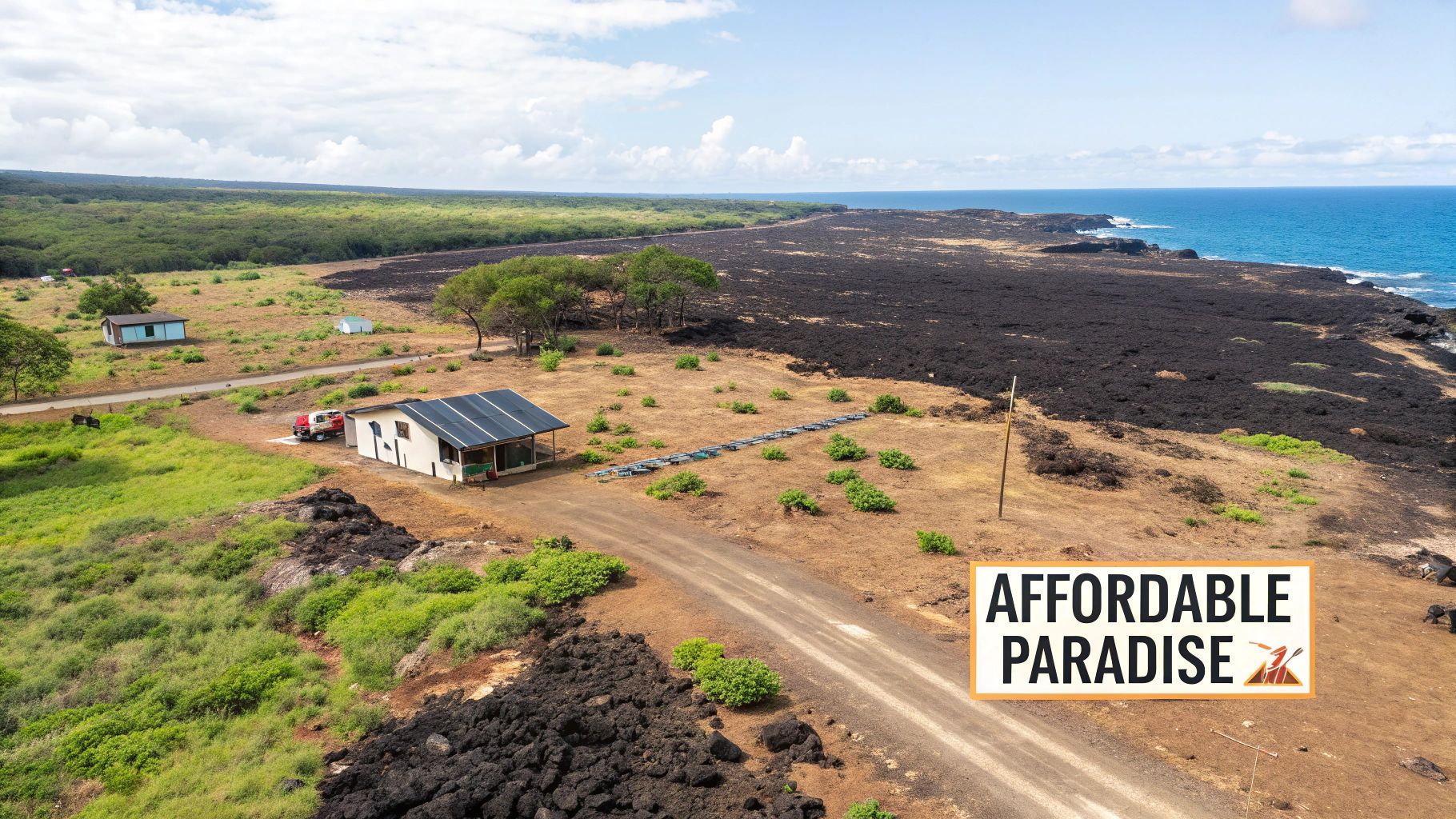
Key Factors Influencing Affordability
- Vast Land Availability: The Big Island is enormous—larger than all the other Hawaiian islands combined. That sheer scale means there’s simply more land available, which naturally keeps prices more competitive than on land-scarce islands like Oahu or Maui.
- Off-Grid Living: Much of the most affordable land is in rural areas, far from county water lines or the power grid. These properties are ideal for a self-sufficient lifestyle using rainwater catchment systems and solar power. This off-grid nature significantly reduces the purchase price.
- Lava Zones: The island is geologically active, and every property is mapped into a Lava Flow Hazard Zone. Land in areas with a higher statistical risk of lava flow, like Lava Zone 1 or 2, often sells for significantly less. This creates opportunities for buyers who understand and are comfortable with the calculated risks.
The secret to the Big Island’s affordability often involves a trade-off: a willingness to embrace a more self-reliant lifestyle. This means setting up your own water and power, which is a completely normal and accepted way of life for thousands of residents.
A Practical Approach to Buying
Success in this market is about having a practical mindset. Instead of focusing on what a property lacks, informed buyers learn to see its potential. That off-grid parcel in a higher-risk lava zone isn't a problem; it's an opportunity to own land outright for a fraction of the cost you'd pay elsewhere in Hawaii.
If you’re new to this, concepts like catchment tanks and solar arrays might seem unfamiliar. But they are standard practice here. By learning the basics and doing your homework on zoning, access, and other details, you can confidently find a property that fits your budget and vision. This guide breaks down each of these unique factors into simple, easy-to-understand steps.
A Look at the Big Island Land Market and What Things Cost
The Big Island is where the dream of owning a piece of Hawaii can become a reality. Unlike Maui or Oahu, the land market here is incredibly diverse. You can find a one-acre lot in one area for a fraction of what a similar-sized parcel costs just a few miles down the road. It’s a market with different tiers, which is excellent news for anyone looking for an accessible entry point.
Think of it like different neighborhoods in a city. Some have all the utilities and paved roads, while others are more rugged and off the beaten path. On the Big Island, the key differentiators are paved access, proximity to towns, available utilities, and, of course, the Lava Zone ratings. The most affordable land is almost always in rural, undeveloped subdivisions where self-sufficiency is a way of life.
What Really Drives Land Prices Here?
When you’re looking at a raw, undeveloped parcel of hawaii big island land for sale, a few key factors determine the price tag. It's less about ocean views and more about practical considerations.
- Lava Zone Rating: This is a major factor. Land in higher-risk zones (like Zones 1 and 2) is almost always more affordable than land in lower-risk areas (like Zones 3, 6, or 8).
- Access: Is the property on a paved, county-maintained road? A private gravel road? Or an unmaintained dirt track that requires a 4x4? Easier access generally means a higher cost.
- Utilities: Parcels with the ability to connect to the county power grid (HELCO) or county water come at a premium. The best deals are typically found on off-grid land, where you'll rely on solar power and a rainwater catchment system.
- Location: Districts like Puna and Kaʻū are known for their large inventory of affordable raw land. In contrast, areas like North and South Kona or the Kohala coast are in a completely different price range.
To give you a clearer picture, here’s a quick look at how prices can vary across the island. These are hypothetical examples to illustrate how much location and features matter.
Big Island Land Price Snapshot by District (Hypothetical Examples)
| District | Typical Lot Size | Median Price Range (Illustrative) | Key Considerations |
|---|---|---|---|
| Puna | 1 acre | $15,000 - $50,000 | Lava Zones 1-3. High rainfall. Known for off-grid living. |
| Kaʻū | 1-3 acres | $20,000 - $75,000 | Lava Zones 2 & 6. Rural, vast open spaces. Great value. |
| South Kona | 3-5 acres | $150,000 - $400,000+ | Higher elevation, agricultural land. Lower-risk lava zones. |
| North Kohala | 5+ acres | $300,000 - $1,000,000+ | Dry, sunny weather. Higher-end communities. |
As you can see, your budget goes a lot further in some places than others. It all comes down to your goals and priorities.
How to Set a Realistic Budget
Knowing these factors makes it much easier to determine what you can afford. If your budget is limited, your best bet is to focus on off-grid properties in Puna or Kaʻū. The price-per-acre can vary significantly from one listing to the next, so it pays to look closely at what each property offers.
For example, a one-acre lot in lower Puna (Lava Zone 2) with an unpaved road might be available for under $20,000. A similar-sized lot in a lower-risk zone with paved roads and grid power could easily command five to ten times that amount.
Buyer Insight: The Big Island market is ideal for buyers with clear goals. If you're looking for a recreational getaway spot, a place for occasional use, or a long-term land investment, an affordable off-grid parcel can be an excellent value.
Recent market data shows that land prices on the Big Island offer intriguing opportunities, especially for those seeking affordable entry points. While the statewide median price per acre for land can be high, the Big Island offers far more accessible options. Puna, a hotspot for affordable rural lots, saw median land sale prices at $42,750 year-to-date in 2025 across 272 sales. Compare that to the area's median home price of $385,000, and you can see the opportunity. You can dive deeper into these trends by exploring more Hawaii land market statistics.
The takeaway is simple: for anyone willing to embrace what makes this island unique, owning a piece of it is more attainable than most people think. It's less about finding a perfect, ready-to-build lot and more about finding a property with great potential at a price that makes sense.
How to Navigate Hawaii's Lava Zone Classifications
When you start looking at hawaii big island land for sale, one term will appear more than any other: "Lava Zone." It's a significant factor shaping the land market here, but it's not as intimidating as it may sound.
Think of it as a map illustrating volcanic hazard levels. It doesn't predict an eruption, but it shows the statistical likelihood of lava flows based on where they have occurred in the past.
The U.S. Geological Survey (USGS) mapped the island into nine zones, from Lava Zone 1 (highest likelihood) to Lava Zone 9 (lowest). Understanding these zones is critical because they directly impact property values, insurance availability, and financing options. For a buyer, this isn't about fear—it's about making an informed decision that aligns with your budget and risk tolerance.
A property’s zone is a major driver of its price. The trade-off is straightforward: lower prices are almost always found in zones with a higher statistical risk.
This diagram illustrates how a property's Lava Zone, along with factors like road access and utilities, helps determine its market value.
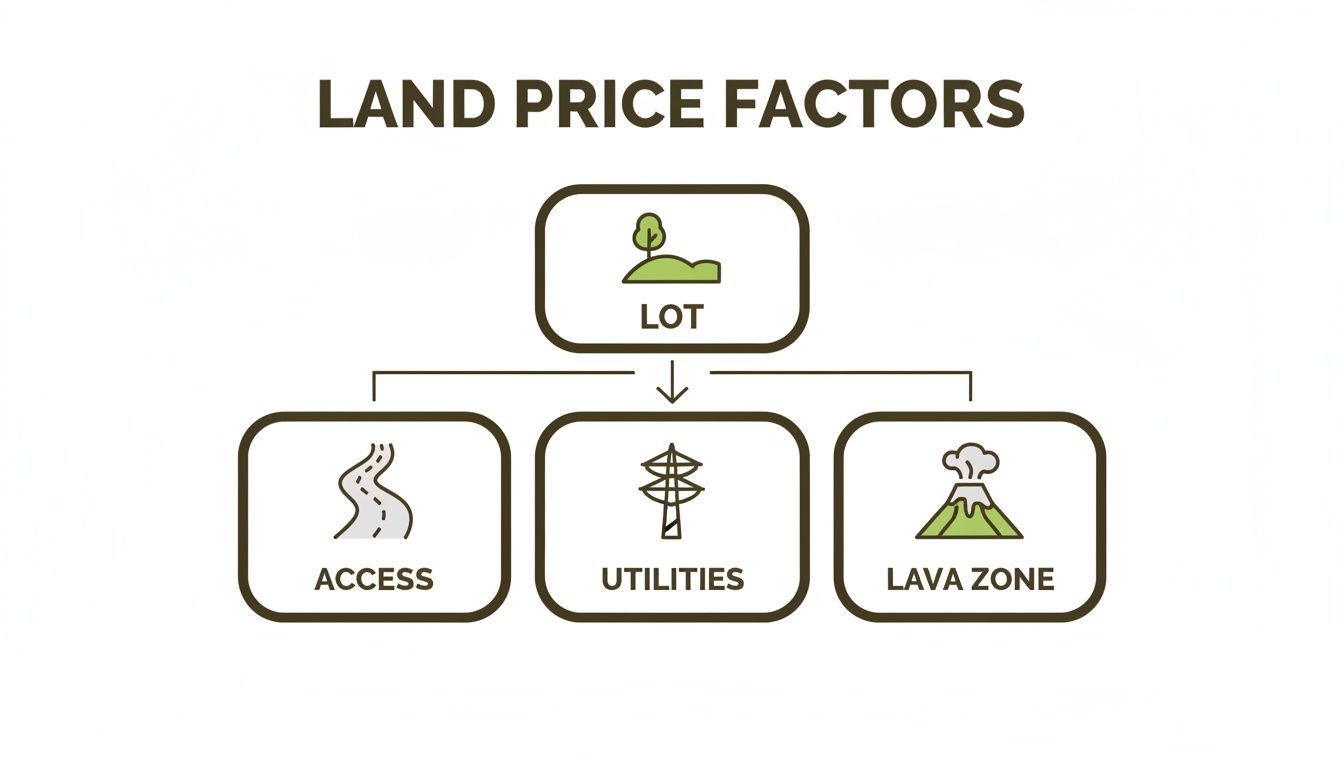
As you can see, the land's inherent features—especially its Lava Zone—are the foundation of its price before you even consider roads or power.
A Simple Breakdown of the Lava Zones
Not all zones are the same. You’ll quickly notice that most affordable land listings are concentrated in just a few of them. Here’s a practical look at the zones that matter most to raw land buyers.
- Lava Zone 1: This zone covers the summits and rift zones of Kīlauea and Mauna Loa, the island's most active volcanoes. Land here has the highest statistical risk of being covered by lava. As a result, it's the most affordable but also the most difficult to insure or finance with a traditional bank.
- Lava Zone 2: This zone is adjacent to Zone 1 and includes large parts of the Puna and Kaʻū districts. A significant portion of the affordable land market is located here. While still considered high-risk, thousands of people live in these areas. Obtaining insurance and financing is more challenging than in lower-risk zones but not impossible.
- Lava Zone 3: This zone covers areas considered safer than Zone 2, such as parts of Hilo and Puna. The risk is lower because the land is flatter or farther from recent volcanic vents. These properties often strike a balance between affordability and lower risk, making them very popular.
- Zones 4 through 9: These zones represent progressively lower risk. Zone 4 includes areas around Hualālai, while Zone 9 covers the Kohala volcano, which hasn't erupted in over 60,000 years. Land here is significantly more expensive and often falls outside the budget of first-time raw land buyers.
Buyer Insight: Many established communities, like Leilani Estates and Hawaiian Ocean View Estates, are located in Lava Zone 2. For decades, residents have balanced affordability against the risk and built vibrant neighborhoods.
Practical Implications of Lava Zones
A property's Lava Zone has real-world consequences beyond its price. When you're researching a property, these are the factors you need to investigate.
- Insurance: Obtaining homeowner's insurance in Zones 1 and 2 can be difficult and expensive. Many standard companies will not write policies here. The common option is the Hawaii Property Insurance Association (HPIA), a state-created provider that typically offers limited coverage for higher premiums.
- Financing: Traditional banks and mortgage lenders are often hesitant to finance properties in Lava Zones 1 and 2. This is a primary reason why seller financing is so common and essential in these areas. It provides buyers a direct path to ownership without conventional lending hurdles.
- Building and Permitting: The county does not prohibit building in any specific lava zone. However, the classification can sometimes influence building codes or other requirements. It's always best to confirm the specifics directly with the Hawaiʻi County Planning Department. Buyers must conduct their own due diligence.
Choosing a lava zone is a personal decision. By understanding the system, you can evaluate properties like a local, balancing affordability with your own comfort level for risk to find the right piece of land for your goals. To help guide your search, check out our article on what to look for when buying land for a broader checklist.
Your Essential Due Diligence Checklist
Falling in love with a photo of a property is easy, but making a smart purchase requires doing your homework. This process, known as due diligence, is the most important step for any first-time land buyer. This is where you verify all the practical details that determine whether a piece of land can be used as you envision.
Before you commit, every buyer should personally verify a few non-negotiable items. This isn't about looking for problems; it's about getting clear answers so you can feel confident in your purchase. By focusing on access, utilities, and county rules, you can avoid common pitfalls and ensure the land you buy is truly the land you want.

Confirming Legal and Physical Access
One of the first questions you must ask is, "How do I get to my property?" It’s more complicated than just looking at a map.
- Physical Access: Is there a physical road leading to the property? You need to know if it's a paved county road, a private gravel road, or an overgrown 4x4 trail that can wash out.
- Legal Access: Just because a road exists doesn't mean you have the legal right to use it. Does the property have a legally recorded easement granting you the right to cross other people’s land to get to yours? Without one, a property could be landlocked. This information is typically found in a property’s title report.
Buyer Insight: Never assume a road on a map means you have guaranteed legal access. Always verify both the physical condition of the road and the legal right-of-way with county records or a title company to avoid future issues.
Researching Utility and Water Options
For most affordable parcels of hawaii big island land for sale, going off-grid is the primary option. Your due diligence here is about confirming what's possible for your specific lot.
- Electricity (HELCO): Contact the Hawaiian Electric Light Company (HELCO) to see if grid power is available in the area. Even if poles are nearby, the cost to extend lines to your property can be substantial—often tens of thousands of dollars.
- Water (Rainwater Catchment): Since most rural land does not have access to county water, rainwater catchment is the standard solution. Research the average rainfall for that specific microclimate and verify that county rules permit catchment as the main water source for a dwelling.
- Solar Power: For electricity, you’ll likely rely on a photovoltaic (solar) system. Begin researching the typical costs for a system that will meet your needs and consider getting quotes from local installers.
While you're at it, it’s always smart to look into any major environmental risks or legal issues that could impact the area, like the lawsuit over Hawaii's largest wildfire.
Verifying Zoning and Permitted Uses
Finally, you must confirm that you can legally use the land for your intended purpose. Your plans—whether camping, farming, or building—must align with county regulations.
The Hawaiʻi County Planning Department is your most important resource. Obtain the property's Tax Map Key (TMK) number and contact them to ask these simple questions:
- Zoning Designation: What is the official zoning? (e.g., Agricultural, Residential)
- Permitted Uses: What can I legally do or build in that zone?
- Setbacks and Restrictions: Are there rules about how close I can build to property lines?
This step is mandatory. An affordable piece of land is of little value if zoning rules prohibit your intended use. For more basics, check out our guide on what to look for when buying raw land for sale. Taking the time to complete this checklist will empower you to make a smart, informed investment.
Financing Your Land Purchase and Closing the Deal
So, you’ve found the perfect piece of the Big Island. Now for the big question: how do you pay for it?
If you approach a traditional bank for a loan on a raw land parcel—especially in certain Lava Zones—you are likely to be told "no." Banks often view undeveloped land as a risky investment. It doesn't generate income, and if a borrower defaults, it can be difficult for the bank to sell.
This is particularly true on the Big Island. Factors like lava risk and off-grid locations don’t fit into a lender’s standard criteria. For many buyers, this can seem like a major obstacle, but it's a common hurdle with a straightforward solution.
Understanding Seller Financing
The most common way to buy affordable land on the Big Island is through seller financing, sometimes called owner financing. The concept is simple: instead of getting a loan from a bank, the seller of the land acts as the lender. You make monthly payments directly to the seller until the property is paid off.
This approach bypasses the strict rules and bureaucracy of traditional banks, opening the door for buyers who might otherwise be excluded from the market.
A few key benefits are common with this method:
- No Credit Checks: Most sellers offering this option are more concerned with your ability to make payments than your credit score.
- Low Down Payments: Seller financing often allows you to get started with a much smaller down payment than the 20-50% banks typically demand for land.
- A Simpler Process: You and the seller agree on the terms directly. It’s faster, less complicated, and leads to ownership without extensive paperwork.
Buyer Insight: Seller financing is a primary mechanism that drives the affordable land market on the Big Island. It keeps land accessible, especially for lots in Lava Zones 1 and 2.
When you use seller financing, you will sign a contract that outlines all the details: purchase price, interest rate, payment amount, and loan term. It is a direct and transparent path to owning your land. For a deeper dive, read our guide on how to finance a land purchase.
The Closing Process in Hawaii
Once financing is arranged, it’s time to complete the transaction. In Hawaii, the final steps are managed by a neutral third party, usually an escrow company or a title company. Their job is to ensure the transaction is handled correctly and fairly for both the buyer and seller.
The escrow officer will:
- Hold all funds in a secure account until every condition of the deal is met.
- Conduct a title search to confirm the seller is the legal owner and that there are no hidden claims or liens on the property.
- Prepare legal documents, including the deed that will transfer ownership to you.
- Record the deed with the State of Hawaii Bureau of Conveyances once all terms are met and funds are paid.
This process is designed to protect both you and the seller. The moment that deed is recorded, you are officially the owner of your new Big Island property.
What This Means for Buyers
Buying land on the Big Island is an excellent opportunity, but it is different from buying a typical suburban lot on the mainland. For first-time buyers, the key is to adjust your mindset. You are not just looking for a perfect, ready-to-build property. You are embracing a trade-off: in exchange for remarkable affordability, you take a more hands-on, self-reliant approach to land ownership.
All the discussions about lava zones, off-grid utilities, and county rules come down to one simple idea: preparedness is everything. Your success hinges on your willingness to do your own research.
Embracing Self-Sufficiency
The most affordable parcels of hawaii big island land for sale will almost certainly require you to provide your own utilities. This might sound intimidating to a first-time buyer, but for thousands of Big Island residents, it’s a normal, practical way of life.
- Water Independence: A rainwater catchment system isn’t just a backup; it’s your primary source of fresh water.
- Power Independence: Solar power is the standard for off-grid living here, providing reliable electricity.
If you can view these systems as opportunities for independence rather than as obstacles, you are already on the right track. They empower you, give you control, and drastically lower the financial barrier to owning land in Hawaii.
The Big Island rewards proactive buyers. The challenges—from understanding lava zones to setting up a solar system—are not roadblocks. They are manageable steps for anyone willing to perform their own due diligence.
The Real-World Implications
The sales trends on the Big Island show a resilient and active market, one well-suited for buyers using alternative financing. In 2025, the island saw 3,249 total sales, and land sales showed remarkable strength. In Puna, there were 272 land deals, which outpaced sales in many home categories. Over in South Hilo, land sales jumped 42% to 61 sales. You can explore these numbers in the full Big Island market report.
This activity confirms that the Big Island offers a rare chance to own property in a world-class destination for a fraction of mainland prices. By understanding the local realities and taking the time to verify the details for yourself, you can turn the unique characteristics of this market into your greatest advantage.
Why Consider Dollar Land Store?
Dollar Land Store specializes in making the purchase of vacant, undeveloped land straightforward and accessible. We focus on affordable, rural hawaii big island land for sale and offer a simple online process designed to remove the complexities that can make buying land difficult.
We provide seller-financing options on our properties, which means you don’t have to secure a loan from a traditional bank—a process that is often challenging for raw land, especially in certain lava zones. As the direct seller, we are not a broker or agent. This means there are no middlemen and no commissions, just a clear path to ownership.
A Clear and Simple Process
Our goal is to make buying land easy and transparent.
- Transparent Terms: All our listings show the full price and financing terms upfront. You will know all costs before making a commitment.
- Simple Contracts: We use easy-to-understand agreements that clearly state the purchase price, your monthly payment, and the loan term. There are no hidden clauses or confusing legal language.
- Fast Setup: Because we own the properties we sell, we can prepare your paperwork quickly, allowing you to secure your land without long delays.
This approach is designed to help you acquire land for recreational use or long-term investment without the usual hassles. To see how it works in a popular area, you can explore properties available in communities like Nanawale Estates.
By focusing on making land ownership accessible and transparent, we help turn the dream of owning a piece of the Big Island into an achievable goal.
Buyer Guidance / Next Steps
Jumping into the Big Island land market for the first time is an exciting step. Here are some answers to common questions from beginner buyers.
Can I build a house on any lot I buy?
No, buildability is never guaranteed with raw land. Your ability to build a home depends on Hawaii County zoning regulations, obtaining the correct permits, and practical site conditions like the slope of the land and legal access.
Before making an offer, your first step should be to contact the Hawaii County Planning Department. Provide them with the property’s Tax Map Key (TMK) number, and they can tell you what the zoning allows. This is a critical part of your due diligence.
What does an off-grid setup cost?
When you buy a remote parcel, you will likely need to budget for two main systems to make it livable: one for water and one for power.
- Rainwater Catchment: A basic, professionally installed system with a 10,000-gallon tank, pump, and filters typically costs between $10,000 and $15,000.
- Solar Power: A modest solar power system sufficient for a small cabin or home generally costs from $15,000 to $30,000, depending on your power needs.
These are foundational costs for most affordable hawaii big island land for sale, so it's wise to factor them into your budget from the start.
Do I have to fly to Hawaii to buy property?
While it is highly recommended, it is not strictly required. You can purchase land from the mainland if you conduct thorough online research.
You can use tools like Google Earth to check the terrain, review county websites for zoning maps and tax information, and even hire a local inspector. However, nothing replaces visiting the property to see it and the access roads for yourself.
How much are property taxes on raw land?
This is a pleasant surprise for many buyers. Property taxes on undeveloped land on the Big Island are often very low. For a typical one-acre vacant lot, it is not uncommon for the annual tax bill to be just a few hundred dollars.
You should always confirm the exact amount yourself by looking up the property's tax records on the Hawaii County website as part of your research.
Conclusion
Owning land on Hawaii's Big Island is a unique and achievable goal, especially for buyers who are well-prepared. The market's affordability is directly linked to its distinct characteristics, including vast land availability, the prevalence of off-grid living, and the Lava Zone classification system.
By embracing a self-sufficient mindset and committing to thorough due diligence—verifying access, utilities, and zoning—first-time buyers can confidently navigate this market. Seller financing further opens the door, making ownership possible without the hurdles of traditional bank loans. With careful research and a practical approach, your dream of owning a piece of paradise is within reach.
Ready to find your own affordable piece of paradise? Dollar Land Store makes the process simple and transparent.