


How Much Does an Acre of Land Cost? A Complete Buyer's Guide
Ross AmatoHow much does an acre of land cost? In practical terms, buyers in the U.S. can see prices anywhere from about $1,500 per acre for very remote raw land to $1 million or more per acre near major metro growth corridors. Most of that spread comes down to three things: where the land sits, what you can legally do with it, and how much work is already done to make it usable.
For a grounded benchmark, agricultural values are useful because they strip away some of the premium attached to subdivision-ready lots. Recent farmland data puts average U.S. farmland around $4,350 per acre in 2025, with cropland typically higher and pasture lower, according to AcreTrader's farmland price summary. That does not mean every one-acre parcel should cost $4,350. A buildable acre outside a fast-growing city can be many times that; a rough recreational acre with dirt-road access can be much less.
Understanding the difference between raw, undeveloped land and a fully prepped, utility-ready lot is the first step. By focusing on raw land—the kind we specialize in at Dollar Land Store—you can tap into the most affordable end of the market. Understand what drives land prices, what to budget for, and how to judge whether a cheap acre is a good buy.
See What Your Budget Gets You →
How We Estimated Acre Costs
The ranges in this guide combine national agricultural benchmarks, broad land-market context, and what we repeatedly see in real rural listings. We use farmland values as a baseline because they offer one of the few consistent nationwide per-acre data points; the USDA Land Values summary is especially useful for comparing farm real estate, cropland, and pastureland. For trend context, we also looked at AcreTrader's 2025 farmland price overview, which tracks recent appreciation and reinforces that usable agricultural land now sits in the low-thousands per acre nationally.
We do not treat raw land, improved home lots, and infill development parcels as interchangeable. In our experience, that is where buyers get misled by averages. A one-acre tract with paved frontage, water, sewer, and easy financing is competing in a completely different market from an off-grid parcel an hour from the nearest full-service town.
We also exclude house value, barns, mobile homes, and major site improvements when talking about broad acre costs unless the context specifically requires them. If a local listing includes a well, septic, driveway, clearing, and legal survey, the sticker price is no longer a clean per-acre comparison with untouched land.
Finally, local estimates become incomparable when zoning, floodplain status, road frontage, or utility availability differ. That is why two parcels in the same county can have radically different prices. When we evaluate raw land pricing, we look less at the headline acre count and more at whether the parcel is usable for the buyer's intended purpose.
The True Cost of an Acre of Land
To get a real sense of what you might pay, it helps to have a baseline. The best place to start is with agricultural land, which gives us a solid benchmark for the value of open, usable ground.
According to the latest USDA data, the average value for U.S. farm real estate hit $4,350 per acre. But that number doesn't tell the whole story. Dig a little deeper, and you'll find that land already prepared for farming (cropland) averaged $5,830 per acre, while undeveloped pastureland was a whole lot cheaper at just $1,920 per acre. You can check out more farmland value trends in the full USDA report to see the data for yourself.
The lesson here is simple: the "raw" in raw land means real savings. The less that's been done to a property, the lower its price tag will be.
This is exactly why undeveloped parcels are such a fantastic starting point for first-time investors, future homesteaders, or anyone who just wants a private spot to get away from it all. Your budget stretches so much further when you aren't paying a premium for infrastructure and utilities you might not even need.
Seven Key Factors That Determine Land Prices
So, you've seen that an acre can cost a few thousand dollars or a few million. The big question is why. Think of it like buying a car—a basic sedan and a luxury SUV are both cars, but their features and capabilities create a huge price difference. The same is true for land.
Once you get a handle on these seven key factors, you'll be able to look at any listing and have a much clearer picture of what you're really paying for.
1. Location: How Close Is It to Everything Else?
You've heard it a million times: location, location, location. It's the number one driver of land cost, without a doubt. An acre just 20 minutes from a growing city with jobs, shops, and schools is always going to command a higher price than a similar piece of land three hours out in the middle of nowhere.
Proximity is valuable because it means convenience. It also signals potential. Land closer to urban areas is seen as prime for future development, which naturally attracts more buyers and drives up the price.
2. Access: Can You Actually Get to It?
How you physically reach your property has a massive impact on its value. Land with direct frontage on a paved, county-maintained road is the gold standard. It's easy to get to, you don't need a special vehicle, and it makes any future building plans much simpler.
On the other hand, a parcel you can only get to via a rough dirt road or a legal easement cutting through a neighbor's property will be much more affordable. This kind of rugged access might be perfect for a weekend hunting camp, but it creates headaches for building a full-time home, and the price reflects that.
3. Utilities: Is It On-Grid or Off-Grid?
The availability of utilities creates a sharp dividing line in land prices. A property that can easily hook up to the electrical grid, city water, and a municipal sewer system is considered "improved," and you'll pay a premium for that convenience.
Raw, undeveloped land often has no utilities in place, which is a huge reason it's so affordable. This gives you the freedom to go completely off-grid with solar panels, a well, and a septic system. The land itself costs far less upfront, making it a fantastic choice for buyers who are after self-sufficiency and a lower entry price.
This chart shows the average value for different types of agricultural land, which often sets the baseline for raw land prices.
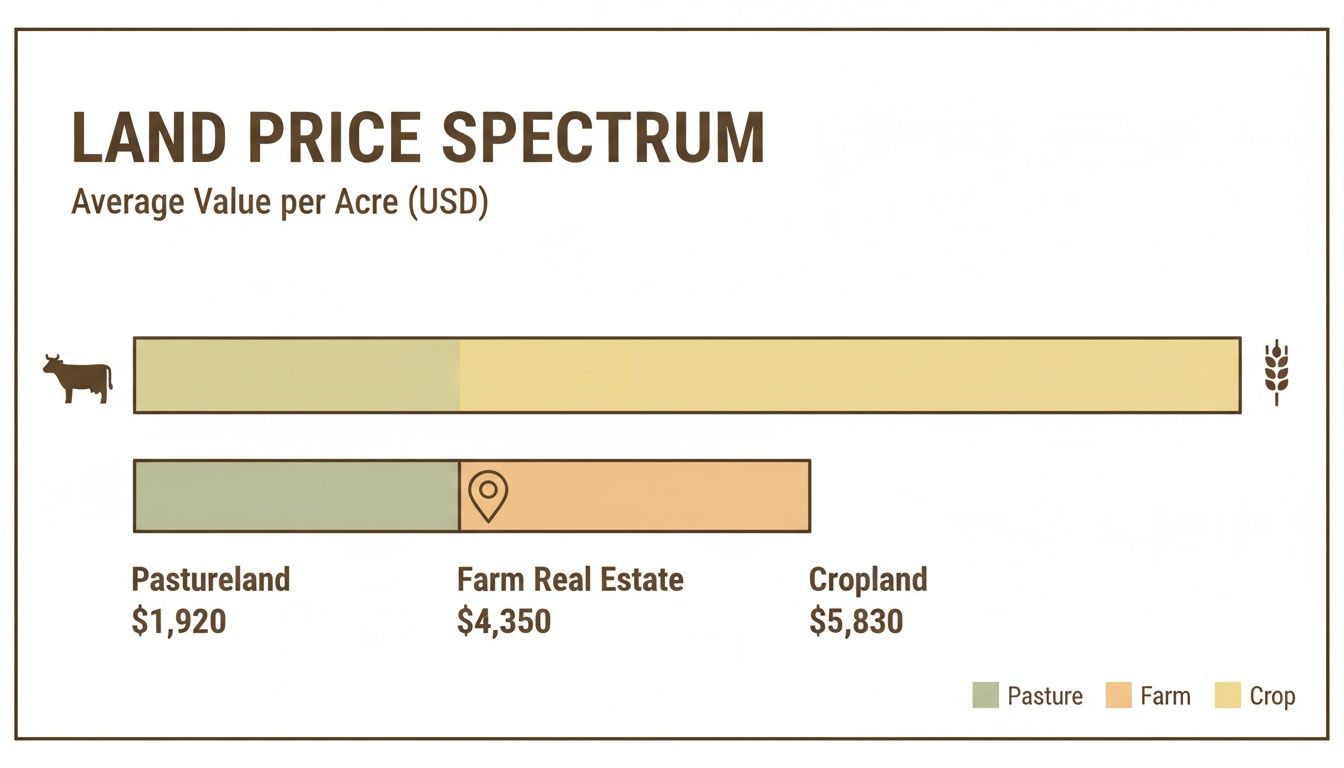
As you can see, less developed land like pastureland is way more affordable than cropland that's ready for immediate use.
4. Zoning: What Are the Rules?
Zoning regulations are the official county rules that say what you can and can't do with your land. These rules directly influence its value.
- Residential Zoning: Land designated for single-family homes is usually more expensive because its purpose is clearly defined for building.
- Agricultural Zoning: This is often less restrictive and more affordable. It's great for farming, ranching, or just holding as a recreational spot.
- Commercial Zoning: Land zoned for business is typically the most expensive because of its potential to generate income.
Don't just take the seller's word for it—always call the county planning and zoning department to confirm the rules yourself. Knowing what to look for when buying land, especially zoning, is one of the most important parts of your research.
5. Topography: What's the Lay of the Land?
The physical shape of the land itself plays a huge role. A flat, clear, and easily buildable parcel is more valuable because it will cost you less in site preparation when you're ready to build.
Land with tricky topography, like steep ravines, rocky ledges, or areas inside a floodplain, will be priced much lower. A steep hillside that makes building a traditional house a nightmare could be the perfect spot for a hunting blind or a private campsite. You can find incredible deals if the land's quirks match your goals.
How Different Factors Impact Your Per-Acre Cost
It helps to see these factors side-by-side to understand how a single attribute can swing the price from affordable to astronomical.
| Cost Factor | High-Cost Example | Low-Cost Example | Impact on Price |
|---|---|---|---|
| Location | 1 acre, 15 miles from a major city | 1 acre, 100 miles from the nearest town | Major |
| Access | Paved road frontage | Dirt road access via easement | Significant |
| Utilities | City water, power, sewer at the lot line | None (requires well, septic, solar) | Significant |
| Topography | Flat, cleared, ready to build | Steeply sloped, rocky, in a floodplain | Moderate |
As you can see, a property with "low-cost" features across the board offers a much more accessible entry point for land ownership.
6. Market Conditions: What's Happening Locally?
Just like anything else, land prices follow the simple laws of supply and demand. In a county that's growing fast with not much land available, prices will be high. In a quiet, rural area with plenty of open space, prices will be much lower.
Broader economic trends also play a part. For instance, recent reports showed the national average for some types of farmland hit $8,164 per acre in early 2025, a small dip from the year before. This shows how market forces can shift, so it's important to look at what properties have sold for recently in the specific area you're targeting.
Some of the most affordable per-acre pricing we carry is in the desert Southwest. Browse our Desert Land for Sale, Cheap Land in Nevada, and Land for Sale in New Mexico collections for current listings—including parcels like this 10 acres in Luna County, NM at $111/month.
7. Improvements: What's Already on It?
Finally, anything that's already been built on the property adds to its cost. This can be something as simple as a gravel driveway or a small shed, or more significant structures like a barn, a well, or perimeter fencing.
Raw, vacant land has zero improvements. That's exactly why it represents the lowest-cost way to get into the property market. At Dollar Land Store, we specialize in this kind of blank-canvas land. It gives our buyers the freedom to create their own vision without having to pay a premium for someone else's old barn or busted fence.
Budgeting Beyond the Land Purchase Price
Knowing how much an acre of land costs is the perfect starting point, but the listed price is really just one piece of the puzzle. It's easy for first-time buyers to get caught off guard by the other expenses needed to buy and prepare a new property.
To avoid any surprises, you need a budget that looks past the sticker price and accounts for both one-time fees and future holding costs. Getting this right from the beginning makes the whole journey of land ownership smooth and stress-free.
Common One-Time Purchase and Development Costs
Before you can even think about breaking ground, there are a few upfront expenses you might run into. Think of these as smart investments that verify what you're buying and get it ready for whatever you have planned.
- Property Survey: While not always mandatory, getting a survey is almost always a good idea. It officially marks your property lines so there are no disputes later. Depending on the size and terrain of your parcel, this can cost anywhere from $500 to over $2,000.
- Title Search & Insurance: This step confirms the seller legally has the right to sell the property and that there are no old claims or liens attached to it. Costs typically range from a few hundred to a thousand dollars.
- Percolation (Perk) Test: If your plans include a septic system, you'll need a perk test. This county-required test ensures the soil can properly absorb wastewater and usually costs between $750 and $1,500.
- Initial Clearing & Access: Raw land often needs a little work to become usable. You might need to budget for clearing trees, removing brush, or grading a simple driveway, which can cost several thousand dollars depending on how much work is needed.
Buyer Tip: When you buy directly from a seller like Dollar Land Store, we simplify some of these steps. For instance, we handle the title work and deed recording for you, cutting down on the number of third parties you have to manage and making the process much smoother.
Factoring in Ongoing Holding Costs
Once the land is officially yours, you'll have some annual expenses just for owning it. These "holding costs" are a critical part of your long-term budget.
- Annual Property Taxes: Here's the good news: property taxes on raw, undeveloped land are usually very low. Still, they are a recurring expense you'll need to pay to the county every single year.
- POA/HOA Dues: Some rural properties are part of a Property Owners Association (POA) that handles things like road maintenance or other shared amenities. These yearly dues can be under $100 or up to several hundred dollars, so always check if a POA exists before you buy.
- Utilities & Maintenance: If you're dreaming of off-grid living or just want a spot to park your RV, you'll need to think about utilities. This might include costs for things like installing solar panels for off-grid power or other essential equipment.
Budgeting for these items is every bit as important as planning for the initial purchase. For more tips on the financial side of things, check out our guide on how much down payment for land is usually required.
What This Means for Buyers
A broad national average is useful, but it does not answer the question most first-time buyers are really asking: what should I expect to pay for the kind of land I want? In practice, the market breaks into a few very different categories, and each one attracts a different buyer.
Residential or recreational lots near towns usually sit at the expensive end because they compete with homebuilders, future homeowners, and buyers who want easy weekend access. One acre with paved frontage and nearby power can cost dramatically more than a larger raw tract farther out because convenience is what buyers are paying for. For a first-time buyer, this category makes sense if quick usability matters more than getting the lowest price per acre.
Rural raw land is where entry-level pricing usually shows up. These are the parcels that may be outside town, off a dirt road, without utilities or major improvements. We see many low-cost listings in this category because the buyer pool is smaller and the to-do list is longer. The hidden costs that can erase a bargain are usually access work, clearing, survey issues, and the expense of bringing in power or drilling a well. Browse our Value Properties collection for below-market deals, or our Recently Added listings for fresh inventory.
Agricultural cropland tends to price above rough raw acreage because the land is already productive. It can support row crops, has clearer economic value, and often attracts both working farmers and investors. As a benchmark, U.S. farmland averaged about $4,350 per acre in 2025, with cropland typically above that level, according to AcreTrader's farmland values data. That makes cropland a poor reference point for a remote off-grid homesite, but a useful one for understanding what usable income-producing ground costs.
Pasture and rangeland are often cheaper than cropland because they generate less income per acre and may require fewer improvements. That lower price can make them attractive to buyers who want open space, grazing potential, recreation, or long-term land banking. In our experience, this is often where buyers find a workable middle ground: less expensive than build-ready land, but not always as limited as very rough recreational tracts. Our Homestead Land for Sale collection is a good place to start for this type of parcel.
The practical takeaway is simple: first-time buyers should not expect one universal number. If you want a remote acre for camping or long-term holding, the lower end of the national range is realistic. If you want an acre that is close to jobs, ready to build on, and easy to finance, expect a much higher number even in otherwise affordable states. The cheapest listing is only a win if the land still fits your use after you add setup costs.
For anyone new to real estate, checking out a good first-time home buyer closing costs guide can give you a solid idea of what to expect in any property transaction. Having that knowledge helps you budget properly and move forward without any last-minute financial surprises standing between you and your new piece of land.
Why Consider Dollar Land Store?
Low-priced rural land is cheaper for a reason, and understanding that reason makes you a better buyer. Owner-financed raw land listings usually sit on the lower end of the national price range because they are often remote, unimproved, and lightly competed for. They may have no utilities, no driveway, limited nearby services, or terrain that makes immediate building harder. Those tradeoffs push away buyers who want suburban convenience, which is exactly why the price can stay accessible.
That pricing model fits a specific kind of buyer well: someone who values privacy, flexibility, recreation, or a gradual long-term plan more than instant build-readiness. In our experience, the most successful raw-land buyers are the ones who go in with clear expectations. They know a cheap acre may also mean hauling water for a while, using solar before grid power, or budgeting for legal access confirmation before doing anything else.
Owner financing can also matter because many banks are reluctant to lend on inexpensive vacant land, especially in rural counties. That does not make the parcel better or worse on its own; it just changes who can realistically buy it. If you want to understand that route better, our guide on how seller financing paves the road to land ownership explains how it works.
Where Dollar Land Store fits is straightforward: we focus on the lower-cost side of the market, where buyers are looking for raw rural parcels rather than turnkey home sites. That means our inventory is often relevant to people comparing the bottom end of the broad U.S. acre-price range—not because every parcel is identical, but because the same pricing drivers keep showing up: distance from town, lack of improvements, and simpler land use.
Your Next Steps to Owning Affordable Land
Buying inexpensive land goes better when you treat it like a cost-check exercise, not just a listing hunt. The goal is to compare the advertised price with the actual first-year cost of owning and using the parcel.
Step 1: Compare Sold Comps, Not Just Asking Prices
Start by checking what similar parcels sold for in the same county or nearby zip code. A listing can be optimistic; a closed sale is a better pricing signal. We usually compare acreage size, road access, terrain, zoning, and whether utilities were nearby before deciding a price is competitive.
Step 2: Browse Real-World Listings
With a baseline in mind, look at active listings to see what your money buys at different price points. A great way to start is to explore our current inventory. You'll see real-world examples of just how much an acre of land costs when you focus on affordable, rural properties like ours.
- Cheap Land in Colorado
- Cheap Land in Nevada
- Land for Sale in New Mexico
- Land for Sale in Arizona
- Land for Sale in Oregon
Step 3: Confirm Zoning and Intended Use
Before making an offer, call the county planning or zoning office and verify what the parcel can be used for right now. Ask whether you can camp, park an RV, build a cabin, install a manufactured home, keep animals, or subdivide later. This is also the point to revisit what to look for when buying land so your research stays focused on use, not just price.
Step 4: Price Out Access and Utility Setup
A cheap acre can stop being cheap once you add the missing basics. Get rough estimates for driveway work, clearing, power connection or solar, well drilling if needed, septic or perk testing, and any floodplain or grading issues. In our experience, this is the step buyers skip most often, and it is usually where the surprise costs live.
Step 5: Estimate Annual Taxes, Dues, and Financing Costs
Check the county assessor for annual property taxes and ask whether there is a POA or HOA with recurring dues. If you are financing the purchase, calculate the total cost over the term rather than only looking at the monthly number. That is also a smart time to review how much down payment for land so you know what up-front cash you may need.
Step 6: Build a First-Year Cost Snapshot
Before you commit, total the listing price and the immediate setup items you are likely to pay within the first 12 months. A hypothetical low-cost rural acre might look like this:
- Listing price: $3,900
- Survey: $900
- Title/recording-related costs: $600
- Perk test: $1,000
- Basic access clearing or driveway work: $1,500
- Light site clearing: $800
That turns a seemingly cheap acre into a first-year outlay of about $8,700 before any well, septic installation, or power setup. That does not make it a bad deal; it just provides an accurate number to use when comparing properties.
Frequently Asked Questions
What size is an acre of land?
An acre is 43,560 square feet. A common visual is a parcel about 208.7 feet by 208.7 feet if it were a perfect square, though real parcels can be long, narrow, irregular, or shaped by road frontage and survey lines.
Is 200 ft by 200 ft considered an acre?
No. A 200-foot by 200-foot parcel is 40,000 square feet, which is a little smaller than a full acre. To convert it, divide 40,000 by 43,560, which comes out to about 0.92 acres.
How many acres is a football field?
A standard American football field including the end zones is about 57,600 square feet, or roughly 1.32 acres. Without the end zones, the playing field itself is smaller, so people using the comparison should make sure they know which version they mean.
How much is 1 acre in Georgia?
Georgia acre prices vary widely depending on whether you mean metro-adjacent residential land, rural recreational property, timberland, or productive farmland. A remote raw acre in a rural county can be dramatically cheaper than an acre near Atlanta's growth path or in a build-ready lake community. The best approach is to compare recent sold comps in the exact county and then adjust for access, utilities, and zoning rather than relying on a single statewide average.
Why can one acre cost $2,000 in one place and $200,000 in another?
Because acreage alone does not determine value. The biggest pricing differences usually come from location, legal use, and improvements already in place. A rough off-grid acre with no utilities is competing in a completely different market from a one-acre lot near jobs, schools, sewer hookups, and paved roads.
Are old land prices useful for understanding today's market?
Only as historical perspective. By the mid-1800s, some U.S. land traded at what would now look astonishingly low prices; one widely shared historical example notes a 40-acre parcel in 1865 at about $400 total, or roughly $10 per acre. That contrast shows how dramatically land values have appreciated, but it does not help price a modern parcel without current local comparables.
Conclusion
So, how much does an acre of land cost? A practical national answer is roughly $1,500 per acre on the low end for remote raw land to $1 million or more per acre for build-ready land near major cities, with useful agricultural benchmarks generally landing in the low-thousands per acre. The three biggest variables are location, permitted use, and how much infrastructure is already in place. For buyers, the smartest move is to judge total cost, not just acreage, by adding access, utilities, taxes, and setup work before deciding whether a parcel is affordable.
Contact Dollar Land Store with questions about buying raw land.