


What Can You Do With 5 Acres of Land? A Buyer's Guide
Ross AmatoOwning 5 acres of land is a popular goal for good reason. It represents a practical balance—large enough for a home, a garden, and significant privacy, but not so large that it becomes unmanageable, especially for a first-time buyer.
Visually, five acres is roughly the size of four American football fields placed side-by-side. That is more than enough space to build a home, create a weekend retreat, or simply hold a tangible asset for the future. For many people, it is an ideal entry point into land ownership.
This guide provides the practical, straightforward information you need to understand what is possible with five acres and how to approach the buying process with confidence.
What Can You Really Do With 5 Acres?
The idea of buying land can seem complex, but 5 acres makes it a realistic objective. It is a versatile canvas that opens up numerous possibilities, whether you are planning a self-sufficient homestead or a private spot to camp under the stars.
The key is to align your vision with the practical realities of a specific property before you buy. This guide will help you understand the essential steps and considerations.
What You'll Learn in This Guide
We will break down the key topics you need to know so you can move forward with a clear understanding of the process. Here’s what we’ll cover:
- Getting a Feel for the Size: We'll go beyond the numbers and use real-world comparisons to help you visualize what 5 acres looks and feels like.
- Ideas and Common Uses: We’ll explore what people are actually doing with their land, from small-scale homesteading and off-grid living to creating a private recreational retreat for family and friends.
- The Must-Do Homework: You'll learn the essential due diligence every buyer must complete, like understanding zoning rules, verifying legal access, and evaluating utility options. You can also dig deeper with our guide on how to determine land value.
- How to Afford It: We'll explain how options like seller financing—a common offering at Dollar Land Store—can make owning 5 acres possible without requiring a large bank loan or a perfect credit score.
By the end of this guide, you won’t just understand the size of the land; you'll have a clear roadmap for turning an empty lot into your personal project. Our goal is to provide the knowledge you need to take that next step.
Visualizing The True Scale Of 5 Acres
It’s one thing to see a number on a land listing, but it’s another to actually picture what 5 acres looks like on the ground. Let's break it down.
An acre is a unit of area equal to 43,560 square feet. Therefore, a 5-acre property provides a total of 217,800 square feet to work with.
But what does that feel like? If your 5-acre parcel were a perfect square, it would measure approximately 466 feet on each side. That’s slightly longer than one and a half football fields. A casual walk around the perimeter would take about 10 minutes. It’s a substantial amount of space.
This overview gives you a good sense of how the size of a 5-acre lot opens up a world of possibilities while still being a manageable piece of land for a new owner.
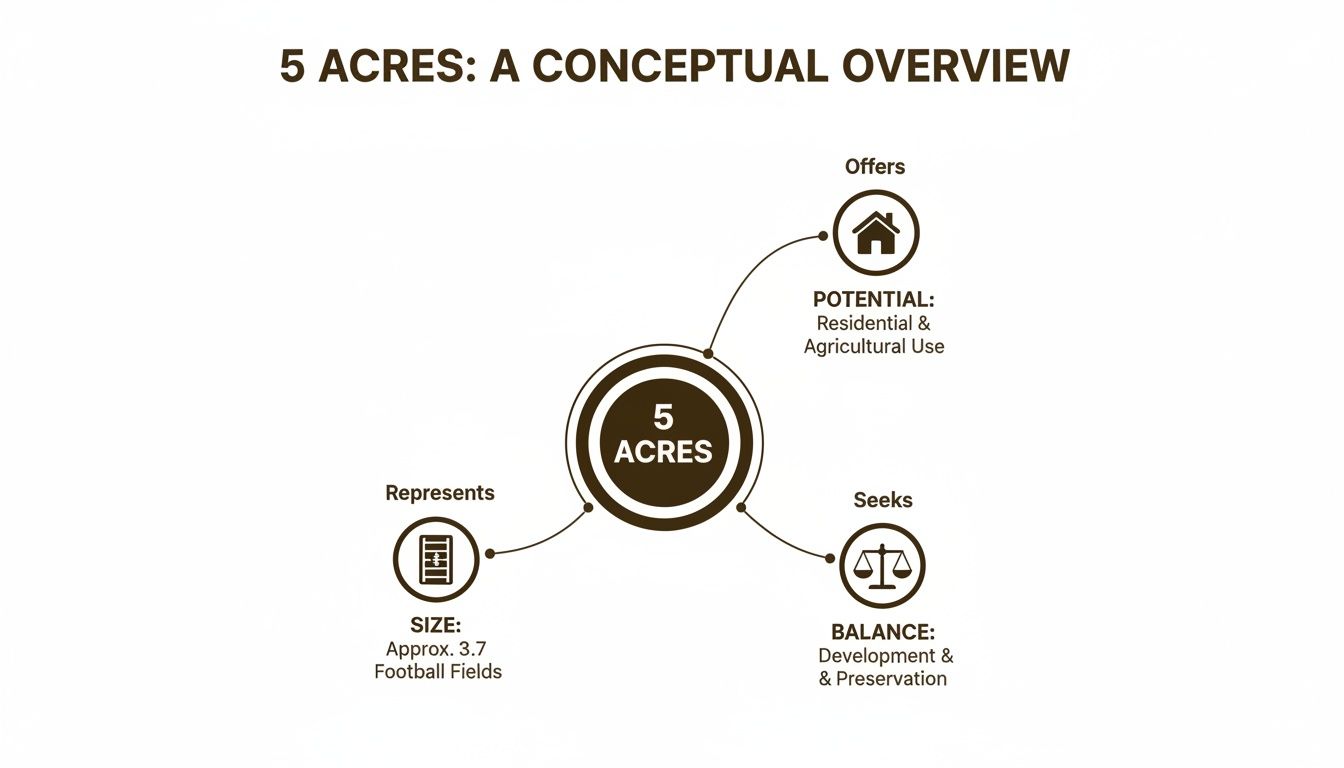
As you can see, 5 acres provides a useful balance. It is large enough for privacy and various projects but not so large that it becomes overwhelming for a first-time owner.
From Acres To Everyday Comparisons
To put it in more familiar terms, the entire area of a large home improvement store, including its parking lot and garden center, is roughly 5 acres. It is also nearly four times larger than a typical city block.
A 5-acre parcel provides enough room for a spacious home, a detached garage or workshop, a large garden, and still leaves several acres untouched for a wooded buffer, recreational trails, or simply open space.
This amount of acreage allows for true privacy. Your nearest neighbor could be hundreds of feet away, creating a sense of seclusion that smaller suburban lots cannot offer. That separation is one of the primary reasons people seek land of this size.
How 5 Acres Stacks Up To Other Parcel Sizes
Comparing 5 acres to other common lot sizes helps put its scale into perspective. Each size is suited for different goals, and this chart can help you determine what might work best for you.
Land Size Comparison Chart
Here's a quick look at how different acreages compare, from a large residential lot to a small farm.
| Acreage | Square Feet | Approx. Square Dimensions | Common Use Case Example |
|---|---|---|---|
| 1 Acre | 43,560 | 209 ft x 209 ft | A large single-family home with a spacious yard. |
| 5 Acres | 217,800 | 466 ft x 466 ft | A small homestead with a house, garden, and outbuildings. |
| 10 Acres | 435,600 | 660 ft x 660 ft | A recreational property with private trails or a hunting area. |
| 40 Acres | 1,742,400 | 1,320 ft x 1,320 ft | A larger-scale homestead or a significant long-term investment. |
As the chart illustrates, the jump from one acre to five completely changes the potential uses. It opens the door for privacy, small-scale farming, and recreation, and is often seen as the ideal starting point for someone who wants more than just a backyard.
For a real-world example of what this size offers, consider a property like this 5-acre lot in Costilla County, Colorado. A parcel like this is a blank canvas, providing enough room for various projects without being too much to handle.
Popular Uses For a 5-Acre Property
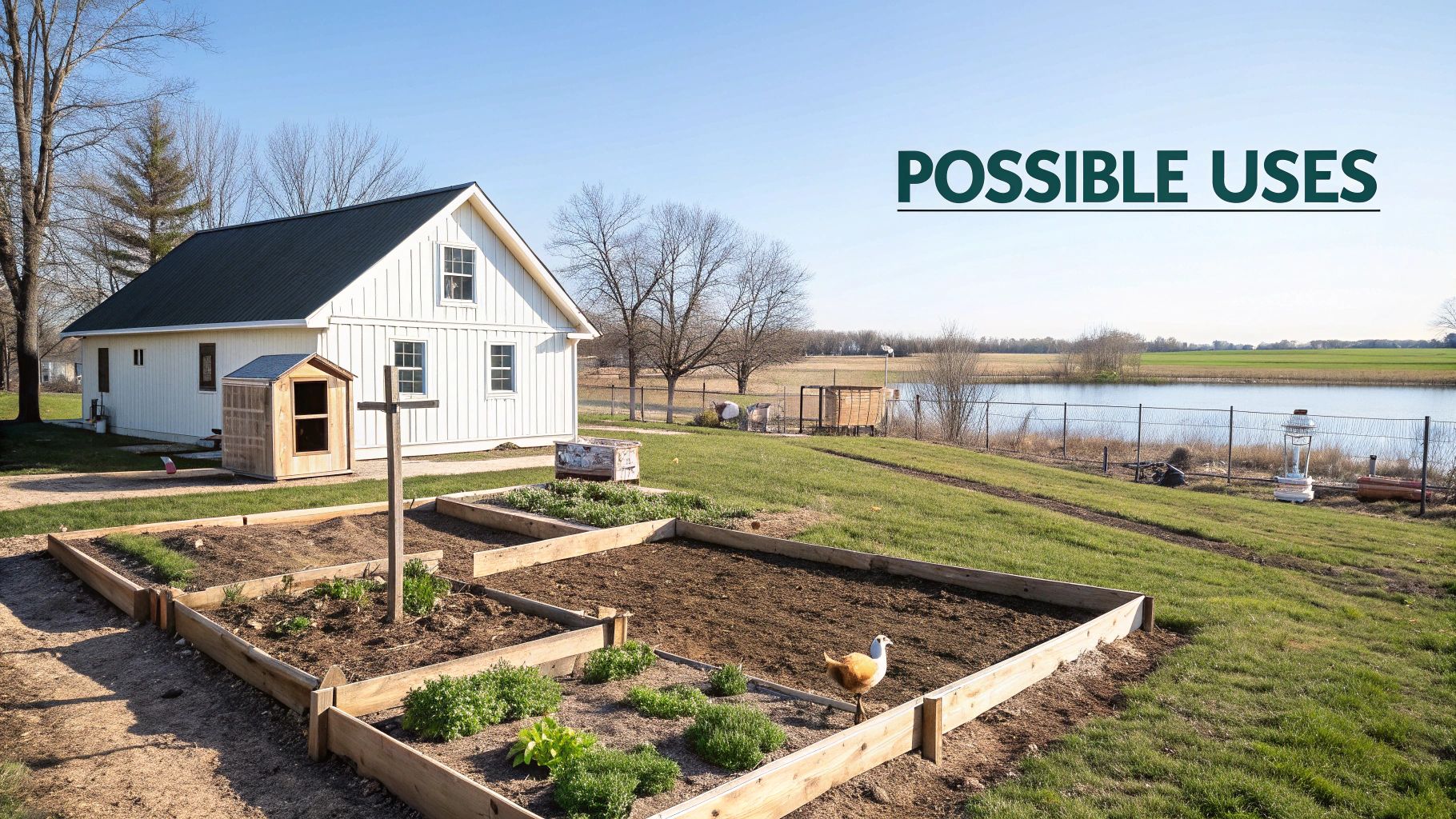
A 5-acre property is an excellent choice for first-time land buyers. It’s a versatile blank canvas—large enough for ambitious projects but not so big that it feels overwhelming to manage. Let's look at some of the most popular ways people use five acres of raw land.
The Small-Scale Homestead
Building a small, self-sufficient homestead is a primary motivation for people seeking a 5-acre lot. It is an ideal size for a family home with ample room left for everything needed to live more closely connected to the land.
You can easily accommodate a large vegetable garden, a small orchard of fruit trees, and still have space for a chicken coop, a workshop, or a barn. Many find it is the right amount of land for a few smaller animals like goats or sheep without concerns of overgrazing.
This is a common and practical use for land. According to the USDA's 2022 Census of Agriculture, 42% of all farms in the United States operate on less than 50 acres. This indicates that a smaller parcel is a realistic way to grow your own food and connect with the land.
The Recreational Retreat
For those who want a place to get away, five acres can become a private recreational paradise. It is more than enough space to create a personal basecamp for family and friends, far from crowded public campgrounds.
A 5-acre parcel can support a permanent campsite with a fire pit, a small hunting cabin, or a dedicated spot for an RV. You could also create your own private trails for hiking, riding ATVs, or taking quiet walks. In the right location, it can serve as a launchpad for hunting, fishing, or stargazing away from city lights.
With 5 acres, you can design your own outdoor experience. You control access, what you build, and the rules. It is your personal getaway.
There is significant peace of mind in having a secure and familiar place to unwind and make memories, without the logistics of booking sites or dealing with noisy neighbors.
The Off-Grid Sanctuary
Five acres provides the necessary space to build an independent and sustainable lifestyle. Going off-grid is not just about being remote; it requires space for the right infrastructure, and this is a suitable parcel size for it.
Here’s what a 5-acre lot can easily accommodate for an off-grid setup:
- Solar Power: You will have plenty of open, sunny space to install a solar array large enough to power a home, without worrying about shadows from trees or buildings on a neighbor's property.
- Water Systems: There is enough ground to drill a well for fresh water and install a septic system for waste, keeping them safely distanced from each other and your home.
- Rainwater Collection: A house and a few outbuildings provide significant roof surface area to feed into cisterns, giving you a backup water source for your garden and other non-potable needs.
This amount of acreage allows you to place these systems where they will work most effectively while maintaining a functional and beautiful property.
The Long-Term Investment
You do not have to develop your land to realize its value. For many, simply buying and holding five acres of raw land in a developing rural area is a straightforward investment strategy.
Land is a tangible asset. As more people seek rural and recreational properties, a well-located parcel has a solid chance of appreciating over time. It is a stable part of a portfolio that you can physically visit and see for yourself.
Once you own the land, you can always decide later to delve into homesteading or build a small cabin. That flexibility makes land a powerful investment, both for your finances and for your future.
Your Due Diligence Checklist Before Buying
It’s easy to become attached to a listing for a 5-acre property online. But the critical work—the steps that protect your investment and your plans—happens before you sign any documents.
This is where due diligence comes in. It is the process of verifying facts and ensuring the land you think you’re buying is the land you’re actually getting. The goal is to identify any potential issues before they become your problem. This checklist will walk you through the essential questions you need to ask to ensure your 5 acres of land can truly become what you envision.
Understanding Zoning and Land Use
What you can legally do with your land is determined by its zoning designation. Every county has a planning and zoning department that establishes the regulations for land use. You must verify these rules directly with them.
Never rely solely on a seller's description. Here are a few common rural zoning codes you might encounter:
- AR (Agricultural Residential): This often allows for a single-family home and small-scale farming or keeping a few animals.
- RU (Rural): This designation usually has fewer restrictions, making it a good fit for homesteading, recreation, or sometimes even small home-based businesses.
- REC (Recreational): This zoning might limit use to a cabin or RV camping and could restrict building a permanent home.
The only way to be certain is to call the county’s planning department. Provide them with the property’s Assessor’s Parcel Number (APN) and ask directly: "What is this land zoned for, and what uses are permitted?"
Verifying Legal and Physical Access
Just because you can see a dirt road leading to a property does not mean you have the legal right to use it. You need to confirm two types of access.
Legal access is a documented right, usually specified in the property deed, that guarantees you can get to your land. Physical access means a road or trail actually exists on the ground. You need both. It's also wise to ask the county if the roads are publicly maintained year-round. The cost of repairing a private road can be significant.
A property without clear, deeded legal access can be nearly impossible to use, finance, or sell later on. This is a non-negotiable detail to confirm.
Planning for Utilities
Raw, undeveloped land is a blank canvas, which also means it rarely comes with utilities ready to connect. It is your responsibility to investigate the cost and logistics of bringing them to the property.
- Water: For most rural properties, this means drilling a well. Contact local well drillers for a cost estimate, as the price can vary significantly based on the required depth.
- Sewer: You will almost certainly need to install a septic system. The county health department can tell you if the soil is suitable based on a percolation ("perc") test.
- Electricity: Check with the local power company to find the location of the nearest power lines. The cost to extend poles and lines to your property can be high.
These three items can represent a major expense, so getting rough cost estimates early is critical for your budget.
Assessing Topography and Usability
The physical characteristics of the land will have a huge impact on your plans. A satellite map is a good place to start, but nothing replaces walking the property yourself.
Look for steep slopes, rocky areas, or low-lying wetlands that could make building difficult. The soil type also matters, affecting everything from gardening to pouring a foundation. You can often find soil and topography maps on the county’s website. Understanding the terrain ensures you're buying usable land, not just 5 acres of an impractical hillside.
For a more hands-on approach, you can even learn how to survey your own property to get a preliminary layout.
This entire due diligence process is a fundamental part of private land ownership. In the U.S., about 60% of all land is privately held. This is especially true in the Western states, where a high concentration of public land makes private parcels highly sought after. Discover more insights about U.S. land ownership on nationalland.com.
How to Finance Your 5 Acres Affordably
For many buyers, figuring out how to pay for land feels like the biggest hurdle. However, the process is often more straightforward than you might think. Understanding the real costs and your financing options is what turns the goal of land ownership into a deed in your name.
When budgeting for 5 acres, remember that the list price is just the beginning. You will also have the purchase price, potential closing or document fees, and annual property taxes, which vary by county. Considering the complete financial picture from the start helps avoid surprises.
Why Traditional Bank Loans Are Rare for Raw Land
One of the first things prospective buyers discover is that large banks are often hesitant to lend money for raw, undeveloped land. From their perspective, raw land is a higher-risk investment compared to a house. Since there is no building to serve as collateral, they often require a large down payment—sometimes as high as 50%—and an excellent credit score.
This high barrier to entry puts land ownership out of reach for many people. It is precisely why alternative financing methods have become so common in the rural land market.
Seller Financing: The Accessible Alternative
This is where seller financing (also known as owner financing) can be a valuable option. In this arrangement, the seller of the property—such as a company like Dollar Land Store—provides the financing directly to the buyer. You make payments to the seller over an agreed-upon period, eliminating the need for a traditional bank.
This approach removes the typical hurdles of getting a loan:
- No Credit Checks: Your credit history is often not a factor in the approval process.
- Low Down Payments: Instead of saving for a large down payment, you can often get started with a small document fee.
- Simple Terms: The agreement is straightforward, with a fixed interest rate and a predictable monthly payment.
This option is particularly relevant today. Data shows that large agricultural operations are consolidating land. Between 2017 and 2022, the U.S. lost over 141,000 farms, and the average farm size continues to increase. The largest 2% of farms now control 42% of all farmland. This trend makes affordable, smaller parcels—and the financing to buy them—more important than ever. You can review the data in this market intelligence report from the American Farm Bureau Federation.
Seller financing is not an unconventional workaround. It is a standard, legitimate path to land ownership designed for buyers who may not meet the rigid criteria of traditional banks. It makes owning land a practical goal for a wider range of people.
When it comes to buying vacant land, the two main financing paths—bank loans and seller financing—are very different. Here’s a quick comparison to help you see what might make the most sense for you.
Financing Raw Land Comparison
| Feature | Traditional Bank Loan | Seller Financing (e.g., Dollar Land Store) |
|---|---|---|
| Credit Check | Required, with a high score needed for approval. | Generally not required. |
| Down Payment | Very high, often 20-50% of the purchase price. | Very low, often just a small document fee. |
| Approval Process | Long and complex, with extensive paperwork. | Fast and simple, often completed online. |
| Flexibility | Rigid terms set by the bank. | Flexible payment terms can be tailored to the buyer. |
| Interest Rates | Can be high for land loans due to perceived risk. | Fixed and clearly stated in the agreement. |
| Accessibility | Difficult for first-time buyers or those with imperfect credit. | Accessible to a broad range of buyers. |
As you can see, seller financing is designed to be a straightforward path to ownership. It opens the door for first-time buyers to invest in a tangible asset without needing a large amount of cash upfront. It can take the process from intimidating to achievable.
What This Means for Buyers
Entering the rural land market for the first time can feel overwhelming, but owning 5 acres is a realistic and powerful way to get started. It is not just about square footage—it is about finding a piece of land that aligns with your goals and budget.
The most important takeaway for a first-time buyer is that a successful purchase occurs when the property’s reality matches your vision. You must align the land’s zoning, access, and terrain with your plans, whether that is a small homestead, a private weekend getaway, or a long-term investment. Completing your due diligence is what distinguishes a good-looking property from a truly great purchase.
The process of buying raw land requires foresight and patience, as you are responsible for installing utilities and building any structures. However, this also means every decision is yours.
Modern, direct-to-buyer purchasing options have made this process more accessible than ever. You no longer need a large down payment or a perfect credit score to start building your future on your own land. By focusing on the fundamentals—verifying details with the county and understanding your financing options—you can move forward with confidence.
Why Consider Dollar Land Store?
After learning about the steps involved in buying land, it is clear why a simple, transparent process is so important. Dollar Land Store specializes in affordable rural land—often in popular sizes like 5 acres—and we aim to make ownership achievable, especially for first-time buyers.
Our approach is built on simplicity and transparency. We work to remove the common barriers that prevent people from buying their own land.
A Straightforward Path to Your Land
We offer a direct way to buy property without the usual complexities. Our process is designed to be clear and efficient, focusing on what matters most: getting you your land.
- Seller Financing: We provide financing directly. This means you can often get started with a low down payment and predictable monthly payments, and we generally do not require credit checks.
- No Middlemen: You buy directly from us. There are no agents or brokers involved, which eliminates extra commissions and communication delays.
- Clear and Simple Terms: Every property listing details the price, terms, and property information in plain language. The terms are disclosed upfront so you can make an informed decision.
We manage the documentation to keep things moving, so you can focus on planning for your new 5 acres.
Buyer Guidance / Next Steps
By now, you should have a solid, real-world understanding of what owning 5 acres of land involves. From visualizing the space to knowing which questions to ask, you have the foundational knowledge to move forward. The goal of owning land is not a distant fantasy—it is an achievable objective with good research and the right financing.
Five acres is a manageable size for many goals, and doing your own due diligence is the key to a smart purchase. Affordable financing options have made land ownership more accessible than ever before.
Turning Knowledge into Action
Feeling informed is the perfect place to start. Now it is time to turn that knowledge into action. This is where you can begin looking at actual properties and see how they align with your vision.
- Browse available land: Start exploring current listings for 5-acre parcels. This will give you a real feel for market prices, different locations, and the types of land available.
- Understand financing: Learn how seller financing works. Understanding the simple terms, low initial payments, and predictable monthly costs will help you plan your budget.
- Ask questions: Never hesitate to seek more information. A reputable seller will be happy to answer your questions about a specific lot, the buying process, or financing terms.
This shift from learning to doing is the most important step in your journey. It’s where your plans start to take shape.
Conclusion
Owning 5 acres of land is an attainable goal for many aspiring landowners. It offers a perfect balance of space, privacy, and manageability, making it an excellent starting point for a homestead, a recreational retreat, or a long-term investment.
The key takeaways are straightforward: five acres is a versatile and practical size, thorough due diligence is essential for a confident purchase, and accessible options like seller financing have opened the door to land ownership for more people than ever. The path from browsing listings to standing on your own property is clearer and more achievable than you might think. We encourage you to take the next step, explore the possibilities, and see what you can achieve.