


How to Determine Land Value: A Buyer's Guide
Ross AmatoTrying to figure out what a piece of raw land is actually worth can feel like a shot in the dark, especially for a first-time buyer. Unlike a house with four walls and a roof, a vacant lot’s value is all about its potential. That potential is a puzzle pieced together from factors like location, zoning, road access, topography, and whether you can get utilities to the property. Learning how to read these clues is the key to paying a fair price—and finding a great deal.
This guide provides clear, educational information to help beginner and intermediate land buyers understand this crucial process. We'll break down the methods professionals use into simple, actionable steps, empowering you to evaluate properties with confidence.
Key Factors Influencing Land Value at a Glance
To really get to the bottom of a property's worth, it helps to know how professional appraisers approach it. You can learn more by exploring the various real estate property valuation methods they use. While the price per acre gives you a starting point, a parcel's true value is locked in its unique details. Our guide on how much an acre of land costs dives deeper into this topic.
To make things simple, here’s a quick summary of the core factors that can make a property's value go up or down.
| Factor | What It Means | Impact on Value |
|---|---|---|
| Access | The legal and physical way to get to the property. | High (Public road access vs. being landlocked) |
| Zoning | County rules dictating what the land can be used for. | High (Residential vs. limited recreational use) |
| Utilities | How close the property is to power, water, and septic-suitable soil. | Medium-High (Connection costs can be significant) |
| Topography | The physical features of the land, like slopes, trees, and creeks. | Medium (Flat, buildable ground is typically more valuable) |
Think of this table as your checklist. When you're looking at a listing, running through these points will give you a much clearer picture of what you’re really getting for your money.
Using Comparable Sales to Find Your Land's Worth
When it comes to figuring out what a piece of vacant land is worth, nothing beats looking at what similar properties nearby have actually sold for. This is called the Sales Comparison Approach, and it’s the method professional appraisers and smart buyers rely on. It takes the guesswork out of the equation and grounds your valuation in solid, real-world data.
The idea is straightforward: you find properties that are as close to a "twin" of your target property as possible. These are your “comparables,” or “comps.” By seeing what they sold for, you can get a really strong idea of what your parcel is worth. The trick is knowing where to find this information and how to make smart adjustments for the little differences that always exist.
Where to Find Solid Comps
Your hunt for good comps starts online and with the local county government. Not all data is created equal, so you’ll want to stick with verified sales records whenever you can.
- County Websites: This is your best bet for accuracy. The County Assessor, Recorder, or Clerk's office usually has a public, searchable database of recent property sales. Look for the actual sales deeds—they list the final price.
- Online Real Estate Marketplaces: Sites like Zillow, Redfin, and Land.com are great for getting a quick overview with their "sold" filters. Just remember that listing prices can be aspirational, so always try to cross-reference the final sales price with public records.
- Local Real Estate Agents: If you're working with an agent who specializes in land, they have a huge advantage: access to the Multiple Listing Service (MLS), which is the most complete source of sales data out there.
A quick tip: fresh data is everything. You should really focus your search on properties that sold within the last 6 to 12 months. Anything older might not reflect what the market is doing right now.
Making Apples-to-Apples Adjustments
Let's be realistic—no two pieces of land are exactly the same. Once you’ve lined up three to five solid comps, your next job is to adjust their sales prices to account for how they differ from your target property. This is where your judgment really comes into play.
Key Takeaway: Your goal is to adjust the comparable property's price, not the property you're analyzing. If a comp has something extra your property lacks (like a well), you subtract that value from the comp's sale price. If your property has an advantage the comp doesn't (like better road access), you add value to its sale price.
Here are the big-ticket items that almost always require adjustments:
- Access: A property with paved, year-round county road frontage is worth a lot more than one on a bumpy dirt road you can only use in the summer, or one that relies on an easement across a neighbor's land.
- Size (Acreage): While size matters, the price-per-acre often goes down as the parcel gets bigger. For example, a 5-acre lot might sell for $10,000 per acre, but the 40-acre parcel right next door could go for only $4,000 per acre.
- Utilities: Having electricity right at the property line or a proven water source like a well can easily add tens of thousands of dollars to the value compared to a completely raw, off-grid parcel.
- Topography and Usability: A flat, buildable lot is more valuable than a steep, rocky one. Things like mature trees, a stream, or incredible views can also add or subtract value depending on what a buyer is looking for.
The sales comparison approach has been the gold standard in real estate for over a century. For instance, while USDA data showed national farm real estate averaged $4,080 per acre in 2023, local conditions cause massive swings. Cropland in California hit $15,200 per acre, while pastureland in Nevada was closer to $1,200. Appraisers know that a rural Colorado lot might be $5,000, but one just 10 miles closer to Denver could sell for 140% more. Beyond market comps, it's also smart to be aware of how external factors can affect an asset's worth, which is why information on understanding diminished value claims can be helpful. By gathering solid comps and adjusting for the key differences, you can get surprisingly close to a property's true market value.
Understanding a Property’s Physical and Legal Characteristics
A property’s value is so much more than just its acreage. You could have two 5-acre parcels sitting right next to each other, yet one could be worth double the other. Why? It all comes down to their physical and legal characteristics.
Doing your homework here is what separates savvy buyers from those who accidentally end up with a piece of land they can't even use. Think of it as uncovering the property's unique DNA—the hidden traits that truly define its worth.
Reading the Lay of the Land: Topography and Access
First things first, you have to get a feel for the land itself. What you see on the ground has a direct impact on what you can do with it, which is the biggest driver of its value.
A huge factor is topography, which is just a fancy word for the shape and features of the terrain. Is the parcel flat and ready for a homesite, or is it a steep, rocky cliff? A gentle slope with a clear spot to build will always be more valuable than land stuck in a ravine or a designated flood zone.
Just as important is access. It's crucial to understand there’s a massive difference between legal access and physical access.
- Legal Access: This means you have a deeded, legally recorded right to cross whatever land is necessary to reach your property. This usually comes in the form of public road frontage or a formal easement.
- Physical Access: This is the actual dirt trail or road you can see and drive on. The problem is, sometimes a path exists, but there's no legal right to use it. That can create huge headaches down the road.
A parcel with guaranteed, year-round access from a county-maintained road is the gold standard. On the flip side, land that is "landlocked"—with no legal way to get to it—can have its value slashed, sometimes to almost nothing.
The Reality of Utilities and Water
Utilities are another massive piece of the value puzzle. A property with power lines right at the lot line is worlds more valuable than one located miles from the nearest electrical grid. Think about it: extending utility lines can cost anywhere from $25 to over $100 per foot. That's a huge expense that gets factored directly into the land's price.
Out in the country, you’ll likely be looking at a well instead of city water. Drilling a well can run you $5,000 to $15,000 or more, depending on how deep you have to go to hit a good water source.
Similarly, if there's no sewer service, you'll need a septic system. The land must be suitable for one, and that’s determined by a "perc test," which measures how quickly water drains through the soil. A passing perc test is a game-changer. Land that fails might not be buildable at all, which tanks its value.
A Pro Tip for Buyers: Before you even think about making an offer, call a few local well-drilling and septic installation companies. They often give free estimates for the area and can tell you about typical soil conditions and well depths. This gives you a real-world idea of what your development costs might look like.
Making Sense of Zoning and Regulations
The legal side of the equation is every bit as important as the physical. Every single property is governed by zoning codes set by the local county. These rules are the law of the land, dictating exactly how a property can and can't be used.
Some of the most common zoning designations you'll see are:
- Residential (R): For building single-family homes or other dwellings.
- Agricultural (A): Primarily for farming and ranching, but often allows for a home, too.
- Recreational (REC): Usually limits use to temporary camping and non-permanent structures.
- Commercial (C): Set aside for business use.
It’s pretty simple: a property zoned for flexible residential or agricultural use is almost always more valuable than one strictly limited to recreational use. You can usually find a county's zoning map and ordinances on their Planning and Zoning department website. This is a critical step that tells you if your dream for the land is even possible. Always verify regulations directly with the county, as rules can vary significantly.
For a deeper dive into this, check out our guide on what to look for when buying land to make sure you’ve got all your bases covered.
Your Practical Land Valuation Checklist
You've dug through the county records, scouted out the comps, and have a good feel for the property's quirks. Now it's time to put it all together. This is where the real work begins—turning all that research into a realistic price range. We're moving past gut feelings and using a simple, repeatable process to figure out what that land is actually worth.
Think of it as translating features into dollars. That dirt road access, the lack of power, the rolling hills—each one has a real impact on value. By assigning a dollar amount to these differences, you can confidently decide what the property is worth to you and see if the seller’s asking price is grounded in reality.
This flowchart breaks down the essential due diligence steps. Every box—topography, access, utilities—is a piece of the valuation puzzle.
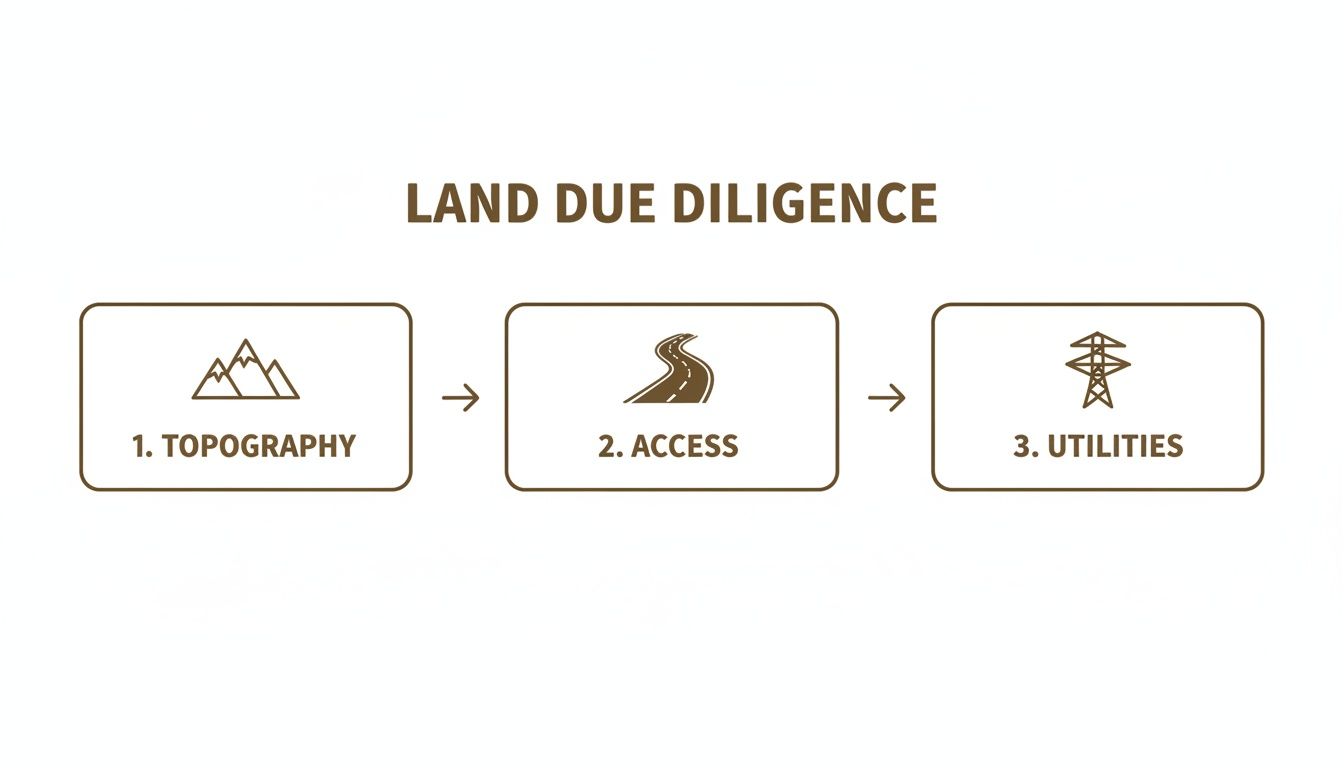
Skipping any of these steps is like buying a car without looking under the hood. You're just asking for expensive surprises down the road.
Building Your Adjustment Worksheet
The easiest way to keep this organized is with a basic adjustment worksheet. Just list your top three to five comps. For each one, write down its sale price. Then, make columns for the most important features: access, utilities, topography, size, and anything else that stands out.
Now, go down the list and compare each comp to the property you want to buy. The only question you need to answer is: Is this comp better or worse than my property on this specific feature?
- If a comp is superior (like it has power at the lot line and yours doesn't), you need to subtract value from its sale price.
- If a comp is inferior (maybe it's on a rough seasonal road while yours has year-round county access), you add value to its sale price.
This simple exercise strips away the differences, giving you a true "apples-to-apples" comparison.
A Real-World Valuation Example
Let's walk through a scenario so you can see how this plays out.
Target Property: A 10-acre parcel in rural Arizona. It has legal access from a recorded easement over a dirt road, no utilities, and some gentle, rolling hills. The seller is asking $20,000.
After some digging, you find three solid comps that sold recently:
- Comp A: 10 acres, sold for $25,000. It’s on a county-maintained road and has power right at the property line.
- Comp B: 8 acres, sold for $16,000. The access is similar, but the land is steep and rocky.
- Comp C: 12 acres, sold for $18,000. It's totally landlocked—no legal access—and is mostly flat.
Now, let's make our adjustments:
- For Comp A ($25,000): This one is way better. The county road access is a huge plus (worth, say, $5,000), and having power is a game-changer (easily a $10,000 advantage). We have to subtract those benefits from its price: $25,000 - $5,000 (access) - $10,000 (power) = Adjusted Value: $10,000.
- For Comp B ($16,000): It's smaller, so let's adjust its price to a 10-acre equivalent—maybe that’s $19,000. Its terrible topography makes it far less usable, which is a major drawback (let's call that a $4,000 negative). So, we add that value back to its price: $19,000 + $4,000 (topography) = Adjusted Value: $23,000.
- For Comp C ($18,000): Being landlocked is a fatal flaw. Your property's legal access adds tremendous value in comparison (at least $10,000). We'll add that to Comp C's sale price: $18,000 + $10,000 (access) = Adjusted Value: $28,000.
The Result: Your three adjusted values are $10,000, $23,000, and $28,000. What does this tell you? The seller's $20,000 asking price is probably in the ballpark, though it's definitely on the high side when you see what Comp A suggests. Now you have real data to back up your offer and negotiate with confidence. You may also find our guide on how to survey your own property useful for verifying boundaries during this process.
What This Means for Buyers
If you’re buying land for the first time, this is the single most important part of the process. It’s what separates a casual browser from a savvy buyer who can make smart, confident decisions.
Learning how to find a property’s real value protects you from the most common pitfalls out there—things like overpaying for a parcel with hidden access issues, impossible zoning restrictions, or land that will never pass a perc test for a septic system. It gives you the vocabulary and the confidence to ask the right questions and look at listings with a healthy dose of skepticism.
From Guesswork to Knowing Your Numbers
Once you can size up a property’s pros and cons, you start seeing the real opportunities. You can filter out the noise and zero in on land that actually fits what you want to do, whether that’s a simple weekend campsite, an off-grid homestead, or just a quiet place to invest your money for the long haul.
This skill is crucial when you're buying directly from a seller or through an online marketplace. It lets you independently confirm whether the asking price is fair or if it's way out of line with what the property is truly worth.
It’s not just about avoiding bad deals. It’s about finding the right one. When you understand a property's value, you can negotiate from a position of strength and recognize a genuinely good deal when you see it.
Ultimately, getting a handle on these valuation basics levels the playing field. It makes sure that when you do find that perfect piece of land, you can sign on the dotted line knowing you’ve made a solid financial move. And that confidence is what a successful land purchase is all about.
Why Consider Dollar Land Store?
Figuring out what a piece of land is worth takes homework, but we believe the actual buying part should be simple and clear. That’s the entire reason we started Dollar Land Store. Our mission is to provide a straightforward, transparent, and accessible path to owning affordable raw land.
As experts in rural land markets, we price our properties competitively based on thorough market analysis. An informed buyer is a confident one, which is why our listings are designed for transparency. We provide all the critical details upfront—acreage, GPS coordinates, zoning info, and real photos—so you have the facts you need to make a good decision.
A Simpler Way to Buy Land
For many of our customers, the biggest game-changer is our direct owner financing. It opens up land ownership to people who can't or don't want to deal with the complexities of traditional bank loans.
- No Credit Checks: We believe everyone deserves a chance to own land, regardless of their credit history.
- Low Monthly Payments: We structure our plans to be affordable, so owning land fits into your budget without becoming a financial burden.
- Simple, Transparent Terms: The price you see is what you get, with clear payment plans and no hidden fees. Our contracts are fast and easy to set up.
- No Middlemen: It’s just you and us. By selling directly, we eliminate agents, brokers, and the extra commissions they bring. This keeps things simple and keeps costs down.
- Broad Inventory: We offer a wide selection of properties across several states.
After you've done your homework on how to determine land value, you’ll see that Dollar Land Store isn't just an easy option—it's a logical one. We offer affordable land through a trustworthy, direct process. We bring the land; you bring the dream.
Next Steps: Ready to Find Your Piece of Land?
Armed with a solid understanding of how to value rural land, you’re no longer just dreaming—you’re ready to start your search. The best way forward is to put your new skills to the test.
Start browsing parcels in areas that catch your eye and see if you can find a few comparable sales. Ask yourself why a property is priced the way it is. Does it line up with what the local market data is telling you? This simple exercise is the perfect, risk-free way to build the confidence you’ll need to make a smart purchase.
Your dream of owning land stays a dream until you start researching, evaluating properties, and asking questions. Here’s a simple action plan to get you started:
- Practice What You've Learned: Spend a little time each day analyzing online listings.
- Browse Our Inventory: Explore seller-financed land options through Dollar Land Store to see what affordable land is available in states that interest you.
- Just Ask: Don’t hesitate to get in touch with us. We’re here to help. Contact Dollar Land Store with questions about buying raw land.
Taking these small steps is how you turn the ambition of owning land into a tangible reality. The path to becoming a landowner begins with that very first property you analyze.
Conclusion
Determining land value is a skill that empowers you to invest wisely and confidently. By focusing on key factors like access, zoning, topography, and utilities, and by using the sales comparison approach, you can move beyond guesswork and truly understand a property's worth. This knowledge protects you from overpaying, helps you spot hidden opportunities, and puts you in control of your land-buying journey. With these tools in hand, you are well-equipped to find the perfect parcel and turn your dream of land ownership into reality.