


Buying Land with Owner Financing: A Practical Guide
Ross AmatoEver felt like owning your own piece of land is just out of reach because of strict banks, perfect credit requirements, or a massive down payment? There’s a straightforward path that makes land ownership possible for almost anyone: buying land with owner financing.
Also known as seller financing, this is a direct arrangement where the property owner acts as the bank. Instead of navigating the complex and often restrictive process of a traditional lender, you make payments directly to the seller. This is a game-changer in the world of real estate, especially since most banks are hesitant to finance raw, undeveloped land. For first-time buyers, it's often the most accessible route to owning property.
How Owner Financing Opens the Door to Land Ownership
Seller financing creates a direct, transparent relationship between you and the property owner. You skip the mountain of paperwork and rigid criteria of a bank, which often views raw land as a risky investment. Instead, you agree on terms with the person who knows the property best—the seller.
This isn't an uncommon or niche practice. In fact, it’s a cornerstone of the rural land market. A 2019 Land Market Survey revealed that seller financing was used in approximately 41% of all reported land transactions, making it the single largest funding source for land that year. This highlights just how vital this option is for connecting buyers with their dream properties.
Why It Matters for First-Time Buyers
For many people trying to buy their first parcel of land, the biggest hurdles are a bank’s strict credit score requirements and the need for a large down payment. It’s common for traditional lenders to demand 20% to 50% down for a raw land loan, an amount that can stop a dream in its tracks.
Owner financing changes the entire equation. Sellers are generally more flexible because their primary goal is to sell the property, not to satisfy a corporate lending checklist. This flexibility results in much more accessible and realistic terms.
Here’s what that typically means for you:
- No Credit Checks: Many sellers, including reputable companies like Dollar Land Store, do not run credit checks. This opens the door to ownership for individuals with less-than-perfect credit or non-traditional income.
- Low Down Payments: Instead of needing tens of thousands of dollars, you can often secure a property with just a few hundred.
- Faster Closing Process: Without the slow, multi-layered bank approval process, you can complete the purchase and gain access to your land significantly faster.
This approach empowers buyers, confirming that land ownership is an achievable goal even on a modest budget. It removes traditional gatekeepers and puts control back into the hands of the buyer and seller.
Weighing the Pros and Cons of Seller Financing
Owner financing is what makes land ownership accessible to so many. It provides a level of practicality that traditional bank loans simply cannot offer for raw land. However, this flexibility comes with a different set of considerations.
Before you commit, it's essential to understand both sides—the clear advantages and the potential risks. This allows you to make an informed, confident decision.
The Clear Advantages for Land Buyers
The primary benefit of buying land with owner financing is simple: it removes the traditional barriers to entry. Most sellers are more focused on completing a sale than on scrutinizing years of your financial history. This opens up opportunities for a wider range of buyers.
Here are the most significant upsides:
- No Strict Credit Requirements: This is a major advantage. Reputable land sellers like Dollar Land Store often don't require a credit check. If you have a complex credit history or are self-employed, this provides a clear path forward.
- Lower Upfront Costs: Traditional lenders often require a massive down payment for raw land, sometimes 20% to 50% of the purchase price. With owner financing, down payments are typically much more manageable.
- Faster and Simpler Closing: Without bank bureaucracy, you can often close on a property in just a few days. The straightforward process saves considerable time and eliminates common frustrations.
- More Flexible Terms: Since you're dealing directly with the seller, there may be room for negotiation. While many established sellers have standard terms, the process is inherently more flexible than a bank's rigid structure.
For many first-time buyers, these are not just minor perks; they are the difference between dreaming of land ownership and achieving it.
Potential Risks and How to Mitigate Them
While the benefits are substantial, it's crucial to approach seller financing with diligence. The freedom it offers places more responsibility on you, the buyer, to conduct thorough research and protect your interests.
Here are the most common risks to be aware of:
- Higher Interest Rates: To offset the risk of not performing credit checks, sellers often charge higher interest rates than banks. This is a standard trade-off for the accessibility and convenience offered. Be sure to calculate the total cost of the loan over its full term.
- Buyer Assumes All Due Diligence: When a bank finances a purchase, it conducts its own appraisal and title search to protect its investment. In an owner-financed deal, this responsibility falls entirely on you. You must verify legal access, zoning regulations, property liens, and water rights.
- "Balloon" Payments: Be cautious of contracts that include a balloon payment—a large, lump-sum payment due at the end of the loan term. If you are unable to make this payment, you could lose the property and all payments made. Reputable companies like Dollar Land Store only use simple, fully amortized loans with no balloon payments.
- Less Formal Contracts: An agreement drafted by an individual seller may lack the standard protections found in bank documents. It is vital to ensure your contract is clear, legally sound, and properly recorded with the county to secure your claim to the property.
Comparing Owner Financing vs. Traditional Bank Loans for Land
To clarify the differences, here is a direct comparison. Securing a loan for raw land is not like getting a mortgage for a house, and the financing options reflect that.
| Feature | Owner Financing | Traditional Bank Loan |
|---|---|---|
| Credit Check | Typically no credit check required. | Strict credit score and history review. |
| Down Payment | Low, often just a few hundred dollars. | High, usually 20-50% of the price. |
| Approval Process | Fast and simple, often within days. | Slow and bureaucratic, takes weeks or months. |
| Interest Rate | Generally higher to offset risk. | Typically lower, based on credit score. |
| Closing Costs | Minimal to none. | Can be thousands in fees, appraisals, etc. |
| Flexibility | More room for negotiation on terms. | Rigid, non-negotiable terms. |
| Due Diligence | Responsibility falls entirely on the buyer. | Bank conducts its own appraisal and title work. |
Ultimately, the choice depends on your financial situation and priorities. For those who value speed, simplicity, and accessibility over a slightly lower interest rate, owner financing is often the most practical and effective way to buy land.
Understanding Your Owner Financing Contract
The contract is the core of your land purchase. It is the legal document that outlines every detail of the agreement between you and the seller. While legal documents can seem intimidating, understanding the key components is the best way to protect your investment.
A clear, well-written contract prevents future misunderstandings and provides a roadmap for both parties. It is absolutely critical to review every clause carefully.
Key Components of a Land Contract
Every solid owner financing agreement should clearly define the terms. If any part of the contract seems vague, consider it a red flag. Ensure these specific details are clearly listed:
- Total Purchase Price: The full, final price for the property.
- Down Payment Amount: The initial sum you pay upfront. Our guide on how much to put down for land offers more context on typical amounts.
- Financed Amount: The remaining balance after the down payment. This is the loan principal.
- Interest Rate: The percentage charged on the financed amount, typically expressed as an annual rate.
- Payment Schedule: This should detail the payment frequency (usually monthly), the exact payment amount, and the total number of payments required.
- Late Fees and Grace Period: The contract must state the penalty for a late payment and the number of days you have after the due date before that fee is applied.
A strong contract leaves no room for interpretation. Every number, date, and responsibility should be clearly defined so both you and the seller are on the same page from the start.
Contract for Deed vs. Deed of Trust
Understanding the type of contract used is one of the most important aspects of owner financing. It determines when you receive the legal title to the land, which directly affects your rights as a buyer.
- A Contract for Deed (also known as a land contract or installment sale agreement) is common. Under this arrangement, the seller retains legal title to the property while you, the buyer, hold "equitable title." This gives you the right to use and enjoy the land, but the deed is not officially transferred into your name until the final payment is made. While this structure simplifies the process, it's important to understand its implications. Research from groups like Pew has shown that land contracts can pose risks to buyers if they miss payments. You can learn more about the risks associated with land contracts to get a complete picture.
- A Deed of Trust functions more like a traditional mortgage. In this scenario, legal title is transferred to you at closing and recorded in your name. The seller then places a lien on the property via the Deed of Trust, which is removed once the loan is paid off. This provides more secure and immediate ownership rights.
Here’s a quick comparison:
| Feature | Contract for Deed | Deed of Trust |
|---|---|---|
| Legal Title | Seller holds title until the loan is paid off. | Buyer receives title at closing. |
| Buyer's Status | Holds "equitable title" during the loan term. | Holds legal title with a lien against it. |
| Default Process | Can be simpler for the seller (forfeiture). | Requires a formal foreclosure process. |
| Security for Buyer | Less secure until the final payment is made. | More secure; ownership is recorded immediately. |
Red Flags to Watch For in Your Agreement
Vigilance is your best defense when reviewing a contract. A reputable seller like Dollar Land Store uses clear, straightforward documents, but not all sellers operate the same way. Be cautious if you encounter any of the following:
- Vague or Missing Terms: If the interest rate, payment amount, or total price isn't clearly stated, stop. Absolute clarity is non-negotiable.
- No Prepayment Clause: You should always have the right to pay off the loan early without a penalty. This allows you to pay off the land faster if your financial situation improves.
- Unfair Default Clauses: Watch for terms that allow the seller to reclaim the property after a single missed payment with no grace period. A fair contract outlines a reasonable process for handling late payments.
- Balloon Payments: Be extremely wary of any contract requiring a massive lump-sum payment at the end. These are often structured to be difficult to pay, potentially forcing buyers into default. At Dollar Land Store, we never use balloon payments—all our loans are fully amortized, meaning your first payment is the same as your last.
Your owner financing contract is your protection. Taking the time to read it, understand it, and ask questions is the most important step you can take to ensure your land purchase is secure and successful.
A Practical Roadmap For Your Land Purchase
Ready to turn your dream of land ownership into a reality? Let’s walk through the steps of buying land with owner financing, from your initial search to signing the contract. Following a clear process is the best way to ensure a smooth transaction and avoid common pitfalls.
It all begins with finding the right property and, just as importantly, the right seller. From there, it's all about due diligence.
Finding And Evaluating Properties
First, you need to find land available with owner financing. While you might find listings from individual sellers, working with a company that specializes in seller financing often provides a more secure and streamlined process. Companies like Dollar Land Store build their entire business around transparent financing, which removes much of the guesswork.
Once you have identified a few potential properties, the due diligence phase begins. This is where you investigate every important detail about the land before making a commitment.
Here are the essential checks to perform:
- Confirm Legal Access: Does the property have clear, recorded legal access, or is it landlocked? A parcel without guaranteed access can be severely limited in value and use.
- Investigate Zoning and Land Use Rules: Contact the county’s planning and zoning department directly. Ask what is permitted on the property. Can you camp, build a cabin, or park an RV? Never rely solely on the listing for this critical information.
- Check for Utilities: For raw, undeveloped land, assume there are no utilities until proven otherwise. Research the costs to bring in electricity, drill a well for water, and install a septic system. These expenses can be significant.
- Review Property Taxes: Determine the annual property tax amount and confirm that they are current. Unpaid taxes can become a major liability for a new owner.
Negotiating The Terms Of The Deal
One of the key benefits of buying land with owner financing is its flexibility. While a company like Dollar Land Store often has standard terms for simplicity and fairness, individual sellers may be open to negotiation. The goal is to reach an agreement that is fair to both you and the seller.
The main points of discussion are usually the down payment, interest rate, and loan term. A solid down payment can strengthen your position. According to industry data, the typical loan-to-value ratio for seller-financed land deals between 2020 and 2024 was around 69%, meaning buyers put down an average of 31%.
When discussing terms, be professional and prepared. Explain what you can comfortably afford while respecting the seller's need to make a sound financial decision.
Reviewing And Finalizing The Contract
The final step before the land is yours is the contract. This document is the legal foundation of your purchase, and it is crucial that you understand every word. Pay close attention to the payment schedule, interest rate, default clauses, and how the deed will be transferred upon final payment.
This chart illustrates the two most common contract structures and the timing of ownership transfer.
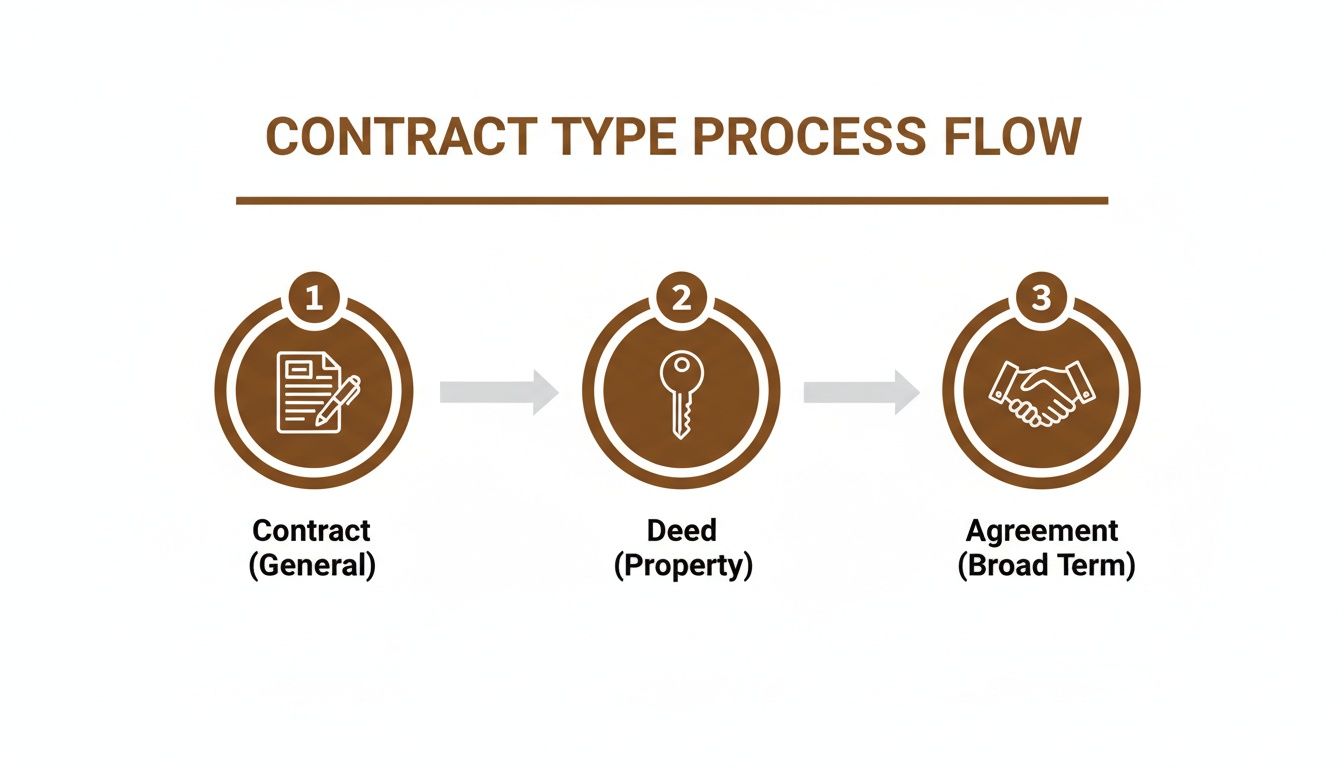
As shown, with a "Contract for Deed," you do not receive the legal deed until the final payment is made. With a "Deed of Trust," it is transferred to you at closing.
If you are not using a real estate agent, which is common in these transactions, the responsibility for reviewing the contract falls entirely on you. Using a detailed real estate transaction checklist can help ensure you don't miss anything critical. Our guide on how to buy land without a realtor provides further insights.
Buyer's Tip: Always request a copy of the contract to review before you are asked to sign or send money. A transparent seller will readily provide this. Read it thoroughly, and if any part is unclear, ask for clarification in writing.
What This Means for Buyers
For first-time land buyers, owner financing is more than just a different way to pay—it’s a fundamental shift in accessibility. It transforms the intimidating process of acquiring real estate into a manageable, step-by-step journey. Instead of facing a high-stakes rejection from a bank, you engage in a direct, human-to-human transaction.
The key takeaway is that you are in control. You have the power to perform due diligence, understand your contract, and select a seller who operates with transparency. This path requires you to be proactive and informed, but the reward is achieving a dream that traditional financing often places out of reach. By taking responsibility for your research, you can confidently secure your own piece of land on terms that fit your budget.
Why Consider Dollar Land Store?
When navigating the world of owner financing, the single most important decision you'll make is choosing your seller. A trustworthy, transparent partner can transform a complex process into a secure and straightforward path to ownership. This is the foundation upon which Dollar Land Store was built.
We specialize in making land ownership a reality, particularly for first-time buyers and those who may not qualify for traditional bank loans. Our entire process is designed to be simple, fast, and transparent.
Our Straightforward, Buyer-Focused Process
We are not a real estate agency or a middleman; we own every parcel of land we sell. This direct-to-buyer model eliminates commissions and confusion, saving you both time and money.
Here's what makes our approach different:
- Affordable Land with Low Payments: Our model is built on low entry costs, including minimal down payments and manageable monthly payments designed for real-world budgets.
- Simple Owner-Financing with No Credit Checks: Your credit score is not a factor. We believe everyone deserves a fair opportunity to own land, and our guaranteed financing reflects that commitment.
- Transparent Terms: Our contracts are written in plain English. We use fully amortized loans with no balloon payments, ensuring you will never face a surprise lump-sum bill.
- Fast Contract Setup: Because you deal directly with us, the owner, we can finalize the purchase quickly—often within a few days. You can even complete the entire checkout process securely online.
- Broad Inventory Across Several States: We offer a wide selection of rural, undeveloped land in states like Arizona, Colorado, Nevada, Oregon, and California.
- No Middlemen or Real Estate Agents: Our direct sales process means you avoid agent commissions and unnecessary complications.
At Dollar Land Store, our goal is to provide a logical, trustworthy, and hassle-free path to owning land. We have removed the typical barriers to entry to make your dream an achievable reality.
Your Next Steps to Land Ownership
Now that you understand how owner financing works, it's time to take the next step. The journey from aspiring landowner to actual owner begins with exploration.
Start by browsing available properties to see what your budget can afford and which areas align with your goals. Are you looking for a recreational campsite, a long-term investment, or a future off-grid homestead? Knowing your "why" will help you focus your search. For many, owning land opens up new possibilities, including strategies for generating passive income through real estate.
Here's your action plan:
- Browse Available Parcels: Explore the current land listings at Dollar Land Store to see what catches your eye.
- Learn More About Our Process: Understand how our simple, no-credit-check seller financing works.
- Contact DLS with Questions: If a property interests you, reach out to our team. We are here to provide clear, straightforward answers about the land and our purchase process.
- Evaluate a Parcel: Use the due diligence checklist to begin your research on properties that stand out.
Taking these steps moves you from a passive dreamer to an active buyer.
Conclusion
Buying land with owner financing is a powerful and practical tool that makes property ownership accessible to a broad range of people. By removing the traditional barriers of stringent credit checks and high down payments, it creates a direct and transparent path to acquiring your own piece of land. It is important to remember that finding the cheapest land in the us is just the first step; verifying access and zoning is what protects your investment.
The key to success lies in diligence and partnership. By thoroughly researching properties, carefully reviewing your contract, and choosing a reputable seller like Dollar Land Store, you can navigate the process with confidence. This approach empowers you to take control of your future and turn the dream of owning land into a tangible, rewarding reality.