


Owner Financed Land Explained: A Beginner's Guide
Ross AmatoThinking about buying a piece of land can feel like a dream that’s just out of reach, especially when you start picturing complicated bank loans and invasive credit checks. But there’s a much more direct path to making it happen: owner financed land. This guide explains what owner financing is, how it works, and why it's a practical option for first-time land buyers.
Your Path to Owning Land Without a Bank
For many first-time land buyers, the biggest hurdle isn’t finding the perfect parcel—it’s figuring out how to pay for it. Traditional banks can be hesitant to finance raw, undeveloped land. They often see it as a riskier investment than a house, which means more requirements for you to meet.
This is where owner financing, sometimes called seller financing, opens up a straightforward opportunity.
Instead of trying to meet the rigid demands of a financial institution, you work directly with the property seller. They act as the lender. This simple shift often cuts through the red tape, removing common barriers that stop people from owning their own land.
Key Advantages for New Buyers
If you're new to buying real estate, this approach has immediate and practical benefits:
- It’s Accessible: Many sellers who offer financing don't require credit checks. This makes land ownership a real possibility, even if you have a limited or less-than-perfect credit history.
- It’s Simple: The entire process is usually much faster. You'll find there’s less paperwork involved compared to getting a conventional bank loan.
- Lower Upfront Costs: You’ll almost always need a down payment, but sellers are often more flexible, and the amount can be lower than what a bank would demand for a land loan.
This guide will walk you through every step of buying owner-financed land. We'll break down everything from understanding the agreement to performing due diligence on the property so you can move forward with confidence. For a broader look at funding options, you can check out our detailed guide on how to finance a land purchase.
By the end of this article, you’ll have a clear roadmap to help you make a smart decision and turn that dream of owning land into an achievable goal.
How Owner Financing Works: A Step-by-Step Breakdown
Think of owner financing like buying something from a friend who lets you pay them back over time. Instead of a bank, the seller acts as the lender. This simple shift cuts out the middlemen and makes the entire process more direct and personal. It all comes down to a straightforward agreement between you and the person selling the land.
Let's walk through what you can expect as a first-time land buyer.
The Initial Agreement
Everything begins with a discussion. You and the seller talk through the details and come to a mutual understanding on the key terms of the deal. This agreement becomes the foundation for all the legal paperwork that follows.
Here’s what you’ll typically establish at this stage:
- Purchase Price: The total cost of the property.
- Down Payment: The upfront amount you pay to secure your land.
- Interest Rate: The percentage charged on the remaining balance after your down payment.
- Loan Term: How long you have to pay off the loan, usually set in months or years.
- Monthly Payment: The fixed amount you’ll pay each month until the land is yours, free and clear.
Once everyone is on the same page, these terms are put into writing.
This flowchart shows just how simple the path to ownership can be when you take the direct route.
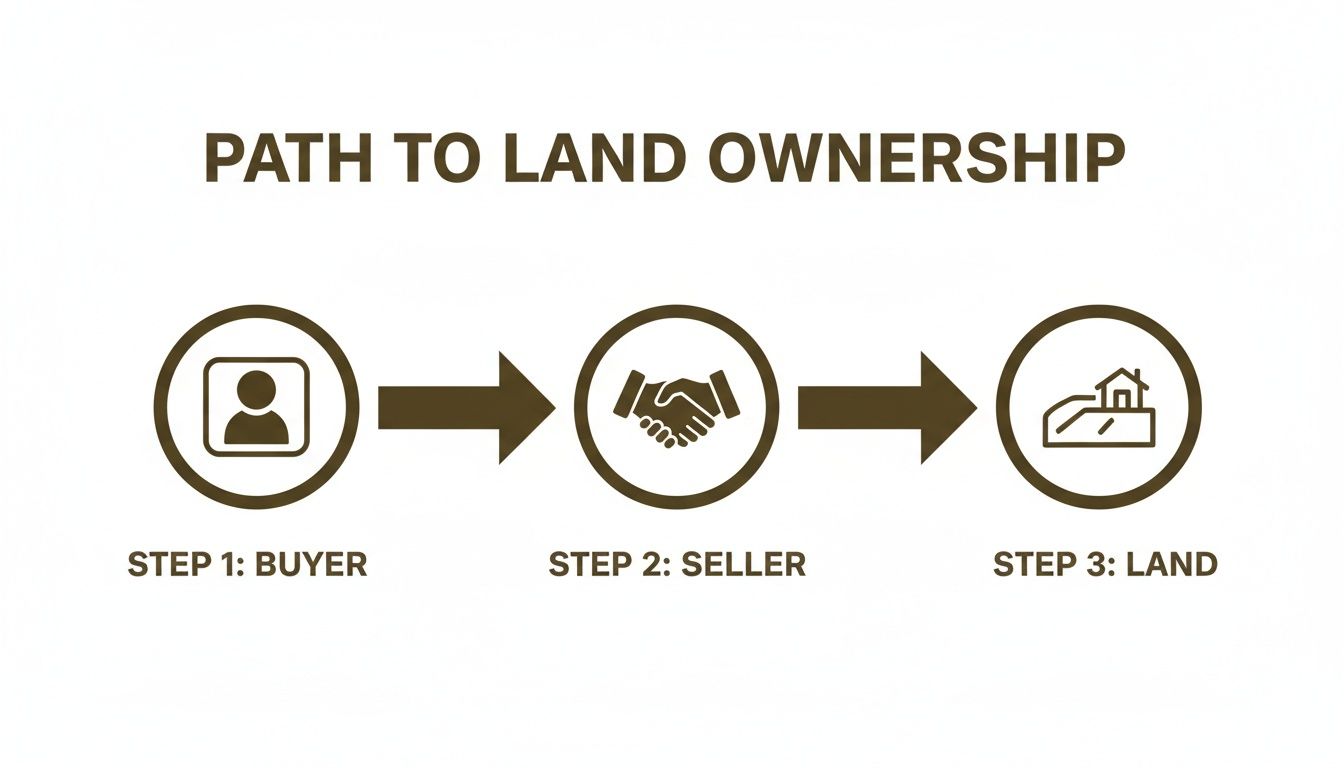
As you can see, the journey bypasses the big banks and creates a direct link between you, the seller, and your new property.
The Key Legal Documents
With the terms set, the agreement is made official with a couple of essential legal documents. The names might vary slightly by state, but their purpose is the same in almost every owner-financed deal.
-
Purchase Agreement (or Land Contract): This is the master document for the sale. It lays out all the terms you agreed on, describes the property in detail, and lists the responsibilities of both you and the seller.
-
Promissory Note: This is your formal promise to pay. It states the total amount you owe, the interest rate, your monthly payment, and the full repayment schedule. Think of it as the official, legally binding IOU between you and the seller.
At Dollar Land Store, we prepare these for you and send them over electronically. You can review and sign everything online, making the process fast and convenient.
Understanding the Financial Terms
So, where does your money go each month? It’s simpler than you might think. Every payment you make is split into two parts.
Principal + Interest = Your Monthly Payment
-
Principal: This is the part of your payment that directly reduces your loan balance. If you borrowed $10,000, every dollar of principal paid chips away at that $10,000.
-
Interest: This is the cost of borrowing—it’s what you pay the seller for letting you pay for the land over time.
For example, on a $200 monthly payment with a 5% interest rate, a small portion covers the interest charged for that month, and the rest goes straight to paying down your principal. As your balance shrinks, more of your payment goes toward the principal and less toward interest. This process is called amortization.
This clear, predictable structure is one of the best parts of owner financing. The terms are set from day one, with no hidden fees or complicated bank rules to navigate.
For a deeper dive into the mechanics, check out our guide on what is seller financing in real estate. Once you understand these core ideas, you’ll be able to look at any owner-financed land deal with confidence.
Pros and Cons of Owner Financing for Land
Owner financing is a straightforward path to land ownership, but like any major financial decision, it's important to see the whole picture. It offers incredible flexibility and opens doors for many buyers, but it comes with its own set of considerations. Understanding both the advantages and potential drawbacks is how you make a smart choice that fits your goals.
By looking at both sides, you can determine if an owner financed land purchase is the right move for you. This balanced view will help you move forward with confidence, knowing you’ve considered all the angles.
The Advantages for Buyers
For many first-time land buyers, owner financing is what makes owning land possible in the first place. The benefits directly address the biggest hurdles you’d face with a traditional bank loan.
- Easier Qualification: This is the biggest plus. Many sellers, including Dollar Land Store, don’t require credit checks. This opens the door for people who are building credit or simply prefer not to deal with banks.
- Faster Process: Without bank appraisals, underwriters, and institutional red tape, the timeline shrinks dramatically. You can often go from selecting a property to signing the contract in just a few days.
- Lower Upfront Costs: While you'll still have a down payment, sellers are often more flexible on the terms than a bank would be. Closing costs are also typically much lower, since you’re skipping common bank fees like loan origination and application charges.
- Simpler Negotiation: You’re communicating directly with the owner. This allows for a more direct conversation about the price, down payment, and other terms without middlemen or rigid corporate policies.
Owner Financing vs. Traditional Bank Loan
To really see the difference, it helps to put the two options side-by-side. For most people looking at raw land, the simplicity and accessibility of owner financing are hard to beat.
| Feature | Owner Financing | Traditional Bank Loan |
|---|---|---|
| Credit Check | Often not required. | Always required; strict standards. |
| Closing Speed | Very fast (days to a week). | Slow (30-60+ days). |
| Upfront Costs | Down payment + minimal fees. | Down payment, appraisal, origination fees, etc. |
| Flexibility | Highly negotiable terms. | Rigid, non-negotiable terms. |
| Approval | Based on ability to pay, not credit score. | Based on credit score, income, debt-to-income. |
| Property Type | Ideal for raw, undeveloped land. | Very difficult to get for raw land. |
As you can see, the traditional route is built for buying a house, not a piece of open land. Owner financing is designed for it.
The Potential Drawbacks and How to Address Them
While owner financing makes buying land simpler, it also means you have to be an informed buyer. Knowing the potential downsides—and how to handle them—is key to protecting your investment.
Your Due Diligence is Key: With owner financing, the responsibility to research the property falls squarely on your shoulders. It's up to you to verify property details, understand every word of the contract, and confirm the seller has the legal right to sell the land.
One thing to watch for is the interest rate. It can sometimes be higher than what a bank might offer. This is often a trade-off for the convenience, speed, and no-credit-check process. Before you sign, calculate the total cost of the loan to make sure it’s comfortable for you in the long run.
Another crucial step is to ensure the seller owns the property "free and clear." This means there are no existing mortgages, liens, or other claims against the land that could complicate your ownership later on. A title search, usually handled by a title company or an attorney, is the best way to confirm this. Your contract should also clearly state how and when the deed will be transferred into your name once you've paid off the loan.
Finally, remember that the seller sets the terms. You need to read every document carefully. Pay close attention to clauses about late payments or what happens if you default on the loan. A transparent seller will provide a clear, easy-to-understand contract that protects both parties. By asking questions and being proactive, you can navigate these issues and make a solid investment.
Digging into the Financial and Legal Details
When you buy land with owner financing, you’re not just buying a piece of property; you’re entering into a financial agreement. The key to a successful purchase is understanding both the money side and the paperwork that backs it up. This is what turns you from a hopeful buyer into a savvy, informed landowner.
One of the best things about owner financing is how straightforward the financial part is. The terms are usually fixed and clear from the beginning. You’ll know your exact interest rate, your monthly payment, and the length of the loan—what’s known as the amortization schedule—before you sign anything. That predictability makes it much easier to budget for your property.
This approach is a significant part of the land market. In fact, owner-financed land deals recently made up 13% of all seller-financed sales, totaling $7.37 billion. That shows how popular and trusted this method has become, especially for rural parcels. You can see more on this trend over at LandSearch.com.
Making Sense of the Paperwork
Two key documents form the foundation of almost every owner-financed land deal. The names might vary slightly from state to state, but their function is always the same: to outline the agreement and protect both you and the seller.
-
Land Contract (or Contract for Deed): Think of this as the main agreement. It lays out all the critical details: the legal description of the property, the agreed-upon price, your payment schedule, and what’s expected of both parties. A crucial point is that the seller usually retains legal title until the loan is paid off. In the meantime, you receive equitable title, which gives you the right to use and enjoy your land.
-
Promissory Note: This is your official, legally binding promise to repay the loan. It’s the "IOU" of the deal, clearly stating the total loan amount, the interest rate, and the consequences of missed payments. It’s what makes the financial terms enforceable.
These documents are your protection. At Dollar Land Store, we ensure our contracts are written in plain language, so you know exactly what you’re signing.
Making Sure the Title is Clear
This is one of the most important steps you’ll take. Before you buy, you must confirm the seller has the legal right to sell the property. That means verifying it has a clear title—a legal term for ownership with no hidden claims or debts attached.
A significant risk is a hidden lien, which is a legal claim against a property for an unpaid debt, like the seller's own mortgage or overdue taxes. If the seller defaults on a loan they have on the land, it could put your ownership in jeopardy.
Your Job as the Buyer: You must confirm the title is free and clear before you sign anything. The best way to do this is with a professional title search from a reputable title company. It’s a small upfront cost that provides invaluable peace of mind.
Who is Responsible for Property Taxes?
Another detail to establish in your agreement is who pays the property taxes. In almost all owner-financing deals, the buyer is responsible for paying the annual property taxes from day one, even while the seller holds the legal title.
Your Land Contract needs to state this clearly. If property taxes go unpaid, the county can put a lien on the property, which could eventually lead to foreclosure and the loss of your land and all payments made. Always confirm this detail and budget for this yearly expense.
For more on upfront costs, check out our guide on how much down payment is typical for land.
Your Essential Due Diligence Checklist
The freedom of owner financing is one of its best features. You’re in the driver’s seat. But that freedom comes with responsibility—it’s up to you, the buyer, to do your homework. This is what we call due diligence, and it’s the process of researching the property before you finalize the purchase.
Think of it as your personal investigation. Doing it right protects your investment and ensures the land you’re buying is everything you hoped it would be. For many first-time buyers, this is the most empowering part of the journey, because it turns a hopeful purchase into a confident one.
Verifying Access to Your Property
One of the first and most important questions to ask is: "How do I get to my land?" This is about more than just finding it on a map; it’s about having both physical and legal access.
- Physical Access: Is there a real, usable road or trail that leads to the property? If the land is remote, you might need a truck or a 4x4. The only way to know for sure is to see it for yourself.
- Legal Access: Just because you can drive on a road doesn’t mean you have the legal right to. You need to confirm that there’s a recorded easement or that the road is public. The county recorder's office is the best source for this information.
A Quick Word of Caution: Never assume you have access. Always check with the county to make sure the roads are officially recorded and legally usable. A property without proven legal access can be a challenge to use or sell later.
Investigating Zoning and Land Use Rules
Every county has its own set of rules. These zoning regulations dictate what you can and cannot do with your land.
Before you get too far, call the county’s Planning and Zoning Department. Ask specific questions about your plans. Can you build a home there? Can you park an RV? Are tiny homes allowed? What about camping? Getting these answers upfront saves a great deal of hassle later.
Checking on Utilities and Resources
For raw, undeveloped land, you’ll also need to figure out the basics—especially if you ever plan to build on the property.
- Water Source: How will you get water? Common options are drilling a well, hauling it in, or setting up a cistern. A local well-drilling company or the county health department can give you an idea of groundwater depth and quality in the area.
- Septic System: If there’s no city sewer hookup, you'll likely need a septic system. The county health department can explain the requirements and permit process.
- Power: Is the property close to power lines, or will you need to go off-grid with something like solar? Call the local utility company. They can tell you how close their lines are and what it might cost to bring power to your parcel.
The owner-financed land market has proven to be a reliable path to property ownership. In fact, research shows that between 2018 and 2022, land deals consistently made up 13-19% of all owner-financed transactions. With an average loan-to-value ratio of 74%, it’s clear that buyers are using this method to make their land ownership dreams a reality, which makes doing your homework all the more important.
For a deeper dive into what to look for, check out our guide on the key factors to consider when buying land. By taking these steps, you’ll build a complete picture of the property and know you’re making the right move.
What This Means for Buyers
For a first-time or beginner land buyer, owner financing changes the game. It removes the traditional gatekeepers—banks and credit bureaus—and creates a direct, accessible path to owning property. Instead of focusing on your credit score, the process prioritizes your ability to make a reasonable down payment and affordable monthly payments.
This means you can focus on what really matters: finding a piece of land that fits your budget and your vision. However, it also places more responsibility on you. You are in charge of due diligence. You must verify access, check zoning rules, and understand the terms of your contract. This empowerment is the core of owner financing; it puts you in control of your purchase from start to finish.
Why Consider Dollar Land Store?
Understanding how owner financing works is one thing. Finding a seller you can trust to make the process simple and fair is another.
That’s exactly why we created Dollar Land Store. Our business was built around the concepts in this guide, specifically to give everyday people a straightforward path to buying affordable rural land. We designed our process from the ground up for first-time buyers who want to avoid the complexities of dealing with banks.
Every parcel we sell comes with our clear, simple seller-financing. It’s all about making land ownership accessible and ensuring you know exactly what you’re getting into from day one.
Our whole system is designed to remove the traditional barriers that stop most people from buying land. When you work with us, here’s what you can expect:
- No Credit Checks: We believe your financial past shouldn’t block your future. We approve buyers based on their ability to make a small down payment and a monthly payment they can afford.
- Low Down Payments: We keep the entry barrier low, often just a small initial payment plus a one-time document fee to get you started.
- Simple, Honest Contracts: All the terms are laid out in plain English. No hidden fees or confusing legal jargon.
- A Quick Online Process: You can browse our properties, select your favorite, and complete the entire purchase online, sometimes in just a couple of days. We handle the paperwork, provide clear property information, and give you the confidence to finally own your own piece of land.
Buyer Guidance and Next Steps
Now that you have a solid understanding of owner financed land, your journey is just beginning. The next step is to put this knowledge into action.
- Define Your Goals: What do you want to do with your land? Camp, build, invest? Knowing your goal will help you focus your search.
- Set Your Budget: Determine what you can comfortably afford for a down payment and a monthly payment.
- Start Your Search: Begin looking at properties that match your criteria. Pay close attention to location, size, and features.
- Perform Due Diligence: Once you find a parcel you like, use the checklist in this guide to research it thoroughly. Call the county, verify access, and ask plenty of questions.
- Review the Contract: Read every word of the purchase agreement and promissory note. If anything is unclear, ask the seller for clarification.
Taking these deliberate steps will ensure you make an informed decision and find a property you'll be happy with for years to come.
Conclusion
Owner financed land offers a practical and accessible route to property ownership, especially for those new to the market. By working directly with the seller, you can bypass the strict requirements of traditional lenders and simplify the entire buying process. The key to success lies in understanding the terms, doing your due diligence, and choosing a trustworthy seller. With this guide as your roadmap, you are now equipped with the knowledge to confidently take the next step toward owning your own piece of land.
Explore seller-financed land options through Dollar Land Store.