


Decoding the Per Acre Price for Land Buyers
Ross AmatoWhen you start looking for vacant land, you will see one term appear consistently: per acre price. This is the most common way to measure and compare the value of different properties. For beginners, it’s helpful to think of it like the "price per square foot" used when evaluating a house. Understanding this single metric is the first step toward making a confident purchase.
This guide will explain what the per acre price means, the key factors that influence it, and how it translates into an affordable monthly payment, especially for first-time land buyers.
What Is a 'Per Acre Price' and Why Does It Matter?
The per acre price is a straightforward metric that helps buyers compare properties of different sizes on an equal basis. Whether you are considering a 5-acre recreational parcel or a 40-acre investment property, this number provides a quick snapshot of its relative cost.
The calculation is simple:
Total Purchase Price ÷ Total Acres = Per Acre Price
For example, a 10-acre property listed for $20,000 has a per acre price of $2,000. This basic math is the starting point for any land buyer.
However, a lower per acre price does not automatically mean a better deal, and a higher one does not always indicate an overpriced property. The true value is determined by many factors beyond this initial figure.
Why This Metric Is Important for Buyers
For first-time land buyers, the per acre price is a valuable tool for clarifying your options. It helps you accomplish three critical tasks:
- Compare Properties Fairly: You can instantly assess whether a 7-acre parcel is priced competitively against a 12-acre lot in the same area.
- Identify Potential Issues: An unusually low price might indicate challenges such as poor access, difficult terrain, or restrictive zoning regulations.
- Understand the Local Market: By tracking this metric across various listings, you begin to learn what land should cost in a specific county or region.
To better understand the valuation process, it helps to be familiar with the different Real Estate Property Valuation Methods that professionals use. This knowledge allows you to see beyond the listing price and grasp what truly drives land value.
Before starting your search, it is essential to learn what factors cause the per acre price to rise or fall. You can learn more in our guide on how much an acre of land costs.
Key Factors That Influence the Per Acre Price
The per acre price is a useful starting point, but it does not tell the whole story about what a piece of land is worth. Two parcels of the same size can have vastly different prices. Understanding why is key to making a smart purchase and avoiding costly mistakes. The most significant factors are location, access, physical characteristics, and permitted land use.
Location and Access
The old saying "location, location, location" is especially true for land. A property one hour from a major city will almost always have a higher price than a similar parcel four hours away in a remote area.
Just as important as location is access—the physical and legal right to get to your land.
- Physical vs. Deeded Access: A dirt road leading to the property provides physical access. However, without a legally recorded easement, you have no guaranteed right to use it. Deeded access is the legally documented right-of-way that ensures you can always reach your property.
- Road Frontage: Land that borders a county-maintained road is more valuable than a parcel that can only be reached by crossing private property.
- Quality of Access: A well-maintained gravel road is very different from a rugged, 4x4-only trail that becomes impassable after rain.
Land without clear, year-round legal access will always have a lower per acre price because its usability is limited. Buyers should always verify access through official county records and not rely solely on maps.
Topography and Usability
The physical layout of the land—its topography—directly impacts what you can do with it. A flat, clear acre is a blank canvas for building or recreation. A steep, rocky, or heavily wooded acre has more limitations.
Key Takeaway: The "usability factor" is critical. A 40-acre parcel where only five acres are flat and buildable may be less valuable than a 10-acre parcel that is entirely usable.
Here’s what to look for:
- Slope: Steep terrain can make construction difficult or prohibitively expensive.
- Soil Quality: The composition of the ground (rocky, sandy, clay) affects everything from foundations to wells and septic systems.
- Water Features: A pond or stream can be a great asset, but a floodplain or marsh can render large portions of the property unusable.
Utilities and Services
Access to essential services like electricity and water can dramatically increase land value. A property without these connections is considered "raw land"—more affordable upfront but requiring significant investment to develop.
- Electricity: How far is the nearest power line? Extending electrical service can cost thousands of dollars.
- Water Source: Is a public water connection available? If not, you will need to drill a well, and the cost and probability of success vary by area.
- Septic Suitability: If a public sewer is not available, the soil must pass a percolation ("perc") test to confirm it can support a septic system. If it fails, you may not be able to build a permanent residence.
The presence of nearby utilities can easily double or triple the per acre price compared to a similar off-grid property.
How Different Factors Impact Per Acre Price
This table illustrates how specific attributes can increase or decrease a property's value. A parcel with "High-Value" features will have a premium price, while one with "Low-Value" attributes will be more affordable but may have limitations.
| Factor | High-Value Attribute (Higher Price) | Low-Value Attribute (Lower Price) |
|---|---|---|
| Access | Paved, county-maintained road frontage | 4x4 trail, unrecorded easement, or landlocked |
| Topography | Flat, level, and entirely usable | Steep slopes, rocky terrain, or marshland |
| Utilities | Power, water, and sewer at the lot line | Completely off-grid, far from utility lines |
| Water | Drilled well on-site or city water | No water source; low well-drilling success rate |
| Zoning | Residential or Agricultural (allows homes) | Recreational or other restrictive zoning |
| Location | Close to towns, services, and attractions | Remote, far from paved roads and amenities |
A property's value is a combination of these elements. The right piece of land for you will have a mix of features that align with your goals and budget.
Zoning Regulations and Restrictions
Finally, zoning refers to the county's rules about what you can legally do with your land. These regulations are non-negotiable and must be researched before you buy.
Rural land is often zoned for purposes like Agriculture, Residential, or Recreation. Each classification has specific rules regarding minimum lot sizes for building, types of structures allowed (e.g., single-family homes vs. mobile homes), and whether activities like camping are permitted.
For a deeper look at these factors, check out our complete guide on how to determine land value.
How Per Acre Prices Vary Across Different Regions
The price of land is not uniform. A 10-acre parcel in Arizona might cost a fraction of a similar-sized lot in Colorado because the per acre price can shift dramatically from one state to another, and even between neighboring counties.
Understanding these regional differences is key to finding a property that fits your budget. Local demand, state regulations, and proximity to desirable features like national parks or growing towns all play a role. For instance, land near popular recreational areas almost always commands a higher price.
Regional Price Drivers
Every state has a unique land market. A parcel in the arid Arizona desert will have a different value than a forested mountain lot in Colorado.
These price variations are typically driven by a few key factors:
- Economic Growth: Counties with job growth and development often see land prices rise.
- Recreational Demand: Proximity to lakes, mountains, national forests, or hunting areas increases the per acre price.
- State and Local Regulations: Land use laws, property taxes, and water rights can differ significantly and impact a property's value and utility.
Visualizing market data can help you understand these trends. Learning how to create a heat map is one way to get a geographical picture of land value hot spots.
Understanding Market Averages
National data reveals how much land values can differ. Across the United States, the average value of farm real estate has climbed to $4,350 per acre.
However, regional differences are significant. Cropland averaged $5,830 per acre nationally, while in the Pacific region (including states like California and Oregon), values exceeded $8,200 per acre. This gap highlights why vacant lots and pastureland in less-developed areas represent a great opportunity for first-time buyers.
This infographic breaks down the three pillars that support a property's value.
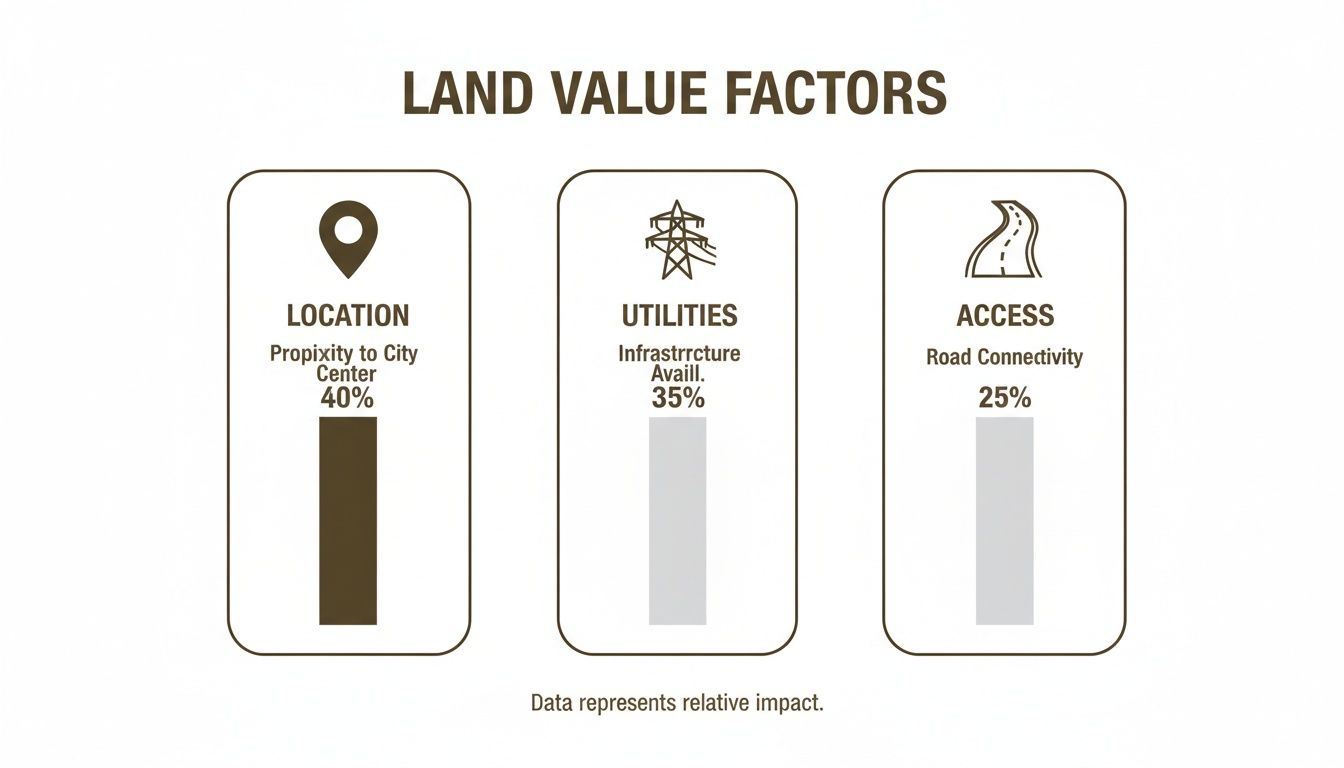
As you can see, a property's location, utility availability, and physical access are the fundamental elements that determine its market worth.
Finding Value in Less Populated States
For buyers looking for affordability, certain states consistently offer more accessible pricing. This is especially true for raw, undeveloped land located away from major population centers.
Key Insight: A lower per acre price often involves a trade-off. You might get more land for your money, but it could be more remote, lack utilities, or have challenging terrain. The key is to ensure those trade-offs align with your long-term plans for the property.
States like Arizona and Nevada, for example, often have large tracts of affordable land suitable for off-grid living, recreational use, or as a long-term asset. To find these opportunities, it's best to research specific county markets. For a helpful comparison, check out our guide on the cheapest states to buy land.
Translating Price Per Acre Into an Affordable Payment

The total purchase price of a property can seem large, but for most first-time land buyers, the most important number is the monthly payment.
This is where seller financing becomes a powerful tool. It breaks down a large purchase into a series of predictable, manageable payments that can fit into a budget, often without the strict requirements of traditional bank loans. When you see how the total cost translates into a simple monthly amount, land ownership becomes much more accessible.
Breaking Down the Math
With a seller like Dollar Land Store, the financing process is designed to be straightforward. The terms are simple and disclosed upfront, removing the need for bank negotiations or credit approvals.
Let's walk through a hypothetical example to see how a $2,000 per acre price on a 5-acre parcel becomes an affordable monthly payment.
Hypothetical Property Example:
- Total Acres: 5 Acres
- Per Acre Price: $2,000
- Total Purchase Price: $10,000
With seller financing, this total is broken down into a down payment, a loan term, and the amount financed. If you want to dive deeper into these concepts, our guide on how to finance a land purchase is a great resource.
From Total Price to Monthly Payment
How does that $10,000 property become a manageable payment plan? It starts with a few key definitions.
Key Terms to Know:
- Down Payment: The initial amount you pay upfront to secure the property.
- Document Fee: A one-time fee to cover the cost of preparing contracts and paperwork.
- Loan Term: The length of time you have to pay off the land, usually expressed in months.
Using these terms, we can build out a sample payment structure. The table below shows how simple and affordable the math can be.
Sample Seller Financing Calculation
| Item | Example Cost |
|---|---|
| Total Purchase Price | $10,000 |
| Down Payment | $249 |
| Document Fee | $249 |
| Amount Financed | $9,751 |
| Loan Term | 84 Months (7 Years) |
| Estimated Monthly Payment | ~$165 |
In this hypothetical example, a $10,000 property becomes a monthly payment that is often less than a typical utility bill. This predictable cost makes it possible for buyers on nearly any budget to own a real asset without needing a large amount of cash upfront.
What This Means for First-Time Land Buyers
For a first-time land buyer, the per acre price is a tool for asking the right questions. It is the starting point for your research, not the final word on a property's worth. It helps you compare options and identify potential red flags before you invest time and money.
A suspiciously low per acre price should prompt you to ask, why? Is the property landlocked with no legal access? Is the terrain too steep to be usable? Conversely, a higher price might signal a better long-term investment, indicating valuable features like existing utilities, guaranteed road access, or favorable zoning.
Shifting Your Focus to an Affordable Monthly Payment
Seller financing can change the accessibility of land ownership. While the total price reflects a property's overall value, the monthly payment is often the number that matters most for budgeting. It makes ownership a realistic goal. By focusing on a monthly cost you can comfortably handle, you can confidently explore listings and find a piece of land that fits your budget.
Global land market trends show how valuable securing an affordable parcel can be. For example, farmland in Brazil saw cropland values increase 128% between 2019 and 2022. That trend puts the value of U.S. pastureland—averaging around $1,920 per acre—into perspective as an accessible entry point for new buyers. You can read more about these global trends.
Key Takeaway for Buyers: Use the per acre price to compare similar properties, but let the monthly payment guide your final decision. A slightly more expensive parcel with better features and an affordable payment plan is often a better long-term value than the cheapest land you can find.
Why Consider Dollar Land Store?
Understanding the per acre price and the factors that drive land value is the first step. The next is finding a simple and accessible way to make a purchase. Dollar Land Store was founded to create a clear, straightforward path to land ownership, especially for those new to the process.
Our approach is built on transparency and simplicity. We buy rural, undeveloped land and sell it directly to you. There are no agents or middlemen involved. This direct model eliminates commissions and extra fees, allowing us to focus on making land ownership affordable.
Making Land Ownership Accessible
For many first-time buyers, the biggest hurdles are large down payments and bank loan approvals. Our seller financing program is designed to remove these obstacles.
Here is what makes our process different:
- No Credit Checks: We believe everyone deserves the opportunity to own land, regardless of their credit history.
- Low Down Payments: Our initial payment requirements are low, so you can secure a property without needing significant upfront cash.
- Transparent Pricing: Every listing clearly details the total price, down payment, document fee, and monthly payment. There are no hidden fees or surprises.
Our goal is to make buying land as straightforward as any other online transaction. With a diverse inventory of properties across multiple states and clear, upfront terms, we provide a practical alternative for anyone who has dreamed of owning land.
Your Next Steps to Finding Land
You are now equipped to look at land listings with a more informed perspective. The per acre price is no longer just a number—it's a tool you can use to evaluate a property and identify a good value. You know that factors like road access, terrain, and utility availability affect that price, which is the first step to making a smart decision.
Most importantly, land ownership is an achievable goal. Seller financing breaks down a large purchase price into a simple, predictable monthly payment. The objective isn't just to find the cheapest property, but to find the right piece of land with a payment plan that works for you. While the national averages give a rough idea, determining exactly how much is an acre of land depends heavily on location and access.
Charting Your Path to Ownership
It helps to keep a broad perspective. In a place like Malta, where land is scarce, a single acre of farmland can cost over $120,000. In Croatia, you might find it for under $2,000. You can see these wild differences in agricultural land prices for yourself on ec.europa.eu. These figures highlight the value still available in the rural United States.
With this knowledge, you are ready to take clear steps toward finding your own property.
- Browse Real Listings: The best way to understand pricing is to look at actual properties for sale. As you browse, notice how the per acre price, total cost, and monthly payments connect.
- Understand Seller Financing: Take a few minutes to learn how seller financing works. Once you see the terms laid out, the process becomes less intimidating and you can plan your budget with confidence.
- Ask Questions: Do not hesitate to ask for more information. If you have questions about a specific property or the buying process, a reputable seller will be happy to provide clear answers.
You have the foundational knowledge. Now you can begin the exciting part: putting what you've learned into practice and starting the search for your own piece of land.
At Dollar Land Store, we have designed our entire process to be straightforward and transparent to help you feel confident in taking the next step.
“Browse available land at DollarLandStore.com.”