


A Guide to Rural Land for Sale by Owner
Ross AmatoThe phrase "rural land for sale by owner" describes a direct transaction where you buy a property straight from the owner without involving real estate agents. For first-time buyers, this can be an accessible and affordable path to land ownership.
Instead of navigating through intermediaries, you communicate directly with the seller. This straightforward approach often opens up unique opportunities, such as more flexible pricing and seller financing, that are less common in traditional real estate deals. Understanding how this process works is the first step toward finding your own piece of land.
What Buying Land Directly from an Owner Means
When you buy rural land directly from an owner, often called a For Sale By Owner (FSBO) transaction, you eliminate the middlemen. All communication about price, terms, and closing happens directly between you and the seller. This can simplify negotiations and make the process more transparent.
This direct approach often uncovers opportunities that aren't available in the traditional market. For example, a landowner might be more open to negotiating the price or offering seller financing. Seller financing is an arrangement where the owner, not a bank, finances the purchase for you. This is a significant advantage for buyers who may not qualify for a conventional bank loan, making land ownership more attainable.
The Buyer's Role in a Direct Purchase
Without a real estate agent guiding the process, the responsibility for conducting thorough research—known as due diligence—falls entirely on the buyer. You become the manager of your own purchase. While this requires a hands-on approach, it is a manageable process for any well-informed buyer.
In an FSBO land deal, your primary responsibilities include:
- Verifying Property Details: You must independently confirm property lines, legal access, and any land-use restrictions with the local county authorities.
- Negotiating Terms: All discussions about the purchase price, financing details, and closing timeline occur directly between you and the landowner.
- Managing Paperwork: You are responsible for understanding the purchase agreement and ensuring all legal documents are handled correctly, often with the help of a title company or attorney.
Navigating a direct purchase might seem challenging, but with clear guidance, you can proceed with confidence. To better understand the steps involved, consider learning more about how to buy land without a realtor.
Weighing the Pros and Cons of an FSBO Land Purchase
Buying rural land directly from the owner offers distinct advantages but also comes with unique responsibilities. It places you in control of the transaction, which can lead to significant benefits, particularly in communication and financing. However, this control requires you to be proactive in your research and decision-making.
Advantages of Buying Directly from an Owner
For many first-time buyers, the benefits of an FSBO purchase are what make land ownership achievable. The primary advantages relate to cost, communication, and financing flexibility.
- Potential for a Better Price: With no real estate agents involved, there are no agent commissions (typically 5-6% of the sale price) for the seller to pay. A seller saving on these fees may be more willing to negotiate a lower price.
- Direct Negotiation: You communicate directly with the owner, who is the ultimate decision-maker. This eliminates the delays of passing messages through agents and allows for clearer, faster answers on price, closing, and other terms.
- Access to Seller Financing: Many private landowners are open to offering seller financing, an option rarely available in traditional agent-led deals. If you do not meet the strict requirements for a bank loan for raw land, this can be an excellent path to ownership.
- More Property Information: Speaking directly with the owner gives you the chance to learn the history of the property. You can ask about neighbors, past land use, or specific features—details an agent might not know.
Disadvantages and Risks to Consider
While the benefits are compelling, the FSBO path requires careful attention to detail. The main challenge is the absence of a licensed real estate agent who is professionally obligated to guide you.
- You Are Responsible for All Due Diligence: You must verify every detail, including legal access, county zoning ordinances, utility availability, and any restrictions on land use.
- Risk of Incomplete Disclosures: A private seller may not be aware of all legally required property disclosures. Unlike licensed agents bound by professional standards, an owner might unintentionally omit important information.
- Complex Paperwork: Real estate transactions rely on legally binding contracts. Without an agent providing state-approved forms, you and the seller must arrange for the purchase agreement. It is highly recommended to have a real estate attorney review all documents to protect your interests.
- Potential for Title Issues: It is critical to ensure the property title is "clean," meaning the seller has the legal right to sell it and there are no outstanding claims or liens. A professional title company must be hired to conduct a thorough title search.
Successfully buying rural land for sale by owner requires you to balance these pros and cons. You must be organized, proactive, and know when to engage professionals—like an attorney or a title company—to ensure a secure transaction.
Comparing FSBO Land Purchases with Traditional Agent-Led Transactions
This table highlights the key differences between buying land directly from an owner and using a traditional real estate agent.
| Aspect | Rural Land For Sale by Owner (FSBO) | Traditional Agent-Led Purchase |
|---|---|---|
| Key Players | Buyer, Seller, Attorney, Title Company | Buyer, Seller, Buyer's Agent, Seller's Agent, Attorney, Title Company |
| Communication | Direct and immediate between buyer and seller. | Filtered through real estate agents; can be slower. |
| Negotiation | Buyer negotiates price and terms directly with the owner. | Agents negotiate on behalf of their clients. |
| Due Diligence | Buyer's sole responsibility. You must research access, zoning, utilities, title, etc. | Agent provides guidance and checklists, but final responsibility is still the buyer's. |
| Paperwork | Buyer and seller source or draft contracts. Attorney review is recommended. | Agent provides standardized, state-approved forms. |
| Financing | Seller financing is a common and flexible option. | Primarily traditional bank loans with strict requirements. |
| Cost Structure | No agent commissions, potentially leading to a lower price or better terms. | Seller typically pays a 5-6% commission, which is often factored into the asking price. |
| Potential Risks | Higher risk of missed details, title issues, or unfavorable contract terms without expert help. | Lower risk due to professional guidance, standardized processes, and agent liability. |
Ultimately, neither approach is universally "better." An agent-led purchase offers a structured process with professional guidance. The FSBO route provides more control and potential savings but demands that you become an active participant in your own transaction.
How Seller Financing Makes Land Ownership Possible
One of the most significant advantages of searching for rural land for sale by owner is the availability of seller financing. This concept is a game-changer for many aspiring landowners. In simple terms, seller financing means the property owner acts as the lender. Instead of needing a large sum of cash or a bank loan, you purchase the property by making regular payments to the seller over time.
This approach bypasses the common obstacles of traditional bank financing. Banks are often hesitant to lend for raw, undeveloped land and typically require large down payments (20% to 50%), excellent credit, and extensive documentation. Seller financing offers a more direct and often more flexible alternative.
The Core Components of a Seller-Financed Deal
A seller-financed land purchase is built on a few key documents that create a clear and legally sound agreement.
- The Down Payment: This is the initial amount you pay to the seller to secure the property. With seller financing, the down payment is typically much lower than what a bank requires.
- The Promissory Note: This is a legal document that contains your promise to repay the loan. It outlines the total loan amount, interest rate, monthly payment amount, and the loan term (the number of months you will be paying).
-
Standard Agreement of Sale:
Dollar Land Store stays on title until the property is paid off and the deed is recorded. The buyer has the rights in the signed agreement only. You may not live on, build on, or store property on the land during financing unless the agreement says you can. The deed is delivered after payoff.
These documents work together to create a transparent arrangement that protects both the buyer and the seller.
A Hypothetical Example of Seller Financing
To illustrate how this works, consider this hypothetical scenario. You find a 10-acre rural parcel listed for sale by the owner for $15,000.
The seller offers financing with the following terms:
- Down Payment: $500
- Loan Amount: $14,500
- Interest Rate: 8%
- Loan Term: 10 years (120 months)
Based on these terms, your monthly payment would be approximately $175.92. You would make this payment directly to the seller each month for 10 years. After the 120th payment, the loan is paid off, and the seller signs the deed over to you, making you the official owner. This predictable structure makes budgeting for land ownership manageable.
The process is designed to be accessible. To learn more about the specifics, you can read a full guide on what seller financing is in real estate. Companies like Dollar Land Store specialize in this type of transaction and have streamlined the process, handling the paperwork to make it accessible for first-time buyers.
Your Essential Due Diligence Checklist for Rural Land
Once you've found a promising piece of rural land for sale by owner, the next step is due diligence. This is the practical process of researching a property to uncover all relevant details before you commit to buying. In an FSBO transaction, you are in charge of this investigation. This checklist provides a roadmap for a smart and secure purchase.
Many FSBO transactions utilize seller financing, which follows a simple and transparent path.
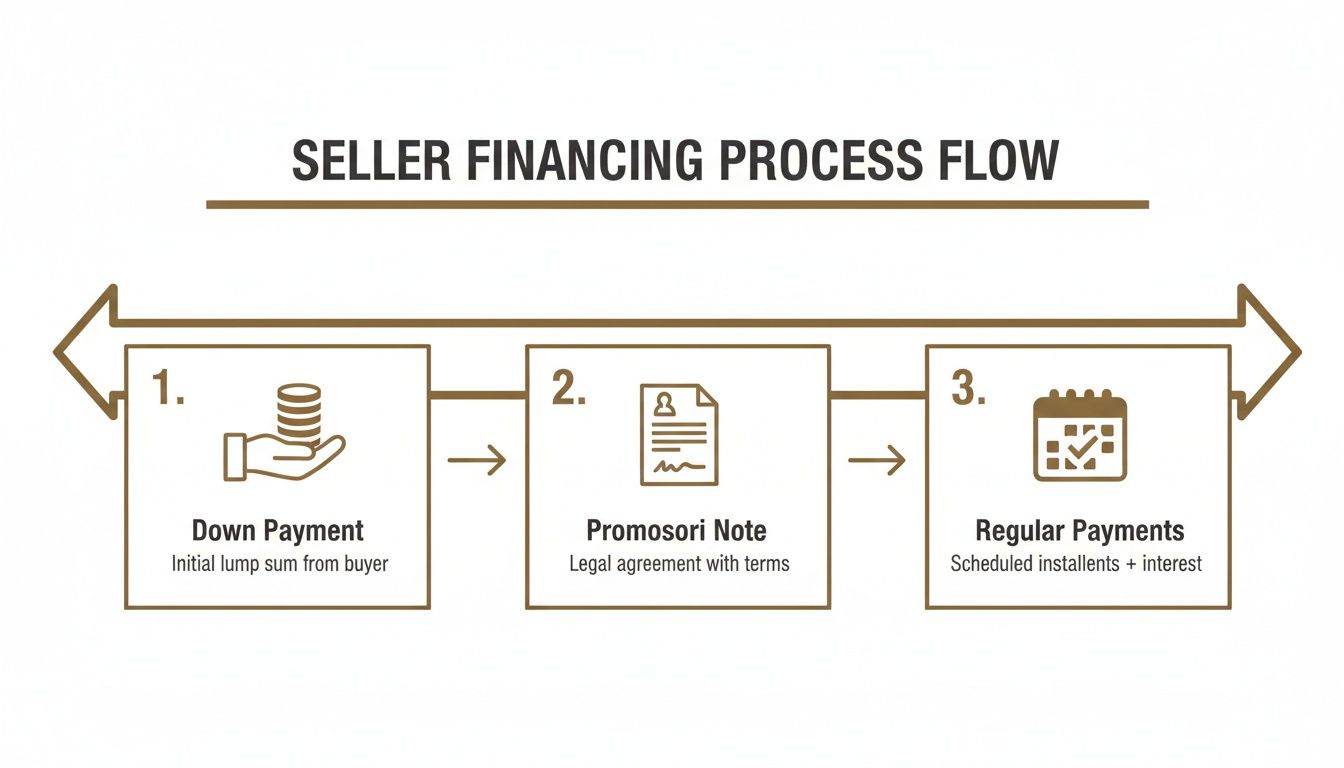
The process typically begins with a manageable down payment, is formalized with a promissory note, and continues with regular payments to the owner.
Confirm Legal Access and Easements
One of the most critical questions to answer is: how do you legally access the land? A visible dirt path on a map does not guarantee a legal right to use it. You must confirm that the property has legally recorded access.
- Public Road Frontage: This is the ideal scenario, where your property borders a road maintained by the county or state.
- Deeded Easement: If the property is landlocked (surrounded by other private properties), you need a legal easement recorded in the deed. An easement is a permanent, legal right to cross another person's property to reach your own.
A property without clear, legal access can be extremely difficult to use or sell. Do not rely solely on the seller's word; always verify access by reviewing the deed and official county plat maps.
Investigate Zoning and Land Use Restrictions
Your plans for the land must comply with local county regulations. Zoning regulations are rules that dictate how land in a specific area can be used, whether for residential, agricultural, recreational, or commercial purposes.
Contact the county's Planning and Zoning department directly and ask specific questions:
- What is the zoning designation for this parcel?
- Can I build a single-family home on this property?
- Are there restrictions on living in an RV or tiny home?
- What is the minimum acreage required to build or install a septic system?
- Are there any planned developments in the surrounding area?
Every county has different rules, so this is a mandatory step. Skipping it could prevent you from using the land as you intend.
Verify Utility Availability
Undeveloped rural land rarely comes with utilities already in place. It's crucial to know what is available and what it will cost to get services to your property.
- Water: Is there a municipal water line nearby? If not, you will likely need to drill a well. Contact local well drillers to ask about average well depths and costs in the area.
- Sewer: If public sewer is not available, you will need a septic system. A soil evaluation, often called a "perc test," performed by a qualified professional will determine if the land is suitable for a septic system.
- Electricity: How far is the nearest power pole? Extending electrical lines can be very expensive, sometimes costing thousands of dollars per quarter-mile.
- Internet: Research connectivity options. Check for the best rural internet provider options, which may include satellite or cellular services.
Understanding these potential costs upfront is essential for budgeting.
Conduct a Title Search
A title search is a professional review of public records to confirm the property's legal ownership and identify any issues. This is a non-negotiable step to protect your investment.
A thorough title search will uncover potential problems such as:
- Liens: Unpaid debts attached to the property, such as back taxes or mechanics' liens.
- Encumbrances: Other claims or restrictions, like easements or ongoing legal disputes.
- Chain of Title: The complete ownership history, ensuring all past transfers were legitimate.
Always hire a professional title company or real estate attorney to conduct the title search. They can also help you obtain title insurance, which protects you financially from any title defects discovered after the purchase.
By carefully working through this checklist, you can move forward with confidence. For a more detailed look at what to evaluate, explore our guide on what to look for when buying land.
What This Means for Buyers
For a first-time land buyer, pursuing rural land for sale by owner is about shifting from a passive role to an active one. Instead of relying on an agent to provide information, your primary job is to investigate the property yourself, step by step. This hands-on approach empowers you to make a well-informed decision.
The freedom of an FSBO transaction is its greatest benefit. You can negotiate directly, avoid agent commissions, and access flexible seller financing. However, this freedom is balanced by the responsibility of due diligence. You become the project manager, tasked with confirming every critical detail, from legal access to zoning rules.
This process is not about becoming a land expert overnight. It is about knowing which questions to ask and where to find the answers. Each task you complete—a phone call to the county, a review of the deed—builds your confidence and ensures you are making a sound investment. The goal is to be empowered by what you know, removing uncertainty from the purchase.
Why Consider Dollar Land Store?
When searching for rural land for sale by owner, you may encounter individual sellers or specialized businesses. Dollar Land Store is an established seller of vacant land, not a real estate agency or broker. Our process is designed to combine the benefits of an FSBO transaction with the reliability of working with a professional company.
Our approach addresses common concerns for first-time buyers by providing:
- Affordable Land with Low Monthly Payments: We specialize in offering undeveloped land at accessible price points.
- Simple Seller-Financing: Our seller-financing options are straightforward, with no credit checks required, making land ownership attainable for a wider range of buyers.
- Transparent Terms: All property listings and purchase agreements provide clear terms and disclosures, so you know exactly what to expect.
- Fast Contract Setup: We handle the paperwork and use a streamlined digital process to make the purchase experience efficient and secure.
- Inventory Across Multiple States: We offer a diverse selection of rural and recreational land in various regions of the United States.
- No Agents or Middlemen: As the direct seller, we eliminate the need for agents, allowing for clear communication and a simpler transaction.
Working with an experienced seller like Dollar Land Store provides a structured and transparent path to owning land.
Buyer Guidance / Next Steps
With a solid understanding of how to approach an FSBO land purchase, you are ready to take the next step. The key to a successful purchase is methodical research and a commitment to verifying every detail.
- Browse available parcels to see how properties are described and what terms are offered.
- Learn more about seller financing to understand how affordable payments can make land ownership possible.
- Contact DLS with questions about the buying process or specific properties.
- Understand how to evaluate land independently by using a due diligence checklist for every property you consider.
The journey from searching for land to owning it is a process of careful investigation. Taking the time to confirm access, zoning, and title ensures you are making a wise long-term investment.
Conclusion
Buying rural land for sale by owner is a practical and rewarding way to become a landowner. By dealing directly with the seller, you gain more control over the transaction and can often access flexible financing that makes land ownership affordable.
Success depends on your willingness to be an active participant in the process. By conducting thorough due diligence—confirming access, investigating zoning, verifying utilities, and ensuring a clean title—you can confidently navigate the purchase. This hands-on approach empowers you to avoid common pitfalls and make a smart investment in your future.
Browse available land at DollarLandStore.com.