


What to Know Before Buying Land: A Comprehensive Guide
Ross AmatoBuying raw land is one of the most exciting investments you can make, but it's very different from buying a house. Before you fall in love with the beautiful views, it's critical to look past the scenery and understand exactly what you're buying. This is where due diligence comes in—it’s the single most important step in the land-buying process, and skipping it is the biggest mistake a new buyer can make.
Due diligence is simply the research you do to uncover a property's details before you sign on the dotted line. It’s your homework, your investigation, and your best protection against costly surprises. This guide will walk you through exactly what to know before buying land to ensure your purchase is a confident and successful one.
Starting Your Journey: The Land Buyer's Essential Checklist
With a house, you can see a leaky roof or a cracked foundation. With raw land, the biggest potential deal-breakers are invisible, hidden away in county records, zoning maps, and title reports.
Think of due diligence as a home inspection for dirt. It’s your chance to find out if your dream off-grid cabin is even allowed, or if that perfect-looking access road could be legally blocked by a neighbor tomorrow. A few hours of research today can save you from a massive headache and thousands of dollars down the road. This checklist covers the core areas you must investigate.
The Core Areas of Investigation
Your research should be focused and methodical. We can break it down into four foundational pillars, each one answering a make-or-break question about the property. Getting clear, confident answers here is non-negotiable.
-
Legal & Physical Access: How do you get to your land? It’s not enough to see a dirt road. You need to confirm there's a legally recorded right of way (legal access) and that the road is actually driveable (physical access).
-
Zoning & Land Use: What can you actually do with the property? Local county zoning rules will tell you if you can build a home, camp long-term, park an RV, or raise livestock.
-
Utilities & Services: How will you get the basics? This means checking for power lines, figuring out if you can drill a well for water, and determining if the soil is suitable for a septic system.
-
Title & Ownership History: Is the seller the true owner? A title search ensures they have the right to sell the property and that there are no old debts or claims (liens) attached to it that could become your problem.
Performing thorough due diligence is the most important part of what to know before buying land. It transforms a potentially risky purchase into a confident, well-informed investment in your future.
To put it into perspective, I've seen buyers find what they thought was the perfect parcel, only to learn it was landlocked. They had physical access down a friendly neighbor's road for years, but no legal easement was ever recorded. When the neighbor sold their property, the new owner put up a gate, and just like that, their land became unreachable. This is exactly the kind of disaster this checklist helps you avoid.
Quick Due Diligence Checklist for Land Buyers
To make things even simpler, here's a quick reference table. Think of this as your starting point for every single property you consider. Each item is a thread to pull—unraveling it will tell you the real story of the land.
| Checklist Item | Why It's Critical |
|---|---|
| Clear Title | Confirms the seller can legally sell the property and that it's free of liens or claims from others. |
| Legal Access | Ensures you have a permanent, undeniable right to get to your land. Without it, your property could be landlocked. |
| Zoning & Use Restrictions | Dictates what you're allowed to build or do. It tells you if your plans for a home, RV, or farm are even possible. |
| Utilities Availability | Determines the cost and feasibility of getting power, water, and septic. Essential for any kind of building. |
| Property Taxes | Verifies that taxes are current. Unpaid taxes can lead to foreclosure, and you need to know the annual cost. |
| HOA/POA Covenants | Reveals any community rules that might restrict things like fence types, building sizes, or even what animals you can keep. |
| Environmental Concerns | Checks for issues like flood zones, unstable soil, or past contamination that could make the land unusable or unsafe. |
Remember, this isn't about finding problems for the sake of it. It's about buying with your eyes wide open, so the land you choose can truly become the place you've been dreaming of.
Your Due Diligence Deep Dive: Decoding Property Details
Alright, you’ve gone through the initial checklist. Now it’s time to put on your detective hat. This is where the real work begins—the hands-on research that turns assumptions into solid facts. This deep dive is single-handedly the most important part of the process, protecting you from nasty surprises down the road and making sure the land is truly a perfect fit for what you have in mind.
This means you'll be making a few phone calls, digging into online county databases, and hopefully, putting your own boots on the ground. It’s less about ticking off boxes and more about getting to know the land's true character. Let's break down exactly how to investigate the essentials for any piece of rural land.
Confirming Access: Legal and Physical
Access isn't as simple as seeing a road on Google Maps. It’s a two-part puzzle, and you absolutely need to solve both pieces.
-
Legal Access: This is your guaranteed, undeniable right to get to your property. It’s usually established by a public road touching your property line or a recorded easement that lets you cross a neighbor’s land. You can verify this by looking at the county’s plat maps or the property's deed history, which you can typically find at the County Recorder or Clerk's office.
-
Physical Access: This is the actual road or trail on the ground. Is it a well-kept gravel road? A rugged dirt path that demands a 4x4? Or is it completely overgrown and impassable? It’s possible to have legal access on paper but no physical road, making your land practically unreachable without spending a fortune. There's no substitute for visiting the property to see for yourself.
Without both, you could end up with a landlocked parcel that’s virtually useless.
This simple workflow shows the natural order of your investigation: confirm you can get there, find out what you’re allowed to do, and then figure out if you can get basic services.
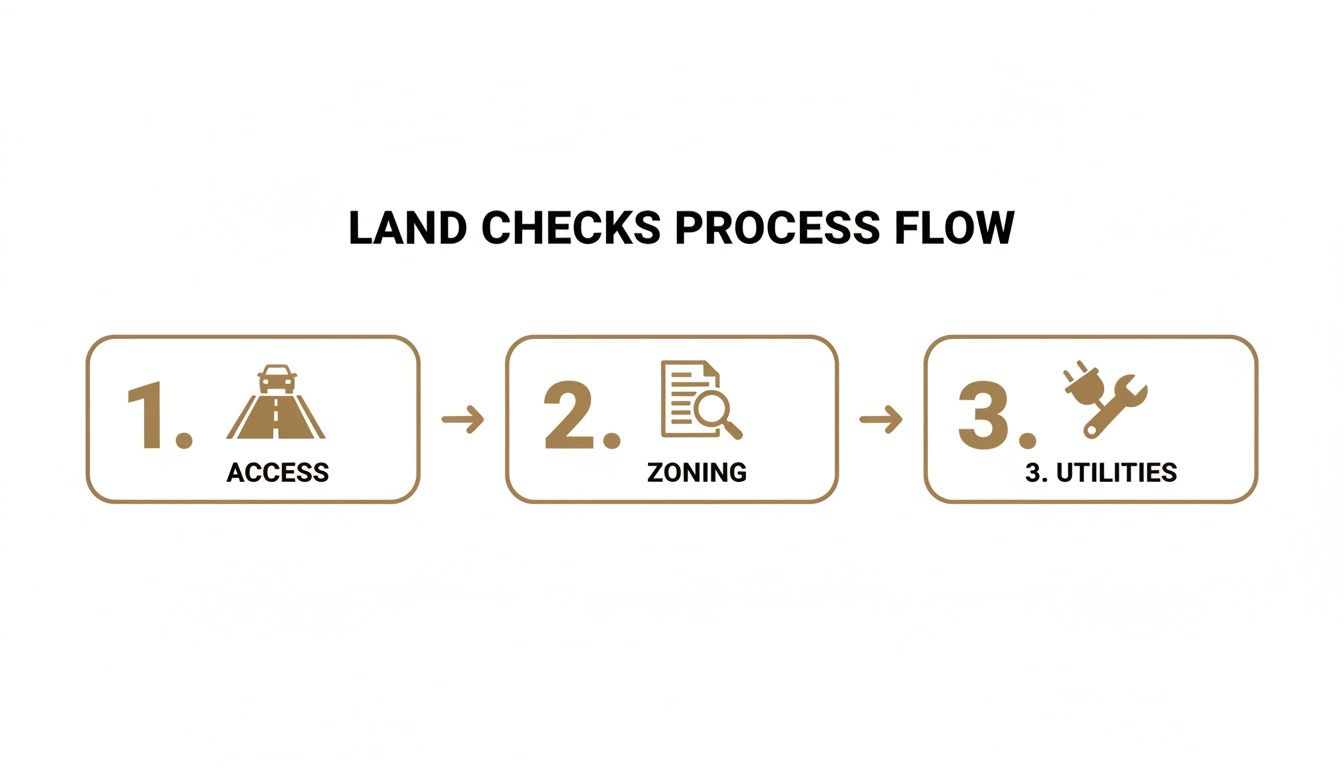
Nailing these three checks is fundamental. It’s how you ensure a piece of land will work for what you want, whether that’s recreation, investment, or building your dream home.
Researching Zoning and Permitted Uses
Zoning rules are the local laws that dictate exactly what you can and cannot do on your land. They’re set by the county, and trust me, they are non-negotiable.
Never, ever rely on what a seller claims or what you think you can do. The only way to get the real story is to call the county’s Planning and Zoning Department. Have the property’s Assessor’s Parcel Number (APN) handy and ask direct questions about your plans:
- Can I camp here? If so, for how long at a time?
- Am I allowed to park an RV on the property?
- Is this lot zoned for a single-family home?
- What are the setback requirements for building a shed or a house?
A quick five-minute phone call can save you from the massive headache of buying a property you can't even use.
Verifying Title and Ownership
A clean title is everything. It’s the proof that the seller has the legal right to sell you the property and that there are no old debts (liens) or ownership disputes attached to it. While a formal title search is usually handled by a title company in a traditional closing, reputable sellers like Dollar Land Store guarantee a free and clear title on every single property we sell.
This transparency removes a layer of risk and complexity right off the bat, providing peace of mind for buyers. It’s important to remember that the land market can have tangled ownership histories. For any buyer, ensuring that title is clean and clearly recorded is just as critical as the price per acre.
Investigating Utilities for On-Grid and Off-Grid Land
Figuring out how you’ll get power and water is a major factor that will heavily influence your budget and your plans.
-
For On-Grid Use: If you’re planning to build a traditional home, get in touch with the local utility companies. Ask them if service is available at the property line and, more importantly, get a quote to extend power poles or water lines. These costs can easily run into the tens of thousands of dollars.
-
For Off-Grid Use: If you're going the self-sufficient route, your research shifts. For water, you’ll need to look into the cost and feasibility of drilling a well. For wastewater, you'll need a septic system, which first requires a percolation (perc) test to see if the soil can absorb liquid properly. A failed perc test can completely stop a building project in its tracks.
A professional survey can be a lifesaver for confirming boundaries and spotting potential issues before you commit. If you're thinking about it, check out our guide on how to survey your own property for some helpful pointers.
How to Finance Your Land Purchase Without a Bank
For many people dreaming of owning land, the biggest hurdle isn't finding the perfect spot—it’s figuring out how to pay for it. Getting a traditional bank loan for raw, undeveloped land is notoriously tough. Banks tend to see vacant land as a risky investment since it doesn't produce immediate income and can be harder to sell than a house.
This caution means they set the bar incredibly high for borrowers. To even be considered for a conventional land loan, you’ll likely need a large down payment (often 20-50%), a top-tier credit score, and a mountain of paperwork. The entire process can be slow and frustrating, knocking many first-time buyers right out of the game.
But here's the good news: there’s a much more direct and accessible way to do it, one that cuts the banks out of the picture entirely.
Understanding Owner Financing
Owner financing, sometimes called seller financing, is a simple concept: the person or company selling the land is also the one lending you the money to buy it. Instead of going through a bank, you make your monthly payments directly to the property owner. It’s a straightforward, common-sense approach that opens up land ownership to people from all walks of life.
This method completely removes all the usual institutional roadblocks. Companies like Dollar Land Store are built on this model because our goal is to make land ownership achievable for everyone. Since we own every property we sell, we can offer flexible, transparent terms without involving underwriters and loan committees.
How the Process Typically Works
The whole point of owner financing is to keep things simple and fast. It eliminates the middlemen and the headache-inducing paperwork that comes with bank loans, making it the perfect route for anyone who wants to buy land without a massive upfront investment.
Here’s a quick look at the typical steps:
- Find a Property: You browse listings from a seller who offers owner financing.
- Agree on Terms: Everything—the purchase price, down payment, interest rate, and monthly payment—is laid out clearly in a purchase agreement. No fine print.
- Make a Down Payment: Down payments are usually very low. For instance, Dollar Land Store offers plans starting at just $1 down plus a one-time document fee.
- Sign the Paperwork: You sign a land contract and a promissory note electronically. These documents formalize your payment plan and the terms of the sale.
- Start Making Payments: You begin making your affordable monthly payments directly to the seller. Once the property is paid off, the deed is officially transferred into your name.
The beauty of owner financing is its predictability. You lock in a fixed interest rate and a consistent monthly payment for the entire term of the loan, so there are no surprises down the road.
Comparing Financing Options
The difference between a conventional bank loan and owner financing is night and day, especially for people buying affordable, rural land. Getting a handle on these differences is a crucial part of what to know before buying land.
| Feature | Bank Loan for Land | Owner Financing (DLS Model) |
|---|---|---|
| Credit Check | Almost always required | No credit check needed |
| Down Payment | Typically 20-50% | As low as $1 + doc fee |
| Approval Process | Weeks or even months | Instant or within hours |
| Flexibility | Rigid, one-size-fits-all terms | Flexible and straightforward |
| Accessibility | Limited to high-credit buyers | Open to everyone |
This comparison makes it clear why so many people are turning to owner financing. It’s a practical tool that empowers everyday buyers to acquire an asset without the traditional gatekeepers getting in the way. For a deeper dive, our guide on owner financed land for sale breaks down even more benefits of this simple path to ownership.
What This Means for Buyers
Understanding these details—access, zoning, utilities, and financing—is what separates a smart land purchase from a potential disaster. For a first-time buyer, this knowledge is your power.
It means you can look at a listing and know exactly what questions to ask. You can call a county office with confidence and understand what their answers mean for your plans. You won't waste time on properties that don't fit your goals, and you won't overpay for a parcel with hidden problems.
Most importantly, it means you can move forward without fear. By doing your homework, you transform the process from a gamble into a calculated, strategic investment in your future. This due diligence ensures that the land you buy will truly serve your purpose, whether it's for recreation, investment, or building a dream home.
Why Consider Dollar Land Store?
For a lot of people who dream of owning land, the whole process can feel intimidating. Between the high costs, confusing paperwork, and strict bank financing, it’s easy to feel like it’s out of reach. That’s exactly why Dollar Land Store was created—to cut through all of that and open the door to land ownership for everyone, especially if you’re a first-time buyer.
Our entire approach is built on making things simple, transparent, and accessible. Here's what makes our process different:
- Affordable Land with Low Payments: We specialize in finding affordable rural land and offering it with low down payments and manageable monthly terms.
- Simple Owner-Financing: We offer straightforward owner financing with no credit checks, which means your financial history doesn't have to be a barrier to owning an asset.
- Transparent Terms: All terms are laid out clearly in our agreements. There are no hidden fees or surprise costs. What you see is what you get.
- Fast Contract Setup: Our process is streamlined and digital. You can browse our inventory, choose a parcel, and sign your contracts electronically in a matter of hours.
- Broad Inventory: We have a wide selection of properties across several states, giving you plenty of options to find the perfect fit for your needs.
- No Middlemen: We own every property we sell. This means no real estate agents, no banks, and no commissions—just a direct, simple transaction between you and us.
When you work with Dollar Land Store, you're partnering with a team dedicated to making your dream a reality. We handle the complexities so you can focus on your vision for your new property.
Your Next Steps to Becoming a Landowner
You've done the hard part—you now understand what to look for, what to ask, and how to protect yourself when buying land. That knowledge is your most powerful tool. Now, it’s time to shift gears from learning to doing and start turning that dream of owning land into a reality.
The very first step is getting crystal clear on what you want. What’s the end goal?
- A Weekend Escape? Are you picturing a private spot to camp, hunt, or just get away from it all?
- A Smart Investment? Is the plan to buy an affordable piece of land now and let its value grow over the years?
- A Future Home? Do you see yourself building an off-grid cabin or a forever home down the road?
Your answer will help you zero in on the right location, the perfect acreage, and the kind of property that truly fits your vision. With your goal in mind, you can start looking at properties with a real purpose. When you feel ready to take that next step, we've made the process as simple as possible.
Ready to find your piece of the American West? Your journey starts now.
- Browse available land at DollarLandStore.com.
- Explore seller-financed land options through Dollar Land Store.
- Contact Dollar Land Store with any questions about buying raw land.
Conclusion
Buying land is a significant milestone, and being well-informed is the key to a successful purchase. By focusing on the fundamentals—verifying access, understanding zoning, checking utilities, ensuring a clear title, and exploring accessible financing—you can move forward with confidence. The process doesn't have to be complicated or out of reach. With the right knowledge and a trustworthy partner, you can turn your goal of land ownership into a tangible asset and a source of pride for years to come.