


Your Guide to Buying 10 Acres of Land
Ross AmatoTrying to picture a plot of land from a listing can be difficult for a first-time buyer. So, what does 10 acres actually look like? A helpful comparison is about seven and a half football fields put together. It's a size that is large enough for a home, a garden, and plenty of room for privacy, but still manageable for someone new to land ownership. This guide will provide practical information to help you understand the process.
What Does 10 Acres of Land Actually Look Like?
For anyone new to buying land, understanding the scale of 10 acres is the first step. It is a popular parcel size because it strikes a balance between having enough space for various projects and not being overwhelming to maintain.
Imagine a square piece of land nearly 660 feet long on each side. That’s more than enough room for significant privacy, a small hobby farm, or your own private recreational area. It's a blank canvas for your vision, whether that’s a self-sufficient homestead, a weekend getaway for camping, or a long-term investment.
A Balance of Versatility and Affordability
Many buyers find that 10-acre parcels offer an ideal combination of features. You get the seclusion and freedom that a smaller lot cannot provide, but without the higher cost and maintenance that come with much larger 40-acre tracts. This versatility makes it a practical choice for many different goals.
With ten acres, you could plan for:
- A main house with a large yard and a workshop or barn.
- A sizable garden, a small orchard, or a greenhouse.
- A fenced pasture for a few animals like goats, chickens, or a horse.
- Private trails for hiking, riding ATVs, or walking.
- A dedicated campsite for personal use.
This guide is designed to be a clear resource. We will explain everything you need to know about buying your own 10 acres, from visualizing the layout and understanding costs to navigating important details like zoning and utilities. The objective is to provide the information you need to move forward with confidence.
How to Visualize and Plan Your 10 Acres
Once you have a general idea of what 10 acres entails, the next step is planning. This is where your goal of a homestead, a private weekend escape, or a practical investment begins to take shape. To do this effectively, it helps to understand how land is described and how its shape can affect its potential uses.
Before you start planning, it's useful to know a few key terms that you will see in land listings. These are fundamental for understanding exactly what you're buying.
- Acre: The standard unit of measurement for land in the United States, equal to 43,560 square feet.
- Parcel: A specific piece of land with legally defined boundaries. A parcel can be any size, including 10 acres.
- Frontage: The portion of a property that borders a road or body of water. More frontage often means easier access.
Understanding these terms will help you interpret listings and survey maps accurately, so you know exactly what a property offers.
Common Uses for a 10-Acre Property
Ten acres is a flexible size, offering enough room for significant projects without being too much for one person or family to manage. It can be ideal for self-sufficiency, recreation, and privacy.
This diagram provides a visual representation of the space, comparing it to football fields and illustrating how it could accommodate a home and a large garden.
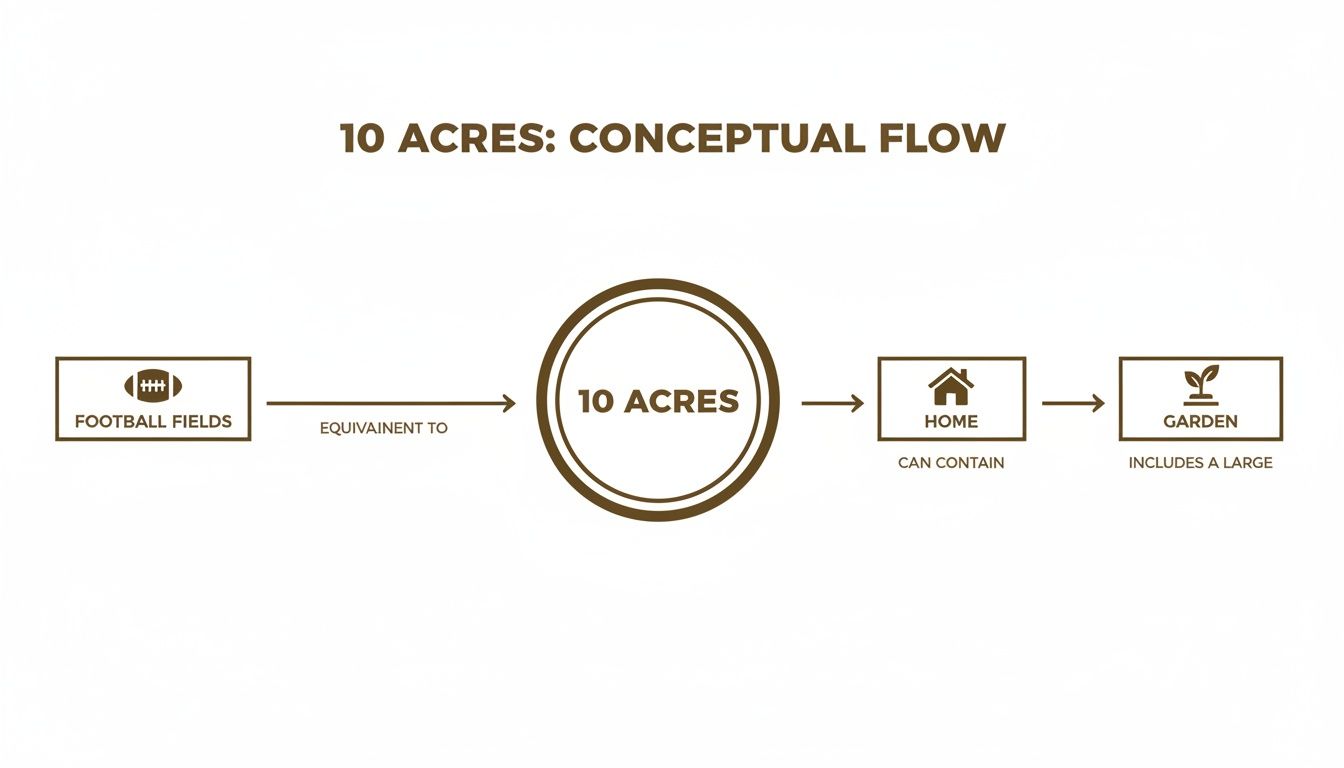
As shown, 10 acres is a generous amount of land, providing plenty of space for more than just a house. It’s a significant and versatile property for any landowner.
The table below outlines a few popular ways a 10-acre parcel could be used.
| Potential Uses for a 10-Acre Parcel | ||
|---|---|---|
| Use Case | Hypothetical Space Allocation | Key Considerations |
| Small Homestead | 2-5 acres | Suitable for a house, large garden, chicken coop, and a few small animals, with buffer space for privacy. |
| Recreational Getaway | 5-10 acres | Ideal for setting up a campsite, building a small cabin, and creating trails for ATVs or hiking. |
| Small-Scale Farming | 3-7 acres | Enough room for a market garden, a small orchard, or pasture for a couple of horses or goats. |
| Off-Grid Living | 4-8 acres | Provides ample space for a solar array, rainwater collection systems, a septic field, and a secluded home. |
| Buy-and-Hold Investment | Full 10 acres | Land is left in its natural state or with minor improvements like clearing an access road, with the goal of potential appreciation. |
These are illustrative examples. The true potential is realized when you combine elements to fit your specific vision.
How Parcel Shape Influences Your Plans
Not all 10-acre parcels are identical. The shape and layout of your land directly impact how it can be used. A square parcel is efficient for many uses, while a long, rectangular parcel might be better for creating long private trails or positioning a home far from a road.
Consider these two hypothetical examples:
- The Square Parcel (approx. 660 ft x 660 ft): This shape is often preferred by homesteaders. A house can be placed in the center for maximum privacy, with gardens, workshops, and pastures radiating outward. It is a balanced and practical layout.
- The Rectangular Parcel (approx. 330 ft x 1320 ft): This long shape might provide significant road frontage, which is useful for creating multiple access points. The deeper rear portion of the land is suitable for a private shooting range, a secluded campsite, or ATV trails away from neighbors.
Buyer Tip: Always review the plat map or satellite view in a listing to see the parcel’s shape. Consider how your primary goal—whether it's privacy, access, or a specific hobby—fits within those property lines.
Knowing the shape helps you create a mental blueprint. You can begin to visualize where a driveway could go, the best spot for a cabin, or which area receives morning sun for a garden. If you want to learn more about property lines, you can read this guide on how to survey your own property. This planning phase is crucial for ensuring the land you choose is a good match for your intended use.
Understanding the True Cost of 10 Acres
The price on a land listing is just the starting point. To make a well-informed investment, you need to look beyond that number and understand all the factors that contribute to the total cost of owning 10 acres of land. Price is a reflection of a property's features and potential. For a first-time buyer, understanding these cost drivers is key to finding land that fits both your goals and your budget.
Two 10-acre parcels located near each other can have very different prices. The reason almost always comes down to a few critical factors. For example, a remote, off-grid property in a desert region will typically be more affordable than a parcel with good road access near a growing town.
Key Factors That Determine Land Value
When you evaluate a 10-acre property, you are buying more than just land. Its value is shaped by its current features and what it would cost to make it usable for your specific purposes.
- Location and Proximity: This is a major factor. The closer land is to towns, cities, or recreational areas like lakes and national forests, the more it will likely cost. A parcel within an hour’s drive of a small town offers convenient access to supplies and services, which adds value.
- Access: A critical question is how you get to the property. Land with direct, year-round access from a county-maintained road is more valuable than a remote parcel accessible only by a 4x4 vehicle on unmarked dirt trails. It's important to confirm deeded access, which is your legal right to cross another's property to reach your own.
- Terrain and Topography: Flat, usable land is almost always more expensive than steep, rocky, or heavily wooded terrain. The topography dictates what and where you can build, and how much site preparation will cost.
- Utility Availability: Access to public utilities like electricity, city water, and sewer lines significantly increases a property's value. Most raw, rural land does not have these, which means you will need to budget for off-grid solutions like a well, a septic system, and potentially solar power.
Uncovering Additional Costs
Beyond the purchase price, several other expenses can arise. It is wise to factor these into your budget from the beginning to avoid surprises.
Buyer Tip: Always request a full cost breakdown before you commit. A transparent seller will be upfront about all fees and ongoing expenses associated with the property.
Here are the most common costs to plan for:
- Property Taxes: This is an ongoing expense. Taxes are typically paid annually and can vary widely depending on the county and state. You can usually find the most recent tax information on the county assessor’s website.
- Closing Costs or Doc Fees: Even when buying directly from a seller, there are administrative fees to prepare legal paperwork, such as the deed and land sale contract. At Dollar Land Store, we have a one-time document fee to cover this process, which is stated clearly in every listing.
- Land Survey: While not always required for purchase, a survey is a good investment. It officially marks your property boundaries, which can prevent future disputes with neighbors and is often necessary before building.
- Development Costs: If you plan to build, live, or even camp on your land, you will need to budget for improvements. This could include clearing trees, installing a driveway, drilling a well, or installing a septic system. These costs can be significant.
Understanding all these components allows you to evaluate a property's true value. For more detail, you might find our guide on how much an acre of land costs helpful. By looking beyond the listing price, you can make a more informed decision.
How Seller Financing Makes Land Ownership Possible
For many people dreaming of their own 10 acres of land, the primary obstacle is not finding the right property but financing it. If you have tried to get a traditional bank loan for raw land, you may know that lenders often view undeveloped land as a higher risk than a house. This can lead first-time buyers to believe a large cash payment is their only option.
Fortunately, there is another path. A straightforward and effective option that makes land ownership more accessible is seller financing.
The concept is simple. Instead of borrowing from a bank, you make monthly payments directly to the person or company selling the land. The seller acts as the lender, which simplifies the process and eliminates intermediaries.
The Benefits for New Land Buyers
Seller financing, sometimes called owner financing, is particularly well-suited for buying rural land. It removes common barriers, especially for those who may not have a high credit score or a large down payment.
Here’s why it is a practical option:
- No Credit Checks: Most sellers who offer financing, including Dollar Land Store, do not run credit checks. Your financial history does not prevent you from securing land.
- Low Down Payments: Banks might require 20-50% down for a land loan. With seller financing, the initial payment is often a small fraction of that. Many of our properties are available with a very low down payment plus a one-time document fee.
- Simple and Fast Process: You can avoid the extensive paperwork, strict approval processes, and long waiting periods associated with a typical mortgage. The transaction can often be completed online in a few days.
This approach makes land ownership more attainable. It means you can secure your property now and pay for it over time with a fixed monthly payment.
How Payments Are Calculated
It is important to understand what your monthly payment will be. With seller financing, the calculation is transparent.
Let’s review a hypothetical example for a 10-acre property:
Hypothetical Land Parcel
- Purchase Price: $15,000
- Down Payment: $1
- Document Fee: $249 (one-time)
- Loan Amount: $14,999
- Interest Rate: 9.0%
- Loan Term: 10 years (120 months)
With these terms, the monthly payment would be approximately $190.
This example shows how owning a substantial piece of land can be financially manageable. The terms are fixed and disclosed from the start, so there are no surprises.
Seller financing removes much of the complexity from buying land. It provides a direct, affordable path to owning your own 10 acres of land, allowing you to invest in your future without traditional financial hurdles. To learn more, you can read about what seller financing in real estate is.
Your Essential Due Diligence Checklist
 Buying land is an exciting process, and informed buyers know that success depends on thorough research. This research phase, known as due diligence, is your opportunity to verify all the details about a property before you complete the purchase. It is the most important step you can take to ensure your 10 acres of land meets your expectations.
This checklist is a guide to help you ask the right questions and contact the appropriate authorities. By taking the time to investigate these key areas, you can move forward with confidence. You can perform most of this research yourself with a few phone calls and online searches.
Confirm Zoning and Permitted Uses
The first question to ask is: “What can I legally do with this land?”
The answer comes from the county’s Planning and Zoning department. Each county has its own regulations for land use, covering everything from building a home to parking an RV or raising animals.
When you contact the county, have the Assessor’s Parcel Number (APN) available, which you can find in the property listing. Ask about the zoning designation and what uses are permitted.
Here are critical questions to have answered:
- What is the official zoning for this parcel (e.g., Agricultural, Residential, Rural)?
- Can I build a single-family home on it?
- Are there regulations regarding long-term camping or living in an RV?
- What are the minimum acreage requirements for building or installing a septic system?
Never assume you can build or live on a property without confirming with the county. These rules are not flexible, and a brief phone call can prevent significant problems later.
Verify Legal and Physical Access
Access is another critical factor. You need to confirm two things: if you have a legal right to get to your property, and if you can physically drive to it.
Legal access means there is a recorded easement or public road that provides a permanent right to reach your land. Physical access refers to the road's condition—is it a paved county road, a rough dirt trail requiring a 4x4, or something else?
While we provide detailed access information in every Dollar Land Store listing, you should always verify it for yourself. Review satellite maps and, if possible, visit the property to see the roads firsthand.
Investigate Water and Utility Options
On most rural 10-acre parcels, you will be responsible for your own water and power. This is often referred to as "off-grid" living.
Here are the typical options to consider:
- Water: Drilling a well is a common solution for a permanent water source. Contact local well drillers to get an estimate of the average drilling depth and cost in the area. For recreational use, hauling water in tanks is also a viable option.
- Sewer: A septic system is the standard for waste management on rural land. The county health department can provide information on permit requirements, which usually include a percolation ("perc") test to ensure the soil drains properly.
- Power: Extending power lines from the nearest utility provider can be very expensive. Solar power has become a more affordable and popular alternative for off-grid homes and cabins.
Buyer’s Responsibility: Remember, it is always the buyer's responsibility to conduct their own due diligence. The information provided by a seller is a great starting point, but you must confirm all details directly with the relevant local county authorities. This article does not constitute legal advice.
This checklist provides a solid foundation for your research. For a more comprehensive overview, you can read our guide on what to look for when buying land. Following these steps will help you make a smart, informed purchase.
What This Means for Buyers
Buying your first piece of land can seem like a major undertaking, but the process is often more straightforward than people imagine. Owning 10 acres is an achievable goal, especially once you understand the factors that determine its value. The price of a parcel is not arbitrary—it reflects its location, accessibility, and terrain. These are all details you can investigate yourself.
Approaching the purchase with a plan helps reduce uncertainty. By using a simple due diligence checklist and making a few calls to county offices, you are gathering facts. This research is one of the most important things you can do to make a sound purchase.
Key Takeaways for Your Journey
As you begin looking at properties, keep these points in mind:
- You are in control. You have the ability to check on zoning, road access, and utility options yourself. A few phone calls can confirm the information you need.
- Knowledge builds confidence. Becoming familiar with concepts like seller financing and due diligence demystifies the process and makes it less intimidating.
- There is a clear path forward. You do not need a large down payment or a perfect credit score to begin. Options like seller financing exist to make land ownership more accessible.
The biggest concern for many new buyers is making a mistake. By following a clear process and working with a transparent seller, you can verify every detail and ensure the land you choose is the right fit for your vision.
Why Consider Dollar Land Store?
If you are looking for a way to buy 10 acres of land, we offer a direct path to ownership. The entire approach at Dollar Land Store is built around making rural land ownership simple and affordable, particularly for individuals who are new to the process.
We specialize in raw, undeveloped land across several states. Because we sell land that we own directly to you, there are no real estate agents or brokers involved. This means no middlemen and a more streamlined transaction.
A Clear Path to Owning Your Land
Our straightforward owner financing is designed to help buyers overcome common hurdles.
- Simple Financing: We do not run credit checks. Your credit history is not a factor, making it possible for almost anyone to own land.
- Low Down Payments: Many of our properties can be secured with a small down payment, sometimes as low as $1, plus a one-time document fee.
- Affordable Monthly Payments: Our terms are structured to keep monthly payments low, so you can fit land ownership into your budget.
- A Transparent Deal: All costs are laid out clearly in our listings—the total price, the document fee, and your monthly payment. The entire purchase can be completed online, making it fast, secure, and easy to understand.
At Dollar Land Store, we sell land we own directly to our customers. This allows us to offer a clear, simple buying experience focused on making land ownership a reality, even if it's your first time.
Our goal is not just to sell land, but to provide the factual information and support you need to feel confident in your decision. We aim to be a helpful and credible resource as you take this exciting step.
Ready to Find Your 10 Acres?
You now have a solid understanding of what it takes to find, evaluate, and buy your own 10 acres. You know what this versatile parcel size can offer, what drives its price, and how to conduct your due diligence. You are prepared to move from planning to action.
The path to owning land is a series of small, informed steps. The best way to build confidence is to apply what you have learned and turn your goal into a concrete plan.
Buyer Guidance / Next Steps
Before you begin browsing listings, a few minutes of planning can make your search more efficient.
- Define Your "Why": What is the primary reason you want this land? A weekend campsite? A future homestead? An off-grid retreat? A long-term investment? Your main objective will guide all other decisions.
- Determine Your Budget: Review your finances and decide on a monthly payment that is comfortable for you. Knowing your budget helps you focus on the right properties and find financing that works for you.
- Prepare Your Toolkit: Refer back to the due diligence checklist. Save the phone numbers for the county planning department, assessor's office, and health department. Being prepared allows you to move quickly and confidently when you find a parcel you like.
Owning 10 acres of land is within reach for most people. The key is to replace uncertainty with a structured process. With the right research, a clear plan, and a transparent partner, you can confidently navigate your land-buying journey.
Once your personal plan is in place, it’s time to see what is available. Exploring real-world listings is the best way to connect this information to actual opportunities. You will begin to see how location, access, and terrain impact price and potential. This is where your research becomes practical.
Ready to take the next step? The team at Dollar Land Store is available to answer your questions and help you find the right property.