


A Beginner's Guide to Agricultural Real Estate
Ross AmatoAgricultural real estate refers to undeveloped rural land that can be used for farming, ranching, recreation, or long-term investment. Unlike residential property, where value is in the house and its location, the worth of agricultural land comes from the soil, water access, and its potential uses. For first-time buyers, understanding these fundamentals is the first step toward owning a tangible piece of America.
What is Agricultural Real Estate?
Many new buyers hear “agricultural real estate” and picture large-scale commercial farms. While that’s part of it, the term also includes smaller, more accessible parcels perfect for a weekend retreat, a small hobby farm, or simply a tangible investment. At its core, it’s about owning the land itself.
This tangible quality—knowing you can walk the property, test the soil, or set up a campsite—appeals to individuals looking for an asset outside of the fluctuating stock market. Grasping this simple concept opens up a world of possibilities in rural and undeveloped land.
Breaking Down The Core Concept
The main difference between agricultural and residential real estate isn’t the presence of buildings; it’s what the land itself can produce or provide. A house’s value is tied to its design, age, and neighborhood. Agricultural land, however, derives its value from natural features.
This could be fertile ground for growing crops, open meadows for grazing livestock, or a wooded area ideal for building a cabin. Even a remote, undeveloped tract holds value as a private hunting spot, an off-grid getaway, or a long-term asset that may appreciate over time.
Why It Matters to First-Time Buyers
Entering the world of land ownership doesn’t have to be intimidating. With agricultural parcels, you focus on clear, measurable traits—like soil type, water sources, and road access—rather than the complexities of home renovations.
Key benefits for new buyers include:
- Tangible Asset: You are investing in something physical and real—a piece of ground you can visit and use.
- Diverse Use Cases: From recreational camping and small-scale homesteading to an off-grid hideaway or a straightforward investment, the options are broad.
- Lower Entry Costs: Raw rural land is often more affordable than developed properties, especially when purchased directly from a seller offering financing, like Dollar Land Store.
The real opportunity in agricultural real estate for a new buyer is its versatility. You are not just buying acreage; you are acquiring potential. Whether for personal enjoyment, a future project, or financial growth, the land offers a blank canvas for your goals.
The Different Types of Agricultural Land
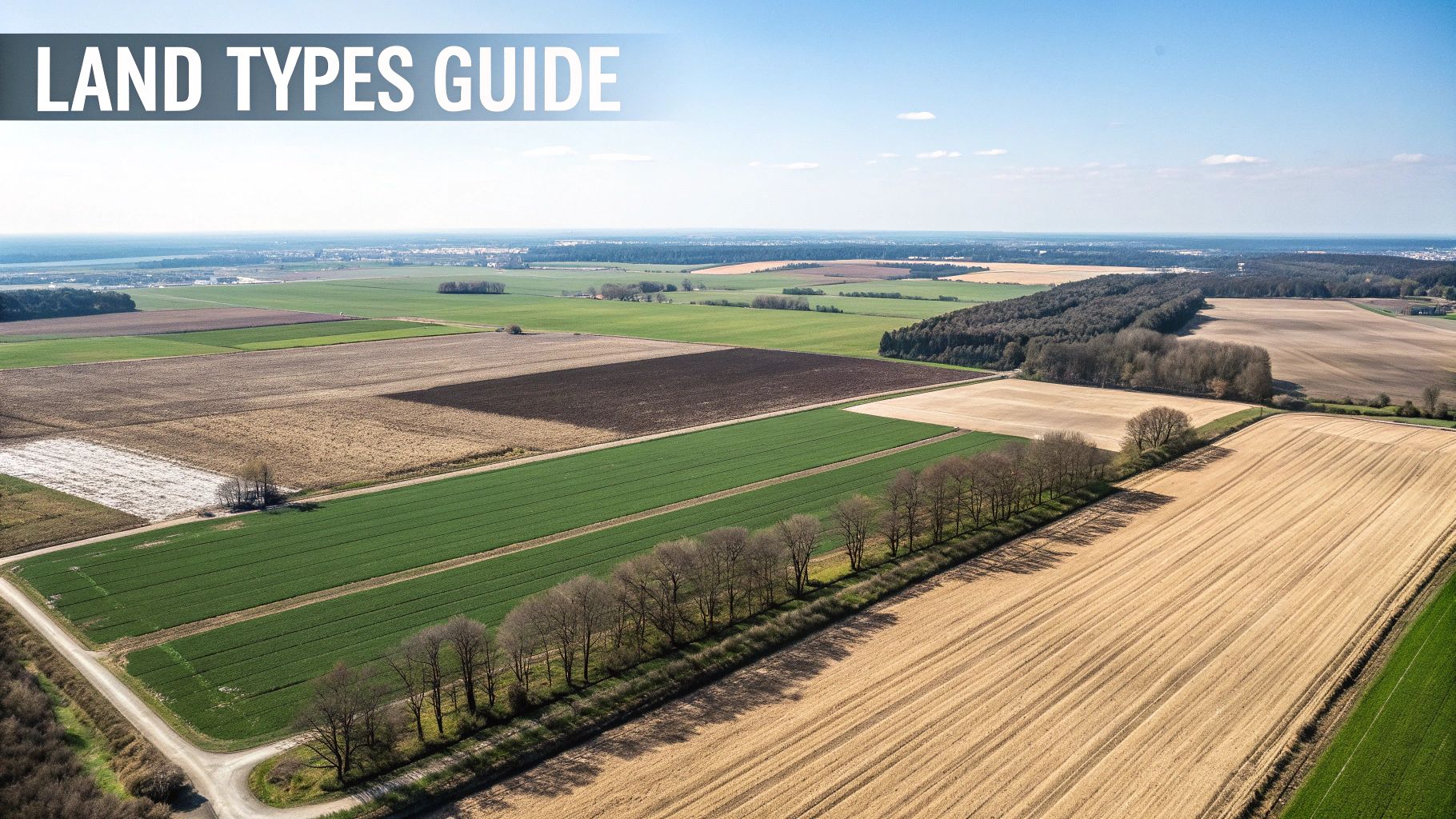
When you begin searching for agricultural real estate, it’s easy to view all open land as the same. However, rural land comes in distinct types, each suited for different purposes. Understanding these categories is the first step in matching a property to your specific goals. A listing for "raw land" doesn't tell the whole story. Is it fertile soil ready for planting, rugged hills perfect for hunting, or a quiet patch of woods for a cabin? Let's break down the common types.
Cropland: For Growing and Cultivating
This is what most people picture when they hear "farmland." Cropland is acreage intended for growing crops—from corn and soybeans to fruit orchards and vegetable gardens. Its value is primarily determined by soil quality and water availability.
Cropland is often categorized as either irrigated or non-irrigated (dryland). Irrigated land has a reliable water source, such as a well or access to a canal, making it more productive and valuable. Dryland farming relies on natural rainfall, which introduces more risk but can be effective for drought-tolerant crops. For a first-time buyer, a small, fertile parcel of cropland can be perfect for a large garden or hobby farm.
Pastureland and Ranchland: For Grazing and Open Space
Pastureland is primarily used for raising animals like cattle, sheep, or horses. Its value comes from its ability to grow forage—the native grasses and plants that livestock consume.
Key features of good pastureland include:
- A reliable water source: A creek, pond, or spring is essential for animals.
- Secure fencing: Existing fences can save a new owner significant expense and labor.
- Natural shelter: Trees or hills provide animals with protection from the elements.
Ranchland is a broader term that often includes pasture but may also feature woods, hills, or rugged terrain. These larger properties are suitable for livestock operations and are also ideal for recreational uses like hunting, hiking, and horseback riding.
Timberland: A Long-Term Growth Asset
Timberland is forested land managed for the purpose of growing trees to be harvested for wood products. This is a long-term investment strategy, as trees can take decades to mature. The land's value is tied to the species of trees, their age, and current lumber market conditions.
Beyond its commercial potential, timberland offers a quiet, secluded environment ideal for an off-grid cabin, a hunting camp, or a private natural retreat. Land with mature trees provides a unique sense of peace and privacy.
Recreational Land: For Personal Enjoyment
This category includes land where the primary goal is personal use and enjoyment rather than generating income. A recreational parcel might be a wooded lot for hunting, a property with a pond for fishing, or a remote spot for camping and hiking.
Here, value is measured by the quality of the experience. Desirable features include:
- Proximity to public land: A property bordering a national forest or state park expands your recreational area.
- Natural features: A creek, a scenic view, or interesting topography can make a property unique.
- Year-round access: It's important to confirm you can reach the property in all seasons if you plan to visit often.
For many first-time buyers, recreational land is an excellent entry point. It’s a tangible asset you can use and enjoy immediately without the management demands of a working farm.
Matching Land Types to Your Goals
This table helps illustrate which type of agricultural land might best suit your objectives.
| Land Type | Primary Use | Key Characteristics | Ideal For |
|---|---|---|---|
| Cropland | Growing crops | Fertile soil, water access (irrigation), level terrain | Hobby farmers, homesteaders, commercial farm investors |
| Pastureland | Grazing livestock | Native grasses, reliable water, good fencing | Ranchers, livestock operators, equestrian enthusiasts |
| Ranchland | Livestock and recreation | Mix of pasture, woods, rugged terrain; large acreage | Buyers seeking open space, privacy, hunting, and grazing |
| Timberland | Wood production, long-term investment | Forested with valuable tree species, long timeline | Long-term investors, hunters, buyers wanting a secluded retreat |
| Recreational Land | Personal enjoyment | Natural beauty, unique features, physical access | Outdoor enthusiasts, weekend campers, off-grid adventurers |
How Agricultural Land Value Is Determined
Evaluating residential property often focuses on square footage, bedrooms, and neighborhood. With agricultural land, the criteria are entirely different. Acreage is just a starting point—the real value is determined by what the land can do.
Understanding these value drivers is critical for a first-time buyer. It helps you identify a property with strong potential and avoid one with hidden limitations. A smart assessment protects your investment and ensures the land aligns with your goals, whether for homesteading, recreation, or long-term holding.
Core Physical Attributes
The land itself reveals most of what you need to know. These physical traits form the foundation of its value.
The three most important attributes to investigate are:
- Soil Quality: Healthy soil is essential for nearly any agricultural use. A property with rich loam that supports crops or pasture will be more valuable than land with rocky, sandy, or clay-heavy soil.
- Topography: This term refers to the land's physical shape. Is it flat, gently rolling, or steep? Flat and rolling terrain is ideal for farming and building. Steep, rugged land may be better suited for hunting or hiking but presents challenges for development.
- Water Availability: Access to a reliable water source is critical. This can include surface water (rivers, creeks, ponds) or groundwater (wells). In many states, especially in the West, legal water rights are a significant component of the property's value.
Legal and Logistical Factors
A property's value is also tied to legal permissions and practical considerations.
Access is essential. The property must have both legal and physical access. Legal access means there is a recorded public road or a permanent, deeded easement allowing you to cross another property to reach yours. Physical access means you can actually drive a vehicle onto the land. A landlocked parcel without guaranteed legal access has very limited value.
Zoning and land-use regulations are equally important. Local counties establish these rules, which dictate what you are permitted to do. Land zoned for “Agricultural Use” will have different permissions than land zoned "Residential" or "Recreational." Buyers must verify the specific zoning and permitted uses directly with the county planning department before purchasing.
A real estate comparative market analysis can also be a helpful tool. This process helps you understand how a property's features compare to similar parcels that have recently sold in the area, providing context for its price.
Market and Economic Influences
The value of agricultural land is also influenced by broader economic trends. Commodity prices, the growth of nearby towns, and overall demand for rural land all play a role. For example, as a city expands, undeveloped land on its outskirts typically becomes more valuable.
Recent market data shows that land values have continued to climb. According to the USDA, U.S. cropland values reached an average of $5,460 per acre in 2023, an 8.1% increase from the previous year. This trend demonstrates that land remains a stable, tangible asset.
Navigating the Purchase Process
The financial and legal aspects of buying agricultural land can seem complex, but breaking them down into manageable steps makes the process much clearer. This section serves as a roadmap for handling the business end of your land purchase, from financing to final paperwork.
Financing Your Agricultural Real Estate Purchase
Securing funding is often the first major step. While traditional lenders like banks offer land loans, their requirements can be a significant barrier for first-time buyers.
They often require:
- Large Down Payments: Lenders may demand 20% to 50% of the purchase price upfront for raw land, which they consider a higher-risk asset than a house.
- High Credit Scores: A strong credit history is almost always necessary to qualify for a conventional land loan.
- Detailed Development Plans: Some banks will not finance undeveloped land without a comprehensive plan for its use.
These requirements make traditional financing impractical for many aspiring landowners.
The Seller Financing Advantage
Seller financing, also known as owner financing, is an arrangement where the seller of the property also acts as the lender. This direct approach removes banks from the transaction, creating a more flexible and accessible path to ownership.
At Dollar Land Store, this is our primary model. It is designed to be straightforward and transparent, particularly for those new to buying land. There are no credit checks, and all terms are clearly stated from the beginning. This process makes land ownership achievable without needing a large down payment or navigating the strict requirements of a traditional lender.
Understanding Key Legal and Financial Details
Once financing is in place, a few other critical details must be addressed to protect your investment.
- Property Taxes: All landowners pay annual property taxes to the local county. It is wise to investigate if the land qualifies for an agricultural exemption, which can significantly lower the tax bill. Always contact the county treasurer or assessor’s office to confirm the current tax status and annual amount due.
- Title Insurance: This is a one-time policy that protects you from past claims on the property, such as unresolved liens or ownership disputes. It ensures you receive a "clear title," meaning your ownership is legally sound.
- Water, Mineral, and Access Rights: Owning land does not automatically grant you ownership of everything associated with it. You must verify what rights are included in the sale. This includes your legal right to access the property, rights to any water on or under it, and ownership of any minerals beneath the surface. Ensure these details are clearly defined in your purchase agreement.
The Buyer's Due Diligence Checklist
Thorough research, known as due diligence, is what separates a smart land investment from a costly error. A property listing provides the highlights, but it is the buyer's responsibility to verify every detail with official sources before committing to a purchase. Following this checklist will help you avoid common pitfalls and ensure the land you buy is right for your needs.
This infographic outlines the three core stages of the land buying journey, from arranging financing to taking ownership.
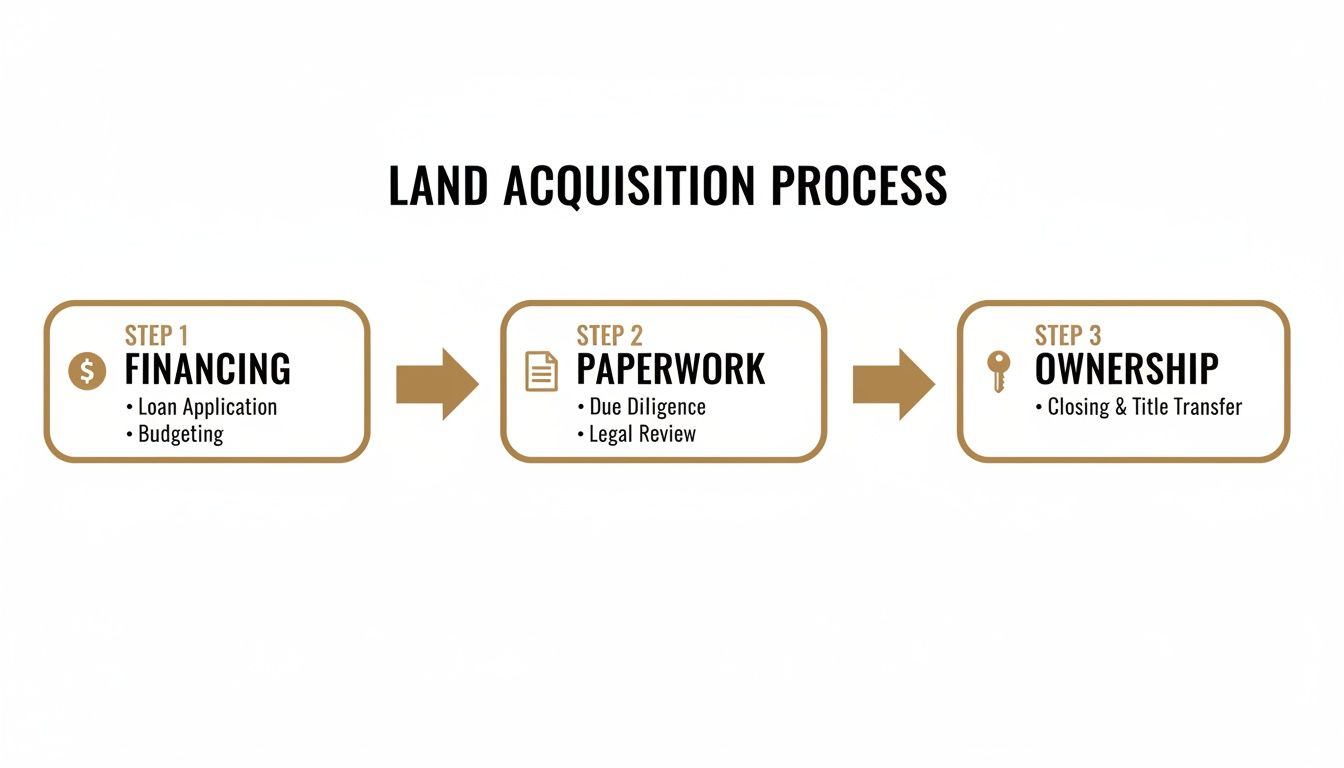
As you can see, buying land is a process involving financial, legal, and administrative steps that must align for a secure purchase.
Verify Zoning and Permitted Land Uses
Your first step should be to confirm what the county will allow you to do on the property. Zoning regulations are local laws that control land use and vary significantly between counties.
Contact the county planning and zoning department and ask two key questions: What is the exact zoning designation for this parcel? And what are the permitted uses under that designation? Can you build a residence? Is camping allowed? Are there restrictions on livestock? Never assume—get direct confirmation from the local authorities.
Confirm Legal and Physical Access
A beautiful property is of little use if you cannot legally and physically get to it.
- Legal Access: This confirms that a public road touches the property or that a formal, recorded easement grants you permanent right to cross a neighbor's land to reach yours. This is a critical legal requirement.
- Physical Access: This refers to the actual condition of the road. Is it passable year-round? Does it require a four-wheel-drive vehicle?
You can verify legal access at the county recorder’s office by reviewing the property's deed and official maps. For physical access, an in-person visit is the only way to be certain.
Investigate Water and Utilities
If your plans include building or farming, water is a primary concern. Investigate both its availability and your right to use it. Is there a municipal water line nearby, or will you need to drill a well? If a well is the likely option, contact local drilling companies to ask about typical well depths and costs in the area.
Apply the same process to other utilities. Determine the location of the nearest power lines. Extending electricity over a long distance can be very expensive. Also, check with the county health department regarding the requirements for installing a septic system. Our guide on what to ask when buying land offers a more complete list of questions.
Check for Liens and Encumbrances
Finally, ensure the property has a "clear title," which means no one else has a hidden legal claim to it. A professional title search will uncover any issues like old debts (liens), unpaid taxes, or other encumbrances. This step is essential for protecting your ownership rights.
What This Means for Buyers
Navigating the world of agricultural real estate becomes much simpler once you understand a few key concepts. Market trends, valuation methods, and due diligence are tools to help you find the right property for your goals. Most importantly, owning a piece of rural America is an achievable goal for everyday people, not just large-scale investors.
With these fundamentals, you can look at a raw land listing and see its true potential. The process transforms from an intimidating financial puzzle into a straightforward search for a solid, tangible asset—something real and disconnected from the daily volatility of the stock market. For a deeper look at market trends, you can review analysis on the state of the 2025 agricultural market.
The two factors that make land ownership possible for more people are knowledge and accessible financing. You don’t need a background in agriculture or a large sum of cash to begin. By doing your homework and utilizing simple purchase options like seller financing, you can confidently take the first step toward building tangible wealth, creating a private retreat, or starting a new chapter of self-sufficiency.
Why Consider Dollar Land Store?
The traditional process of buying agricultural real estate—with its bank loan applications, real estate agents, and complex closing procedures—can feel overwhelming for a first-time buyer. Dollar Land Store was founded to offer a simpler, more accessible path to land ownership.
Our business model is built on transparency and simplicity. We purchase and own every parcel of land we sell, which means you deal directly with us. There are no agents or middlemen. Our focus is on providing affordable raw land across multiple states with a clear, straightforward purchase process.
Key features of buying with Dollar Land Store include:
- Simple Seller Financing: We offer seller financing with no credit checks, making land ownership accessible to more people.
- Low Monthly Payments: Our financing is structured with affordable monthly payments to fit a variety of budgets.
- Transparent Terms: All costs and terms are disclosed upfront, with no hidden fees.
- Efficient Process: The entire transaction, from contract to ownership, is handled efficiently and documented clearly.
Our goal is to remove the traditional barriers to owning land, allowing you to focus on finding the perfect property for your needs.
Your Next Steps
Armed with this foundational knowledge, you are better prepared to start your search for agricultural real estate. The journey to owning land begins with clear goals and careful research.
To continue your journey, consider the following actions:
- Browse available parcels: Take a look at the variety of properties available to get a feel for different types of land and locations.
- Learn more about seller financing: Understand how this accessible financing option can make your land ownership goals a reality.
- Ask questions: Don't hesitate to reach out to professionals or sellers with your questions. A reputable seller will always be willing to provide clear answers.
Conclusion
Investing in agricultural real estate is about more than just buying land; it’s about acquiring a tangible asset with a world of potential. By understanding the different types of land, what drives their value, and the steps involved in the purchase process, you can approach the market with confidence. Whether your goal is recreation, investment, or building a homestead, the path to owning your own piece of land is within reach.
Ready to take the next step? Browse available land at DollarLandStore.com.