


Colorado Land for Sale Park County: A Practical Guide
Ross AmatoYou're comparing a low-priced mountain parcel with a mental picture of a future cabin, weekend retreat, or homesite. The difficult part is separating what the listing appears to offer from what the land can legally and practically support. For Colorado land for sale in Park County, the right first question isn't “How much is the parcel?” It's “What would make this parcel usable for my intended purpose?”
Park County can offer privacy, mountain scenery, and rural recreation, but raw land often comes with unanswered questions about access, water, wastewater, electricity, roads, hazards, and permits. The following guide focuses on those feasibility traps so you can evaluate the total project rather than judge land by its listing price alone.
Understanding the Park County Land Market
Affordable-looking land is easier to find when you search across a large rural county, but that scale also makes comparisons difficult. Park County had 17,390 residents in the 2020 Census and an estimated 18,117 residents on July 1, 2023, spread across 2,193.51 square miles of land, producing a population density of roughly 7.9 people per square mile, according to Census-based Park County demographic information. That combination creates a market shaped more by rural parcels, mountain recreation, and second-home interest than by continuous suburban development.
The county's size matters because two parcels in Park County can have very different practical characteristics. One may sit near an established community or maintained road, while another may involve steep terrain, seasonal access, limited utilities, or a longer path through the permitting process. A listing's acreage and scenic description won't answer those questions by themselves.
Why parcel-level research matters
County assessment research recorded 41,753 real-property parcels in 2024, illustrating that the market contains many individually assessed properties rather than only a small collection of enormous ranches. That variety can create opportunities for buyers looking for a recreational lot or a future homesite, but it also means broad assumptions about “Park County land” are unreliable.
A useful search strategy is to compare each parcel against the same practical criteria:
- Location: Identify the community, road system, and nearby services without assuming proximity means utility connection.
- Terrain: Look beyond photographs and review slopes, drainage, ridgelines, and likely building areas.
- Access: Treat a mapped road as a starting point for verification, not proof of legal or year-round physical access.
- Intended use: Decide whether you want a future residence, occasional recreation, or a long-term hold before evaluating feasibility.
For a broader look at available opportunities, review Colorado land for sale, then investigate every candidate at the parcel level. The strongest purchase isn't necessarily the cheapest listing. It's the parcel whose access, land-use rules, utilities, and site conditions fit your plan without creating surprises you can't afford.
The Hidden Costs of Building on Raw Land
A low purchase price can be attractive, but it doesn't represent the cost of creating a usable homesite. Park County's 2025 housing assessment reported 746 vacant lots generally priced at $20,000 to $75,000, while warning that wells, septic systems, electricity, and driveways can require significant additional investment, as documented in the Park County housing assessment.
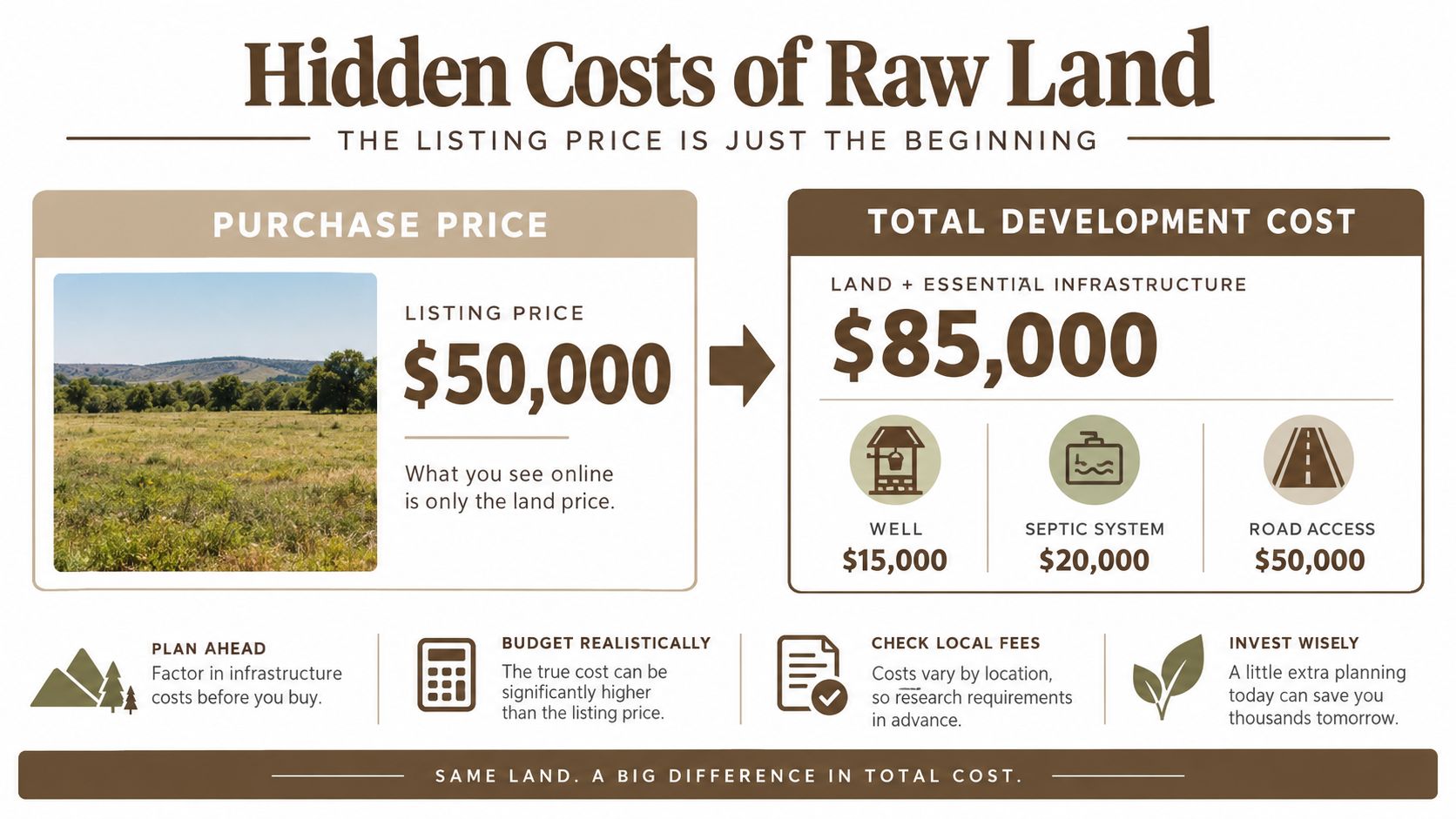
The important distinction is between purchase price and project cost. A parcel may be inexpensive because it lacks nearby infrastructure, has difficult terrain, or requires more engineering before development can proceed. Those conditions don't automatically make it a bad purchase, but they change what the land is worth to you.
Four cost questions to answer early
Water: Determine whether a well is possible, whether a permit may be available, and what site conditions could affect installation. Nearby homes with wells don't guarantee that your parcel has the same water options.
Wastewater: Rural land commonly requires an individual septic system. The parcel must have enough suitable area for the system and replacement area, while also meeting required setbacks and health regulations. A low price doesn't help if the site can't support an approved system. For background on the planning involved, see this practical guide to septic system installation costs.
Electricity: A power line visible from a road isn't the same as a service connection at the building site. Ask the utility provider about availability and the work required to extend service. If grid power isn't practical, an alternative system still requires careful design and budgeting.
Driveway and access: A parcel may require a driveway permit, culvert work, grading, snow management, or improvements for emergency access. Verify both the legal right to reach the property and the physical route a vehicle must use.
Infrastructure can outweigh scenery
The county's assessment identifies Alma, Fairplay, Bailey, and Will O' Wisp as the areas with water and wastewater treatment infrastructure supporting denser development. That doesn't mean every parcel in those places is ready to build, and it doesn't mean a remote parcel is unusable. It does mean that “near a town” and “connected to utilities” are different descriptions.
The county's strategic plan also says roughly 20,000 vacant lots remain undeveloped, particularly around Hartsel, because rural infrastructure limits development. Use that context to challenge the cheap-land narrative. The best value may be the parcel with a higher asking price but a clearer path to access, water, wastewater, and power.
Navigating Zoning and Permitting Requirements
A deed gives you ownership rights, but it doesn't automatically give you permission to build. Park County regulates development through zoning ordinances, land-use and subdivision regulations, building codes, and health requirements. Before you commit to a cabin, house, garage, accessory dwelling, RV arrangement, or other structure, confirm that the intended use is allowed on that specific parcel.
The county's Park County Development Guide states that a building permit is required to erect, construct, enlarge, alter, repair, move, improve, remove, convert, or demolish a building or structure. It also states that a septic permit must be obtained before applying for a building permit. That sequence makes wastewater feasibility an early decision point, not an item to address after buying.
Use a verification sequence
- Confirm parcel identity and boundaries. Compare the listing information with county records and determine whether the parcel is legally recognized for the intended use. Don't treat an online map as a substitute for a boundary review.
- Request zoning and setback information. Ask Planning and Zoning about the zone district, permitted structures, setbacks, parcel legality, and any use-specific limitations. A zone district can affect both what you may build and when construction may occur.
- Evaluate wastewater before designing a structure. Contact Environmental Health about the septic approval path and site requirements. A building concept that leaves no suitable area for wastewater treatment may need to be abandoned or redesigned.
- Verify access and driveway requirements. Confirm the legal route to the parcel and ask whether a driveway permit, access improvements, or fire-related documentation will be required.
Documents are part of the feasibility test
The county's permit FAQ lists materials such as a warranty deed, approved planning-and-zoning sheet, approved plot plan, individual sewage-disposal-system approval form, and driveway permit among documents that may be required for certain work. It also identifies possible fire-department or fire-protection-district forms, construction drawings, and an owner-builder statement. Required documents must be submitted at the same time.
Treat the approval path as part of the purchase decision. If you can't explain which office handles zoning, wastewater, access, and building approvals, you aren't ready to rely on the parcel for a future structure.
Financing Options for Vacant Land
Vacant land financing works differently from a conventional home mortgage because raw land may not have a house, utilities, or completed improvements that a lender can evaluate. Buyers commonly compare a cash purchase with an owner-financed arrangement, but the right choice depends on the agreement, the buyer's budget, and the intended timeline.
Cash is straightforward from a budgeting perspective. Once payment clears and required documents are completed, the transaction moves toward deed preparation under the applicable purchase terms. Financing can spread payments over time and may not require a traditional bank loan or credit check, but it creates an ongoing contractual obligation. A buyer should compare the cash price, down payment, document fee, monthly payment, and total financed cost rather than focusing on only one figure.
Read the agreement before checkout
For Dollar Land Store financed purchases, the company retains legal title until payoff and completion of deed-transfer requirements. Buyers must complete the required documents and set up payments through ZimpleMoney. The signed agreement, checkout disclosures, and transaction-specific documents control the details, so review them before treating the financing as a path to ownership.
A helpful general resource on state rules for land contracts can provide context, but it doesn't replace the agreement for the specific parcel. Buyers should also remember that checkout starts the purchase process. It doesn't, by itself, complete the transaction or transfer ownership.
Match financing to your actual plan
Financing may make it easier to acquire land without a traditional mortgage, but it doesn't remove the feasibility questions discussed above. During financing, don't assume you can live on the property, place a structure, store an RV, make improvements, or begin construction without the written permission required by the agreement and applicable local rules.
For a focused comparison of available arrangements, review Colorado land with owner financing. Then calculate whether the monthly obligation fits alongside taxes, due diligence, access work, and future infrastructure. Paying off the agreement doesn't automatically guarantee a building permit, septic approval, utility connection, or permission for a particular use.
Property Taxes and Holding Costs
The purchase price is only one part of the ownership budget. Even if you won't build immediately, you may need to plan for property taxes, association charges where applicable, road or access responsibilities, site maintenance, and professional reviews connected with future use.
Park County explains that the annual tax amount is calculated by multiplying the property's assessed value by the applicable tax rate, while taxing authorities set the mill levies. Those authorities may include the Board of County Commissioners, school boards, town councils, and special districts, as described by the Park County Assessor's Office.
Why similar parcels can carry different obligations
Two properties with similar purchase prices can have different annual tax obligations because their assessed values and taxing districts may differ. Possible district charges can relate to schools, fire protection, water, sanitation, libraries, and other local services. The Assessor locates, values, and classifies taxable property, but doesn't set every levy.
Before buying, request the parcel-specific tax record and identify the taxing districts attached to it. Ask whether an HOA or property owners' association applies, and review any recorded restrictions or recurring charges. Don't assume that a parcel with no visible improvements has no ongoing ownership expense.
A practical holding-cost worksheet should include:
- Annual property taxes: Use the parcel's record rather than a broad county estimate.
- District and association charges: Confirm applicable special districts and any association obligations.
- Access responsibilities: Determine whether maintaining or improving the route to the parcel may fall partly to owners.
- Due diligence costs: Account for document review, site inspections, surveys, engineering, or environmental-health work.
The key is to budget for ownership before construction begins. A parcel that remains vacant for years still needs a realistic carrying-cost plan.
Exploring Southern Colorado Land Opportunities
Southern Colorado can appeal to buyers who value broad scenery, open space, and access to outdoor activities. A parcel near Fort Garland, for example, may sound attractive because the surrounding region can support interests such as fishing, hunting, and mountain recreation. Those regional opportunities shouldn't be confused with rights on the parcel itself.
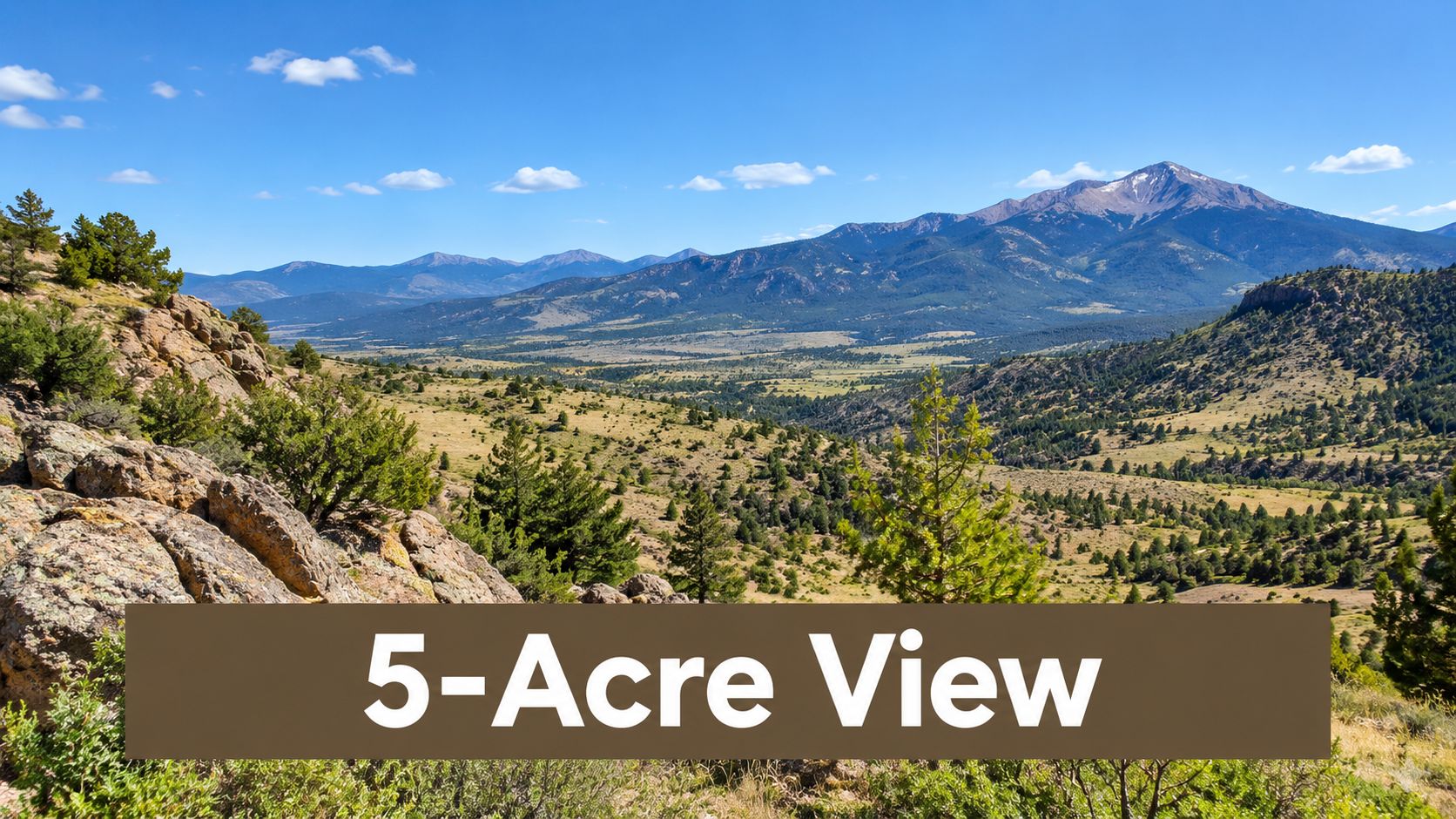
Consider a 5-acre parcel in the Top of the World Subdivision as an evaluation exercise rather than a promise about any specific listing. A buyer might see enough land for privacy, a future retreat, or recreational use. The useful question is not whether the parcel looks spacious. It's whether the subdivision documents, county rules, access, water, wastewater conditions, and terrain support the buyer's intended plan.
Separate lifestyle appeal from parcel rights
A mountain view doesn't establish a building envelope. Nearby fishing access doesn't create fishing rights on private land. Regional hunting opportunities don't authorize hunting on the parcel. Likewise, a subdivision name doesn't prove that utilities are connected, roads are maintained, or a structure can be approved.
For any Southern Colorado listing, verify:
- Recorded information: Check the legal description, ownership records, easements, and restrictions.
- County requirements: Confirm zoning, setbacks, permitted uses, septic procedures, and building rules.
- Physical conditions: Visit or independently evaluate access, slopes, drainage, vegetation, and likely construction areas.
- Regional services: Identify where water, wastewater, power, emergency response, and supplies would come from.
This approach keeps the attractive lifestyle benefits in view without turning them into unsupported property guarantees. The parcel should earn its place in your plan through documentation and feasibility, not just scenery.
Essential Due Diligence Checklist
A land listing is a starting point, not a completed feasibility report. Before committing to Park County acreage, verify the facts that determine whether you can reach the property, use it as intended, and pursue future improvements. The county's guidance on hazards and development identifies concerns including flooding, erosion, debris flow, steep slopes, ridgelines, drainage, geologic conditions, and wildfire.
Work through the parcel in order
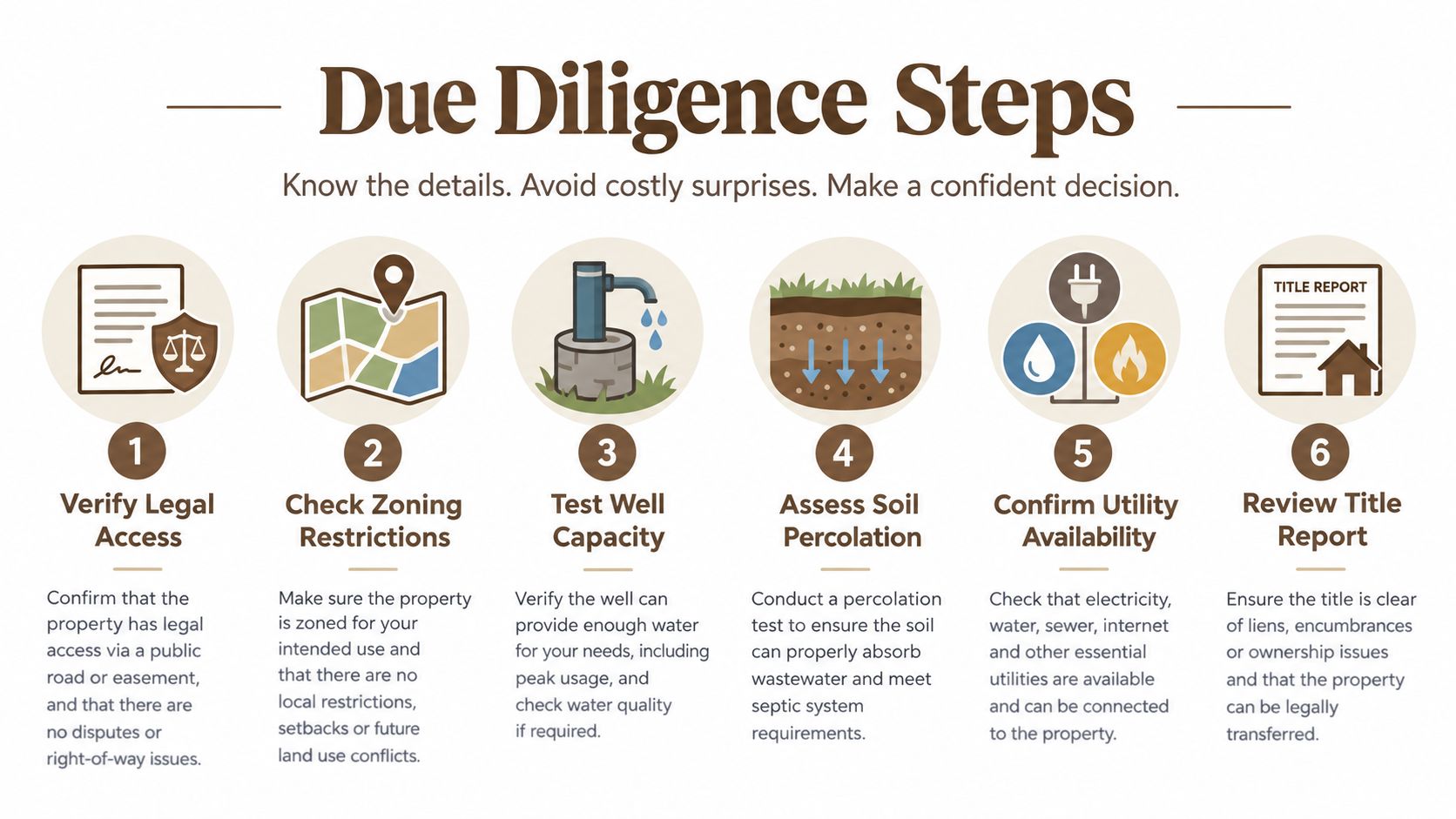
- Verify legal access: Confirm recorded access rights and inspect the physical route. A road shown on a map may not be legally available, maintained, or usable in every season.
- Check zoning restrictions: Ask Planning about the zone district, setbacks, parcel legality, and intended use. Don't assume a deeded lot is buildable.
- Evaluate water: Determine well-permit eligibility and investigate the practical water source for the intended use.
- Assess septic suitability: Confirm the process for environmental-health review and whether the site can accommodate an approved system.
- Review utilities: Ask power providers about service availability. Nearby lines don't establish a connection to the building area.
- Screen hazards: Overlay the parcel with applicable flood and hazard information, then inspect slope, drainage, erosion, wildfire exposure, and emergency access.
Make the decision from verified records
Review the title and recorded documents for easements, restrictions, and access terms. Confirm the parcel's tax record and taxing districts. If the property is financed, read the agreement and understand when title transfers, what documents you must complete, and what activities are restricted before payoff.
For a broader process you can adapt to a specific parcel, use this land due diligence checklist. Contact the relevant county offices directly when a listing description, map, or informal assumption leaves a question unanswered. A parcel that passes these checks may be worth pursuing. One that fails a central requirement should be rejected before the purchase price becomes the smallest part of the project.
Dollar Land Store offers vacant land in Colorado and other approved Western states, with cash and owner-financing options available on eligible properties. Visit Dollar Land Store to check current availability, compare parcel details, and begin with land whose location and purchase terms fit your due diligence plan.