


Commercial Zoning: A Buyer's Guide for Vacant Land
Ross AmatoBrowse available properties before you commit to a vacant parcel, especially if the listing mentions commercial zoning. A parcel can look like a simple piece of open land, yet its zoning designation may affect what you can build, which permits you need, how utilities reach the site, whether camping or RV use is allowed, and how easily another buyer can understand its potential later.
The short answer is this: commercial zoning is a local rule that identifies business-related uses allowed on a parcel, but it doesn't guarantee that the land is buildable, serviced, accessible, or financially practical. Requirements vary by county and city, so you'll need to verify the zoning code, parcel records, access, utilities, taxes, and private restrictions before purchasing.
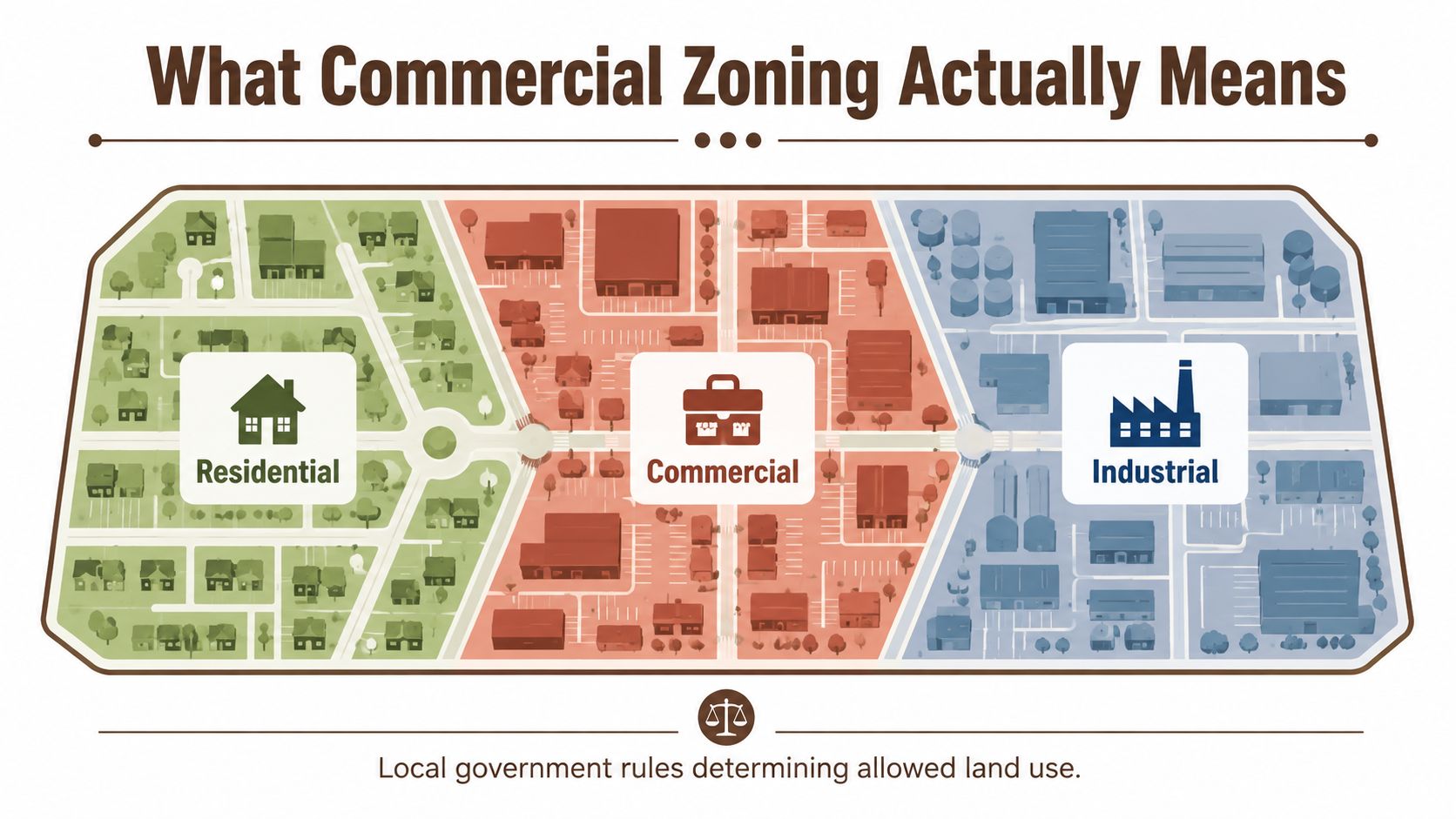
What Commercial Zoning Actually Means
Commercial zoning is a local-government rulebook for land use. It tells you what kinds of buildings, businesses, and activities may be permitted on a parcel. The rule applies to the land, not to the seller's description of it, and it's separate from the physical condition of the property.
A useful analogy is a neighborhood with house rules. One rule might allow quiet home businesses, while another might limit large deliveries or tall buildings. A zoning map does something similar across a city or county. It divides land into districts and assigns each district a set of allowed uses, development standards, and review requirements.
The local government sets those rules. There isn't one national meaning for a label such as C-2, General Commercial, or Neighborhood Commercial. A C-2 district in one county may allow uses that a similarly named district elsewhere restricts. Read the local code instead of relying on the abbreviation.
Why commercial zoning developed
Commercial zoning became a core land-use tool with New York City's 1916 zoning ordinance, the first zoning scheme in the United States. It created residential, commercial, and unrestricted use districts, along with bulk districts controlling building height and setbacks. By 1925, more than 500 cities had adopted zoning plans, and by the postwar era, almost all U.S. urban areas used commercial zoning regulations. EBSCO's overview of commercial zoning provides that historical context.
The original purpose was to separate incompatible activities and shape how buildings fit together. Commercial districts generally support income-producing activity, services, retail, offices, and sometimes mixed business and residential development. They may not allow a private home, heavy manufacturing, outdoor storage, or short-term lodging without additional approval.
Practical rule: Treat the zoning label as the beginning of your research, not as permission to use the property however you wish.
For a comparison with residential districts, review this guide to residential zoning. The buyer's key question is always the same: What does this specific district allow on this specific parcel?
Common Commercial Zoning Categories and Permitted Uses
Commercial zoning categories help planners separate neighborhood services from larger or more intensive activity. The names below are common examples, but they're not universal definitions. Rules differ by jurisdiction, and the permitted-use table in the local ordinance controls.
| Category | Uses a buyer might commonly see |
|---|---|
| Neighborhood commercial | Small shops, cafes, personal services, and convenience businesses |
| General commercial | Larger retail, restaurants, auto services, and other customer-facing businesses |
| Central business district | Offices, retail, restaurants, entertainment, and denser urban development |
| Office | Professional offices, clinics, administrative space, and related services |
| Mixed-use | A combination of commercial space and housing, often in the same building or district |
Neighborhood commercial
A neighborhood commercial district is usually designed for daily needs close to homes. A small grocery, coffee shop, salon, bakery, or professional service might fit the intended pattern. The code may still limit building size, operating hours, signage, parking layout, or vehicle access.
This designation can sound attractive to a first-time buyer because it suggests a manageable project. Yet a small parcel may still fail to support the required parking, setbacks, loading area, stormwater controls, or driveway design.
General commercial
General commercial districts usually accommodate more intensive activity. Possible examples include larger stores, restaurants, repair services, automotive businesses, or service facilities. Those uses may bring more traffic, deliveries, noise, lighting, and site-design requirements.
A parcel near a major road may appear suitable for general commercial use, but the road agency or local code could control curb cuts, turning movements, frontage improvements, and driveway spacing.
Central business district and office districts
Central business districts often support concentrated retail, office, restaurant, and entertainment activity. Office districts are narrower, focusing on professional, medical, or administrative uses. Neither label automatically answers whether a vacant parcel can support a particular business, parking arrangement, or residential unit.
Mixed-use districts
Mixed-use zoning may allow commercial and residential uses together. That could mean apartments above storefronts, live-work space, or separate housing and business buildings within one district. Mixed-use doesn't always mean that every residential or commercial use is allowed by right. Some uses may require a conditional-use permit, site-plan review, or compliance with special design standards.
A code also distinguishes between permitted uses, conditional uses, and prohibited uses. A permitted use may proceed after ordinary development approvals. A conditional use may require a public review process. A prohibited use generally needs a zoning change before it can move forward. Never infer the answer from the category name alone.
How Commercial Zoning Affects a Vacant Land Purchase
Commercial zoning affects more than the future building. It can change the entire cost and approval path of a vacant land purchase.
Permits and site approval
A commercial project commonly involves more than a building permit. The county or city may review grading, drainage, parking, landscaping, lighting, signage, fire access, driveway design, and the relationship between the proposed building and nearby parcels. A use that sounds simple, such as a small retail building, may still require a detailed site plan.
Floor area ratio, or FAR, can create a hard ceiling on the amount of floor area you can build. In one California example, a commercial district allows either a zero-foot front setback with FAR 1.5 or a 10-foot front setback with FAR 0.6. A 10,000-square-foot parcel at FAR 1.5 could support roughly 15,000 square feet of floor area before other code limits apply. The National City development standards show how setbacks, FAR, height, and density work together.
Utilities and infrastructure
Raw land may not have water, sewer, power, or adequate drainage at the property line. Commercial activity can require greater capacity than a small residential use, and the buyer may need extensions, connection approvals, treatment systems, or engineered improvements.
Don't treat a nearby utility line as proof that service is available. Ask the utility provider or county authority about connection requirements, capacity, ownership, and extension responsibility.
Roads and access
A commercial site needs access that works for customers, employees, emergency vehicles, deliveries, and sometimes larger service vehicles. The approving authority may require a particular driveway location, paving, sight-distance work, turn improvements, or restrictions on direct access.
A recorded easement can establish a route across another parcel, but it doesn't necessarily mean the route is improved for commercial traffic. Review the easement language and ask the local road authority about the proposed use.
Taxes and resale
Commercial land may be assessed differently from residential or agricultural land, and a change in use can affect future tax treatment. Exact taxes depend on the jurisdiction, assessment practices, exemptions, and the parcel's condition. County and state land-record fees and deed taxes also vary, so budget for transaction and recording costs separately from property taxes.
Resale depends on local demand and the actual permissions attached to the land. A commercial label may help if nearby businesses need sites, but it may narrow the buyer pool if the parcel lacks access, utilities, parking capacity, or a realistic permitted use. Use this guide to what to look for when buying land as a practical checklist before you focus on the zoning label.
How to Check Zoning and Verify Restrictions on a Parcel
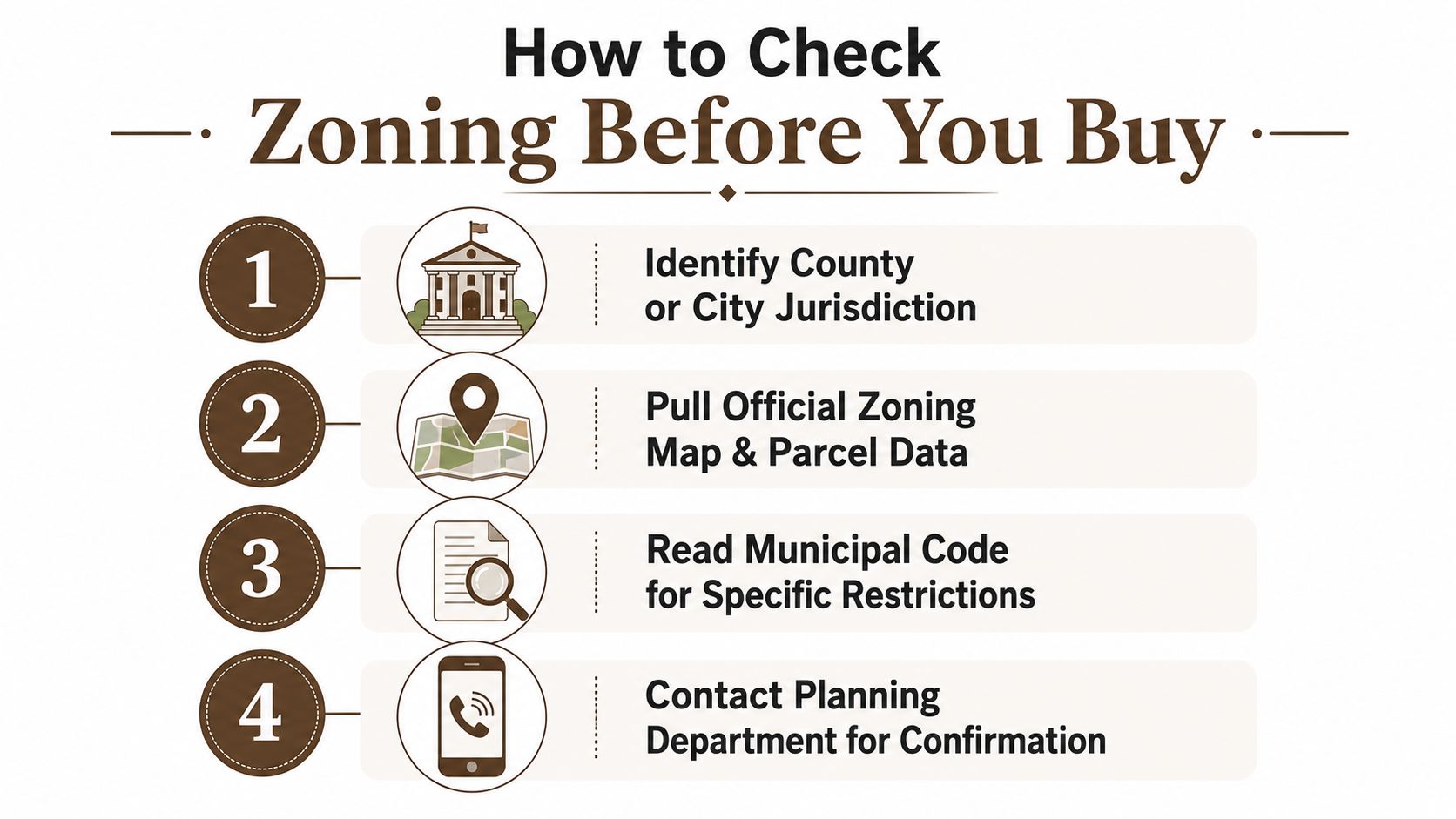
Before making an offer, create a parcel-specific due-diligence folder. Save the listing, parcel number, assessor record, zoning map, ordinance pages, maps, emails, and notes from government calls. A written record helps you distinguish confirmed information from assumptions.
- Identify the governing jurisdiction. Find the county, city, town, or special district responsible for zoning. A parcel may have a county address but fall inside a municipality, or it may be subject to more than one authority.
- Pull the official zoning map and parcel data. Use the government's map or planning portal where available. Match the parcel number and boundaries, because a nearby property's zoning designation may be different.
- Read the ordinance for the exact district. Find the permitted-use table, conditional-use section, dimensional standards, parking rules, setbacks, height limits, signage provisions, and development procedures. Check whether the code uses terms such as “by right,” “administrative approval,” or “public hearing.”
- Check overlays and special districts. Flood, wildfire, environmental, scenic, historic, corridor, airport, and planned-unit-development rules can add requirements. A base commercial designation may not tell the whole story.
- Contact the planning department. Bring the parcel number, address, zoning designation, a simple description of the intended use, and questions about access, utilities, parking, and permits. Ask staff to identify the exact code sections that support their answer.
- Review recorded documents. Search the recorder's office for covenants, easements, restrictions, liens, and other recorded instruments. Private CC&Rs may limit a use even when public zoning appears to allow it.
- Request written confirmation. A zoning verification letter or similar written determination can give your file a clearer record of the government's position. It still may not replace engineering, environmental, title, or building review.
For a broader transaction checklist, these dealmaking tips on the site from Richard Maize can help you organize questions before closing. Also review the building permit requirements guide, while remembering that the planning department, building department, utility providers, and recorder handle different parts of the process.
Rezoning and Conditional-Use Permits Explained
A rezoning changes the zoning map or district designation. It's a legislative decision that can affect the parcel and surrounding area. A conditional-use permit, by contrast, allows a specific use within the existing district if the proposal meets stated conditions.
For example, a parcel might already permit offices but classify a proposed vehicle service use as conditional. The owner would apply for permission for that use rather than asking the government to redraw the zoning map. If the desired use is prohibited, a conditional-use permit usually isn't a substitute for rezoning.
How the approval path usually works
The exact procedure varies, but applicants commonly move through these stages:
- Pre-application meeting: Planning staff identify likely issues, required materials, and relevant departments.
- Formal application: The applicant submits plans, forms, fees, ownership information, and supporting studies.
- Staff review: Departments evaluate land use, access, utilities, drainage, traffic, fire safety, and environmental matters.
- Public hearing: Neighbors and other members of the public may comment, depending on the application.
- Planning commission recommendation: The commission may recommend approval, denial, or approval with conditions.
- Council decision: For a rezoning, the elected council or equivalent body generally makes the final decision. A conditional-use decision may go to a planning commission, hearing officer, or another designated authority.
Approval usually depends on consistency with the master plan, compatibility with adjacent uses, traffic effects, infrastructure capacity, and environmental constraints. The applicant may need a survey, site plan, traffic analysis, drainage work, utility confirmation, or other professional materials.
Timelines commonly range from several months to more than a year, depending on the jurisdiction and complexity. Costs vary widely. Plan for application fees, consultants, engineering, surveys, public-notice expenses, and possible impact fees without relying on a generic estimate.
A rezoning request is a proposal, not an entitlement. Price the land and plan your financing as if the current zoning is the only zoning you can count on.
State policy can also change the answer. Texas Senate Bill 840 allows multifamily development in office, commercial, retail, warehouse, and mixed-use zones by right, while Florida's Live Local Act expands housing eligibility on commercially zoned land. The practical lesson is that state preemption may affect conversion feasibility, parking relief, density limits, and local review. For broader context on international land use cases, compare how different governments approach land-use policy and housing conversion.
Practical Tips for Dollar Land Store Buyers in the Western U.S.
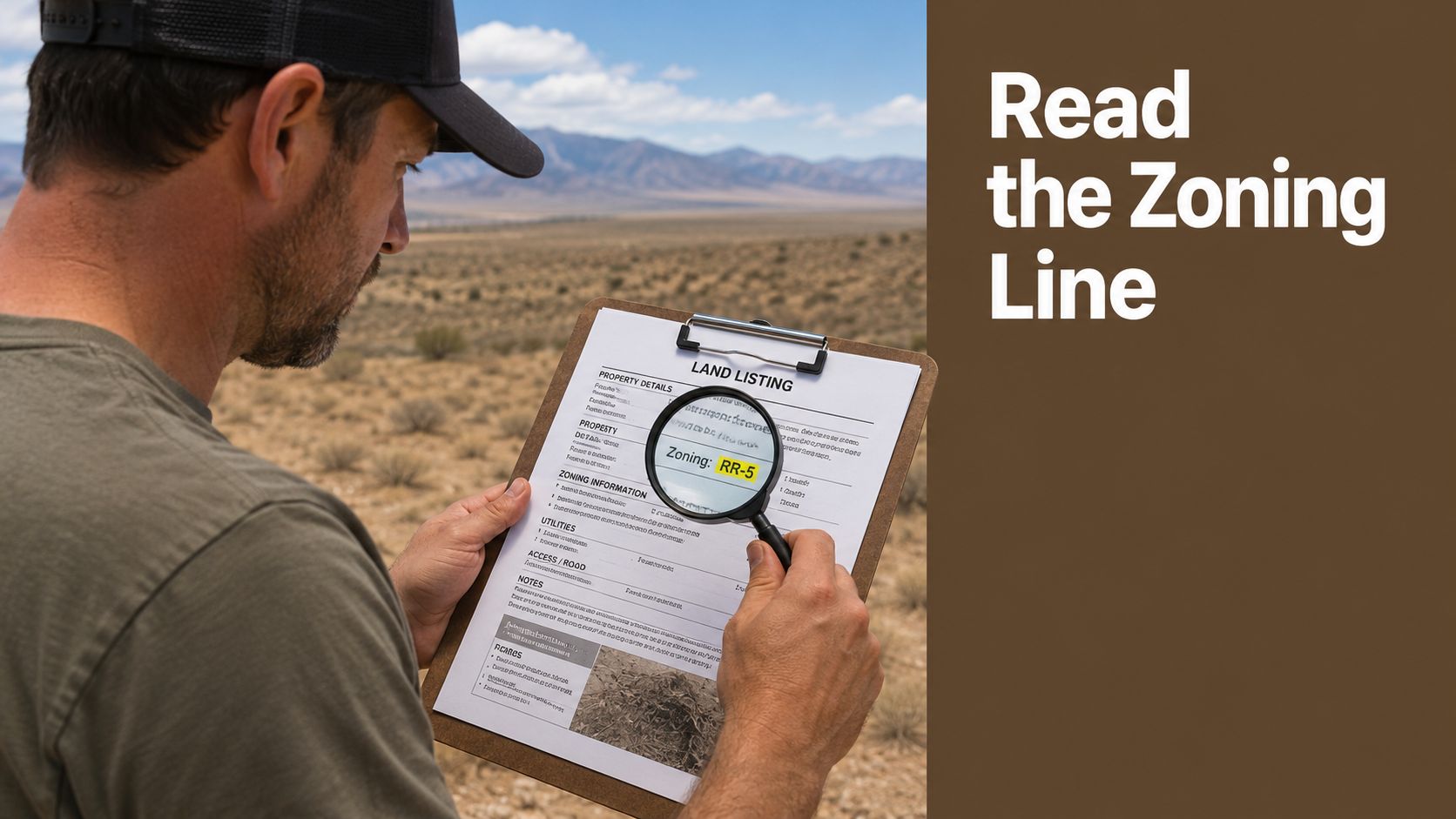
A listing that says “commercial” gives you a useful starting point, but it doesn't answer the questions that determine whether the parcel fits your plan. Read the Current Zoning and Zoning Code lines carefully, then confirm them with the county or city before you make assumptions about a store, workshop, home, campsite, or RV.
Start with the parcel number and the official zoning map. Look for mismatches, such as a property that appears commercial in a search result but sits in a residential, agricultural, or resource district. Then check the issues that can stop a project even when the use appears allowed.
- Access: Confirm whether the parcel has legal and practical access, and ask whether the existing road can support the proposed use.
- Slope: Steep or uneven ground can affect grading, driveway design, drainage, and building placement.
- Water rights and supply: A map or nearby development doesn't establish that water is available to your parcel.
- Septic: If public sewer isn't available, ask the responsible health or environmental department about site evaluation and approval requirements.
- Private restrictions: HOA or POA rules, CC&Rs, and easements may limit commercial activity, structures, signs, or occupancy.
- Utilities: Western parcels may involve wells, septic systems, off-grid power, long driveways, or utility extensions. Each can materially affect the development budget.
Camping and RV use deserve their own verification. Commercial zoning doesn't automatically allow overnight occupancy, permanent RV placement, recreational use, or a residence. Counties may regulate these activities through separate building, health, sanitation, access, and occupancy rules.
Financing and ownership records
Many traditional lenders are cautious about unimproved commercial land. Buyers may use cash, seller financing, or a land-loan specialist, depending on the property and the buyer's circumstances. Dollar Land Store sells vacant land directly and offers seller-financed options, including no-credit-check seller financing on applicable properties. Rates, terms, fees, down payments, and monthly amounts vary by property, so review the specific agreement rather than relying on a general example.
Seller financing creates a payment and transfer process you should understand before signing. Owner-financed buyers generally receive the deed after payoff and completion of the transfer process. Receiving the deed and recording it with the county are separate steps, so ask how the transfer will be handled, which documents will be provided, and who is responsible for recording.
For additional inventory context, you can review rural property for sale. Whether a parcel is rural or commercial, resale depends on clear records, accurate zoning information, usable access, and a realistic explanation of what the next buyer can do.
Frequently Asked Questions About Commercial Zoning
What's the difference between commercial and mixed-use zoning?
Commercial zoning generally focuses on business, retail, office, and service activity. Mixed-use zoning combines commercial and residential uses, but the exact combination and approval process vary by code.
Can I build a home on commercially zoned vacant land?
Maybe, but don't assume it. Some districts allow residential use, some treat it as conditional, and others prohibit it. State laws may also expand residential eligibility, as seen with Texas Senate Bill 840 and Florida's Live Local Act. Confirm the current local and state rules for the parcel.
How long does rezoning take?
The process commonly takes several months to more than a year. Public hearings, studies, revisions, and council schedules can extend the timeline.
Where should I confirm zoning?
Start with the official county or city planning department. Obtain the zoning map, parcel record, applicable ordinance, overlay information, and written confirmation when available.
How can zoning affect taxes?
Commercial classification or a change in use may affect assessment and tax treatment. The amount depends on the jurisdiction, assessor, exemptions, and property details. Ask the county assessor for the current and potential future treatment.
Dollar Land Store offers direct vacant-land sales, seller-financed options on applicable properties, and educational resources for buyers comparing zoning, access, utilities, and county requirements. Visit Dollar Land Store to browse available parcels and review the buying process before choosing land for your intended use.