

Homesteading in Colorado: A Practical Guide to Land and Water
Ross AmatoDreaming of homesteading in Colorado? The idea of a self-sufficient life set against a backdrop of stunning mountains and wide-open plains is powerful. But turning that dream into reality requires a practical approach. Success here isn't just about finding a piece of land; it's about navigating Colorado's unique water laws, understanding its diverse climates, and budgeting for the real costs of setting up a life from scratch. This guide provides the foundational knowledge for first-time land buyers.
Starting Your Colorado Homestead Journey
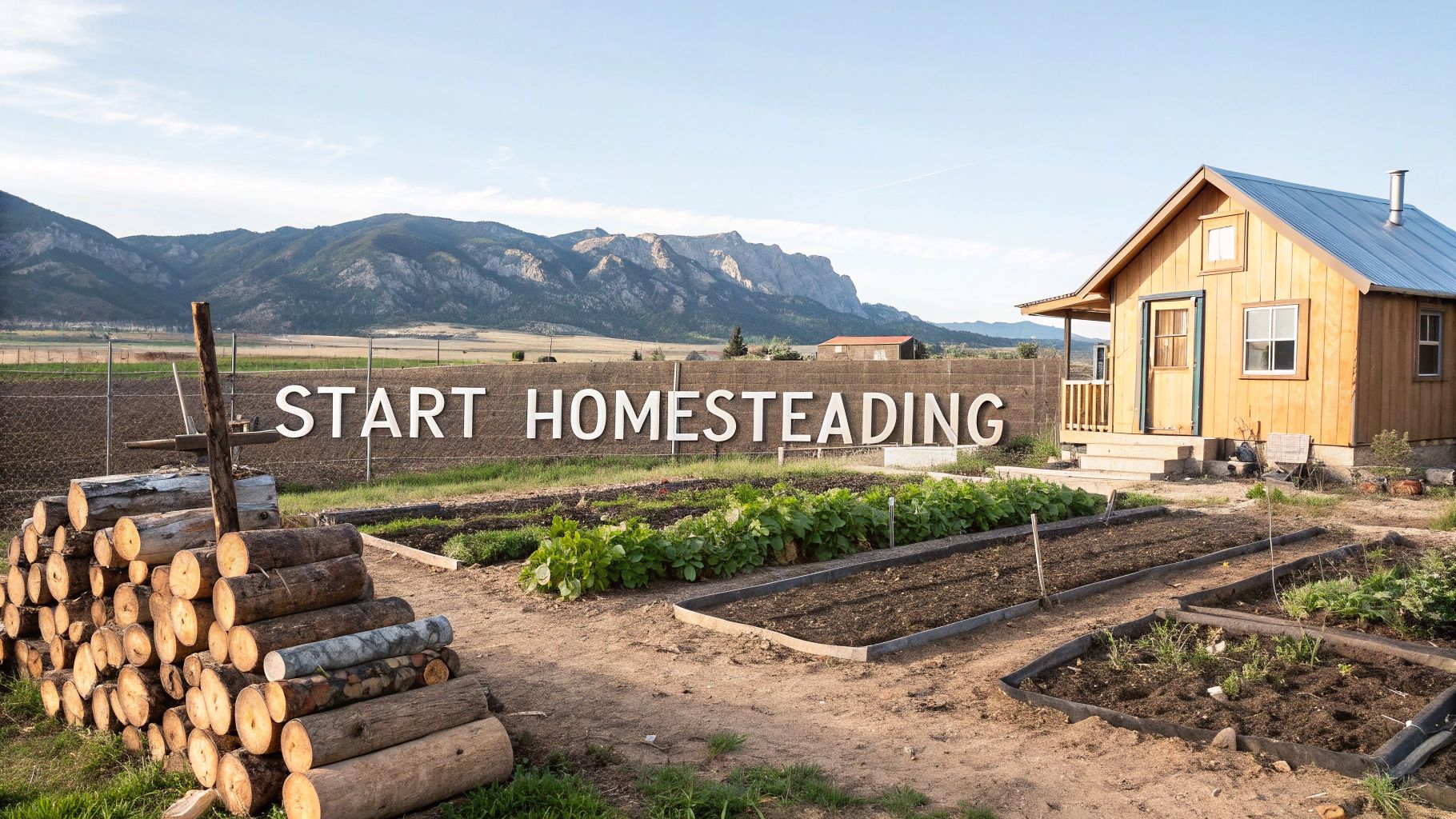
The vision of a Colorado homestead—a rustic cabin, a thriving garden, and a deep connection to the land—is what gets most people started. But to make it last, you have to move beyond the romantic idea and get into the practical details. This guide is built for the first-time land buyer, offering a clear, no-nonsense roadmap for the journey ahead.
We’re going to focus on the essential knowledge you need before you even think about buying your first acre. This isn't about finding the cheapest land possible; it’s about finding the right land that actually fits your goals for a self-sufficient lifestyle.
What to Expect From This Guide
This guide breaks down the most critical things you need to know to build a homestead from the ground up. We’ll cover the big topics that can make or break your success:
- Regional Differences: We’ll explore how Colorado's distinct climates—from the dry Eastern Plains to the rugged Rocky Mountains—will shape everything from what you can grow to how you'll live.
- Legal Hurdles: You’ll get a plain-English breakdown of Colorado's complex water rights system and learn why checking county-specific zoning rules is non-negotiable.
- Infrastructure Planning: We'll take a hard look at the real costs and logistics of putting in the basics like a well, septic system, and power on raw land. Our guide on off-grid living for beginners is a great place to start learning more about this.
By the end of this guide, you’ll have a solid framework for looking at land, asking the right questions, and sidestepping the common mistakes that trip up new buyers. Our goal is to replace uncertainty with confidence, so you can make a smart investment in your future.
Choosing the Right Region for Your Homestead
Finding the perfect slice of land in Colorado isn't just about the view; you have to understand the ground beneath your feet. The state is a patchwork of different regions, each with its own climate, soil, and land use realities. The single most important first step you can take is matching your homesteading goals to the right environment.
A five-acre parcel that looks perfect online might be in a region with a growing season too short for your garden, or it might lack the water you need for a few animals. A five-acre lot in the high Rockies is a world away from five acres on the Eastern Plains.
The Eastern Plains
Often called Colorado's agricultural heartland, the Eastern Plains are defined by vast, open grasslands and gentle rolling hills. This is where you'll find lower elevations, more affordable land, and longer, warmer growing seasons.
- Best For: Traditional farming, raising livestock like cattle or sheep, and large-scale gardening.
- Key Challenges: This is semi-arid country, so water is always the first consideration. Summers get intensely hot, and the wide-open landscape offers little protection from wind and storms.
The Front Range
Stretching from Pueblo up to Fort Collins, the Front Range is where the plains meet the mountains. It's the most populated part of the state, but you can still find rural pockets suitable for a homestead. Properties here can offer a balance—a rural lifestyle without being too far from city amenities. However, land prices and competition are significantly higher.
The Rocky Mountains
This is the rugged, postcard-perfect Colorado that comes to mind for most people. Homesteading in the mountains means dealing with high altitudes, steep terrain, and serious winters. It's a challenging but rewarding environment for anyone aiming for true off-grid self-sufficiency. For a closer look at this lifestyle, you might want to check out the details of living off-grid in Costilla County, a popular spot for high-altitude homesteading.
The growing seasons here are incredibly short, often just 90 days or less, which limits what you can grow without a greenhouse. Access can also be a major challenge, with many rural roads becoming impassable in the winter. Learning how to read a topographic map will give you a huge advantage by showing you the real story on elevation, water sources, and potential building sites.
The Western Slope
Everything west of the Continental Divide is known as the Western Slope, famous for its milder climate, fertile river valleys, and agricultural bounty. This region is where you’ll find Colorado’s orchards, vineyards, and vegetable farms.
- Best For: Fruit orchards, vineyards, diverse vegetable farming, and raising smaller livestock.
- Key Challenges: Water rights are extremely valuable and highly contested in the valleys. Land in prime agricultural spots can also be expensive.
This decision tree shows how your primary goal, whether farming or off-grid living, can guide you to the Colorado region that best suits your needs.
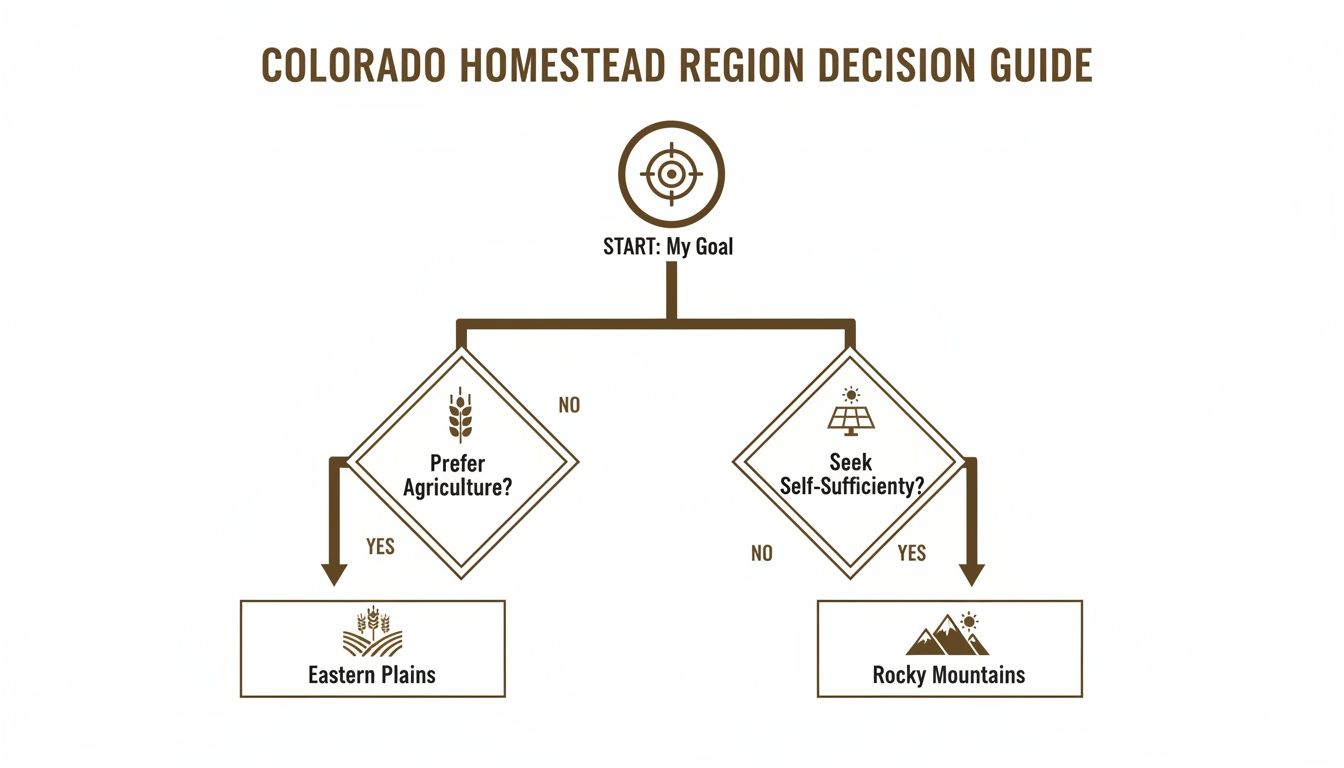 The visualization highlights a critical choice: the Eastern Plains are optimal for agricultural pursuits due to their vast, farmable land, while the Rocky Mountains provide the isolation and rugged terrain ideal for an off-grid lifestyle.
Comparing Colorado Regions for Homesteading
This table breaks down the key differences between Colorado's main regions to help you zero in on a location that truly fits your homesteading plans.
| Region | Primary Climate | Typical Land Use | Growing Season Length | Key Challenges |
|---|---|---|---|---|
| Eastern Plains | Semi-arid, hot summers | Large-scale farming, grazing | 140-160 days | Water scarcity, high winds |
| Front Range | Four-season, moderate | Small farms, residential | 120-150 days | High land costs, development |
| Rocky Mountains | Alpine, severe winters | Off-grid living, recreation | 60-90 days | Short season, difficult access |
| Western Slope | Temperate, milder winters | Orchards, vineyards, farming | 150-180 days | Water rights competition |
Take your time with this decision. Choosing the right region sets the foundation for everything that comes next.
Navigating Colorado Water Rights and Land Zoning
Getting a homestead up and running in Colorado is about more than just finding a scenic piece of land. You must understand the ground rules, and two of the biggest are water rights and county zoning. These aren't small details you can figure out later—they're the very foundation of what you can (and can't) do with your property. Getting this wrong can lead to expensive headaches and legal trouble.
Understanding Colorado Water Rights
In many states, if a creek runs through your property, you can use the water. Not in Colorado. Here, water is governed by a legal principle called prior appropriation, which means "first in time, first in right." The right to use water belongs to whoever first claimed it for a beneficial use, like farming, often decades or even a century ago. It doesn't matter who owns the land today.
This has a huge impact on anyone looking to start a homestead. Just because a stream flows across a property doesn't mean you can legally use it to water your garden or livestock. Those water rights likely belong to someone else.
Key Takeaway: Owning land in Colorado does not automatically mean you own the right to use the water on it. Water rights are a separate asset, and often, a far more valuable one than the land itself.
For most new homesteaders, the answer is a well. But even that isn't as simple as just calling a driller. You’ll need a well permit from the Colorado Division of Water Resources, and the kind of permit you can get depends on how large your parcel is.
- Household Use Wells: On lots smaller than 35 acres, you can typically get a domestic well permit. This allows for water inside your home, irrigating up to one acre of garden, and watering your domestic animals.
- Larger Parcels: If you have 35 acres or more, you may qualify for a permit that allows for more extensive uses, like irrigating bigger fields or supporting more livestock.
Before you buy, always contact the state and local water authorities to confirm what's possible. Do not make assumptions. This step is non-negotiable.
This system has deep roots in Colorado's history. Between 1864 and 1934, over 107,618 homesteaders proved claims on 22,146,400 acres, shaping the laws that govern land and water to this day. You can read more about this history on the National Park Service website.
Decoding County Zoning and Building Codes
Just as critical as water rights are the local zoning and building codes, which can change dramatically from one county to the next. Zoning rules dictate how you're allowed to use your land.
The zoning designation determines everything, including:
- If you can build a house.
- The minimum size your home has to be.
- Whether you can keep livestock (and how many).
- If you're allowed to live in an RV or tiny home while you build.
- How far back from your property lines any structures must be.
For instance, a property zoned 'Agricultural' (AG) might be perfect for your small farm, while a parcel zoned 'Residential Estate' (RE) could have strict rules preventing you from having chickens. You cannot assume that because land is rural, anything goes.
The single most important thing you can do is call the county planning and zoning department for any property you're seriously considering. Ask them directly about the zoning and what it allows. They are the final authority, and a ten-minute phone call can save you from a major mistake.
Planning Your Homestead Infrastructure
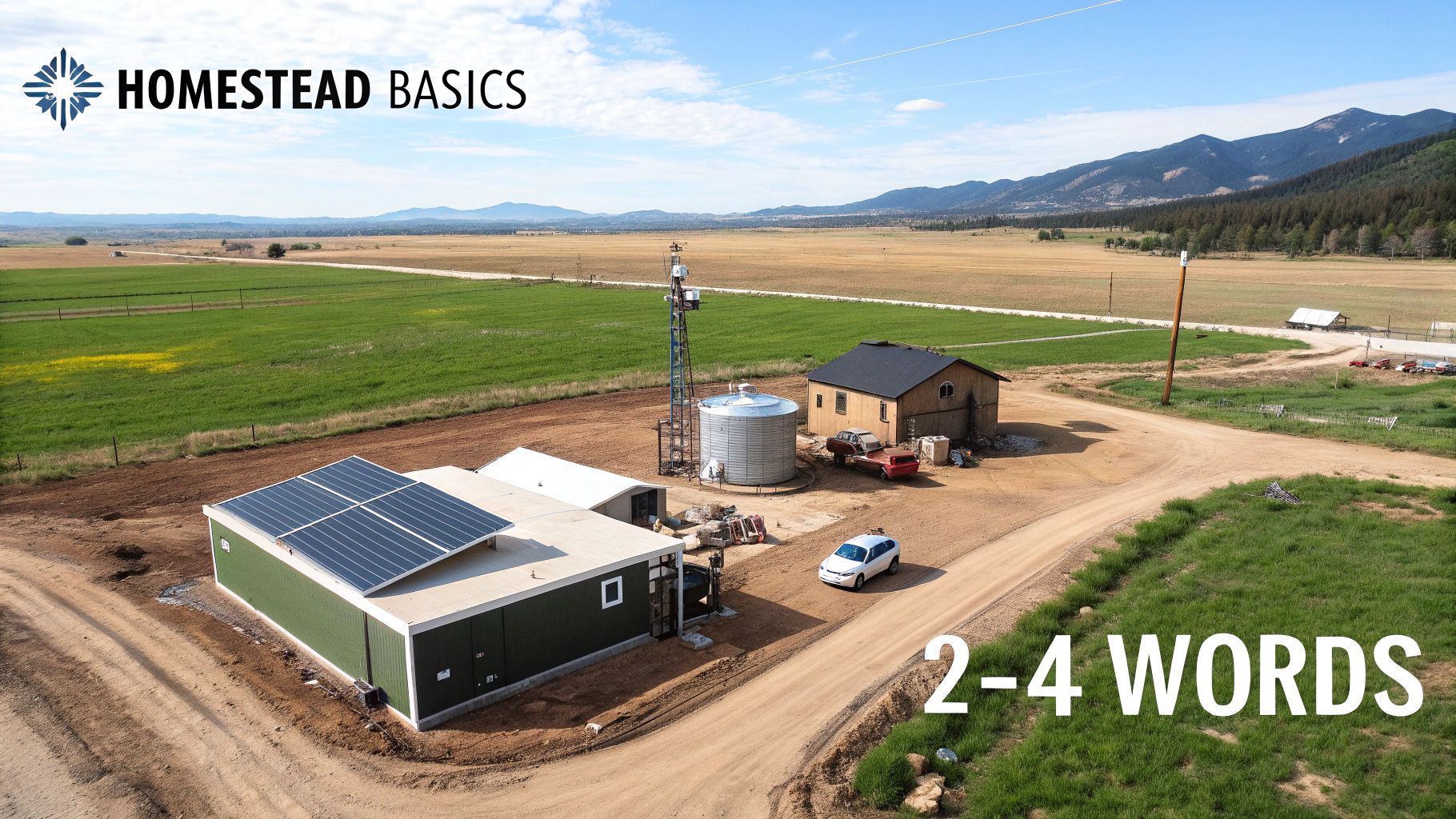
Buying a piece of raw land is just the first step. Turning that empty parcel into a place you can live requires a solid plan for the essentials: water, power, waste, and access. These are the big-ticket items that can make or break your budget. Forgetting to factor them in can quickly derail your plans, so it’s critical to understand the costs and processes before you buy.
Securing Your Water Source
Water is the lifeblood of any homestead. In rural Colorado, you’re generally looking at two main options.
- Drilling a Well: This is the most common and reliable solution. You'll need to hire a licensed driller, get a state permit, and pay by the foot. The final cost can vary widely depending on depth, from $6,000 to over $20,000. Our guide on water well drilling costs breaks this down further.
- Rainwater Harvesting: Using cisterns to catch rain is a great way to supplement your water for gardening. However, relying on it as your sole source can be risky in Colorado’s dry climate, and state rules regulate how you can collect and use it.
Choosing Your Power System
Next is electricity. You need to decide whether to connect to the local utility or generate your own power.
Connecting to the grid means paying the local utility to run power lines to your property. If a power pole is at your property line, this can be affordable. But if the nearest connection is miles away, the cost can be tens of thousands of dollars.
An off-grid solar system provides energy independence. The upfront cost for panels, batteries, and inverters is significant—often $15,000 to $30,000+—but it eliminates monthly electric bills.
Installing a Septic System
If your property isn't connected to a city sewer line (and most rural parcels aren't), a septic system is required by law for any home with plumbing. This requires professional design, installation, and county approval.
The process begins with a soil percolation (or "perc") test. This test determines how fast your soil absorbs water, which dictates the kind of septic system you need. The results directly impact the final cost, which usually falls between $7,000 and $15,000.
Verifying Legal and Physical Access
Finally, you must be certain you can get to your land, legally and physically, all year round. Do not assume a dirt path is a public road.
- Legal Access: This is a recorded easement or a public road that gives you the permanent right to cross onto your land. Without it, you could be landlocked.
- Physical Access: This means the road is actually driveable. A rugged 4x4 trail might seem fine in July, but a snowstorm could leave you cut off for weeks in the winter.
As you plan your homestead, don't forget your food sources. Knowing what to grow to feed chickens is a great example of building self-sufficiency. Careful planning on all these fronts is what separates a successful homestead from a costly mistake.
What This Means for Buyers
For a first-time land buyer, discussions about zoning, wells, and septic systems can feel overwhelming. The goal isn't to discourage you, but to provide the knowledge needed to avoid a significant and costly mistake.
The single most important takeaway is this: the listed price of a rural property is only the beginning of your investment. You must account for the practical but critical costs of getting water, power, and a septic system in place. These aren't optional upgrades; they are the foundation for turning a patch of dirt into a place you can live.
Your Due Diligence Checklist
Instead of feeling intimidated, use this knowledge to build a powerful checklist for your land search. Before you fall in love with the mountain views on a particular property, make it a rule to call the county offices first. This step moves you from being a hopeful dreamer to a confident, informed buyer.
Your mission is to verify everything. For every single property you seriously consider, ask these questions:
- County Planning & Zoning Dept: What is the exact zoning for this parcel? Can I build a house here? Can I have chickens or other livestock? Are there rules about where I can build or if I can live in an RV while building?
- County Building Dept: What is the process for getting permits to build a house, drill a well, and install a septic system? What tests are required, such as a soil "perc" test?
- State Division of Water Resources: For this specific property, what kind of well permit can I realistically get? Is this an area where water is difficult to find?
Taking these steps transforms you from a passive buyer into a smart investor. A few phone calls can uncover deal-breakers you will never find in an online property listing. This diligence is the most important part of your journey into homesteading in Colorado and can save you from significant stress and financial loss.
Why Consider Dollar Land Store?
For many people dreaming of a homestead, the first hurdle is finding land they can afford. At Dollar Land Store, our focus is making raw land ownership accessible through a straightforward process. Our goal is to lower the common barriers that prevent first-time buyers from acquiring their own piece of land for homesteading in Colorado.
A Simpler Path to Land Ownership
Dollar Land Store is a direct seller, not a traditional real estate agency. We own every property we list. By eliminating middlemen and broker commissions, we keep the process simple and transparent.
This direct approach allows you to focus on finding the right spot for your homestead. We handle the paperwork to ensure the transaction is clear and easy, from browsing listings to completing the purchase online.
Accessible Financing for Raw Land
Obtaining a conventional bank loan for undeveloped, rural land can be difficult. Many banks view it as a risky investment and often decline applications, especially from buyers without a perfect credit history.
That’s why we offer seller financing on many of our properties. It is a path to ownership designed for real people, often with low down payments and affordable monthly installments—no credit check required.
Our financing is built on a simple idea: more people should be able to own land.
- No Credit Checks: Your credit score is not a factor in our financing decisions.
- Low Down Payments: Many of our properties require a minimal down payment, leaving you with more cash for setting up your homestead.
- Transparent Terms: Every cost, monthly payment, and detail of the agreement is laid out clearly in the listing and the contract.
By providing these options, we help lower the initial financial barrier, so you can take the first real step toward building your Colorado dream.
Buyer Guidance / Next Steps
With this educational framework, it’s time to move from research to action. Your journey to homesteading in Colorado starts with a practical plan.
First, clarify what you want. Based on everything you’ve learned, define your specific goals, create a realistic budget for both the land and necessary infrastructure, and narrow down the regions that fit your needs. This foundation will keep your search focused and save you from considering properties that are not a good fit.
Creating a Clear Action Plan
The most valuable thing you can do now is start looking at actual land listings. This is about getting a feel for the market, seeing what prices look like, and understanding what’s available in your target counties.
As you start exploring, keep these two things in mind:
- Review Seller Financing: Understanding how seller financing works can open up a more accessible and straightforward path to owning your own piece of Colorado.
- Prioritize Due Diligence: This is the one step you cannot skip. Before making a commitment, you must independently confirm the zoning, water rights, and legal access with the county. You can get a better sense of what to look for by checking out our current Colorado land for sale.
This careful prep work is what separates a confident buyer from a nervous one. Every step you take, from defining your goals to verifying a property’s details, builds the foundation for a smart, successful purchase.
Conclusion
Building a homestead in Colorado is an achievable goal, but it demands careful planning and thorough research. Success hinges on matching your self-sufficiency goals with the right region, understanding the state's complex water laws, and accurately budgeting for essential infrastructure like wells and septic systems.
By prioritizing due diligence and verifying all critical details with local authorities, you can move forward with confidence. The path to owning land and creating a self-sufficient lifestyle is a rewarding one. With a practical, informed approach, you are well-equipped to turn your Colorado homesteading dream into a reality.