


How Much Is Land? A Complete Guide for First-Time Buyers
Ross AmatoThe price of a piece of land can be all over the map. You might find a remote, rural acre for under $1,000, while a plot in a growing area could run you tens of thousands. The final price tag isn't one single number—it’s a spectrum influenced by factors like road access, utilities, and what you can legally do with it.
This guide will break down the key variables that determine land prices so you can find a property that fits your goals and your budget.
Answering the Core Question: How Much Is Land?
If you’re a first-time buyer, asking "how much is land?" can feel like asking "how long is a piece of string?" Unlike a car with a clear sticker price, the value of land is a unique mix of factors. The good news is that affordable land is definitely out there, especially once you learn what drives the price up or down.
For example, a remote desert parcel perfect for weekend camping will naturally cost much less than a lot on the edge of a growing town with a paved road and power lines nearby. Neither one is better than the other; their value is tied directly to what they offer and how you can use them.
Understanding Price Variations
To give you a clearer picture, it helps to break down vacant land into a few general categories. This will help you set realistic expectations as you start your search. If you want to dig deeper into this, our guide on how much an acre of land costs is a great resource.
The table below provides hypothetical examples to show how different types of land compare in value. These are not actual market prices but are for illustrative purposes only.
Typical Price Ranges for Vacant Land Per Acre
| Land Type | Hypothetical Price Range (Per Acre) | Common Characteristics |
|---|---|---|
| Recreational Land | $500 – $5,000 | Remote location, limited or no utilities, basic or undeveloped access, ideal for camping or off-grid use. |
| Undeveloped Rural Land | $3,000 – $15,000 | Some road access, may be near utility lines but not connected, suitable for future homesteading or long-term investment. |
| Suburban/Buildable Lots | $15,000 – $100,000+ | Paved road access, public utilities available at the property line, zoned for residential construction. |
| Prime Development Land | $50,000 – $500,000+ | Located in high-growth areas with full infrastructure, zoned for commercial or high-density residential use. |
As you can see, the jump in price from simple recreational land to a buildable lot is significant. It all comes down to location, access, and infrastructure.
The Seven Key Factors That Determine Land Value
Everyone knows the old real estate saying: "location, location, location." But when it comes to raw land, location is just one piece of a much bigger puzzle.
Seven key factors really drive a property's value. Learning to spot them will help you see a parcel's true potential and sidestep the kind of mistakes that catch first-time buyers off guard.
1. Location and Access
This one is the most obvious, but with a twist. Proximity to towns, major highways, and amenities like schools or hospitals definitely adds value. But for rural land, access is king.
A property with year-round, legal access from a county-maintained road is worth far more than a landlocked parcel you can only get to by crossing a neighbor’s property or navigating a rough dirt path.
2. Utilities and Infrastructure
The availability of utilities can make or break a budget. Raw land with no connections is almost always the most affordable starting point, but you have to know what it will take to get it serviced.
- Water: Does the property tap into a municipal water line, or will you need to drill a well? The cost to drill a well can easily run into the thousands of dollars.
- Power: Is there an electric pole at the property line? Extending power lines can be surprisingly expensive, which is why off-grid solar is becoming a practical choice for many remote parcels.
- Sewer: Can the land connect to a public sewer system, or will it need a septic system? You'll have to factor in the cost of soil testing (a "perc test") and the full installation.
3. Zoning and Land Use Regulations
Zoning rules are set by the county and dictate what you can legally do with your land. A property zoned for residential use lets you build a home, while land zoned for agriculture or recreation comes with a completely different set of rules.
This information is public, and it’s critical that you verify it with the local county planning department before you buy.
Buyer Insight: Never assume you can build or live on a piece of land just because it's for sale. Always confirm the specific zoning and permitted uses directly with county officials to ensure the property matches your goals.
4. Topography and Physical Features
A property's physical character is a huge deal. Flat, usable ground is generally more valuable than steep, rocky terrain that’s tough to build on or even walk across.
Positive features like mature trees, a creek, or a pond can increase a property’s appeal and price, especially for recreational buyers. On the flip side, major issues like being in a flood zone can drag its value down.
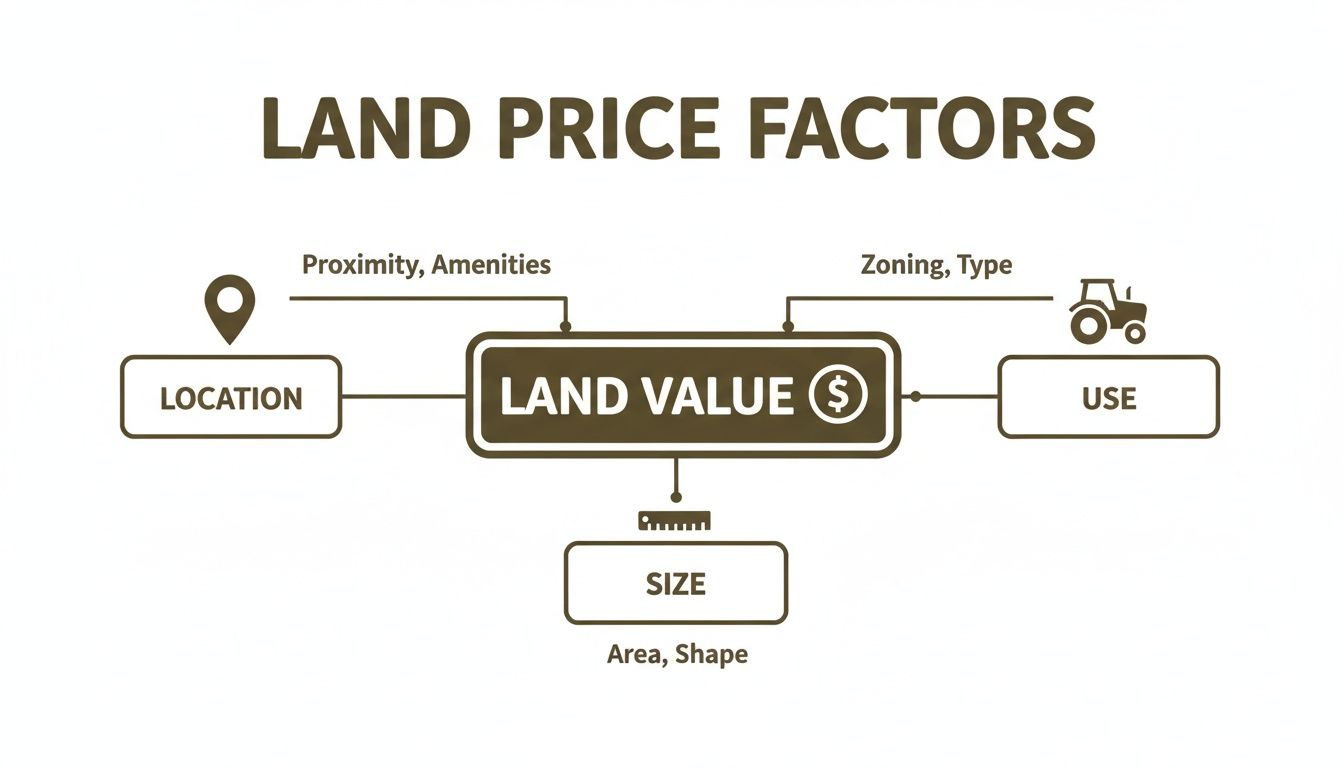
As you can see, these core elements are all connected and work together to shape the final price of a parcel.
5. Acreage and Parcel Size
It seems simple: bigger costs more. While a larger parcel will have a higher total price, the price per acre often goes down as the size goes up.
For example, a single five-acre parcel might sell for $15,000 ($3,000 per acre). In that same area, a 40-acre parcel might sell for $80,000 ($2,000 per acre). This economy of scale is a powerful concept for buyers looking at larger tracts of land.
6. Market Demand and Economic Trends
Land doesn't exist in a bubble. Is a nearby town growing? Are new businesses moving in? A humming local economy boosts demand for land and pushes prices up.
Getting a feel for these trends can help you gauge a property's long-term investment potential. Our guide on how to determine land value dives deeper into this topic.
7. Existing Improvements
Anything already on the property adds to its cost. This could be a pre-existing well, a septic system, fencing, a small shed, or even just a cleared building site.
Even potential uses, like having the right conditions for planting a food plot, can influence its value to the right buyer. These additions can save you a ton of time and money compared to starting with completely untouched land.
Uncovering the Hidden Costs of Buying Land
The listing price of a property is just the beginning of the story. For first-time buyers, one of the biggest surprises is the handful of extra expenses that can pop up, both during the sale and long after. Thinking about these costs upfront is the key to creating a real-world budget and avoiding financial headaches down the road.
It’s a lot like buying a car—you don’t just plan for the sticker price. You also have to account for insurance, gas, and maintenance. Land is the exact same way. A smart budget includes not just the purchase price, but all the related costs of owning and maybe even developing it one day.
Common Expenses Beyond The Purchase Price
When you buy land, especially through a traditional real estate transaction, several fees can appear. While some of these might not apply to simpler deals like owner financing, it’s always good to know what they are.
Here’s a quick rundown of potential expenses you might see:
- Closing Costs: These are fees for things like preparing documents, officially recording the deed with the county, and other bits of administrative paperwork.
- Property Taxes: This is a recurring cost you can count on every year for as long as you own the land. Our guide on property taxes on vacant land breaks this down in more detail.
- Survey Fees: If the property lines aren't crystal clear, you may need a surveyor to mark them out. This can run anywhere from a few hundred to a couple of thousand dollars.
- Title Insurance: This is your protection against any old claims on the property’s title, helping to ensure your ownership is clear.
Budgeting For Future Development
If your plans go beyond just holding the land as an investment, you must factor in development costs. These can easily become the most significant expenses of all, and they change dramatically based on where your land is and what you want to do with it. Just like with any major purchase, a solid financial plan is a must; understanding budgeting for unexpected expenses can help you get prepared for what might come up.
Some of the big-ticket development costs include:
- Well Drilling: If your property doesn’t have city water, you’ll need a well for a reliable water source.
- Septic System Installation: No access to a public sewer line means you’ll need a septic system. This involves soil tests and professional installation.
- Utility Connections: Getting power lines, internet, or gas run out to a remote property can be a surprisingly large one-time expense.
Thinking about these hidden costs ahead of time helps you move from just asking "how much is land?" to building a true, all-in budget for your purchase.
To help you keep track, here’s a simple checklist of common expenses you might encounter when buying and owning raw land.
Checklist of Potential Costs Beyond the Land Price
| Cost Category | Description | Typical Expense (Hypothetical) |
|---|---|---|
| Survey | Professional service to mark property boundaries. | $500 - $2,500 |
| Title Insurance | Protects against claims on your ownership. | $500 - $1,500 |
| Closing Costs | Fees for legal and administrative paperwork. | 1-3% of purchase price |
| Annual Property Tax | Recurring yearly tax paid to the county. | 0.5-2% of assessed value |
| Well Installation | For properties without public water access. | $5,000 - $15,000+ |
| Septic System | For properties without public sewer access. | $7,000 - $20,000+ |
| Utility Hookups | Connecting electricity, internet, or gas. | $1,000 - $25,000+ |
This checklist isn't exhaustive, but it covers the major costs that can catch new buyers by surprise. A little planning goes a long way in making your land purchase a smooth and successful one.
What This Means for Buyers
When you boil it all down, the data, the trends, and the cost factors all point to a simple truth: the best piece of land is the one that fits your goals and your budget. National averages from sources like the USDA's farmland value trends on the USDA's official site are useful for context but don't reflect the affordable entry points available in the rural and recreational land markets.
It's easy to get lost in the numbers, but don't let them discourage you. The key is to use that knowledge to recognize a good deal when you see one and shift your focus from broad statistics to the details of an individual property.
Connecting the Big Picture to Your Search
Global trends can also have a real impact on your purchase. For example, there's a growing demand for land for conservation and carbon removal projects. The 2025 Land Gap Report highlights the increasing need for land to meet climate pledges.
This surge in demand could influence the long-term value of many types of land, including remote rural parcels. A property that seems isolated today might become a valuable asset for conservation or environmental credits down the road. What that means is even an affordable, out-of-the-way property could turn out to be a savvy long-term investment.
Why Consider Dollar Land Store?
Knowing what drives land prices is one thing, but actually buying a piece of property can feel like a different challenge. Traditional real estate often means dealing with banks, credit approvals, and saving up for a large down payment—hurdles that can stop a first-time buyer.
Dollar Land Store was created to provide a simpler, more direct path to owning land. We are not real estate agents; we are the direct seller of all the properties in our inventory.
Our focus is on affordable, undeveloped land, primarily in the Western U.S. We cut through the typical red tape by offering seller financing, which removes many of the common barriers to buying property.
What this means for buyers:
- No Credit Checks: We believe your credit score shouldn't prevent you from owning land.
- Low Upfront Costs: You can often secure a property with a small down payment and a one-time document fee.
- A Simple Online Process: You can review terms and complete the purchase from your computer. No agents or banks are involved.
- Transparent Terms: Our contracts are straightforward, with all terms disclosed clearly upfront.
Our goal is to make owning land a reality for everyday people, especially those who feel locked out of the traditional market. We keep the process clear, honest, and supportive.
Buyer Guidance and Next Steps
Moving from research to action is the most exciting part of the land-buying journey. You now have a solid handle on what drives land prices, from major factors like location and access down to the details of zoning and topography.
The key is putting that knowledge to work. You'll want to combine it with practical steps to find a property that fits your budget and your vision. Your path forward involves doing your homework on any piece of land that catches your eye, creating a realistic budget that accounts for potential costs, and finding the right financing solution.
Start Your Search Today
The best way to see how all this plays out is to start looking. Taking these next steps can turn the idea of owning land into a reality.
- Browse available listings: Explore different areas and parcel sizes to see how the factors we've discussed affect prices.
- Learn about financing: Get comfortable with how different payment options work. Our guide on how to finance a land purchase is a great place to start, especially for first-time buyers.
- Ask questions: A reputable seller should be an open book. Never hesitate to reach out and ask for more details on a property or the buying process.
You've got a solid foundation now. You’re ready to take these steps and begin the hunt for that perfect piece of land.
Conclusion
Understanding "how much is land" is about more than just a price tag; it's about knowing the factors that create value. By focusing on location, access, utilities, zoning, and topography, you can evaluate properties with confidence. Remember to budget for potential hidden costs and consider how financing options like seller financing can make land ownership more accessible. If you're still wondering how much is an acre of land in different parts of the country, understanding local market conditions and land characteristics can help you estimate a property's true value.
With some solid research and a clear budget, owning a piece of affordable land is completely within your reach. It’s not about finding the absolute cheapest parcel out there, but about finding the right one for your vision.
Browse available land at DollarLandStore.com.