


How to Make Money with Vacant Land: A Beginner's Guide
Ross AmatoOwning a piece of vacant land is often seen as a long-term investment—something that slowly gains value over the years. But what if it could be more than that? An empty parcel is a blank canvas, ready to generate income right now. The key to learning how to make money with vacant land is matching what your property offers with what people in your area need. This could range from simple strategies like leasing for farming or hunting to more active approaches like land flipping.
This guide provides a practical framework for turning that untapped potential into a real, profitable plan.
Your Guide to Monetizing Vacant Land
For a first-time landowner, an open parcel can feel overwhelming. The good news is, you don’t need a developer’s license or a large amount of capital to get started. Many successful strategies are surprisingly simple and accessible.
This guide walks through several real-world strategies that work for different goals and timelines. Whether you want a small, passive income stream to cover property taxes or are looking to build long-term wealth, the starting point is the same: understanding what you own and what your local market is looking for.
Turning Potential into Profit
Making the jump from owning an empty lot to creating a cash-flowing asset comes down to a few core steps. You’ll need to assess your land's key features, research local regulations, and then select a monetization strategy that fits your goals and budget. This isn’t about finding a magic bullet, but about finding the perfect fit for your specific property.
Here’s a quick look at what we’ll cover:
- Immediate Income Strategies: We will explore low-cost ideas like leasing your land for farming, hunting, RV parking, or a community garden that can generate cash flow quickly.
- Long-Term Wealth Building: We will also cover bigger-picture plays, such as seller financing, flipping land for a profit, or securing long-term leases for solar panels or cell towers.
- Navigating Local Rules: Understanding zoning laws, permits, and property taxes is critical to unlocking your land’s value and avoiding expensive mistakes.
The most successful land investors don't just buy and wait. They actively seek opportunities to make their land productive, turning a static asset into a dynamic source of income while it appreciates.
Think of this guide as a practical framework to get started. By focusing on solid research and beginning with manageable projects, even a beginner can turn a simple plot of land into a valuable and productive investment.
Generating Immediate Income from Your Land
While some land monetization strategies require significant time or capital, many new owners are surprised by how quickly an empty parcel can start paying for itself. These immediate-income ideas are well-suited for first-time buyers because they typically have low setup costs.
The cash they generate can help cover property taxes or monthly payments while you plan your long-term vision. It all comes down to using what your land already has to meet a need in the local community.
These methods focus on leasing and short-term rentals, turning your property into a working asset from the start. They don’t require permanent structures, but rather provide others with access to your space for a fee. This approach keeps your upfront investment and risk low, making it an excellent starting point for a new landowner.
Leasing for Agriculture and Community Gardens
One of the most straightforward ways to make money with vacant land is to lease it for agricultural use. If your property has decent soil and is relatively flat, local farmers, ranchers, or community garden groups may pay to use it.
- Crop Farming: A local farmer might rent several acres to grow hay, corn, or soybeans. This is typically a hands-off arrangement where the farmer performs all the labor, and you collect a lease payment seasonally or annually.
- Livestock Grazing: If your land is fenced or easy to fence, renting it to a rancher for cattle or horse grazing is a common and simple option.
- Community Gardens: For land closer to a town, leasing small plots to families or garden clubs can be a great option. You can charge a modest annual fee for each plot, and the gardeners often improve the soil and the land's appearance over time.
For any of these options, a simple lease agreement is essential. It should clearly state the lease dates, payment schedule, and what is (and isn't) permitted. This protects both you and the lessee, ensuring a professional arrangement.
Capitalizing on Recreational Access
Your land’s location and natural features can make it valuable for recreational users. This can be a powerful way to generate income, especially if your property is near state parks, lakes, or popular hunting areas.
Consider what makes your land unique. Does it have dense woods, wide-open fields, or access to a creek or pond? These are features that attract different types of recreational users.
A key principle for new landowners is to start with what you have. You don't need to build complex structures to create value. Often, simply providing safe, private access to nature is a service people are willing to pay for.
Some of the most popular recreational uses include:
- Hunting Leases: This is a significant income stream for many rural landowners. Hunters often pay for exclusive access to private land during hunting season. You can lease to an individual, a small group, or a local hunting club.
- Primitive Camping or "Glamping": Offering your land for short-term camping has very low startup costs. You can list your property on websites that connect landowners with campers. If you decide to monetize your vacant land by establishing a campsite, optimizing your booking system can significantly boost earnings. Discover how interactive maps can help you increase campsite income with interactive maps.
- ATV or Trail Riding: If you have a larger property with existing trails or open terrain, you can charge a day-use fee for off-roading or horseback riding.
Remember to secure liability insurance—it's critical for any recreational lease. Before allowing anyone on your property, speak with an insurance professional to ensure you have appropriate coverage. You can find more ideas in our guide on what to do with vacant land.
Offering Simple Storage Solutions
If your land is easily accessible from a main road and feels secure, offering it for storage can be a profitable, low-maintenance business. This works especially well in areas where people own RVs, boats, or trailers but lack sufficient space to store them at home.
The setup is basic. You might only need to clear and level a section and perhaps install a simple gate or fence for security. After that, you're ready to rent out spots on a month-to-month basis.
- RV and Boat Storage: These large items take up significant driveway space. An open-air storage lot is a simple solution for many owners who are willing to pay a monthly fee.
- Contractor Equipment Parking: Local landscapers, builders, and other contractors often need a secure place to park work trucks and equipment overnight.
- Shipping Container Storage: You can either rent space to people who own shipping containers or purchase a few containers yourself and lease them as secure storage units.
You can charge by the foot or set a flat monthly rate per spot. Researching what local storage facilities charge will help you set a competitive price, turning that empty lot into a steady source of income.
Building Long-Term Wealth with Your Property
While immediate income streams are excellent for cash flow, the true power of vacant land lies in its potential to create significant long-term wealth. This is the long game. It requires more patience and a different mindset, but the payoff can be substantial. This involves shifting focus from collecting rent to building equity through capital appreciation and high-value, long-duration leases.
This means moving beyond simple land leasing to more strategic, value-add opportunities. It’s about understanding market trends, identifying a parcel's hidden potential, and sometimes navigating more complex agreements. For the patient investor, this is how an affordable piece of land can become a cornerstone of a financial future.
Buy-and-Hold Versus Active Development
The most traditional long-term strategy is the buy-and-hold approach. This involves finding land in an area poised for growth and allowing the market to drive appreciation. It's a largely passive way to build wealth.
Alternatively, there are more active strategies like land flipping and seller financing. Flipping involves buying undervalued land, making minor improvements—like clearing brush or obtaining a new survey—and then reselling it for a profit. With seller financing, you act as the lender. You sell the land yourself and collect monthly payments with interest over several years, creating a steady income stream while potentially earning a higher total return on the sale.
Comparing Long-Term Land Monetization Strategies
Choosing the right long-term strategy depends on your goals, risk tolerance, and how hands-on you want to be. The table below breaks down popular approaches to help you decide which might be the best fit.
| Strategy | Potential Return | Upfront Cost / Effort | Time Horizon | Best For |
|---|---|---|---|---|
| Buy-and-Hold | Moderate to High | Low | 5-20+ Years | Patient investors betting on market appreciation in growing areas. |
| Land Flipping | High (per flip) | Low to Moderate | 3-12 Months | Active investors skilled at marketing and finding undervalued deals. |
| Seller Financing | High (over time) | Low | 3-10 Years | Investors seeking steady cash flow and a potentially higher total sale price. |
| Solar/Energy Leases | High (stable) | Very Low | 20-30+ Years | Owners of large, flat, sun-drenched parcels with good road access. |
| Cell Tower Leases | High (per sq. ft.) | Very Low | 10-25+ Years | Landowners near highways or population centers needing better coverage. |
| Timber/Minerals | Varies (can be high) | Low to Moderate | Varies | Owners of forested land or property in resource-rich regions. |
Ultimately, the best strategy is one that aligns with your financial situation and long-term vision. Some investors combine these methods, using seller financing to generate cash flow while holding other parcels for long-term appreciation.
Securing High-Value Commercial Leases
One of the most powerful ways to generate long-term income is by leasing your land to commercial entities. These leases can last for decades and provide a stable, predictable, and often significant income stream. Companies are constantly seeking land to support their infrastructure.
- Solar Farms: Energy companies may pay a premium to lease large, flat, sun-exposed parcels for solar arrays. These leases can run for 20-30 years and generate a consistent annual rate per acre.
- Cell Towers: Wireless carriers need to expand their networks. You can lease a small footprint of your property for a cell tower and generate thousands of dollars a year on a long-term contract.
- Billboards: If your land is situated along a busy highway, leasing a small section for a billboard can be one of the easiest sources of passive income.
To secure these types of deals, your property usually needs specific features, such as good road access, appropriate zoning, and a strategic location.
This decision tree offers a simple visual for thinking through some initial paths you could take.
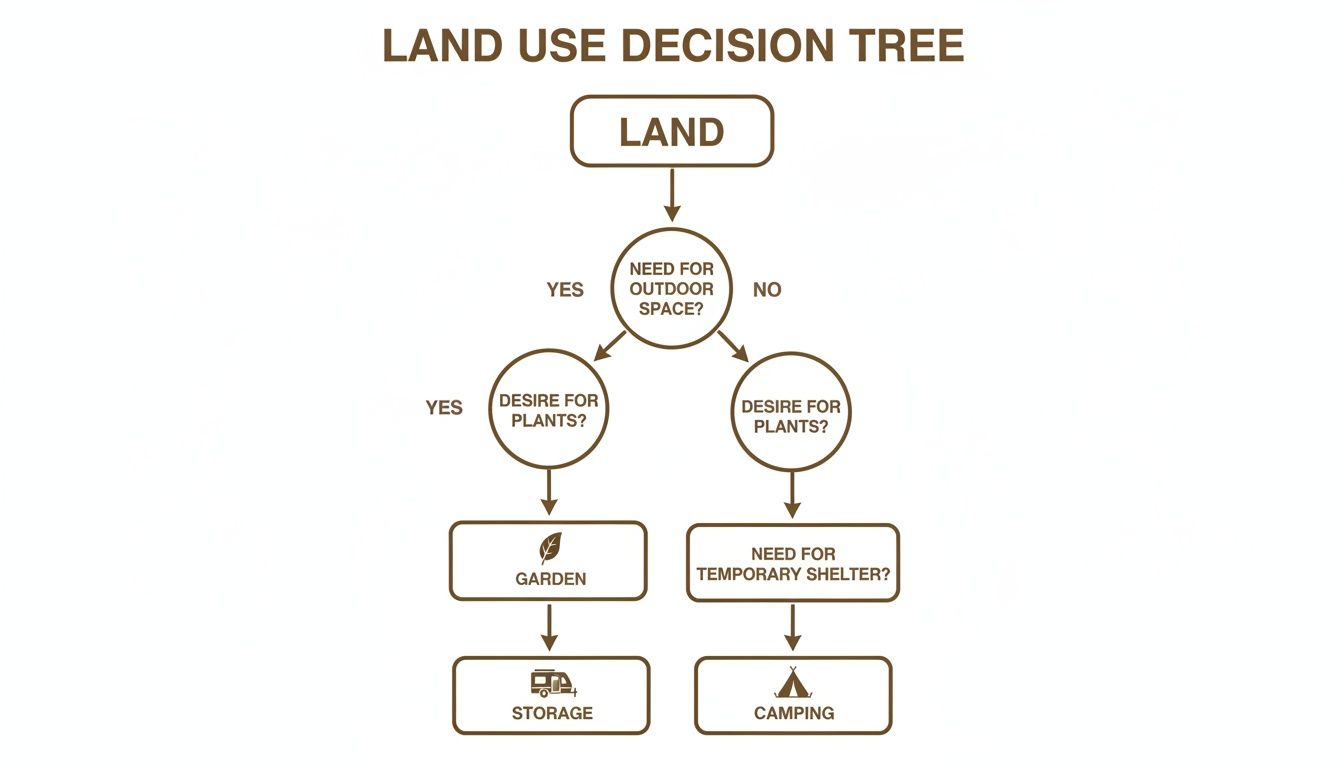
As the graphic shows, you don't have to start big. Even simple uses like a community garden, RV storage, or a rustic campsite can be great starting points for generating value.
Capitalizing on Natural Resources
Don't overlook that your land's value might extend beneath the surface. Depending on your property's location, you could be situated on valuable natural resources that can be monetized.
This could mean implementing a sustainable timber harvesting plan with a professional forester, which allows you to selectively log mature trees for income while maintaining forest health. Another option is leasing your mineral rights, which gives a company the right to explore for resources like oil, gas, or gravel in exchange for royalty payments.
These are more complex strategies that often require expert assistance, but they can offer some of the highest potential returns. Sometimes, what’s under your soil is just as important as what you can build on top of it. You can learn more in our article about how to determine land value.
Finally, consider how to boost your property's appeal for a future sale. In arid regions, for example, a thoughtful drought-tolerant landscape design can add value and beauty without requiring much water. Building long-term wealth with land is a marathon, not a sprint, but with the right strategy, your property can become a powerful financial engine.
Unlocking Your Land's Potential: A Guide to Navigating Local Regulations

Even the most brilliant idea for your land is just an idea until you get approval from local authorities. Researching county regulations isn’t just a formality; it’s the most important homework you'll do. It’s what separates a profitable land venture from a costly dead end.
Every county has its own set of rules that dictate what you can and cannot do with your property. Understanding these rules is about discovering your land's true potential before you invest time and money into it.
Getting a Handle on Zoning and Land Use Codes
The first and most significant hurdle is zoning. Zoning is how a county organizes land use. It divides areas into different districts—such as residential, commercial, agricultural, or recreational—and establishes rules for each.
A property zoned "Agricultural" might be perfect for leasing to a farmer but could prohibit a commercial operation like an RV storage lot. Similarly, a "Residential" zone will almost certainly prevent you from opening a campground.
Your first stop should be the county's Planning and Zoning Department. Their website is often a valuable resource, with zoning maps and the ordinances that govern land use.
Never assume you can do something just because a neighbor is. Their operation might be "grandfathered in" under old rules that no longer apply. Always verify the regulations for your specific parcel directly with the county.
Your Due Diligence Checklist
When you contact the county office, have your property's Assessor's Parcel Number (APN) ready. It is the unique identifier they will use to look up all relevant details for your land.
Here are the essential questions you need to ask:
- What is the exact zoning classification for this parcel? Get the specific code (e.g., "AR-2," "C-1," or "RR-5") and ask where you can find the ordinance that explains it.
- Are there any overlays or special restrictions? Sometimes, a property has a base zone plus an "overlay" that adds extra rules, such as flood-plain restrictions or conservation requirements.
- What uses are permitted, and what requires a special permit? Some activities might be allowed "by right," while others require a Conditional Use Permit (CUP). A CUP process often involves public hearings and is never a guaranteed approval.
- Is there legal and physical access? Confirm the property has recorded legal access to a public road. A landlocked parcel has limited utility and value.
- What is the utility situation? Inquire about access to public water, sewer, and electricity. If they aren’t available, ask about local rules for drilling a well or installing a septic system.
This research is absolutely critical. For example, an investor might find what seems like the perfect spot for tiny home rentals, only to discover a zoning overlay that specifically bans short-term rentals—a deal-breaking detail that could have been found with one phone call.
Knowing your property's permissions is especially important in the current market. Some markets have very little vacant space available for certain uses, and developers are actively scouting for land that is ready for development. If you can show your parcel is properly zoned, you hold a more attractive asset. You can find more insights on market trends at ULI Americas.
This due diligence also directly impacts your holding costs. How a county classifies your land affects your tax bill. Be sure to read our guide on how to handle property taxes on vacant land.
What This Means for First-Time Land Buyers
If you are new to buying land, discussions about zoning codes and monetization can feel complex. However, making money with vacant land can start with one simple, manageable step. The key is to focus on low-risk, low-effort ideas first.
Consider leasing a small section to a local farmer for grazing or for recreational access. Starting with a simple strategy does more than generate your first income—it builds confidence and provides hands-on experience as a landowner. It’s an effective way to let your property start paying for itself while you plan your next moves.
Your Research Is Your Advantage
Doing your homework is your single biggest advantage as a buyer. A thorough investigation into local rules and market needs can uncover opportunities that others miss. This is how you can turn a simple, affordable parcel into a valuable asset without a massive upfront investment.
You don’t need to be a seasoned developer to succeed. A solid, well-researched plan focused on your specific parcel is far more valuable than a complex strategy that doesn't fit your property.
This proactive approach is more relevant than ever. The vacant land market is active, with some sources reporting an increase in land sales in 2023 and the total land value reaching an estimated $18.6 trillion. With a significant percentage of land deals closing in under 30 days, having a clear plan allows you to move decisively. You can discover more insights about the rise of land as an investment at TheGlobalGroup.us.
Ultimately, your success depends on smart, upfront investigation. To help you build this crucial skill, be sure to check out our guide on what to look for when buying land.
Why Consider Dollar Land Store?
Before you can turn a piece of land into an income-producing asset, you need the right property—one that fits your budget and vision. This is where Dollar Land Store can help.
We aim to be a straightforward starting point for your land investment journey. Our approach is built around making land ownership accessible and affordable. We specialize in raw, undeveloped land, which means you don't need a large amount of cash just to get started.
A Simple Path to Owning Land
We streamline the purchase process by offering seller financing with no credit checks. This is a significant benefit for many buyers, as it allows you to secure a property without depleting the savings you may need for your first project, whether that's clearing a spot for an RV or installing a fence for a pasture.
We’ve kept the process as simple as possible:
- No Agents or Middlemen: You deal directly with us. This means no broker commissions and no complex back-and-forth negotiations.
- Clear, Manageable Payments: Our financing plans are designed with low monthly payments to help you manage cash flow while you get your land set up to generate income.
- Transparent Terms: All terms and disclosures are laid out clearly from the start. You'll understand every part of the purchase before you commit.
Our goal is to help you get started on solid financial ground. When you acquire land without a huge upfront cost, you can keep your capital available for the monetization strategies discussed in this guide.
Build Your Land Portfolio, Your Way
We offer a diverse inventory of properties across multiple states, so you can find a parcel that matches your goals. Whether you’re looking for a recreational spot, a long-term buy-and-hold property, or land for a small leasing operation, you can find it with us. And with our fast contract setup, you can go from browsing online to being a landowner efficiently.
This approach lets you spend less time on the purchase process and more time focusing on the potential of your new asset. It's all about getting you to the starting line, ready to make your land work for you.
Common Questions About Monetizing Vacant Land
Jumping into land investing often brings up a few key questions. Getting clear answers will help you set realistic expectations and build a smarter plan for turning your property into a source of income.
How Much Can I Realistically Make From a Small Parcel?
The honest answer is: it depends entirely on the property and your strategy. The income potential is determined by your land's location, its specific features, and how you choose to use it.
A small, remote parcel might only generate a few hundred dollars a year from a simple hunting lease. However, a similar-sized lot near a popular tourist destination could potentially earn that much each month from camping rentals. If it has good road frontage, renting it for RV or boat storage could bring in even more. The key is to match your land's best features to a real need in the local market.
What Are the Most Common Mistakes to Avoid?
The single biggest mistake new investors make is failing to perform adequate due diligence. Never assume you can use your land for a specific purpose without verifying it with the county planning and zoning department. A quick phone call can save you from significant headaches and financial loss.
Another common pitfall is underestimating holding costs. Buyers often focus on the purchase price but forget about recurring expenses like annual property taxes, liability insurance for leasing activities, or minor improvement costs. Always factor these into your budget before you buy.
A solid, well-researched plan—even for a simple strategy—is your best defense against unexpected costs and regulatory roadblocks. Always verify first.
Do I Need a Formal Business to Lease My Land?
While you can lease land as an individual, many owners choose to set up a simple Limited Liability Company (LLC). An LLC can create a legal separation between your personal assets (like your home and savings) and your land investment activities.
This article does not constitute legal advice. It is always a good idea to consult with a legal or financial professional. They can review your specific situation and help you decide on the best structure before you sign any rental agreements or contracts.
Conclusion and Next Steps
Making money with vacant land is an achievable goal for beginners and seasoned investors alike. It starts with understanding that your property is more than just dirt—it's an asset with potential. Success comes from matching that potential to a real-world need, whether it's providing a local farmer with grazing space or offering a beautiful spot for weekend campers.
The key takeaways are:
- Start Simple: Immediate income strategies like leasing for recreation or storage are low-risk ways to cover costs and gain experience.
- Do Your Homework: Verifying zoning, access, and local regulations with county authorities is non-negotiable. This due diligence is what transforms a good idea into a viable plan.
- Think Long-Term: While generating immediate cash flow is valuable, remember the wealth-building power of buy-and-hold strategies, seller financing, and high-value commercial leases.
Your journey as a landowner begins with acquiring the right property. By focusing on affordable land with transparent terms, you can start your portfolio on strong footing.
Ready to find your first parcel?
Browse available land at DollarLandStore.com.