


Off Grid Land in Colorado How to Find and Prepare It
Ross AmatoYou've found a Colorado parcel with mountain views, a low asking price, and enough space for the cabin you've been imagining. Then the practical questions arrive: Can you get a legal well? Where can septic go? Is the road usable in winter? Can the county approve the structure you want? For off grid land in Colorado, those questions matter more than the view or the acreage.
What Off Grid Land in Colorado Really Means for Buyers
A buyer often starts with a simple goal: find affordable acreage, disconnect from utility lines, and create a private retreat. That goal can work, but raw Colorado land usually means the buyer must plan and provide water, wastewater treatment, electricity, heating, and reliable access. A vacant parcel isn't a finished homesite, and a listing photo can't confirm whether the land supports year-round occupancy.
Dollar Land Store sells vacant land online, and most properties are raw and unimproved unless the listing says otherwise. That distinction matters. A parcel may show open terrain, nearby roads, and dramatic peaks, while still requiring separate county verification for zoning, building, septic, access, and utilities. Nearby services or public recreation also don't create rights on the property itself.
Practical rule: Treat every off-grid parcel as a due-diligence project first and a lifestyle purchase second.
Colorado's county system makes location especially important. The state sets minimum standards for wells and onsite wastewater treatment systems, but counties and towns enforce zoning and building requirements. A parcel in Costilla County may face different review questions from land in a mountain jurisdiction, even when both listings are described as suitable for an off-grid retreat.
The most important distinction is between regional opportunity and parcel permission. Hiking, fishing, public land, mountain scenery, or a nearby town can make an area attractive. None of those facts automatically gives you permission to camp, build, place an RV, install a septic system, drill a well, or live on the parcel.
Financing doesn't change that. During financing, buyers must follow the signed agreement and shouldn't occupy the land, store belongings or an RV, place structures, build, or make improvements without the written permission required by Dollar Land Store. Payoff and deed transfer also don't guarantee approval for construction, camping, wells, septic, farming, mobile homes, or subdivision.
A sound evaluation starts with five questions:
- Zoning: Does the county allow the intended residential or recreational use?
- Water: What well category could apply, and is a permit realistically available?
- Wastewater: Can the county approve an OWTS, or onsite wastewater treatment system, on the parcel?
- Access: Do you have legal and physical access, including during snow conditions?
- Construction: Can the planned structure, foundation, roof, and energy system satisfy local review?
The inexpensive parcel is not always the inexpensive project. In Colorado, a smaller tract with no viable water or septic path may be less useful than a more remote parcel that can support the intended use. Start with county records and state water information before you let acreage, scenery, or a low payment make the decision for you.
Where to Look for Off Grid Land in Colorado
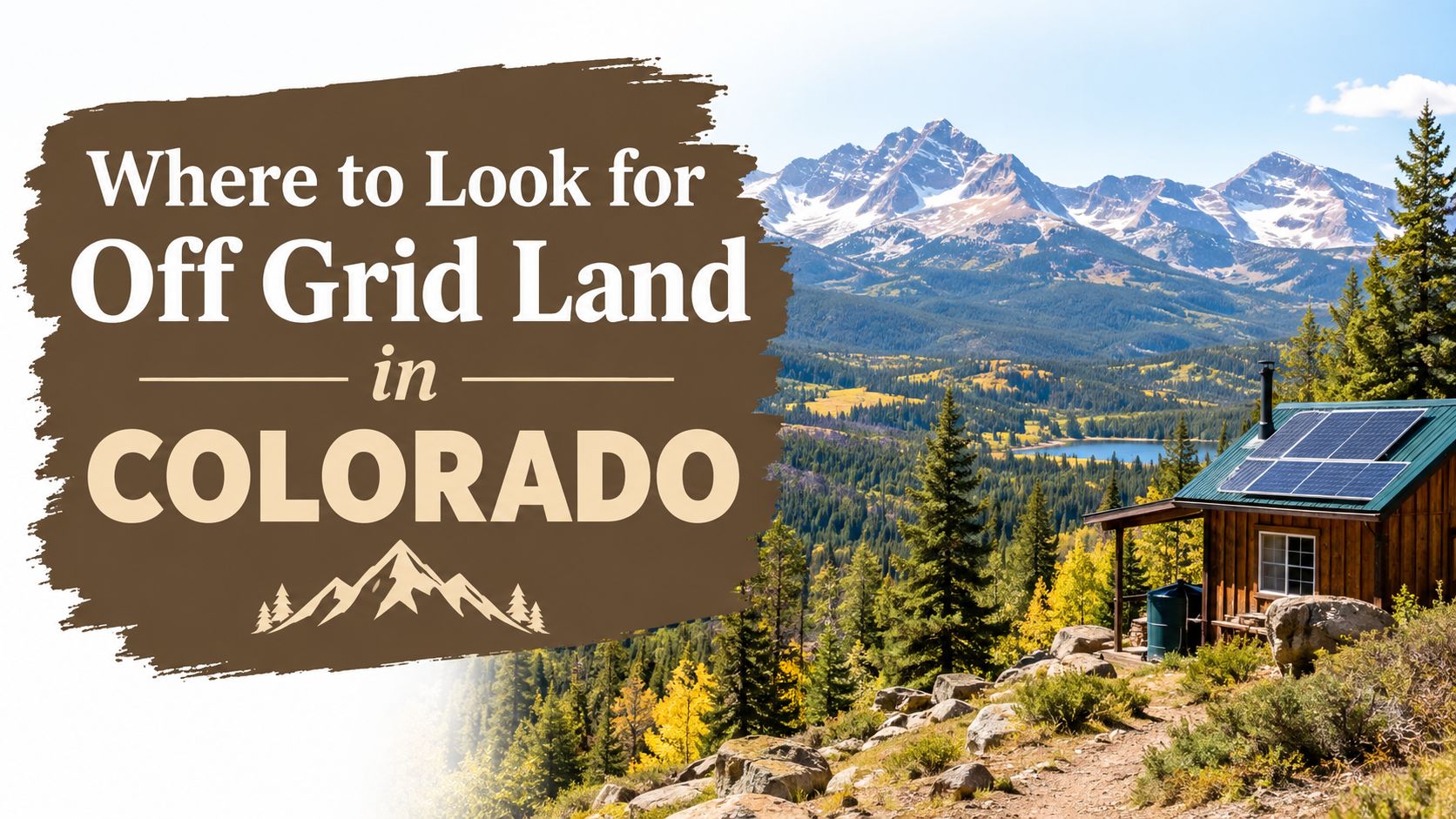
Colorado's off-grid regions don't offer the same experience. High-desert valleys, established rural communities, and high mountain areas each create a different combination of privacy, winter exposure, road difficulty, and service distance. Match the county and terrain to your purpose before comparing listings.
The San Luis Valley, including Costilla County, attracts buyers who want broad views, open space, and a quieter setting. Areas near Fort Garland and the Rio Grande Ranches illustrate the trade-off. The terrain can feel spacious and secluded, but buyers still need to investigate road conditions, county rules, well feasibility, septic placement, and the practical distance to supplies.
| Area character | Often suits | Main trade-off |
|---|---|---|
| High-desert valley parcels | Weekend retreats, long-term holds, quiet rural projects | Exposure, sparse services, and water limitations can shape the plan |
| Parcels near rural communities | Buyers who want access to a town while keeping privacy | Less isolation and potentially more local land-use considerations |
| Higher mountain land | Buyers prioritizing forest, elevation, and mountain setting | Snow, steep terrain, winter access, and structural demands can complicate development |
A parcel near Fort Garland may be more practical for someone who wants a connection to a small community, while a more isolated valley tract may appeal to a buyer focused on privacy. Neither setting should be treated as automatically buildable. A mapped road may be difficult after snowfall, and a nearby town doesn't establish utility service at the property.
For broader regional context, review Colorado land for sale and rural market considerations, then return to the individual parcel file. The listing gives you a starting point, not a substitute for county confirmation.
Match the county to the project
A weekend getaway may tolerate a longer drive, seasonal road limitations, and a simpler power plan. A future homestead requires more. You'll need a defensible water strategy, approved wastewater treatment, storage, heating, food-growing permissions, and access that works when weather changes.
A long-term hold calls for a different review. You might care less about immediate construction and more about ownership documents, access, zoning, surrounding land uses, and whether the parcel's future plan remains realistic. Don't pay for a mountain view while assuming the county will approve a home later.
Before contacting a county, write down the intended use in plain language. Say whether you want a single-family dwelling, a seasonal retreat, livestock, gardening, an RV visit, or only to hold the property. County staff can respond more accurately when the proposed use is specific.
Ask about road maintenance responsibility, winter access, zoning district, minimum dwelling requirements, septic review, well permitting, and any subdivision or covenants affecting the parcel. The right region is the one whose rules and physical conditions match your actual plan, not just the one with the most attractive listing photograph.
How to Verify Zoning and Permits Before You Buy
A parcel can look ready for a cabin until the county rejects the proposed use or the site cannot support wastewater. Review approvals in sequence: zoning first, wastewater feasibility second, water permit status third, and building permits after the site fundamentals are clear. This order keeps an attractive design or solar plan from driving the purchase.
Start with county zoning
Colorado has no single statewide off-grid law. Counties and towns enforce zoning and building rules, while the state sets minimum standards for wells and OWTS systems. Contact the planning department with the parcel number and legal description. Ask for the zoning district, permitted uses, setbacks, minimum dwelling rules, accessory-structure requirements, and restrictions on RVs, camping, or temporary occupancy.
Treat an “off-grid living” label as a marketing description until the county confirms the actual use. Ask staff to identify the applicable rule or permit path in writing when possible. Keep those responses with the listing, survey, and title records so the same assumptions do not get repeated later.
Get wastewater feasibility before designing
Once zoning appears compatible, contact the county environmental health or public health department about an OWTS concept. Ask whether the parcel has enough suitable area for the system, whether soil or slope conditions create problems, where the primary and replacement areas could go, and what documentation the county requires.
A composting toilet does not automatically remove wastewater review. Graywater and any structure with plumbing may still trigger county review and inspection. Rainwater collection also does not replace an approved wastewater plan. Confirm the disposal method before paying for building plans.
For a practical way to organize site observations, Upchurch Inspection's reporting guide can help you record conditions, photographs, and unresolved questions. It does not replace county approval.
Review water and building permits
After confirming a realistic wastewater path, ask the Colorado Division of Water Resources about the well permit category, existing permits, intended use, and basin-specific restrictions. The state's well-permitting guidance states that a new well diverting groundwater requires a permit. Approval depends on available unappropriated water and whether the proposed diversion could materially injure existing vested rights.
Only then should you invest in building plans. Local building officials may require engineered drawings, structural calculations, energy information, foundation details, and snow-load documentation. Review Colorado building permit requirements for general planning, then confirm current requirements with the county or town governing the parcel.
Keep a written file with zoning responses, septic notes, well correspondence, access records, maps, and unresolved questions. It cannot guarantee approval, but it can show exactly what was confirmed before you purchased.
Water Septic Power and Access Checks That Make or Break a Parcel
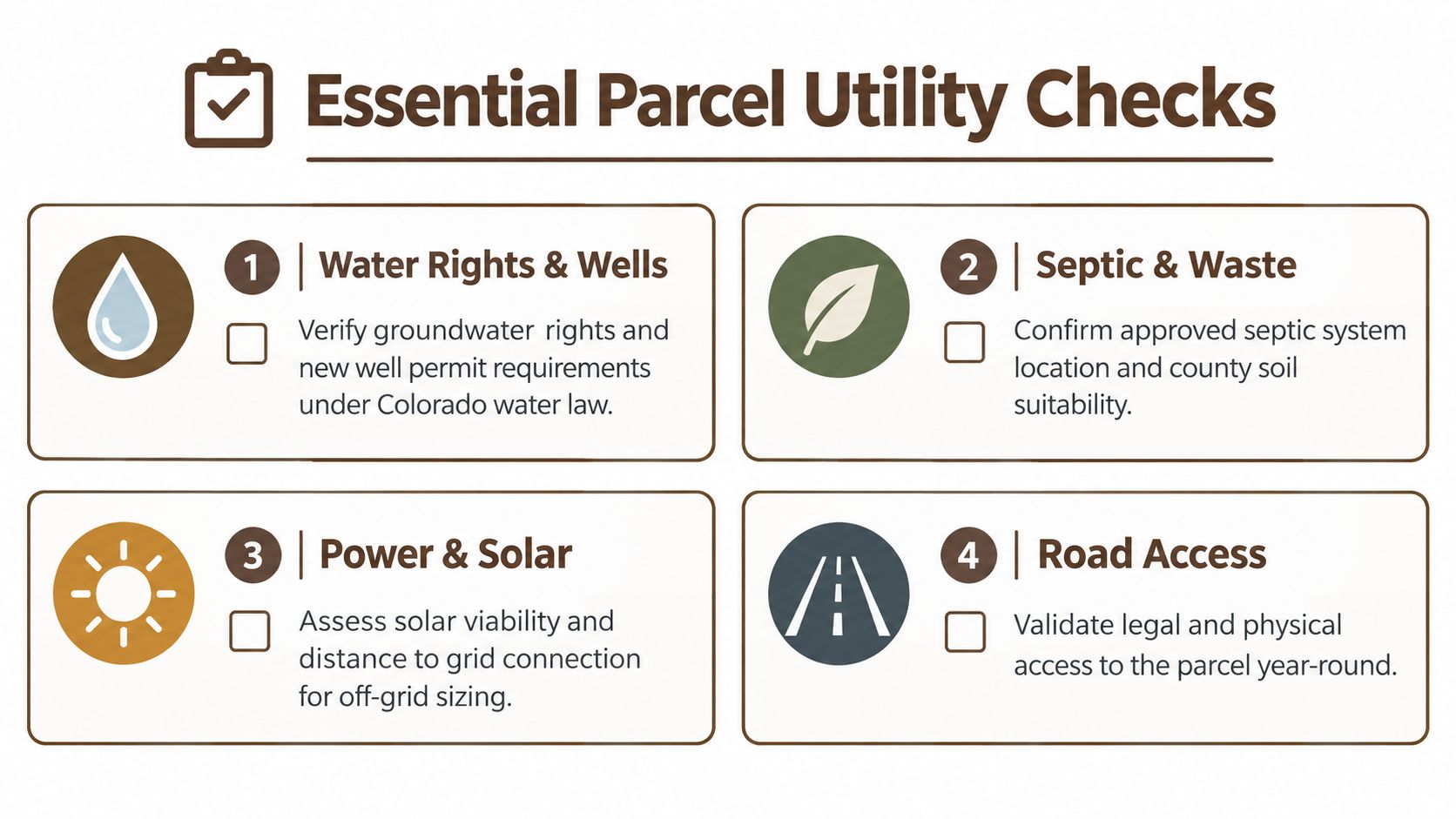
A low-priced parcel can have attractive views and still fail as a year-round homesite. Start with legal water and wastewater feasibility, then check power and access. Drilling a well or installing a septic system is not a substitute for obtaining the approvals that make those systems lawful.
Colorado land ownership does not automatically include usable groundwater. The Colorado Division of Water Resources requires a permit for a new well that diverts groundwater. Colorado statutes have required a written application for new wells since May 17, 1965. Confirm the permit category, existing permits, approved use, designated groundwater basin status, and whether the planned household, irrigation, or livestock demand fits the applicable rules.
The permit question comes before a drilling quote. Prior appropriation principles mean a parcel can look suitable while lacking the legal water capacity needed for the project.
Water use changes with parcel size
Colorado's commonly used 35-acre rule affects rural planning. State guidance generally allows landowners with 35 or more acres to obtain an exempt well for domestic and livestock use, while smaller domestic wells operate under tighter statutory limits. The cited framework also sets a maximum pumping threshold of 15 gallons per minute and, in some cases, limits use to three single-family dwellings plus irrigation for one acre of lawn or garden, according to the Colorado rural living water and sewer guide.
For parcels under 35 acres, the guidance generally limits an exempt well to ordinary household use inside one single-family dwelling, without outdoor watering, gardening, or livestock use. Verify the exact permit conditions with the state and county. Lot size, basin rules, existing rights, and intended use can change the answer.
Colorado manages roughly 646,000 well permits statewide. That figure reflects the scale and history of the regulatory system, not a promise that a particular parcel can receive a permit. The cited application fees are $100 for a new exempt-well application and $60 for a relocation application, but the larger question remains whether the proposed use is legally and hydrologically feasible.
Rain barrels provide only a limited supplement. Colorado allows permit-free collection in rain barrels up to a combined 110 gallons for a single house or a multi-family residence of four units or fewer, according to the EPA summary of Colorado water reuse rules. Rooftop collection connected to certain well permits requires a separate rooftop precipitation collection permit.
Treat septic, power, and roads as site systems
A septic system needs a suitable location, soil conditions, and a protected replacement area, not just enough acreage. Delta County's water and wastewater guidance states that subdivision or property-line-adjustment plats must identify septic locations, and the system must remain entirely on the property it serves. The same guidance notes that subdivision wells may require a state augmentation plan when water crosses property lines.
Before closing, identify the proposed onsite wastewater treatment system location, soil or percolation documentation, setbacks, reserve area, and county approval path. A parcel without a workable septic area cannot support a home merely because it has legal road access or a permitted well.
Solar can serve a rural home, but winter conditions determine the design. Front Range projects often face ground snow loads around 30 to 35 psf, while mountain communities can exceed 60 to 120+ psf, according to this Colorado solar permitting guide. Those conditions may require site-specific engineering, stamped drawings, stronger foundations, and engineered roof or ground-mount attachments. Check solar exposure, winter production, battery capacity, generator placement, and the distance to the nearest grid connection before choosing a system.
Road access requires the same document review as utilities. A line on a map proves only that a route is mapped. Confirm the recorded access instrument, easements, maintenance obligations, drainage, physical condition, and seasonal usability. If a neighbor maintains the road informally, do not treat that arrangement as a permanent right without reviewing the recorded documents. Snow, mud, steep grades, and emergency vehicle access can determine whether the parcel works year-round.
| Feasibility factor | What to verify | Why it matters |
|---|---|---|
| Water | Well permit category, existing rights, basin status, and intended use | Ownership does not guarantee usable groundwater |
| Septic | OWTS location, soil suitability, reserve area, and property-line compliance | A home needs an approved wastewater solution |
| Power | Solar exposure, winter production plan, snow loads, storage, and grid distance | A generic system may not suit the site's energy or structural conditions |
| Access | Legal easements, maintenance responsibility, route condition, drainage, and winter use | Arrival and emergency response depend on more than a mapped road |
For background on equipment choices and planning questions, review these well water systems for rural properties. A Costilla example is #L05944-1 5 Acres in Rio Grande Ranches Costilla, Colorado $5,995.00 ($75.77/Month). The listing describes 5 acres, access via Acoma Trail, and mountain and valley views, but also says buyers must verify county details and that the land is sold as-is without warranties regarding accessibility, terrain, or buildability. Check current availability, then complete the water, septic, access, and zoning review before treating the parcel as a year-round option.
Preparing Your Colorado Parcel for Year-Round Off Grid Living
Year-round preparation starts with the county-approved water and septic plan, then works outward to winter operations. A solar array that performs well in bright months may need more battery reserve and a tighter energy budget when snow, shorter daylight, and heating demand arrive. Size the system around actual loads, including pumps, refrigeration, communications, lighting, water treatment, and backup heat controls.
Build for snow and freeze conditions
Roof and ground-mount designs must match the local snow load. Mountain conditions can require reinforced attachments, stronger foundations, and stamped engineering before the county reviews the project. A generic cabin or solar kit may fit the budget but fail the site's structural or permitting requirements.
Protect tanks, pipes, pumps, and septic components from freezing. The water plan should identify the source, storage location, pump power, shutoffs, insulation, and a way to drain or service the system during extended cold. Septic planning also needs room for snow removal, vehicle access, the replacement area, structures, and driveways.
Residential and commercial construction can involve different code-review practices and project-planning needs. The Front Range residential vs commercial building discussion provides general context, but the county building department controls requirements for the parcel and proposed structure.
Plan operations, not just equipment
A dependable setup includes daily procedures and maintenance responsibilities, not only panels and batteries. Set these decisions before construction:
- Heat: Evaluate propane, wood, or another approved system for fuel delivery, storage, ventilation, fire safety, and backup operation.
- Roads: Assign responsibility for snow clearing, drainage repairs, ruts, and washouts. A private road can limit winter access even when the home systems work.
- Water storage: Match storage to household use and source reliability, then protect it from freezing and contamination.
- Construction staging: Confirm where materials, equipment, and service vehicles can travel before ordering a cabin, tank, foundation, or solar structure.
- Communication: Plan for weather alerts, emergencies, maintenance calls, and supply trips.
Winter readiness also depends on service access. A pump failure, frozen line, or damaged solar mount may require tools, parts, and a vehicle route during poor weather. Include those response needs in the site layout and operating budget.
Do not budget only for the visible structure. Site work, engineering, access improvements, water infrastructure, wastewater, energy storage, and seasonal logistics can determine whether the project stays manageable. Good preparation follows the parcel's physical limits and the county's approval sequence.
For additional building concepts, planning an off-grid house build can help organize ideas, but it does not replace site-specific engineering or county review. Buying land creates no automatic permission to build a cabin, install utilities, or occupy the parcel year-round.
Your Purchase Checklist and Next Steps to Buy With Confidence
Use this order before committing to a Colorado parcel:
- Confirm the county and zoning district. Ask about residential use, structures, camping, RVs, setbacks, and minimum requirements.
- Request septic guidance. Discuss an OWTS concept, soil suitability, system location, replacement area, and inspection requirements.
- Check water feasibility. Review existing permits and ask the Colorado Division of Water Resources which well category and uses could apply.
- Verify access. Review recorded easements, maintenance obligations, physical road conditions, and winter limitations.
- Review the build plan. Ask about snow-load engineering, foundations, solar structures, and the permits required for the proposed improvements.
- Complete purchase documents carefully. Checkout starts the purchase process. It doesn't by itself complete the transaction or transfer ownership.
For financed purchases, buyers must complete the required documents and set up payments through ZimpleMoney. Dollar Land Store retains legal title until payoff and completion of the deed-transfer requirements. For cash purchases, deed preparation begins after payment clears, required documents are signed, and applicable requirements are completed. Dollar Land Store prepares the deed packet, and the buyer ordinarily records the deed with the county.
Amounts paid are generally non-refundable, subject to the signed agreement and applicable law. Read the Dollar Land Store buying process, financing information, and terms and conditions before checkout. Verify every property claim with the county, and remember that payoff or deed transfer doesn't guarantee future approval for building, wells, septic, camping, farming, or subdivision.
Dollar Land Store offers vacant Colorado parcels and eligible owner-financing options for buyers comparing raw land by location, acreage, and purchase terms. Visit Dollar Land Store to browse current listings, check availability, and begin your due diligence with the parcel that fits your off-grid plans.