


Owner Financing Land Terms Buyers Should Know
Ross AmatoYou've found a vacant parcel and the listing shows a monthly payment that looks manageable. Before you decide, separate that figure from the cash price, down payment, document fee, and total financed cost. Owner financing land terms set the rules for how those amounts work, who holds legal title while you pay, and what can happen if you miss a payment.
What Owner Financing Land Terms Actually Do
A buyer reviewing a vacant-land agreement may see a modest monthly payment and still have questions about the full cost. The cash price is what the parcel costs when paid for upfront. A down payment is the opening amount on a financed purchase; a document fee is a separate disclosed charge. The monthly payment is due during repayment, while the total financed cost reflects the complete payment schedule and applicable charges.
Owner financing, also called seller financing, lets a buyer pay the seller in installments rather than use a bank mortgage at closing. It has also been used for home purchases. The American Housing Survey reported that about 3.5 million owner-occupied households, or 4.6% of owner-occupied households, had a contract for deed in 2009, according to the Consumer Financial Protection Bureau's report on contracts for deed. That figure concerns owner-occupied housing, not vacant recreational land, so it does not estimate how many vacant parcels are owner-financed.
Each agreement term answers a different question. Down payment, interest, and amortization affect the amounts paid over time. Balloon payments, prepayment clauses, and late charges set rules for early, final, or overdue payments. A promissory note records the debt. A trust deed, mortgage, or land contract connects that debt to the property and helps determine who holds legal title while the buyer pays.
Read the agreement with three questions in mind: What cash is due, who holds title, and what can a missed payment cost in equity? A small scheduled payment alone cannot answer them.
Check whether the agreement uses escrow, who handles taxes and insurance, and when the deed transfers. Those terms should be clear in writing, and state law can affect how they work. On a Dollar Land Store offer, compare the listed cash price, down payment, document fee, and monthly payment as separate amounts. Then check the full repayment terms and the title provisions before deciding whether the deal fits.
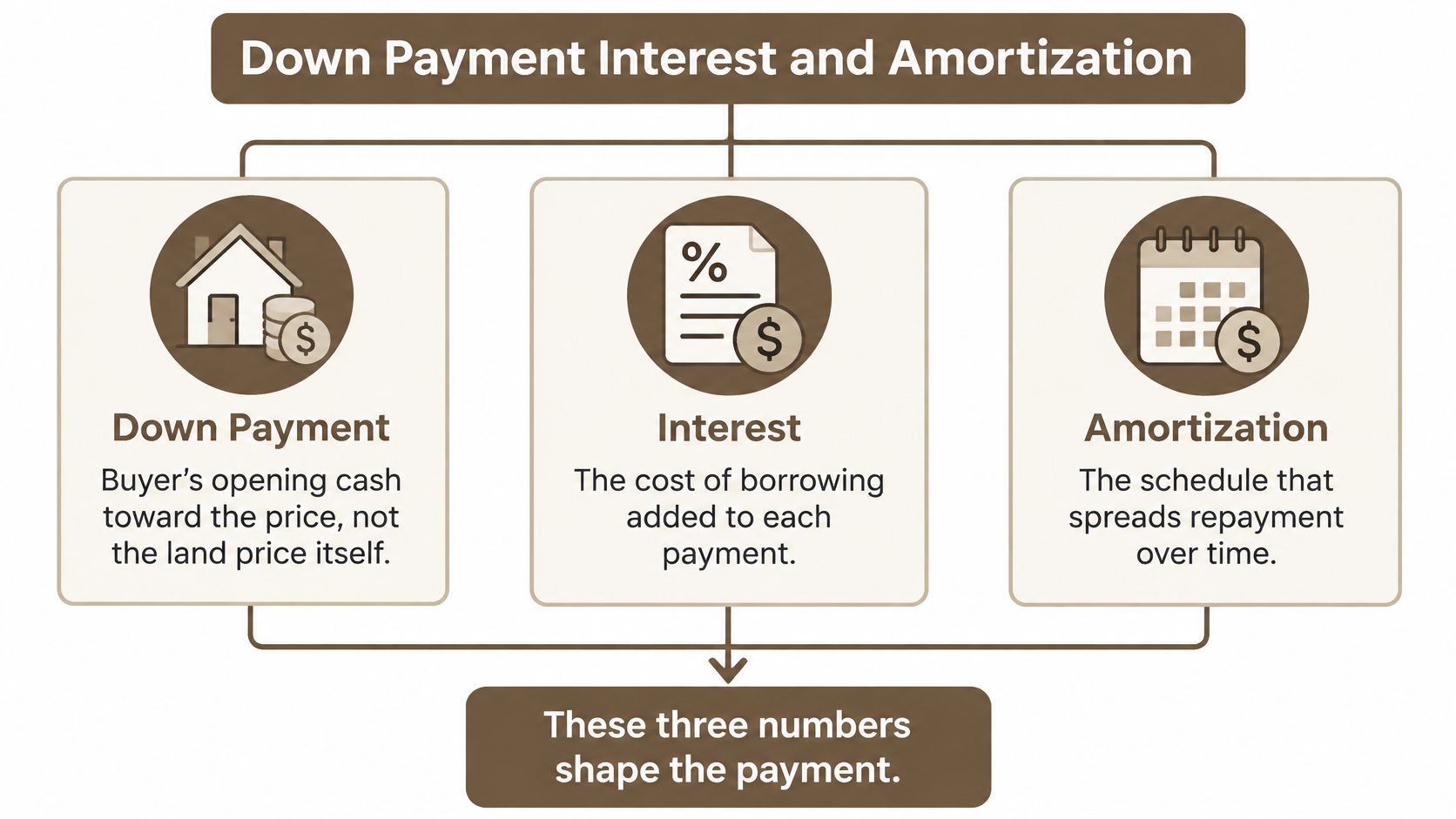
Down Payment Interest and Amortization
These three terms shape the payment, but they don't mean the same thing.
Start with the down payment
The down payment is the buyer's opening cash toward the price. It isn't the land's price, and paying it doesn't mean other disclosed charges disappear. On eligible Dollar Land Store offers, a one-dollar amount is a financing down payment. A document fee shown for the specific property is separate, and scheduled monthly payments still follow.
For a particular parcel, read the checkout amounts line by line. Don't combine the down payment, document fee, and monthly installment into a claim that the land costs only the down payment.
Then look at interest and amortization
Interest is the cost of paying over time. Amortization is the schedule that divides each installment between interest and principal. Think of the schedule as a repayment path leading to a maturity date. The monthly payment is a mile marker along that path, not a summary of the total cost.
A longer repayment schedule can make the ordinary installment smaller while increasing the interest paid over the life of the agreement. That's why buyers should compare the effective annual cost and total scheduled payments, not only the advertised monthly amount. If you're comparing installment borrowing more broadly, BadCreditMD's overview of loan costs can help put repayment structure in context.
A well-written agreement should state the interest rate, how often payments are due, how payments are amortized, and the maturity date. Federal installment-sale rules can recharacterize some stated principal as interest if the contract's stated interest is too low or absent. The IRS explains adequate stated interest and applicable federal rates in Publication 537 on installment sales.
For an explanation focused on land purchase financing, see how owner-financing rates affect a land purchase. Before signing, ask for the payment schedule and identify how each installment is applied. The useful question is not just “What do I pay each month?” It's also “How much of that payment reduces principal?”
The Note Trust Deed and Who Holds Title
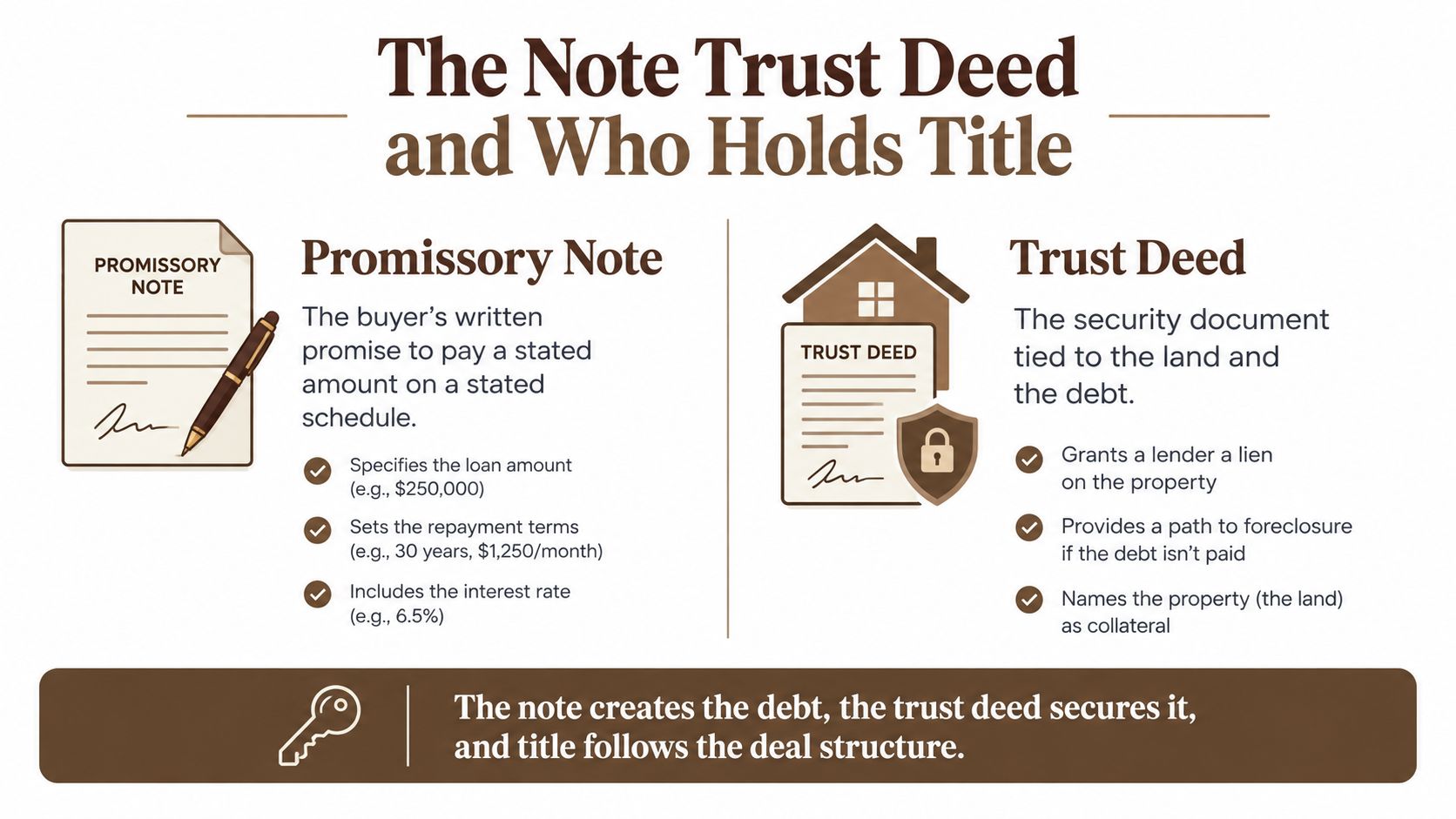
A buyer financing a vacant parcel should check two things in the paperwork: what promises repayment, and who holds title before the balance is paid. The promissory note records the debt. A trust deed or mortgage secures that debt with the land. A land contract can arrange title differently, so the same terms can carry different consequences for a buyer's rights and equity.
The note and the security document
A promissory note is the buyer's written promise to pay an amount on an agreed schedule. The trust deed or mortgage connects that debt to the parcel as security. In many recorded-lien arrangements, the buyer holds legal title while the seller or lender holds a lien. The exact documents and their legal effect depend on the agreement and state law. Learn more about what a deed of trust does.
A contract for deed, also called a land contract, may leave legal title with the seller during repayment. The buyer holds contractual or equitable rights, and the deed transfers after payment and completion of the contract's requirements. That title arrangement can affect the seller's remedy after a default and the buyer's ability to protect equity already built in the parcel.
Title and the purchase process
For financed purchases through Dollar Land Store, the seller retains legal title until payoff and completion of the deed-transfer requirements. Buyers complete the required purchase documents, and financed buyers set up payments through ZimpleMoney. Checkout begins the purchase process; it doesn't by itself complete the transaction or transfer ownership.
For a cash purchase, deed preparation begins after payment clears, required documents are signed, and applicable requirements are met. The deed packet is prepared for the buyer, who ordinarily records the deed with the county. If the agreement uses escrow, the signed papers should explain how the neutral party handles documents or funds. Don't assume escrow is included unless the paperwork says so.
Before paying, identify which document creates the debt, which secures it, and who holds the deed while payments are being made. Compare the sample land purchase agreement with the paperwork for your specific transaction. The signed agreement and applicable law govern the details.
Balloon Payments Prepayment and Late Charges
The ordinary installment isn't always the whole repayment schedule. A balloon payment is a larger remaining balance due on a specified date, even when earlier installments were calculated across a longer amortization period. When that date arrives, the buyer needs to pay the balance, refinance it, or negotiate a different arrangement. Vacant land may be harder to refinance than a house, so check whether the agreement has a balloon and whether you have a realistic plan for it.
Prepayment means paying extra or paying the balance before maturity. Dollar Land Store buyers may make additional payments or pay off early without a prepayment penalty, subject to their agreement. Confirm how an extra payment is applied and whether the agreement sets out any steps for requesting a payoff amount.
A late charge is a contract term that applies when payment is late. Read for the grace period, the charge or formula, and whether a late charge is the only consequence of missing the due date. The terms of a due-on-sale clause are a separate issue, but they're another reminder to read the actual agreement rather than rely on a general description of seller financing.
| Term | Question it answers | What to verify |
|---|---|---|
| Balloon payment | Is a larger balance due before the regular schedule would otherwise end? | The due date, balance calculation, and what happens if you can't pay it |
| Prepayment | Can I pay extra or pay off early? | Whether the agreement allows it and how extra amounts are applied |
| Late charge | What happens if an installment arrives late? | The grace period, charge or formula, and other default consequences |
These clauses work together. Amortization sets the ordinary installment, a balloon can bring repayment forward, prepayment can shorten the schedule, and late charges address delay. A comfortable monthly figure can still leave an important due date or cost out of view.
What a Missed Payment Can Do to Equity
Suppose you have paid on a parcel for several years, then miss an installment. The money you have already paid may not work like savings you can withdraw. Depending on the contract and state law, the seller may be able to seek forfeiture or foreclosure, and you could lose some or all of your prior payments and improvements.
Who holds title affects the process. In many contracts for deed, the seller keeps legal title while the buyer makes payments. A deed of trust or other financing arrangement may handle title and default differently. Read the agreement to see what happens after a missed payment, including whether you receive notice and time to catch up.
State rules vary. Arizona, for example, requires certain land-installment contracts to be ended through foreclosure rather than simple forfeiture. Other states may require foreclosure only after the buyer has paid for a specified period or reached a specified share of principal. Pew's summary of state land-contract statutes describes these differences. A missed payment does not have one nationwide outcome.
Before committing, check how the agreement addresses:
- Recording: Whether the agreement is recorded.
- Title: Who holds legal title during repayment.
- Notice and cure: What notice the seller must give and how long you have to fix a default.
- Prior payments: Whether any amounts paid can be kept or recovered after default.
- Ongoing costs: Who pays taxes, assessments, and maintenance while the agreement is active.
Federal protections do not automatically apply to every seller-financed vacant-land purchase. TILA coverage depends on the transaction and seller, including whether the seller meets the applicable threshold for extending credit. The CFPB discusses disclosure and ability-to-repay requirements for covered contract-for-deed transactions in its enforcement action involving contract-for-deed investors.
Michigan provides one state-specific example. The Michigan State Housing Development Authority's land-contract forfeiture guide says a buyer generally has 15 days after notice to cure unless the contract allows more time. The guide also describes a redemption period after a judgment of possession of 90 days if less than 50% of the purchase price has been paid, or six months if at least 50% has been paid. These are Michigan rules, not nationwide standards.
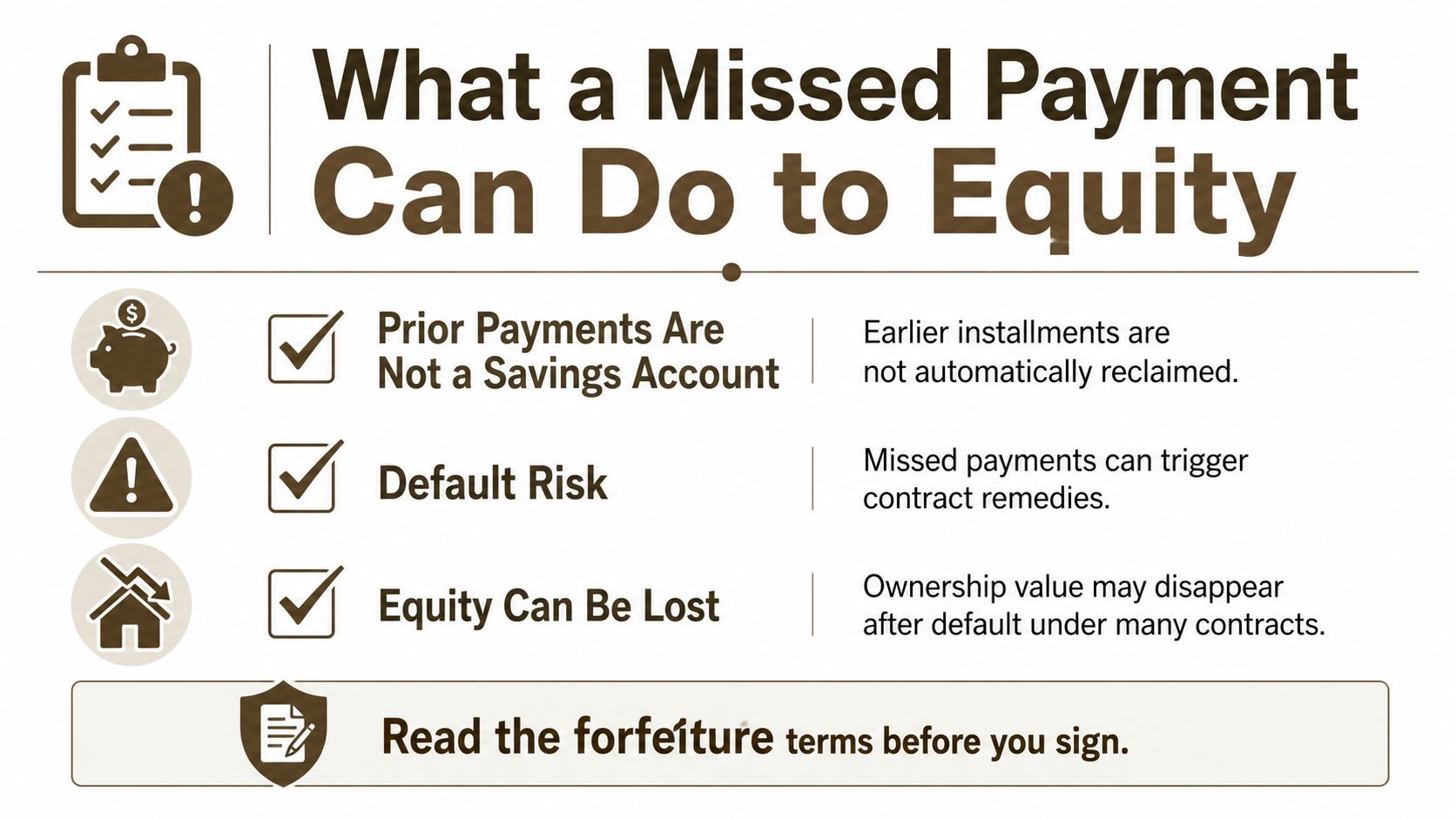
For a Dollar Land Store purchase, amounts paid are generally non-refundable, subject to the signed agreement and applicable law. Before signing, check how the contract treats missed payments, prior payments, and any improvements you make to the parcel.
Reading Real Land Deals Term by Term
A listing can show a low monthly payment while separating the purchase into several charges. On #L40057-1, 42.18 Acres in Pershing County, Nevada, the listed cash price is $28,999, the down payment is $1, the document fee is $199, and the monthly figure is $311.88. Each amount has a different job: the cash price is the listed price for paying upfront, the down payment starts a financed purchase, the document fee is a separate charge, and monthly payments reduce the financed balance under the agreement.
The listing describes a dirt road to the northeast and stated easements, including a 30-foot easement. Treat those as details to verify, not proof of legal or usable access. Nearby ranching or public-land recreation does not establish rights on the parcel. The listing also says buyers should verify property information with the county; its photos and descriptions do not guarantee buildability.
For comparison, L05821-1, a 1.3-acre lot in Bear Valley Springs, Kern County, California, is listed at a $19,899 price with a $458.46 monthly figure. It is described as being in a gated community, where access and amenities have their own rules. The listing calls out a buyer-paid transfer fee and a payment-history condition. Check the governing documents to understand those terms. Kern County's stated limit on dependent mobile homes is a parcel-specific land-use detail, not permission to camp or occupy the parcel while financing.
Use the same reading order for either parcel
Start with the cash price, then identify the down payment, document fee, any buyer-paid transfer fee, and scheduled monthly payment. These figures are separate lines in the deal, like separate labels on a receipt. Then check the agreement for who holds title during repayment and how extra payments work. Verify access, zoning, and permitted uses with the relevant county or community authority.
For more detail on what purchase paperwork can govern, read the key terms in a land purchase agreement. The sample land purchase agreement, discussed earlier, can help you recognize the documents and terms involved. Listing descriptions and photos are not warranties that land is buildable or that a particular use will be allowed.
Choosing Terms and Taking the Next Step
Choose between cash and financing by looking at the funds you have available now and the time you're comfortable taking to pay. With cash, the cash price is paid first; deed preparation begins after payment clears, required documents are signed, and applicable requirements are complete. With financing where offered, the agreement sets the down payment, any disclosed document fee, and scheduled installments. Financed buyers make payments through ZimpleMoney, and legal title stays with the seller until payoff and completion of the deed-transfer requirements. Additional payments and early payoff are allowed without a prepayment penalty under the agreement.
Before choosing, work through this short checklist:
- Compare total costs: Set the cash price beside the down payment, fees, and scheduled payments. Don't treat the monthly installment as the total financed cost.
- Check for a balloon: Find out whether a larger balance comes due before the scheduled installments would otherwise finish.
- Confirm extra payments: Check the agreement for how additional payments and early payoff work.
- Assign property expenses: Identify who pays taxes and assessments during repayment.
- Verify the parcel: Check access, zoning, and permitted uses with the county before relying on a future plan.
Dollar Land Store's approved sales states are Arizona, California, Colorado, Hawaii, Nevada, New Mexico, Oregon, and Utah. That doesn't mean listings are available in every state or county. Review the financing information, terms and conditions, buying process, and sample agreement before deciding. Confirm current availability for the Pershing County and Bear Valley Springs examples before treating either as an option.
Dollar Land Store offers vacant land with cash or financing options where offered, so buyers can compare the written terms as well as the parcel. Visit Dollar Land Store to browse current listings and compare location, acreage, and purchase options before choosing your next step.