


Vacant Land for Sale in Nevada: A Practical Buyer's Guide
Ross Amato“Cheap land” is usually the wrong starting point for a Nevada purchase. The better question is whether the parcel has a legal path to your intended use, including water, access, wastewater approval, utilities, and zoning. A low asking price can be reasonable for a long-term hold, but it can become a poor deal if you're expecting to build, park an RV, or live there soon.
Nevada's private-land supply is limited, and the parcels closest to growth and services carry a different value proposition from remote desert acreage. Before you compare listings, compare the total cost of making the land usable. This guide focuses on the checks that matter after the attractive price catches your eye.
Why Cheap Nevada Land Is Harder to Buy Than It Looks
A low down payment doesn't make raw land easy to use. It only changes how you pay for the purchase. You can still own a parcel that lacks a compliant water source, has no practical access, or cannot support the septic layout needed for a residence.
That distinction matters because Nevada residential land is tightly connected to water feasibility. State standards require access to a secure sanitary water supply, and a parcel without feasible access to a recognized source can be effectively unbuildable for residential development under current standards, as shown in Nevada's sanitary water supply requirements.
The four costs buyers underestimate
The first cost is water. Depending on the parcel, you may need to investigate a permitted well, an approved community source, or another compliant arrangement. Nevada water rights can also be separate from land ownership, so a deed alone doesn't prove that usable water is included.
The second is wastewater. Rural land often requires an individual sewage disposal system, and approval must come before a building permit where such a system is required. The system generally needs to sit on the same lot as the structure it serves, meet setback rules, and fit within the usable portion of the parcel. The Nevada Administrative Code septic provisions identify requirements including separation from property lines and certain wells.
Power is another separate project. A listing that shows nearby utility infrastructure doesn't establish that the serving utility will connect your parcel or what the extension will cost. Ask the utility provider for a parcel-specific answer instead of treating a nearby pole or line as a promise.
Access can stop the entire plan. A dirt track visible on a map isn't automatically a public road, and physical access isn't the same as a recorded legal right to cross someone else's land. If the parcel lacks usable legal access, a buyer may be unable to secure construction deliveries, utility work, or permits for the intended project.
Practical rule: Price the land and the path to use it. If you can't explain how water, access, wastewater, and power will work, you don't yet know what the parcel costs.
For a broader purchase checklist, use this guide to what to look for when buying land. The right bargain depends on your goal. A remote parcel can make sense as a hold or recreational base, while the same parcel may be a bad choice for a near-term homesite.
Where Nevada's Private Land Actually Sits
Nevada's land market is shaped by ownership before it's shaped by listing websites. The federal government controls about 86.1% of Nevada's 70,745,600 acres, while only about 11.5% is privately owned, leaving roughly 8.18 million acres of private land across the state, according to the Nevada Shared Stewardship Agreement.
That pattern explains why a search for vacant land for sale in Nevada can produce two very different markets. Remote parcels may look inexpensive because they're far from services and development pressure. Land near employment centers, transportation corridors, and established communities has a smaller practical supply and usually commands more attention.
Nevada land ownership by category
| Ownership type | Approx. share | Typical land-use effect |
|---|---|---|
| Federal land | About 86.1% | Surrounding public acreage may limit private expansion and can affect road, utility, and development planning |
| Private land | About 11.5% | The primary inventory available for private purchase, subject to local zoning, access, water, and development rules |
The state's public-land share is the highest in the country. Congressional data also reported about 56.1 million acres of federal land in the most recent national land-ownership report, reinforcing the point that Nevada doesn't have an unlimited free-market supply of privately developable acreage.
Why location changes the deal
Private parcels are concentrated in pockets rather than spread evenly across the state. Buyers may encounter listings around places such as Las Vegas, Reno, Sparks, Carson-area communities, Pahrump, Fallon, Elko, Winnemucca, Ely, Mesquite, and other rural markets, but proximity to a named town doesn't establish utility service or buildability.
Southern Nevada shows the supply pressure clearly. A 2023 regional study identified about 16,402 acres of potentially developable employment land across 142 parcels in the Las Vegas Valley area, down 14.1% from the earlier study's 19,088 acres across 198 parcels, as reported in the Southern Nevada land study. The remaining acreage was not uniformly ready for development. The study classified 31% as Tier 2, 62% as Tier 3, and the remainder as Tier 4, which means acreage totals alone don't tell you how quickly land can move toward a project.
The cheapest parcel is often cheap because it solves fewer of the buyer's problems.
Use county assessor maps, recorder records, planning departments, and utility providers to understand where a parcel sits in the practical supply. Don't assume that a wide boundary on a listing map means you're close to services. In Nevada, distance to groceries, emergency response, employers, and utility networks can matter more than acreage.
What to Verify Before You Commit to a Parcel
Start with the intended use, not the listing price. A buyer seeking a future homesite needs a different level of proof from someone buying remote land as a long-term hold. Write down the use first, then test the parcel against the rules and infrastructure that support it.
Access comes before improvements
Ask the county recorder for the deed, recorded easements, rights-of-way, and any access documents tied to the legal description. Confirm whether the route is public or private, whether the easement reaches the parcel, and whether its terms support the activity you're planning.
A road shown in an online map proves very little. It may be unmaintained, impassable in poor conditions, or located on land where you have no recorded right to travel. County assessor maps can help you locate a parcel, but they don't replace a survey or a title review.
Water needs written confirmation
Contact the Nevada Division of Water Resources or the applicable local authority about the parcel's water situation. Confirm whether a well is possible, whether an existing well is documented, whether a community provider serves the location, and whether water rights are included or separate.
Don't treat a listing statement such as “water nearby” as a connection. Ask the provider what service is available at the specific parcel and what requirements apply. For a residential plan, verify the secure sanitary source before spending money on designs or improvements.
Septic feasibility can decide buildability
Nevada sewage rules require approval before constructing, altering, or extending an individual sewage disposal system. That approval is also required before a building permit can be issued for a structure that needs such a system, as explained in Nevada's individual sewage disposal regulations.
Check whether the parcel has enough usable area for the proposed structure, septic system, replacement area, wells, and required setbacks. A construction permit for an individual sewage disposal system is valid for one year, and an occupancy permit isn't issued until the system is inspected and required documents, including as-built plans and well logs, are submitted, according to Nevada public-health guidance.
Zoning controls the plan
Get written zoning confirmation from the local planning authority. Check the zoning district, setbacks, overlays, allowed structures, RV rules, camping restrictions, livestock provisions, enforcement records, and any applicable HOA or recorded covenants.
Also review flood and wildfire information through the relevant county and FEMA flood map resources. If the parcel is near protected airspace, a military range, tribal land, or another restricted area, ask the applicable authority how that affects access and use.
Before you commit, check the title for liens, unpaid taxes, boundary problems, and access disputes. Then confirm power proximity directly with the serving utility. The land due diligence checklist is useful, but local agencies and the signed transaction documents control the final answer.
Cash Purchase vs Owner Financing on Nevada Land
Cash and owner financing solve different problems. Cash can simplify the transaction and remove a monthly payment, but it requires the buyer to commit the full purchase amount before the parcel's practical limitations have been resolved. Financing can preserve cash, but it creates a contract relationship and doesn't make the land more buildable.
Cash gives you simplicity, not certainty
With cash, the buyer still needs to review title, access, water, septic feasibility, zoning, taxes, and recorded restrictions. Paying in full doesn't create a right to build, install a well, park an RV, or occupy the parcel.
Checkout also isn't the same as completed ownership. Buyers must complete the required purchase documents and satisfy the applicable transaction requirements. For a cash purchase, deed preparation begins after payment clears and the required documents are signed. The seller prepares the deed packet, and the buyer ordinarily records the deed with the county.
Financing changes the timing of title
Eligible properties may offer a $1-down financing option, but that is a financing down payment, not the full purchase price. Additional disclosed charges may apply, monthly payments follow, and the buyer needs to review the total financed cost rather than focusing only on the initial amount.
Financed buyers complete the required documents and set up payments through ZimpleMoney. Under the applicable agreement, the seller retains legal title until payoff and completion of the deed-transfer requirements. That means the buyer shouldn't assume that making payments creates immediate ownership or unrestricted use.
During financing, don't plan to live on the property, occupy it, store belongings or an RV, place structures, build, or make improvements unless the written agreement gives the required permission. Limited visits may be possible only when the agreement and local rules allow them. Paying off the balance and receiving a deed also doesn't automatically guarantee approval for a home, septic system, well, mobile home, farming, camping, or subdivision.
Read the agreement before you budget around the land. The down payment, document fee, monthly payment, total financed cost, default terms, and deed-transfer requirements all matter.
Financing doesn't replace diligence. Use the Nevada owner-financing guide to understand the purchase structure, then verify the parcel independently. Amounts paid are generally non-refundable, subject to the signed agreement and applicable law.
Matching Nevada Parcels to Real Use Cases
The same Nevada parcel can be a sensible purchase for one buyer and a frustrating mistake for another. Match the land to the plan you can actually execute, not the use suggested by a dramatic desert photograph.
A remote acreage hold
A large rural parcel can work as a long-term hold when the buyer doesn't need immediate utilities or occupancy. The right questions are whether access is legally documented, whether taxes are current, whether the parcel is affected by easements or restrictions, and whether the surrounding location supports the buyer's long-term objective.
That parcel may be a poor near-term homesite if there's no proven water source, no feasible septic layout, or no economical power plan. A buyer who intends to build should confirm those points before treating the acreage as a future residence.
A small recreational parcel
A smaller parcel near a community, river, or recreation area may appear more convenient, but nearby attractions don't establish rights on the property. Hiking, fishing, camping, and public-land access in the surrounding region are separate from what the owner may do on the parcel.
For RV use or weekend visits, verify county rules, zoning, access, and the written purchase agreement. Don't assume that a parcel near the Walker River, a forest edge, or another recreation area permits overnight occupancy, waste disposal, or RV storage.
An investment parcel near growth
A parcel near Reno, Pahrump, Mesquite, or another expanding corridor may attract buyers because of its location. That doesn't guarantee appreciation or future development. The investment case depends on legal access, surrounding land ownership, zoning, infrastructure, water feasibility, and whether the area can support the intended future use.
Nevada's land supply near major markets is not as broad as the desert scenery suggests. One regional analysis reported about 18,000 acres of privately owned vacant land in the urban Las Vegas Valley, while the region had been developing more than 2,300 acres per year on average over the prior five years and had less than eight years of effective land supply remaining in the pipeline, as reported in the regional land-market analysis. Those figures describe market pressure, not a promise that a particular parcel will rise in value.
Choose the use first. Then reject every parcel that can't support that use on paper.
For any scenario, compare the road, water source, wastewater path, utility distance, zoning, and restrictions. A parcel suited to holding may not suit a cabin. A parcel suited to occasional visits may not suit a residence. The listing price only becomes meaningful after that distinction is clear.
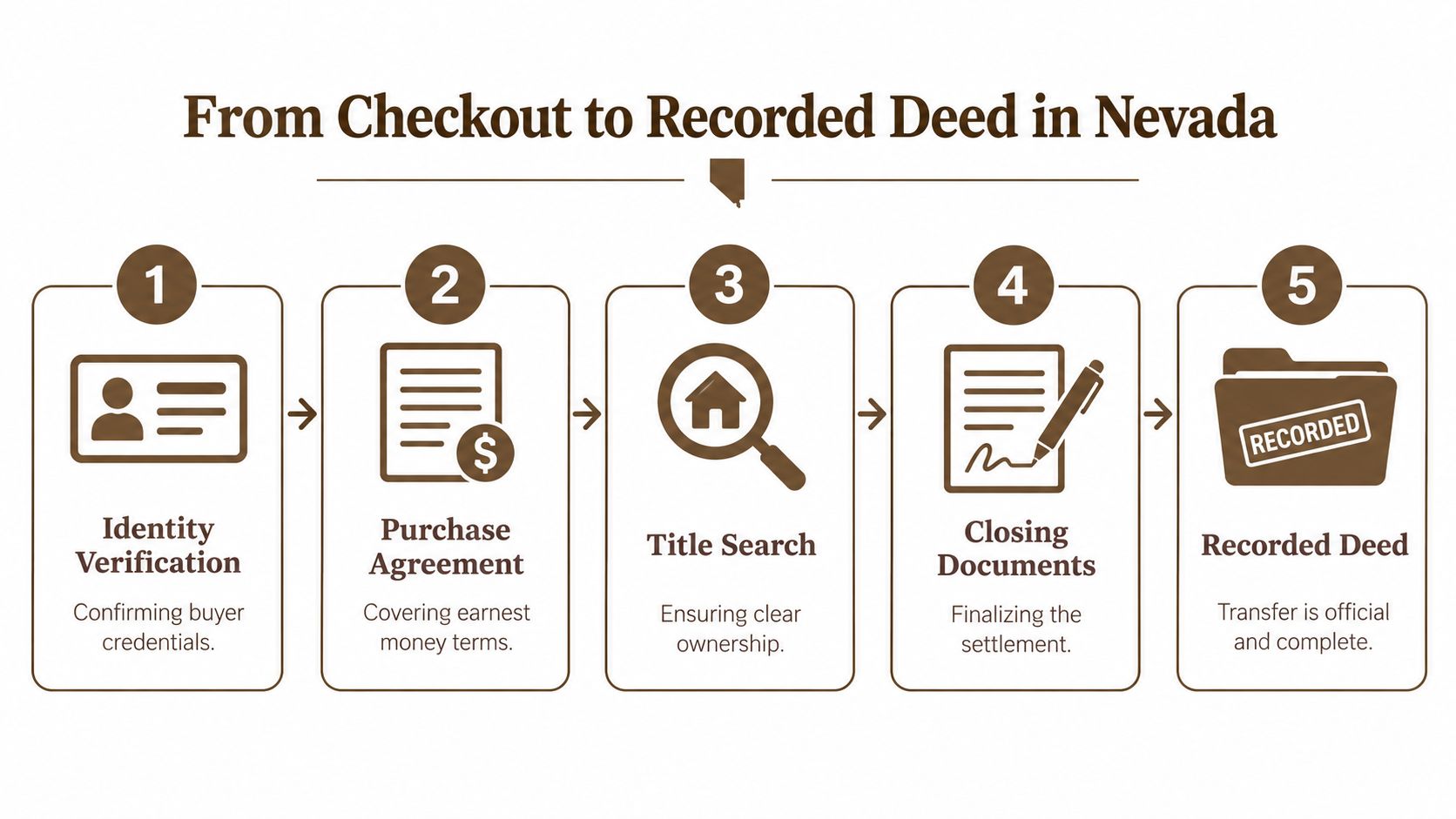
From Checkout to Recorded Deed in Nevada
A land purchase moves through several separate steps. Checkout starts the purchase process, but it doesn't by itself complete the transaction or transfer ownership.
- Identity verification: Complete the required buyer verification and transaction information. Make sure the buyer name matches the person or entity that should appear in the documents.
- Purchase agreement: Review and sign the purchase agreement, including the payment structure, disclosed charges, buyer responsibilities, and any applicable earnest-money terms. Financed buyers must also complete the ZimpleMoney setup.
- Title and property review: Confirm the legal description, ownership records, liens, taxes, easements, and access. If the agreement or transaction requires a boundary survey, well confirmation, lien payoff, or another contingency, resolve it before treating the purchase as complete.
- Payment and closing documents: Cash buyers must satisfy the payment and document requirements before deed preparation begins. Financed buyers receive the contract documents governing payments and title retention. Keep copies of every signed document and payment record.
- Deed preparation and recording: Dollar Land Store prepares the deed packet when the applicable requirements are met. The buyer ordinarily records the deed with the county recorder. Clark, Washoe, Nye, Lyon, Elko, and other Nevada counties handle filings through their own recorder offices, so confirm the current county procedure.
Your closing file should include the recorded deed when the transfer is complete, along with the applicable title documents, recorded easements or rights-of-way, closing statement, and any owner-financing documents such as the land contract, promissory note, and payment ledger. The exact documents depend on the transaction and signed agreement.
After recording, update the county assessor, confirm how any existing water rights are handled, and set up property-tax payments. Don't let a parcel become an administrative problem because the ownership record or tax account was never updated. For more detail on the final filing step, review the Nevada deed recording process.
Dollar Land Store offers vacant Nevada parcels that buyers can review online, with cash and owner-financing options available where offered. Visit Dollar Land Store to compare current listings, examine parcel details, and choose a purchase path that fits your budget and intended use.