


Vested Real Estate Explained: Ownership Rights for Buyers
Ross AmatoA vested right is a fixed right to property that's established under the title records, so the deed and recording status, not possession or a signed contract alone, show who holds it. A lot of popular advice treats vested real estate as if the word itself proves you own the land outright and can use it however you want. It doesn't. You can hold a real, fixed right that's still limited by a contract, a life estate, a lien, or a deed that hasn't been recorded yet. The useful question isn't just "is it vested?" It's "what document proves this stage, and what does that document give me?"
What Vested Means and Where It Sits
In real estate, a vested interest is a right to property that's already fixed under the agreement and title records, not one still waiting on an uncertain event. It is like a paid ticket with your name printed on it. A pending right is closer to an entry in a raffle that hasn't been drawn yet. You might end up with something, but you don't hold it yet.
That distinction sounds simple until you mix it with three other ideas that people often treat as the same thing. Possession means someone occupies or controls the land. A signed purchase contract means two parties agreed on terms. Legal title means the recorded deed shows someone as the owner. Those three can point to three different people at the same time.
Say a buyer signs an installment agreement, starts making payments, and visits the parcel on weekends. That buyer may have contract rights and some limited right to enter, depending on the agreement. That doesn't make the buyer the recorded owner. Possession isn't proof of ownership, and a signed contract isn't a deed.
Equitable interest and bare legal title
This split is where equitable interest comes in. When a purchaser satisfies the conditions required to acquire title, the purchaser can hold an equitable ownership interest even if another party temporarily retains bare legal title, a distinction the U.S. Supreme Court described in its land transaction ruling by explaining that the buyer becomes the equitable owner while legal title may be held in trust until formal conveyance. In plain terms, the buyer has earned the right to receive title, but the paperwork that puts the buyer's name on the deed hasn't happened yet.
You'll see this most often with installment or owner financing arrangements. Some transactions record a deed right away. Some record a contract or security instrument. Some postpone legal title until payoff. Each structure changes who can convey the property, who bears taxes and risk, whether liens can attach, and what you need at payoff.
Practical rule: Find the word that describes the right, check whether it depends on a future event, then confirm what the county recorder shows. If those three answers don't line up, you don't understand the deal yet.
The table below works as a lookup for the confusions above, and one parcel can carry several rows at once.
| Interest | What the holder has | Where it appears | Question to ask |
|---|---|---|---|
| Possession | Right to occupy or use the land | Often no recorded document | Is anyone in control, and under what written agreement? |
| Equitable interest under a contract | Right to receive title once conditions are met | Purchase or installment agreement | Have the payment and other conditions been satisfied? |
| Legal title in fee | Recorded ownership of the parcel | Recorded deed | Does the recorder show this name and this legal description? |
| Vested remainder | Fixed right to future possession that does not depend on a condition | Deed or will creating a life estate | Is the future right fixed, even if enjoyment is delayed? |
| Contingent remainder | Future right that depends on an uncertain condition | Deed or will with a condition attached | Has the condition been met? |
How to read your own paperwork
Start with the agreement in front of you. Look for the vesting event, the specific thing that has to happen before title transfers. That might be full payment, completion of documents, or another stated condition. If the agreement doesn't name that event clearly, ask for it in writing before you pay anything.
Next, check the recording status. Ask whether anything gets recorded now, what gets recorded at payoff, and who handles recording. Then confirm the exact instrument that will transfer legal title at the end. Vague answers here create real problems later, because you'll need that recorded deed to sell, finance, or pass the land to someone else.
It also helps to know what full ownership looks like when everything's finished. Our guide to fee simple ownership and what it includes explains the most complete form of ownership most land buyers are aiming for. Definitions and recording rules vary by state, so treat any general explanation as a starting point and verify the wording against your county records and your signed agreement.
Vested Remainders in Family Land Examples
Future interests sound abstract until you put a family and a parcel in the picture. Both examples below are illustrations only, not property facts and not records from any real parcel. They're built to show how one sentence in a deed changes what a person holds.
Example one with no extra condition
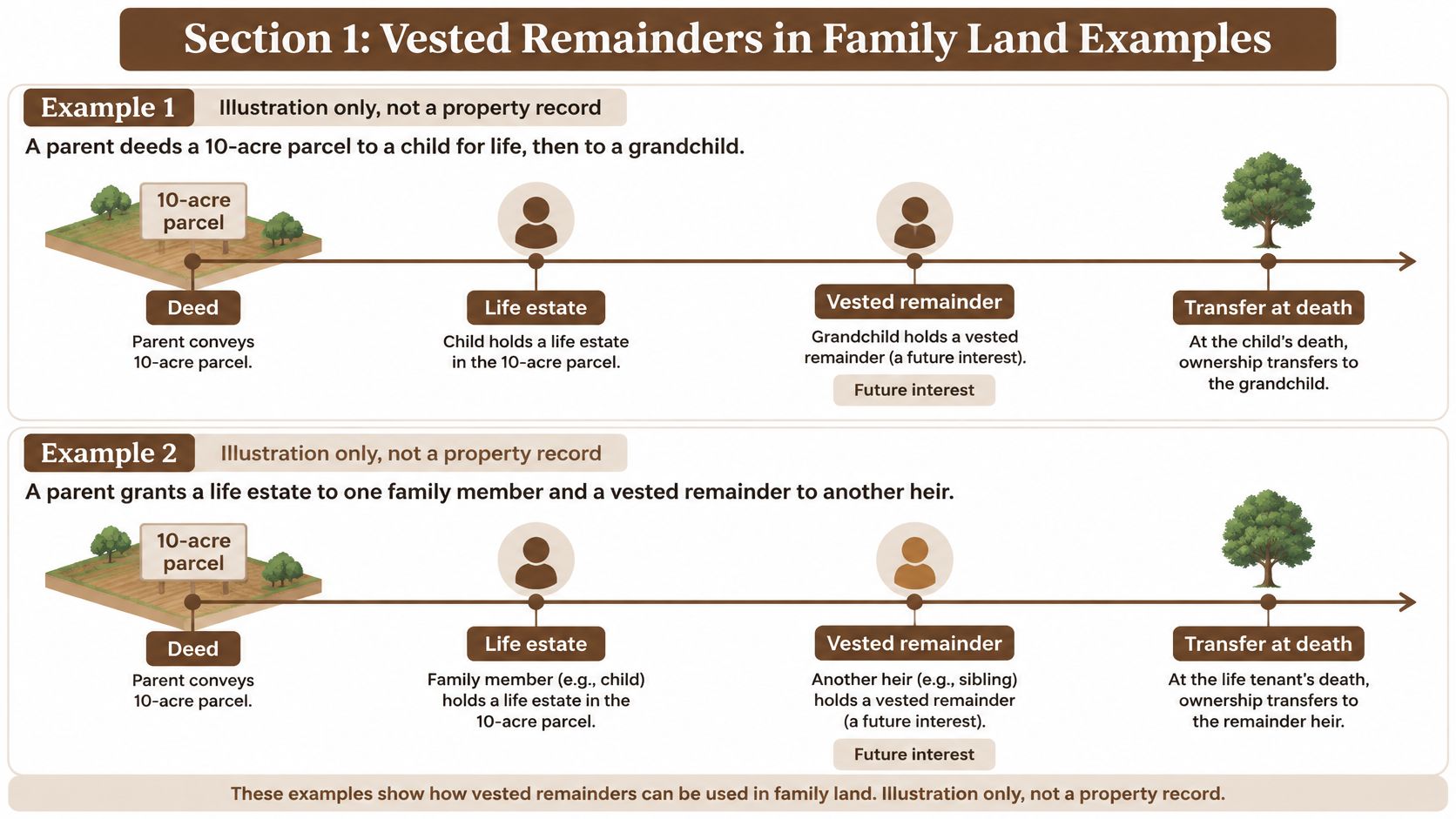
Say a parent deeds a 10-acre parcel to a child for life, then to a grandchild, with no further condition. The child holds a life estate. That means the child can use the land during the child's lifetime, but the child doesn't own the full parcel outright and generally can't sell more than the child's own lifetime interest.
The grandchild holds a vested remainder. The grandchild can't move onto the land or use it as an owner while the child is alive. Still, the grandchild's right is fixed right now. It doesn't depend on anyone's approval or on some event that might never happen. It only waits for the life estate to end.
The timeline runs in a clear order. First, the parent signs and records the deed. Second, the child uses the land for life. Third, the child dies, and the life estate ends. Fourth, the grandchild takes possession as the owner, subject to whatever the deed and state law require to clear the record.
Example two with a condition attached
Now change one line. The same parent deeds the same parcel to a child for life, then to a grandchild only if the grandchild finishes a degree. That small change turns the grandchild's interest into a contingent remainder.
The difference matters. Finishing a degree is an uncertain event. It may happen next year, in ten years, or never. Until it happens, the grandchild doesn't hold a fixed right. The grandchild holds a possibility. If the child dies before the condition is met, what happens next depends on the exact deed language and state law, and that can get messy fast.
A vested remainder waits for time to pass. A contingent remainder waits for something to happen, and that something might never happen.
Because a vested remainder is already fixed, it can generally be transferred or inherited, subject to state law and the exact wording of the deed. Say the grandchild in example one dies before the child does. The grandchild's vested remainder doesn't vanish in most cases. It becomes part of what the grandchild can pass along. A contingent remainder is weaker, because the unmet condition may defeat it entirely.
What this means if you're buying
Most vacant land sales don't involve life estates. But family land changes hands through deeds and wills all the time, and old language stays in the record. If a seller offers you land that came through a family transfer, a life estate, or any unusual deed, read the chain of title and the vesting language before you pay anything. You need to know whether the seller in front of you owns the whole parcel, owns only a lifetime interest, or shares the record with someone holding a future right.
Families sometimes use other structures to hold land across generations, and our explainer on what a land trust is and how it holds title covers one common option. Whatever structure you run into, the reading method stays the same. Find who holds the present interest, find who holds any future interest, and check whether that future interest is fixed or conditional.
How a Vesting Deed Proves Who Owns the Land
A vesting deed is the document that shows how the current owner acquired the parcel and the names and form under which title is held. It's the most recent link in a longer chain. When someone claims they can sell you a piece of land, the vesting deed is where you check whether that claim holds up.
The chain of title is the historical sequence of documents showing successive ownership transfers for a specific parcel, beginning with an original or "root" title and continuing through later deeds and other title transactions up to the present owner. The American Bar Association's title search and examination guide describes the examiner's job as locating the vesting deed, confirming it contains the correct legal description, and reviewing the documents that form the chain of title. The chain works like a family tree for the parcel: every deed should connect to the one before it.
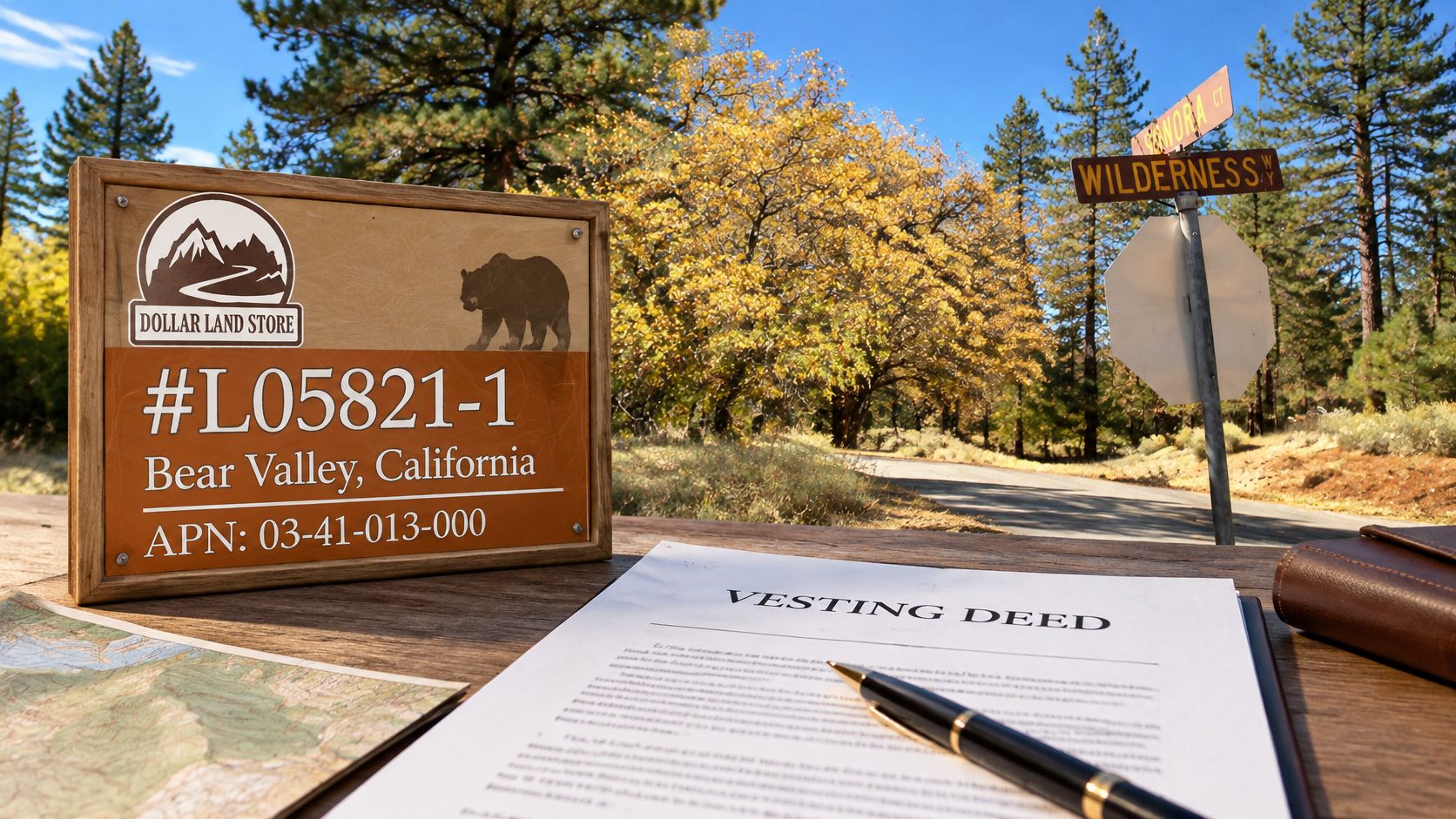
A listing page is where the claim starts. Take #L05821-1, a 1.3-acre lot in Bear Valley, California listed at $19,899.00 ($458.46 per month): the photos and map describe the parcel, and the county record is where you confirm who holds title to it.
What a title examination checks
A title examiner starts with the vesting deed and confirms it contains the correct legal description, the precise wording that identifies this parcel and no other. Rural vacant land often has no street address at all, and a pin dropped on a map can land in the wrong spot. The recorded description is what anchors the search.
From there, the examiner reviews each transfer in the chain. The person who received the land in one deed should be the person who conveyed it in the next. A gap, a mismatched name, or a description that changes between deeds is a question to resolve before closing.
County recording offices are the primary source for these records, although terminology and recording procedures vary by state. When you pull records for a parcel you're considering, ask for four things:
- The vesting deed: shows how the seller acquired the land and how title is held now.
- The legal description: confirms you're looking at the same parcel the listing describes.
- Recorded liens and easements: reveal claims and use rights that travel with the land.
- The recording information: gives you the book, page, or instrument number to reference later.
One caution before you move on. A clean vesting deed confirms ownership. Access, terrain, and buildability are separate checks, and Dollar Land Store sells parcels as-is without guaranteeing a property is buildable unless a listing states it in writing.
Where financed land fits in the chain
With a financed purchase from us, the property stays in Dollar Land Store's name for the full financing term, so the vesting deed in the county record shows us as owner until payoff. While the balance is outstanding, you can't occupy or develop the parcel, pull building permits, or build permanent improvements. Once you pay in full and complete the required payoff items, including any applicable deed preparation fee, outstanding taxes, fees, or account balances, we prepare and record the new deed and ownership transfers to you. That deed becomes the next link in the chain, with your name on it.
That structure is why the deed carries more weight than a purchase receipt. Your payment history shows you paid. The recorded deed shows you own. For the mechanics of that final step, our walkthrough of the deed recording process from preparation to county filing covers each stage in order. Keep your payoff documents and your recorded deed together. Years from now, that folder is what proves your place in the chain.
Vesting Forms for Co-Owners Compared
When two or more people buy land together, the vesting language on the deed decides how their interests work at death, at transfer, and in a dispute. A few words after the buyers' names can override what a will says, or fail to create the protection the buyers assumed they had.
The Los Angeles County Assessor explanation of joint tenancy lays out the core contrast. Joint tenancy generally requires equal interests, acquisition at the same time and through the same conveyance, and express language creating survivorship, so a deceased owner's interest typically passes automatically to surviving joint tenants and is not controlled by that owner's will. Tenancy in common permits unequal fractional interests and lets each owner transfer or will their own share, with no automatic survivorship.
| Vesting form | Ownership shares | Survivorship | What happens at death |
|---|---|---|---|
| Joint tenancy with right of survivorship | Generally equal, acquired together by one deed | Yes, when expressly stated | Share generally passes to surviving owners, typically without probate |
| Tenancy in common | Unequal shares allowed, such as 75% and 25% | No automatic survivorship | Share passes under the owner's will or intestacy rules and may involve probate |
| Sole ownership | One owner holds full title | Not applicable | Passes under the owner's estate plan |
The default that catches people off guard
Two siblings buy a recreational parcel together, and each assumes the survivor will automatically end up with the whole property. That assumption fails when the deed never creates survivorship. When a deed lists multiple names without expressly establishing another form of ownership, tenancy in common is generally the default, and each owner holds an undivided interest in the entire parcel, according to the Larimer County Assessor ownership FAQ. Under that default, one sibling's share can pass under their will to someone outside the original plan, and the surviving sibling ends up co-owning land with a partner they never chose.
Undivided interest deserves a plain explanation too. A 25% tenant in common holds a quarter interest in the whole parcel and generally keeps the right to use all of it, subject to any agreement with the co-owners. The law treats every co-owner as sharing the entire property rather than holding a staked-out section, so fencing off one corner and treating the rest as someone else's problem won't match what the deed says.
Weighing the risks of each form
Joint tenancy can simplify succession, since the transfer at death happens by operation of law and generally without probate. The tradeoff is control. Because survivorship overrides the will, joint tenancy can bypass an intended estate plan. If you wanted your share to go to your children but the deed says joint tenancy with a partner, the deed usually wins.
Tenancy in common preserves individualized percentages and lets each owner direct their own share. The tradeoff is probate and partition risk. A deceased owner's share may go through probate, and a co-owner who wants out may push for partition, which can force a sale or division the other owners never wanted.
Where the choice lands on a real purchase
The vesting form gets fixed at a specific moment: when the deed conveying title is prepared and recorded. The purchase agreement records the contract between buyer and seller. The vesting phrase on the deed controls what happens between the co-owners.
On a cash purchase, the conveying deed is where the co-ownership form enters the record. If you and a partner buy a parcel through Dollar Land Store on owner financing, title stays in the seller's name during the loan term, and the deed packet prepared after payoff is where your vesting choice becomes permanent. Settle the joint tenancy versus tenancy in common question before that deed is prepared, because changing vesting after recording means drafting and recording another deed.
Before you sign, work through three checks. Confirm the exact vesting phrase on the deed, word for word. Confirm that local law recognizes the form you intend, since not every form works the same way in every state. Then coordinate the deed with your wills, trusts, beneficiary planning, and any co-owner agreement, so the documents don't fight each other. Improper names or vesting language can also create title insurance concerns and delay a later resale or financing, so fixing wording now costs far less than fixing it during a future closing.
What Vesting Changes for Buyers and Sellers
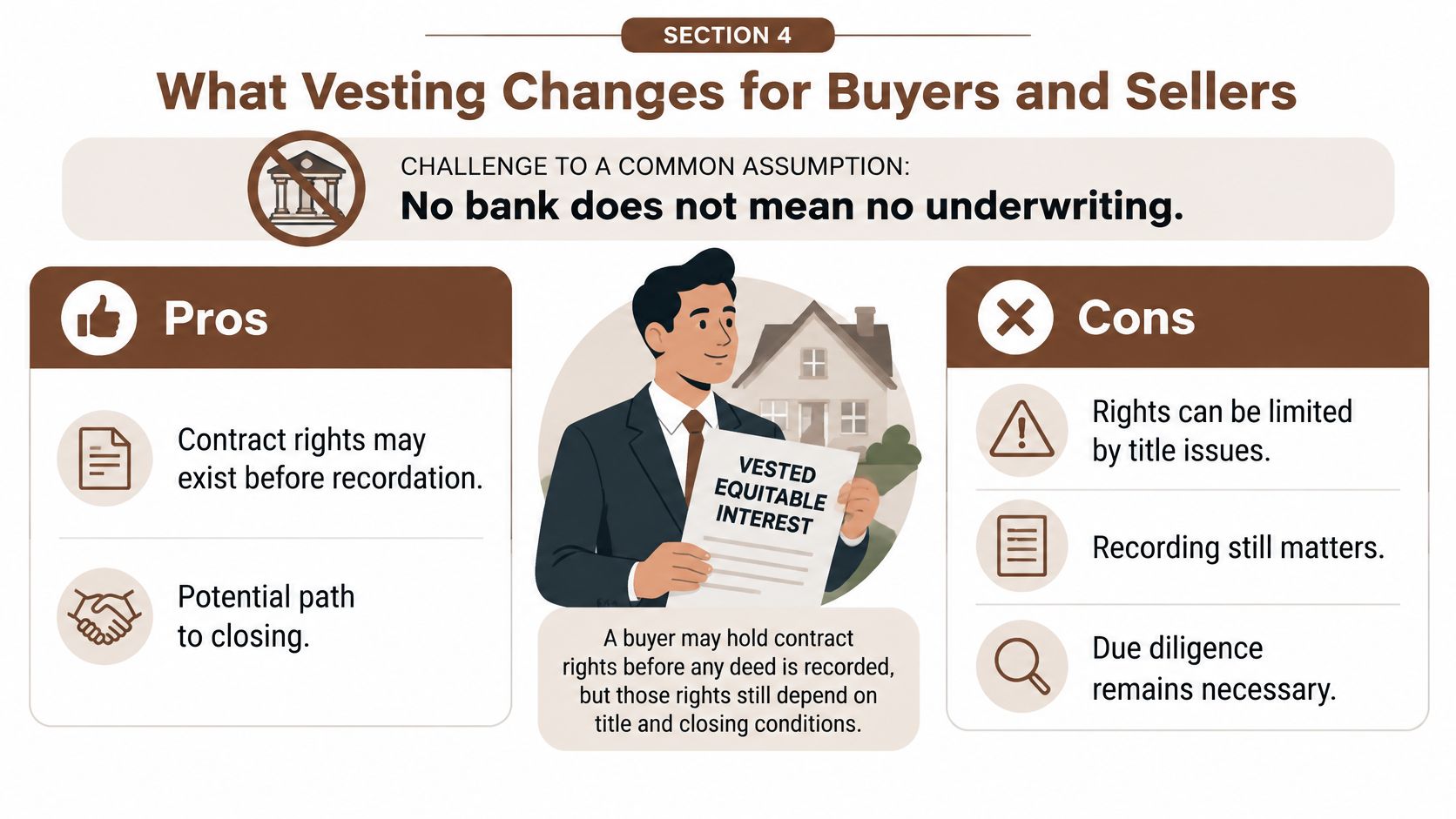
An owner-financed land purchase hands the underwriting job to the buyer. With no bank reviewing the file, you check the title, the contract, the carrying costs, and your exit plan yourself.
Part of the confusion is the phrase itself. In property law, a vested interest is an absolute, fixed right or title that is not subject to being divested, as Cornell Law School's legal definition of vested explains. The term alone does not answer whether the deed has been recorded, whether the seller holds clear title, whether liens or easements exist, or when ownership transfers under an installment contract. A buyer holding a vested equitable interest has real contract rights before any deed is recorded, and those rights still leave clear title unconfirmed.
What each party controls at each stage
Each stage of an owner-financed purchase is proved by a different document. Stage one is the signed purchase agreement. Financed buyers receive a Standard Agreement of Sale and cash buyers a Real Estate Purchase Agreement, and that document carries your remedies, your obligations, and your path to the deed. Read the default provisions and payoff procedure before you sign, because the agreement decides what a missed payment costs.
Stage two is the financing term. Whoever holds legal title controls conveyance, so title stays in the seller's name and the county record keeps showing the seller as owner. During this stretch you cannot sell or encumber the parcel, pull building permits, or begin improvements, and no development or occupancy is permitted until the balance is paid in full and the deed has been transferred.
Stage three is the recorded deed. It is prepared only after the property is paid in full and every payoff item is complete, including any applicable deed preparation fee, outstanding taxes, fees, or account balances. Once those items clear, the deed packet is prepared for transfer and the recorded deed completes the change of ownership. Any seller promising immediate ownership on a financed parcel is skipping steps worth asking about.
We intend to convey properties free and clear at the time of deed transfer, and buyers may request title insurance or escrow at their own expense when available. That safeguard speaks to title at transfer. Access, buildability, utilities, and permission for a particular use are separate questions the word vested does not settle.
Benefits and risks side by side
- Benefit, an identifiable contract right: you hold defined rights under a signed agreement, with a stated path to a deed at payoff.
- Risk, title still needs checking: a contract right does not prove the parcel is lien free or free of recorded easements.
- Benefit, a defined vesting event: payoff and completion of requirements trigger deed preparation, so the finish line is knowable in advance.
- Risk, use is a separate question: vesting does not establish road access, water, septic approval, or zoning permission.
The agreement you sign governs what happens after a missed payment and what completion requires, and our terms and conditions page sets out the default and refund language that applies. Treat vested real estate as a checkpoint word. When you see it, slow down and ask which document proves which stage, and which county record backs it up.
Confirm the Vesting Before You Commit to a Parcel
A land purchase runs on documents, and each stage of ownership has its own proof. The listing describes the parcel, the signed agreement defines your contract rights, the county record shows who holds title, and the recorded deed completes the transfer. Each one hands off to the next, like legs of a relay. Before you commit, lay them side by side and confirm they tell one consistent story.
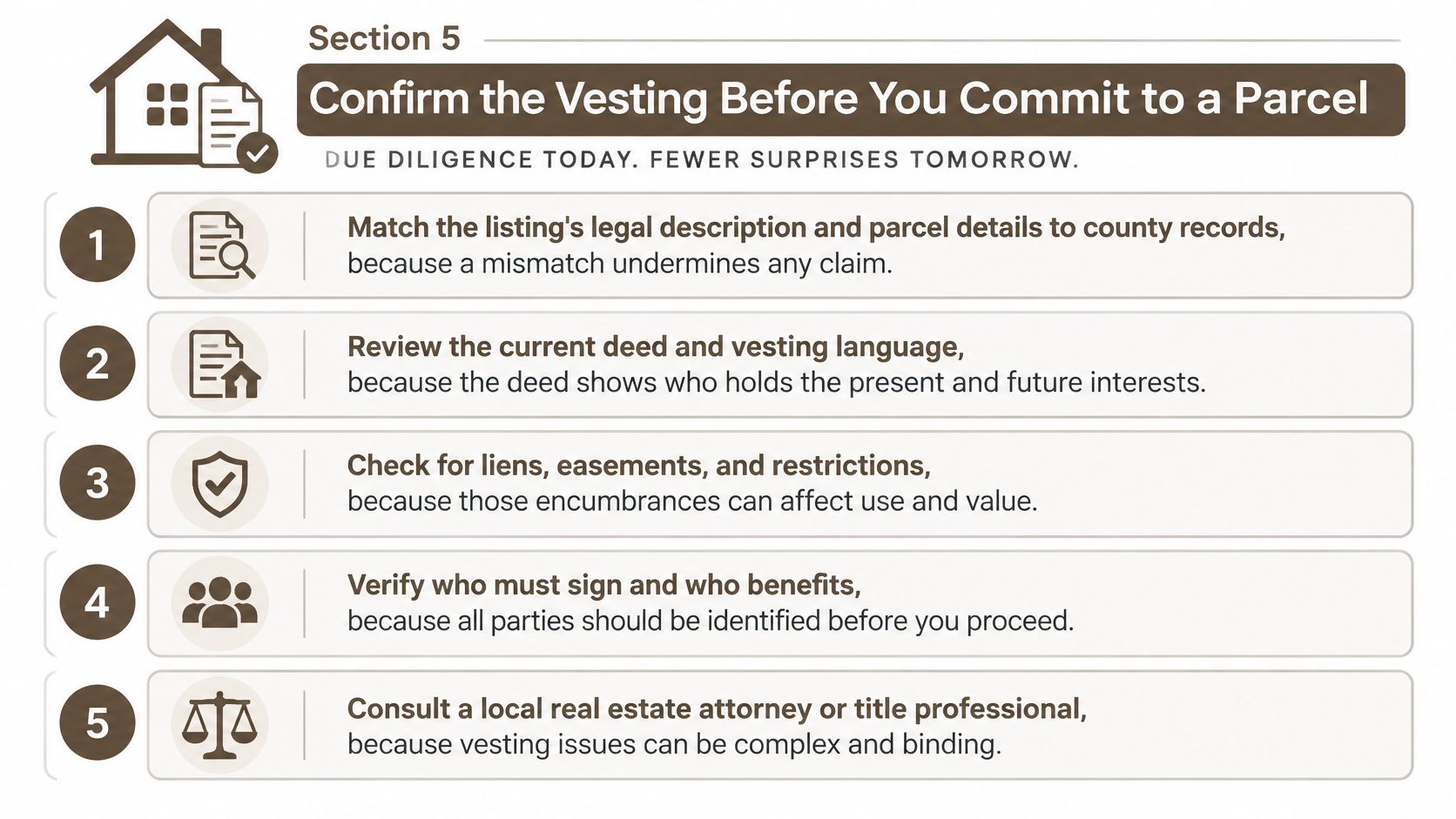
- Match the legal description and parcel number: compare what the listing states to county records, because a parcel that doesn't match cannot produce a clean deed later.
- Pull the current vesting deed: the county recorder or a title company can supply the deed that placed title in the seller's name, plus the chain of title behind it.
- Check whose name is vested and in what form: sole ownership, joint tenancy, or tenants in common each control who must sign and how the property passes on death.
- Search for recorded liens, taxes, and easements: claims filed against the parcel follow the land, so review them before you rely on the contract.
- Verify access and permitted use yourself: the maps and GPS coordinates in a listing help you inspect the parcel, while the county confirms road access, zoning, and utility options.
Then read your own agreement as a vesting document. Financed buyers sign a Standard Agreement of Sale and cash buyers sign a Real Estate Purchase Agreement, and either one should tell you when vesting happens, what triggers default, and how payoff leads to the deed. Our guide to the title search process and what it uncovers shows how step two works in practice.
Checkout begins the purchase process, and ownership transfers at a later stage: once the balance is paid in full and required payoff items are complete, the deed packet is prepared for transfer. The buying process page walks through the required documents and the payment setup for financed purchases.
One boundary deserves plain words. No development or occupancy is permitted until the balance is paid in full and the deed has been transferred, and buyers may not pull building permits or construct permanent improvements while a property is still being financed. County rules continue to apply after the deed records.
As a factual example of how a listing presents parcel details to check, #L05821-1 1.3 Acres in Bear Valley, California Lot at the Top of the World $19,899.00 ($458.46 / Month) is a 1.3-acre parcel in Bear Valley Springs in Kern County, California. The listing supplies price and parcel details; the county confirms access and any restrictions that apply. Check current availability. When you're ready to compare options, browse listings in your target county through our collection pages and compare acreage, location, and purchase options side by side.
Understanding vesting helps you buy land with your eyes open, because you'll know which document proves each stage of ownership and what still needs checking. Dollar Land Store sells vacant land across the Western United States with cash and owner financing options where offered, and every listing gives you parcel details you can verify against county records before you commit. Start your search at Dollar Land Store, pick a parcel that fits your budget and location, and run the vesting checks above before you make your down payment.