


Acreage for Sale in Nevada: A First-Time Buyer's Guide
Ross AmatoYou're scrolling through listings, comparing Nevada's low per-acre prices with what land costs in nearby states, and one parcel suddenly looks like an easy answer. The photos show open desert, a broad view, and enough space for a future home, RV, workshop, or weekend retreat. Then the practical questions arrive: Can you legally reach it? Is water available? Does the county allow your intended use?
The short answer to the main question is this: acreage for sale in Nevada can be affordable and useful, but “vacant” doesn't mean “immediately buildable.” Nevada's water-right system, public-land ownership, county rules, access easements, utilities, and deed restrictions often matter more than the parcel's size or scenery. You can browse available Nevada land properties, but treat every listing as a starting point for verification, not as a promise about use.
What First-Time Buyers Should Know About Nevada Acreage
A first-time buyer often starts with a simple plan. They find a parcel, check the acreage, look at the price, and imagine what they'll do there. A buyer might see a remote lot and think, “I'll put an RV there now, add utilities later, and build a small home when I'm ready.” That plan may work for some parcels, but the listing alone usually can't answer whether it will work on that specific one.
The low price may reflect distance from population centers, limited road maintenance, no nearby power, uncertain water, seasonal access, or restrictive county rules. A parcel can look flat and open while still lacking a recorded access easement. It can appear close to a road while touching that road only at a corner. It can be large enough for a homesite in one county and unsuitable for the same plan in another.
Nevada's land scale makes this confusion more common. The state contains about 70,765,289 acres, or 109,860.4 square miles, making it the 7th largest U.S. state by area, according to the Nevada Division of State Lands executive summary. Vast geography doesn't mean vast private inventory. Much of Nevada is federally or tribally controlled, and private parcels may be scattered through older subdivisions, rural counties, and historic patented holdings.
A practical rule: Don't ask only, “How many acres do I get?” Ask, “What can this parcel legally and economically support?”
Start by writing down your intended use in plain language. “Weekend recreation,” “future homesite,” “RV parking,” “off-grid cabin,” and “livestock” are different plans with different approval, water, septic, access, and utility questions. Then verify the APN, county zoning, legal access, water situation, utility options, taxes, and HOA or POA restrictions before you commit.
Seller financing can make the purchase easier to budget, but it doesn't change the land's physical or legal limitations. Monthly payments may help you acquire a parcel while you complete research, yet you still need to understand the note, payoff process, deed timing, and county recording requirements.
How Much of Nevada Is Actually Available to Buy
Nevada is enormous, but a first-time buyer can't treat the entire state as a private marketplace. The Nevada Division of State Lands manages 286 properties totaling 344,580.62 acres, while Nevada's total area remains roughly 70.8 million acres, according to the state lands summary. A separate Nevada legislative report says more than 85% of the state's land area is federally owned, with about 61 million acres under federal management. In 16 of Nevada's 17 counties, more than half of the land is under federal or tribal control, as described in that same state reference.
That public-land pattern explains why private parcels often cluster. You may find lots inside recorded subdivisions, rural parcels along older transportation corridors, historic mining or grazing patents, or land that passed into private ownership through earlier federal processes. A parcel near public land isn't automatically available to buy, and a parcel beside a national park, military range, or recreation area may have neighboring ownership that's entirely different from what the map suggests.
Use the ownership category as an early filter:
| Ownership Category | Managing Authority | Available to Buy Privately? | Common Listing Scenario |
|---|---|---|---|
| Federal public land | Federal agencies | Generally not through an ordinary private listing | Parcel appears near BLM-managed land |
| Tribal land | Tribal government or authority | Not unless offered through an authorized transaction | Buyer sees tribal boundaries on a county map |
| State-managed property | Nevada state agencies | Availability depends on a specific state process | Land near state holdings is mistaken for private inventory |
| Patented or historic private land | Private owner, with county records | Potentially yes | Old mining, grazing, or homestead-related parcel |
| Platted subdivision lot | Private owner, county-recorded subdivision | Potentially yes | Rural lot with an APN, parcel map, and subdivision name |
The USDA Census of Agriculture report for Nevada records 5,896,654 acres of land in farms in 2022. That's only a fraction of the state's total acreage, so large statewide numbers shouldn't be confused with abundant, productive, readily buildable private land.
Desert Basins vs Mountain Counties in Nevada
Desert basins and mountain counties can both appear in a search for Nevada acreage, but they suit different ownership plans. Desert basins often provide flatter open ground, sparse vegetation, and wide basin-and-range views. They may appeal to buyers considering recreation, an off-grid setup, a future homesite, or an RV base, subject to county rules and parcel-specific verification.
Mountain counties can offer forested terrain, elevation changes, seasonal creeks, and more winter weather. Snow load, snow removal, steep driveways, and seasonal road conditions may shape the cost and practicality of ownership. Mountain scenery doesn't automatically mean reliable water or easy construction, and desert land isn't automatically simple just because it looks flat.
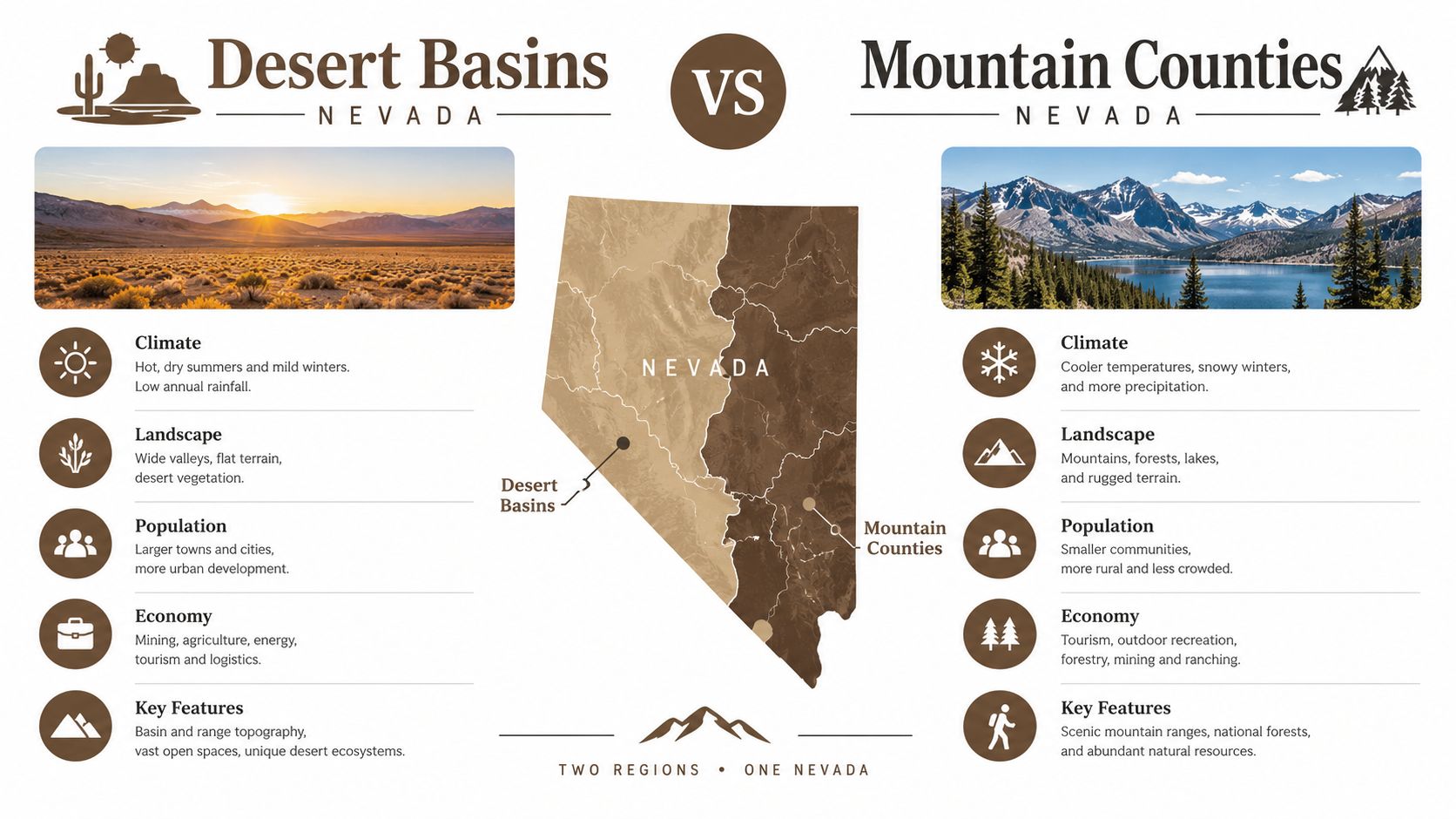
| Consideration | Desert Basins | Mountain Counties |
|---|---|---|
| Terrain | Often open and basin-shaped, but slope still varies | More elevation changes, forest, rock, and uneven ground |
| Access | May involve unmaintained dirt roads or long distances between services | May involve steep routes, snow, mud, or seasonal restrictions |
| Water questions | Well feasibility and water rights can be decisive | Wells, springs, creeks, and winter conditions still require verification |
| Utilities | Grid power may be distant, making off-grid planning relevant | Terrain can increase the complexity of utility extensions |
| Intended use | Recreation, future homesite, or off-grid plans may fit some parcels | Privacy, forest setting, and seasonal use may appeal to some buyers |
| Main caution | Flat land may still lack water, septic approval, or legal access | Scenic land may be difficult to build on or reach year-round |
Both zones can include land above 4,000 feet, so don't rely on the words “desert” or “mountain” to predict temperatures or conditions. Check the parcel's elevation, road route, drainage, and county requirements. For a broader look at desert parcels, review this guide to land for sale in the desert.
Water Rights, Access, and County Rules in Plain English
The word vacant describes a parcel's improvement status, not its readiness for construction. Nevada's land-use classification manual defines vacant land broadly as land without improvements, including raw land and land that may have been prepared or developed but lacks improvements showing a current actual use. That distinction is why a graded parcel can still require separate verification for permits, utilities, access, water, and septic.
Water is often the first practical filter. Nevada generally requires a water right before water can be put to use, except for domestic purposes defined by statute, as explained by the Nevada Division of Water Resources water-rights guidance. A buyer shouldn't assume that a nearby well, an attractive view, or an existing structure proves that a new well or expanded use will be approved.
Churchill County illustrates how local requirements can affect development. When a new parcel isn't connecting to county water, the county requires two acre-feet of surface-water rights per parcel, and a single-family residence also requires two acre-feet, according to the verified Nevada water-rights information. Because one acre-foot equals 325,851 gallons, that requirement represents about 651,702 gallons per residential parcel. Requirements vary by county, so Churchill County shouldn't be treated as a statewide rule.
Access has two separate meanings. Physical access means you can reach the parcel today. Legal access means a recorded easement or public-road right gives you the authority to reach it. A visible track doesn't automatically create legal access, and a public road at one corner doesn't necessarily provide a usable driveway location. Review the deed, title records, easement language, road maintenance responsibility, and parcel map.
County rules then determine what you can do. Nevada doesn't have one statewide zoning code for every vacant parcel. Washoe, Lyon, Nye, and other counties apply their own zoning, subdivision, setback, manufactured-home, RV, and land-use requirements. HOA or POA rules and custom deed restrictions may add another layer.
| Filter Layer | What It Controls | Where to Verify | Common First-Time Mistake |
|---|---|---|---|
| Water | Domestic use, wells, irrigation, and expanded use | Nevada Division of Water Resources and county requirements | Assuming water is available because a neighbor has a well |
| Access | Travel route, easements, and maintenance duties | Recorded deed, title commitment, assessor map | Treating a visible road as guaranteed legal access |
| Zoning | Homes, manufactured homes, animals, RV use, setbacks | County planning department | Assuming acreage size determines permitted use |
| Private restrictions | HOA, POA, CC&Rs, and deed limits | Recorded covenants and association documents | Checking county zoning but ignoring private rules |
| Vacant-land classification | Assessment treatment and improvement status | County assessor and state land-use code | Assuming “vacant” means construction-ready |
For a plain-English explanation of the water issue, see what water rights mean for land buyers. Buyers should independently verify current requirements for the exact parcel and jurisdiction.
How Seller Financing Works for Nevada Land
Seller financing lets the seller accept payments over time rather than requiring the buyer to pay the full price at closing or obtain a bank loan. A typical arrangement includes a down payment, written agreement or promissory note, and scheduled payments. Interest, fees, payment amounts, and other terms vary by parcel, so rely on the listing and signed documents, not assumptions.
Before signing, review the parcel's legal description, APN, purchase price, down payment, payment schedule, interest terms, late-payment rules, and payoff conditions. Also confirm whether the paperwork uses a land contract, installment contract, promissory note, deed of trust, or another recorded instrument. These documents are the operating manual for the transaction.
Ask how funds and documents will be handled. A title or escrow company may hold them, depending on the arrangement. Clarify when the deed will transfer. Buyers commonly receive it after payoff and completion of the transfer process, while recording the deed with the county is a separate step.
Nevada requires a deed, conveyance, or land-sale installment contract submitted for recording to include a declaration of value. The recorder must refuse recordation if the property transfer tax has not been paid, as described in Nevada Revised Statutes Chapter 375. The declaration documents the transaction for recording and tax purposes.
Recording charges can include a $25 document-recording fee, an additional fee of up to $5, and a mandatory $7 fee, under the framework in Nevada Revised Statutes Chapter 247. County charges and document requirements may vary, so confirm the current amount with the relevant recorder.
A title search still matters, even when the seller finances the purchase. Check for liens, unpaid taxes, conflicting deeds, easements, and other title problems before treating the parcel as security for your payments. A general explanation of seller financing in real estate can help clarify common structures, but it does not replace review of the Nevada documents.
Dollar Land Store offers direct land sales and seller-financed land options, including no-credit-check arrangements, with terms shown by property. Buyers comparing owner-financed arrangements may also find practical discussion in the PropLab financing community. Read every document carefully and verify the closing process before signing.
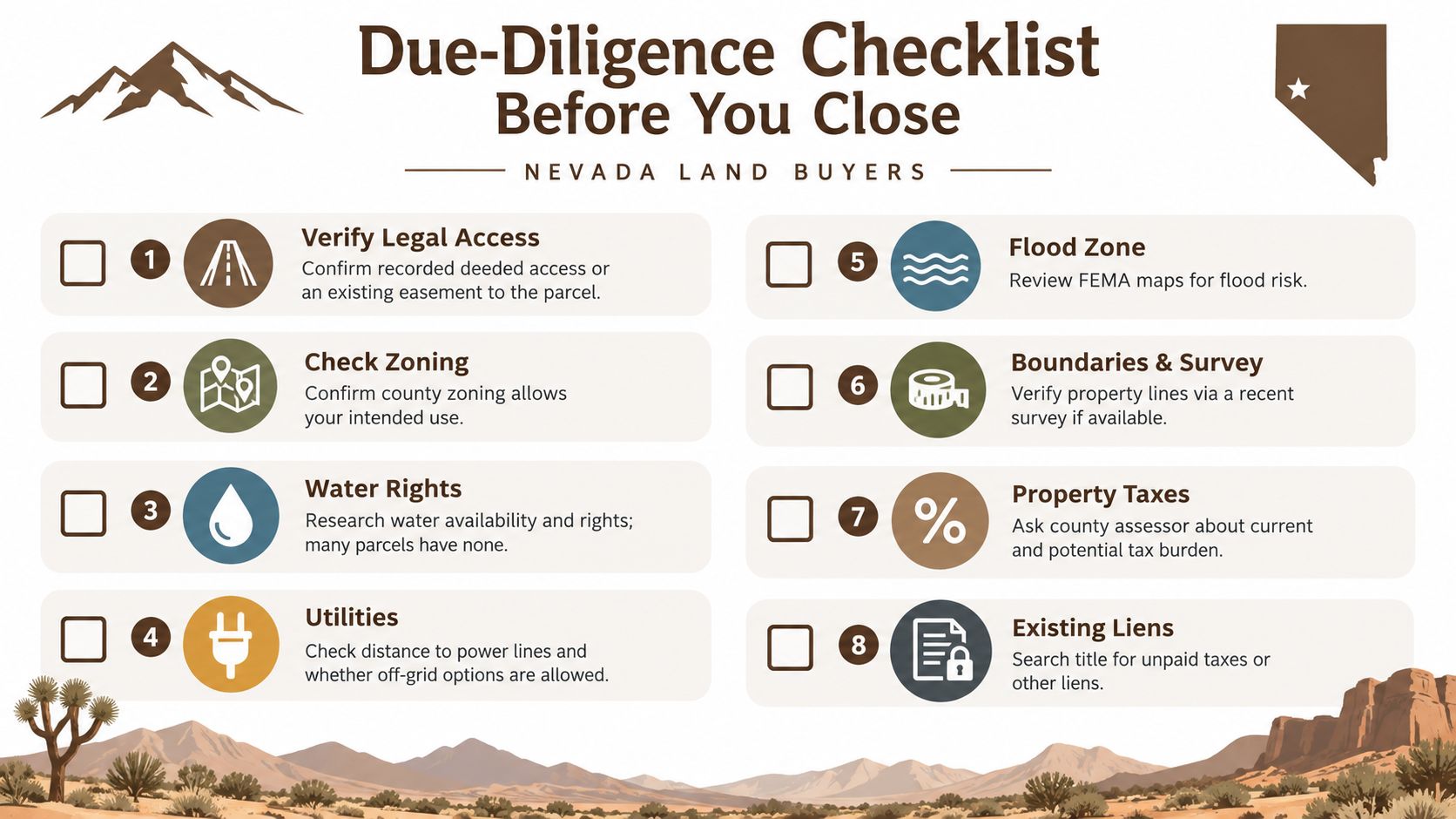
A Due-Diligence Checklist Before You Close
A low-priced parcel deserves the same careful review as a more expensive property. The difference is that vacant land often has fewer obvious clues. There may be no house inspection, utility bills, driveway, or established landscaping to reveal what works and what doesn't.
Start with the parcel record
Match the listing to the county's records. Confirm the APN, legal description, acreage, ownership, tax status, and parcel map. Ask the county assessor whether taxes are current and whether any special assessment or land-use status affects the parcel.
Then order a title search or title commitment. Look for recorded access easements, utility easements, liens, judgments, restrictions, prior deeds, and any document that limits use. If the seller's name or legal description doesn't match the record, pause until the discrepancy is resolved.
Test the intended use
Write down the use you care about most, then verify that use directly:
- Build a home: Confirm zoning, minimum lot requirements, setbacks, water, septic feasibility, and building-permit expectations with the county.
- Place a manufactured home: Ask the county about foundation, placement, conversion, and inspection requirements.
- Use an RV: Verify camping, occupancy, hookup, and temporary-use rules. Some parcels may limit how long an RV can remain or whether it can serve as a residence.
- Keep animals: Check zoning, animal limits, fencing rules, water needs, and any private restrictions.
- Create an off-grid setup: Confirm that solar, propane, septic, water storage, access, and structures are allowed for the intended use.
The Nevada Division of State Lands data shows why location and jurisdiction matter so much. Public ownership dominates the state, while private acreage is a much smaller and more uneven slice of the map. A parcel's neighbors, access route, and county jurisdiction can matter more than its distance from a city.
Confirm the money and closing path
Before closing, put the exact down payment, monthly payment, payoff amount, interest, fees, balloon date if any, recording charges, and transfer-tax responsibility in writing. Ask who holds funds, who prepares documents, and who records the deed after payoff.
The Nevada land due-diligence guide can help organize questions, but buyers should independently verify current county requirements and parcel-specific facts.
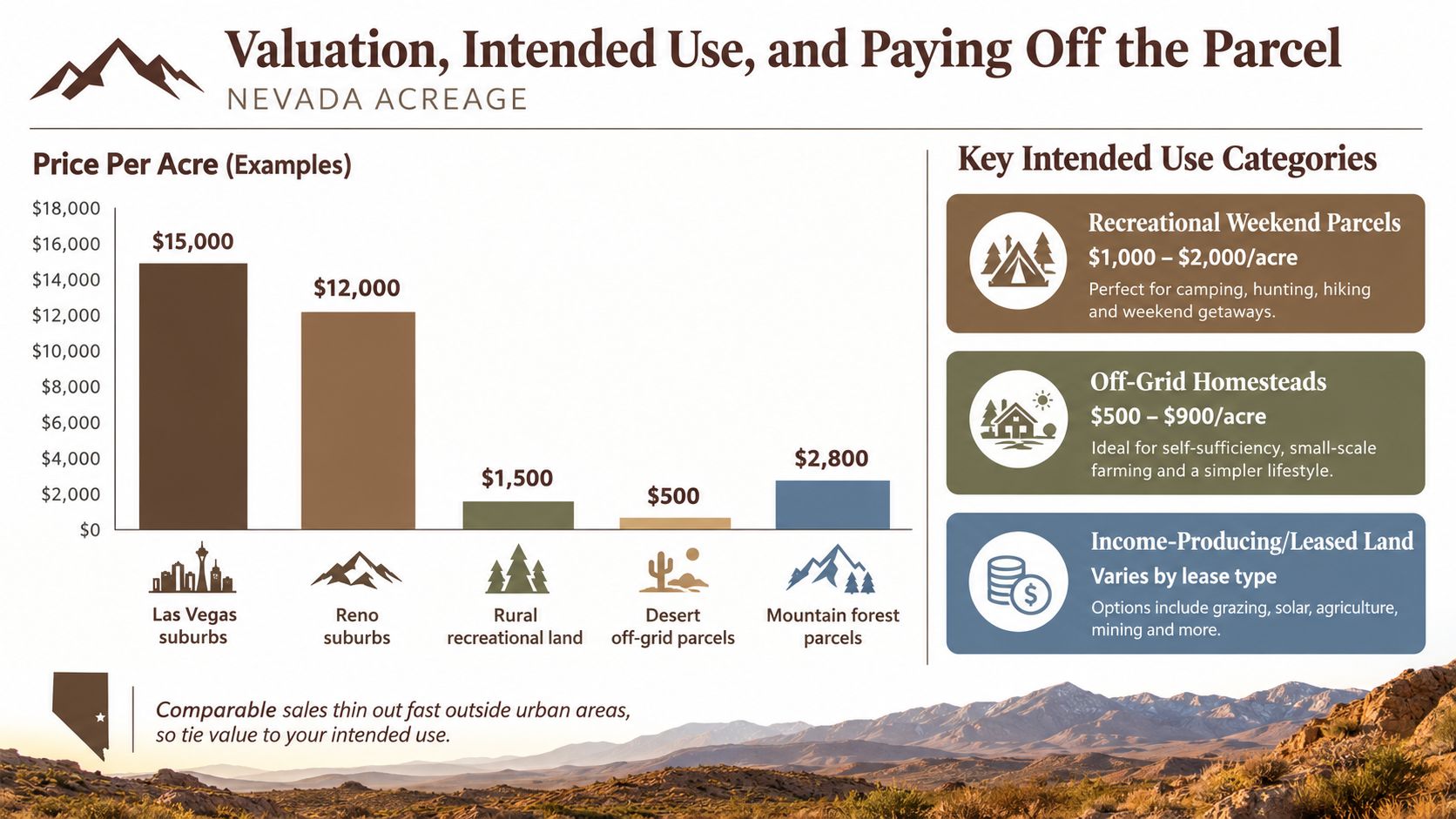
Valuation, Intended Use, and Paying Off the Parcel
Price per acre is useful, but it's not a complete valuation method. A parcel near a service area may carry a different value from a larger remote parcel because access, utilities, water, and county approvals affect what the buyer can do with it. Comparable sales also thin out quickly in rural areas, so a buyer should compare parcels with similar access, zoning, improvements, terrain, and intended use.
Think about three common buyer profiles:
- Recreational buyer: Values scenery, road access, privacy, and distance from a home base. The parcel may be useful without immediate construction, but camping and RV rules still need confirmation.
- Off-grid buyer: Cares about solar exposure, water feasibility, septic, access for deliveries, and whether county rules allow the proposed structures and occupancy.
- Future homesite buyer: Needs a longer review of zoning, minimum lot standards, utilities, financing, construction access, and payoff timing.
Seller financing connects the land's use plan to monthly cash flow. A shorter payoff schedule may increase the monthly obligation while reducing the time the balance remains outstanding. A longer schedule may reduce the monthly figure but extend the period before the buyer owns the parcel free and clear. The actual effect depends on the contract's terms.
Build a simple comparison using purchase documents. Review possible holding periods over 3, 5, and 10 years, using the actual principal, interest, annual taxes, HOA or POA fees, maintenance, and expected payoff balance. Don't assume resale value will rise or that a future buyer will accept the same financing structure.
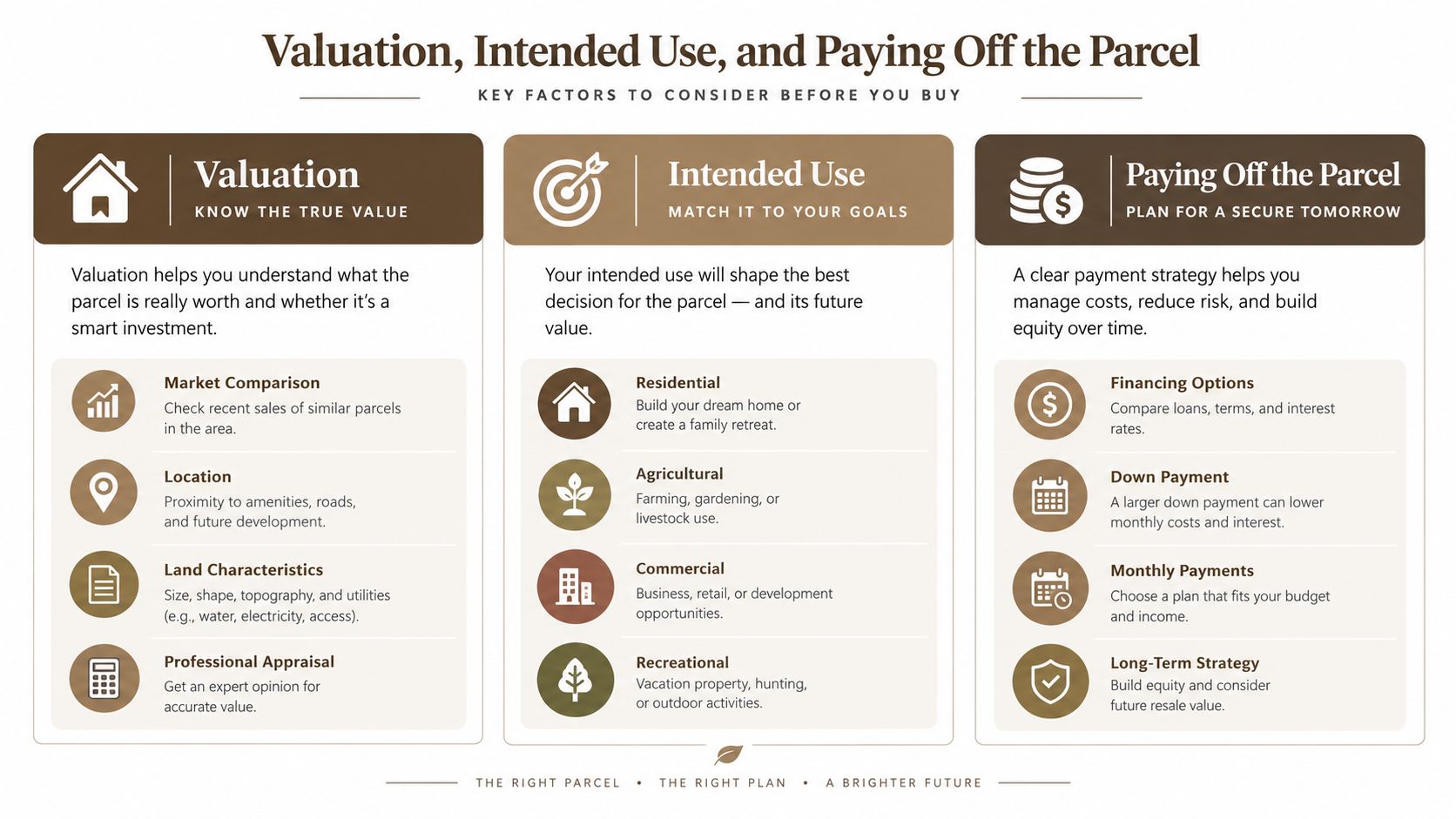
A parcel makes more sense when the price, intended use, and payment plan agree with one another. If the land is cheap but requires expensive access or water work, the monthly payment may be only a small part of the cost. If the parcel works for recreation but not a home, price it according to the use you can verify, not the use you hope to create.
Common Questions About Buying Acreage in Nevada
Can you use Nevada acreage as a primary residence?
Maybe, but the deed alone doesn't answer that question. County zoning, minimum dwelling standards, building permits, water, septic, and utility requirements determine whether a parcel can support a primary residence. RV occupancy and temporary living rules may be different from permanent residence rules.
How is vacant land taxed?
Nevada treats vacant land as a classification for parcels without qualifying improvements. The state land-use manual explains that the category can include raw land and land that lacks improvements showing a current actual use. Your county assessor determines the assessment, while local records may also show special assessments, exemptions, or other obligations.
What happens if you stop making seller-financed payments?
The contract controls the process, including notices, cure periods, late charges, default remedies, and possible forfeiture or foreclosure procedures. Buyers should understand these terms before signing rather than assuming the result will match a bank loan. If a dispute develops, consult a qualified Nevada professional.
Can you subdivide a Nevada parcel?
Possibly, but subdivision depends on county maps, minimum lot sizes, access, water, utilities, and approval procedures. A parcel's current acreage doesn't guarantee that it can be divided into smaller lots. Ask the county planning department to review the APN and intended subdivision concept.
Can you resell land bought with seller financing?
The existing contract and payoff status need to be handled correctly. A title or escrow company can help document the transfer, confirm the seller's remaining interest, and update the relevant county records. Don't advertise the parcel as free and clear until the deed and recording status support that description.
Before you close, confirm the parcel's legal access, water, zoning, taxes, restrictions, utilities, and payment terms. Nevada acreage can be a practical first land purchase, but the right parcel is the one whose verified limitations fit your actual plan.
Dollar Land Store offers direct sales of vacant land, seller-financed options, and no-credit-check financing on selected properties, with terms that vary by parcel. Visit Dollar Land Store to browse Nevada acreage, review available payment options, and learn more about the buying process.