


The Raw Land Buying Process: Search, Due Diligence, and Financing Explained
Ross AmatoThinking about buying a piece of land? The idea of owning your own slice of America—a blank canvas for whatever you dream up—is a powerful one. Unlike buying a house with four walls already built, purchasing raw land gives you total control. You can build a custom home, create a private weekend escape, or simply hold onto a tangible asset for the future.
This guide is your roadmap. We’ll walk you through every critical step, from figuring out what you want to finally holding the deed in your hand. Our goal is to provide clear, accurate information to help first-time buyers navigate the process with confidence.
First, let’s be clear on what "raw land" actually means. We're talking about undeveloped property, often in rural or semi-rural areas, that usually doesn't have utilities like water, sewer, or electricity hooked up yet. It’s land in its most natural state, which means it has maximum potential but also requires some homework.
The Lay of the Land Market
The desire for raw land isn't going away. People are still looking for space, freedom, and a solid investment, which has kept demand strong. Even with market shifts, land continues to prove its resilience as an asset.
According to recent USDA data, the average value for U.S. farm real estate hit $4,350 per acre, with both cropland and pastureland seeing steady growth since 2021. You can dig into more data on rising farmland values to see these trends for yourself. It’s a good sign for anyone looking at land as a long-term hold.
To get you started on the right foot, let’s break down the journey into a few key phases. Knowing what’s ahead makes the whole process feel much less intimidating and puts you in control.
Key Phases in the Land Buying Journey
| Phase | Key Objective | What to Focus On |
|---|---|---|
| Phase 1: Vision & Search | Define what you want and find potential properties. | Your goals (investment, recreation, building), budget, location, and property size. |
| Phase 2: Due Diligence | Investigate every detail of the property. | Access, zoning, utilities, surveys, title history, and environmental checks. This is critical! |
| Phase 3: Financing & Offer | Secure funding and make a formal offer. | Comparing loans, seller financing, and other options. Crafting a solid purchase agreement. |
| Phase 4: Closing | Finalize the legal transfer of ownership. | Working with an escrow or title company, signing documents, and paying closing costs. |
| Phase 5: Ownership | Take possession and manage your new property. | Paying property taxes, setting up insurance, planning improvements, and enjoying your land. |
Think of this table as your high-level flight plan. Each of these phases involves specific, manageable steps that we'll dive into throughout this guide, giving you the confidence to move forward and make a smart, informed decision.
Finding and Evaluating Your Ideal Property
The search for the right piece of land starts with knowing where to look and, just as importantly, what to look for. You can always start with a simple web search, but finding the truly great parcels usually takes a more focused approach. It means looking beyond the big, generic real estate sites and zeroing in on platforms that specialize in what you’re actually after—affordable, raw land.
Where to Find Raw Land for Sale
Your search can take you down a few different roads, and each one has its pros and cons. For most first-time buyers, online land marketplaces are the most direct and efficient place to begin. These sites bring together listings from all over, making it easy to compare properties across different counties and states from your couch.
But not all marketplaces are the same. Some are geared toward high-dollar tracts for big developers. Others, like Dollar Land Store, are built specifically for everyday people looking for accessible, rural acreage.
Here’s a quick rundown of the most common places to search:
- Specialized Online Marketplaces: Sites like Dollar Land Store are designed for buyers who want affordable, owner-financed land. The listings are usually clear, with GPS coordinates and plenty of photos, which is a huge help for remote shopping.
- County Websites: Sometimes, counties will auction off tax-delinquent properties. You can find some incredible deals this way, but be warned—the process can be competitive, complicated, and not exactly beginner-friendly.
- Local Real Estate Agents: A good land agent can be a great resource, but they often focus on more expensive, development-ready parcels. They might not be as familiar with the ins and outs of off-grid or recreational land.
- Driving for Dollars: This one is as old-school as it gets. Simply driving around an area you like can turn up "For Sale By Owner" signs on properties you won't find anywhere online. It’s a great way to uncover hidden gems.
How to Decode a Property Listing
Once you start finding properties, you need to learn how to read between the lines of a listing. A solid listing offers more than just pretty pictures; it’s packed with the critical details you need to make a smart first assessment. Don’t just skim.
Here’s what you should be looking for:
- APN or Parcel Number: This is the Assessor's Parcel Number. Think of it as the property's social security number, used by the county for taxes and records. You’ll need it for pretty much all of your research.
- Legal Description: This is the formal, official description of the land's boundaries. It might look like a string of gibberish (e.g., "NE1/4 of SE1/4 of Section 12, Township 3N, Range 4W"), but it’s the definitive way to identify the property.
- GPS Coordinates: These are absolutely essential for finding the property’s exact location on a map. Any reputable seller will provide them, allowing you to check it out on satellite mapping services.
- Acreage: The listing should state the exact size. Be wary of vague terms like "large lot." You need to know precisely what you’re buying.
- Access: Does the property have road access? The listing should clarify if it’s a paved county road, a gravel road, or just a dirt path. The phrase you really want to see is “legal access.”
Buyer Tip: If a listing is missing a clear APN or GPS coordinates, proceed with caution. Transparency is everything. Reputable marketplaces like Dollar Land Store make sure this fundamental info is front and center on every single listing.
Performing Your Initial Remote Evaluation
Before you spend a dime on gas or a minute of your weekend driving out to a property, you can learn a ton right from your computer. This initial remote check helps you quickly weed out the parcels that are obviously not a good fit.
Start by plugging the GPS coordinates into a satellite mapping tool like Google Maps or Google Earth. Zoom in, zoom out, and switch over to the terrain view to get a feel for the lay of the land.
Look for potential red flags like steep ravines or large washes that could make building a nightmare. Check out the vegetation—is it a dense forest you’d have to clear, or is it wide-open scrubland? This quick flyover gives you a real-world picture before you ever set foot on the property.
Your Ultimate Due Diligence Checklist
Once you've zeroed in on a promising piece of land, the real work begins. This phase is called due diligence, and honestly, it’s the most important part of the entire process. It’s where you roll up your sleeves and verify every single claim about the property to protect yourself from costly headaches later on. Think of yourself as a detective—your job is to turn assumptions into stone-cold facts.
A disciplined approach to due diligence is what separates a savvy land buyer from someone who ends up with a bad case of buyer's remorse. It can feel like a mountain of work, especially for first-timers, but breaking it down makes it completely manageable. We'll focus on the three big areas: what’s physically on the land, the legal paperwork, and the local rules.
This flowchart gives you a great visual of how to tackle the evaluation process, moving from a wide search to a detailed analysis.
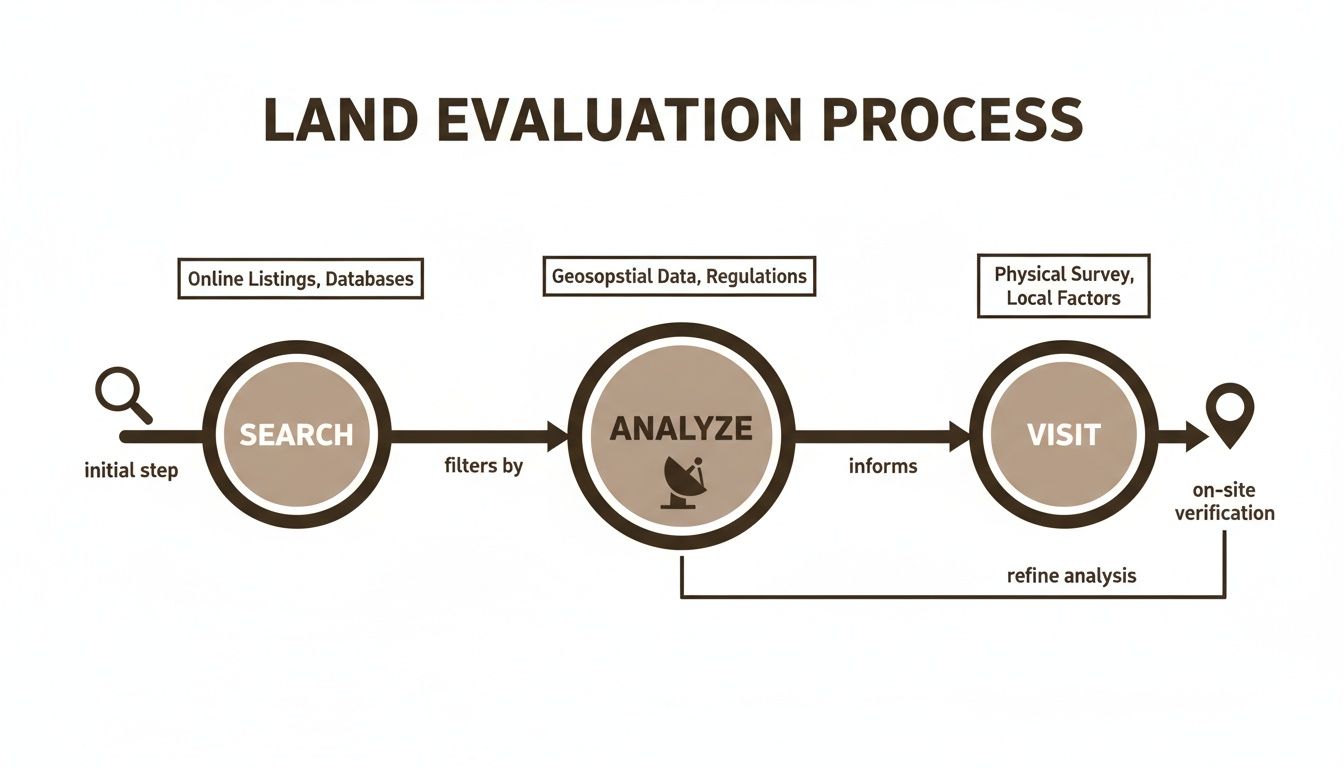
As you can see, a smart purchase involves a ton of research before you ever set foot on the property. That way, when you finally do visit, your time is spent confirming details, not starting from scratch.
Getting a Feel for the Land: Physical Due Diligence
First things first: can you actually get to and use the property? This goes way beyond just looking at a pretty map. You need to verify both your legal right to access it and the real-world conditions on the ground.
-
Access, Both Legal and Physical: Does the property have deeded access? This is a non-negotiable. It means your right to use the road leading to your land is legally recorded and protected. Without it, your property is "landlocked," which is a massive problem. You have to confirm this with the county. Then, go see the road for yourself. That charming dirt path might be perfect for your truck in July, but will it be an impassable muddy pit after a spring rain or a snowstorm?
-
Surveys and Boundaries: So, where does your land actually begin and end? The only way to know for sure is with a recent survey. While sellers like Dollar Land Store provide GPS coordinates that get you incredibly close, if you’re planning to build a fence or a structure right on the property line, investing in a formal survey from a licensed professional is money well spent.
-
Topography and Terrain: Satellite maps are a great starting point, but an in-person visit is absolutely essential. You need to walk the land. Look for hidden challenges like steep slopes, deep ravines, or low-lying areas that look like they'd turn into a swamp after a heavy rain. These features can dramatically affect where you can build—and how much it's going to cost to prepare the site.
Checking the Paperwork: Legal and Title Due Diligence
This is the part where you make sure the seller actually has the legal right to sell the property to you. You're also ensuring that you’ll receive a "clean" title, which means it’s free from surprise claims or debts from other people. This is how you protect your investment.
You can dig into the property’s history yourself at the county recorder's office, but most people hire a title company to run a professional search. They’re looking for red flags like:
- Liens: These are legal claims against the property for unpaid debts, like back taxes or money owed to a contractor. All liens have to be paid off before the title can be transferred to you.
- Easements: An easement gives someone else the right to use a part of your property for a specific purpose. A classic example is a utility company having an easement to run power lines across a corner of your land.
- Encumbrances: This is just a catch-all term for any claim or restriction that impacts the property’s use or value, including both liens and easements.
At Dollar Land Store, we do this work upfront and guarantee the properties we sell have a clear title, which makes the whole process much simpler for our buyers. Even so, understanding these terms is crucial for any land purchase you make.
Finding Out the Rules: Regulatory Due Diligence
Okay, so you’ve confirmed you can get to the land and that the title is clean. Now for the big question: what will the government actually let you do with it?
The rules can change dramatically from one county to the next, so never, ever assume. Your go-to source for this information is the county’s Planning and Zoning Department. For a deeper look at this topic, check out our guide on what to look for when buying land.
Here are the key questions you need to ask them:
-
Zoning: Find out the property’s official zoning classification (e.g., Residential, Agricultural, Recreational). This dictates the primary use of the land. Ask for a copy of the permitted uses for that specific zone. Can you build a house? Can you camp on it, and if so, for how long? Are RVs or mobile homes allowed?
-
Building Codes: If building is in your future, find out which codes the county enforces. Are there minimum home sizes? What’s the permit process like, and how long does it usually take to get approval?
-
Utilities and Water Rights: With raw land, you’re often starting from scratch.
- Water: Can you drill a well? The county health department or state water board can tell you about permits and the average well depth in the area. In many western states, you also have to verify water rights—just because a creek flows through the property doesn't mean you have the right to use that water.
- Sewer: If city sewer isn't an option, you'll need a septic system. The county will require a percolation test (or "perc test") to make sure the soil can handle wastewater safely before they'll even consider giving you a permit.
- Power: How far away is the nearest power pole? Get in touch with the local utility company and ask for a quote to extend service to your property. Be prepared—the cost can be surprisingly high.
To help you keep all of this straight, we've put together a quick-reference table. Think of it as your personal cheat sheet for tackling due diligence like a pro.
Due Diligence Critical Checkpoints
| Diligence Area | Key Questions to Ask | Primary Source for Information |
|---|---|---|
| Physical Access | Is there legally recorded, deeded access? What is the real-world condition of the road in all seasons? | County Recorder/Clerk's Office, In-Person Visit |
| Boundaries & Terrain | Have the property corners been marked by a recent survey? Are there any steep slopes, flood zones, or unusable areas? | Existing Survey Plat, Licensed Surveyor, In-Person Visit, FEMA Flood Maps |
| Title & Ownership | Are there any liens, easements, or other encumbrances on the title? Is the seller the legal owner? | Title Company, County Recorder of Deeds |
| Zoning Regulations | What is the property zoned for? What are the permitted uses (e.g., camping, RVs, tiny homes)? | County Planning & Zoning Department |
| Building & Permits | What are the building codes? Are there minimum structure sizes? What is the permit process and timeline? | County Building Department |
| Water Source | Can I drill a well? Are there water rights? How deep are neighboring wells? Is city water an option? | County Health Dept., State Water Resources Board |
| Wastewater/Sewer | Is a septic system required? Has a percolation test been done? Where is the nearest sewer hookup? | County Health/Environmental Dept. |
| Utilities (Power/Gas) | How far is the nearest power line or gas main? What is the estimated cost to extend service? | Local Utility Companies (Electric, Gas) |
Using a checklist like this ensures you don't miss any critical details. It turns a potentially overwhelming task into a clear, step-by-step investigation, giving you the confidence that you’re making a smart, well-informed purchase.
Navigating Financing and Making an Offer
Figuring out how you'll pay for a piece of land is a huge first step. Most people assume they’ll just get a traditional bank loan, but it’s not that simple with raw land. Banks often see undeveloped land as a risky bet compared to a house.
Because of that, they usually demand a huge down payment—often 20-50%—and tack on higher interest rates. The approval process can be a real headache, too. For a lot of first-time buyers, those hurdles are enough to make them give up.
Luckily, there’s a much more common-sense way to buy rural land.
The Power of Seller Financing
Seller financing, sometimes called owner financing, completely changes the game. Instead of going to a bank, you work directly with the seller and make your payments to them over time. It cuts out the middleman and all the rigid, formal requirements that come with them.
The whole process is refreshingly straightforward. You and the seller agree on the price, the down payment, and the monthly payment. It's all put into a simple land contract, and once it's signed, you can start using your property while you pay it off.
Companies like Dollar Land Store have built their whole business around making this process as easy and transparent as possible.
Key Benefits of Seller Financing
This approach has some serious advantages, especially if you’re new to buying land.
- No Credit Checks: The seller is the lender, so your credit score doesn’t matter. This is a game-changer for anyone who might not qualify for a bank loan.
- Low Down Payments: Banks want a fortune upfront, but owner financing often lets you get started with a much smaller down payment. Some sellers even offer land for just a few hundred dollars down. We break this down in our guide on how much of a down payment is needed for land.
- Faster Process: With no underwriters or long waiting periods, you can close on a property in just a few days instead of weeks or months.
- Simple Terms: The agreements are usually much easier to understand than complicated mortgage documents.
What This Means for Buyers
For first-time buyers, the implications are huge. Seller financing gets rid of the biggest roadblocks that prevent people from owning land. It shifts the question from "Can I get approved?" to "Does this monthly payment fit my budget?" This empowers you to focus on finding the right property without the stress of bank approvals. It makes land ownership accessible, allowing you to invest in a tangible asset on your own terms, often with a much lower entry cost than traditional real estate.
Making an Offer and Understanding the Contract
Once you've found a property and have your financing sorted out, it's time to make it yours. With a seller-financing company like Dollar Land Store, this is often as easy as clicking "Buy Now" on a listing and covering the down payment and a document fee. The prices are fixed, so there’s no haggling.
Whether you go that route or buy from a private individual, you’ll sign a purchase agreement or a land contract. This is the legal document that lays out all the terms, and it’s critical that you read it carefully.
A solid land contract should clearly state:
- Total Purchase Price: The full amount you'll pay.
- Down Payment Amount: What you’re paying upfront.
- Monthly Payment: Your fixed payment each month.
- Interest Rate: The rate charged on the loan balance, if any.
- Loan Term: How many months you’ll be making payments.
- Property Details: The APN, legal description, and acreage must be spelled out.
Even if the terms look simple, take the time to understand every line. A good seller will encourage you to ask questions because they want you to feel confident. After all, this contract protects both you and the seller for the life of the agreement.
Why Consider Dollar Land Store?
For most people, the thought of buying land feels out of reach. You picture high prices, confusing bank loans, and a process that just seems too complicated. That’s exactly why we built Dollar Land Store. Our mission is to open the door to land ownership for everyone, especially for first-time buyers who felt the traditional market wasn’t for them. We provide a direct, simple, and affordable path to owning your own piece of land.
We don't think you should need a pile of cash or a perfect credit score to get started. Our entire approach is designed to remove those old barriers and put you in the driver's seat.
Straightforward and Transparent Financing
The biggest hurdle for most buyers is financing. Banks can be tough, with strict rules and endless paperwork. We do things differently. With our owner-financing process, you deal directly with us, and it’s a whole lot simpler.
Here’s what that means for you:
- No Credit Checks: We’re not worried about your credit score. Your financial past shouldn't prevent you from building a future on your own land.
- Affordable Land with Low Payments: Our specialty is finding properties that fit a real-world budget. We set up low monthly payments that make ownership a reality, not just a dream.
- Transparent Terms: No confusing legal jargon. Our contracts are written in plain English, so you can clearly see the total price, down payment, and your monthly payment. No hidden fees, no surprises.
- Fast Contract Setup: Our streamlined process means you can secure your land quickly, often within a few days.
- No Middlemen: Because you buy directly from us, you avoid dealing with real estate agents, saving you money on commissions and speeding up the entire process.
We have a broad inventory of vacant, undeveloped land across several states, from the open deserts of Arizona to the mountains of Colorado. We handle the headaches upfront by ensuring every property has a clear title and providing all key details—like the APN and GPS coordinates—so you can begin your own research with confidence.
Buyer Guidance: Your Next Steps to Land Ownership
You’ve done the reading, and now it's time for the exciting part—turning that knowledge into action. This is where your research starts to feel real. The very first step is a personal one: take a moment to figure out your budget and get really clear on what you want to do with your future piece of land.
Once you have that vision, you can start searching with purpose. Here’s how to move from just learning about land to actively pursuing it:
- Browse Available Parcels: Start by exploring properties online. It’s a low-pressure way to see what's out there in your price range and get a feel for different types of land.
- Learn About Seller Financing: Take a look at how our simple owner financing process works. When you see just how straightforward it is, you’ll realize that owning land is much more accessible than most people think.
- Evaluate a Parcel: Use the due diligence checklist from this guide to assess any property that catches your eye. Verify zoning, access, and other key details with the county.
- Contact Us with Questions: If you have questions about a certain property or just want to understand the process better, don't ever hesitate to reach out. Our team is here to help.
As you get closer to making a deal, you'll want the final steps to be quick and easy. Many buyers are now expediting real estate closings with e-signatures to make the transaction as smooth as possible. Your journey to land ownership doesn't have to be complicated. By defining your goals, exploring your options, and asking questions, you turn a dream into an achievable plan.
Conclusion
Purchasing raw land is one of the most rewarding investments you can make. It offers the freedom to create something uniquely yours and the security of owning a tangible asset. While the process requires careful research—especially due diligence on access, zoning, and title—it is entirely manageable with the right approach. By understanding the key steps, from your initial search to financing and closing, you can confidently navigate the journey. Whether you use traditional methods or take advantage of accessible options like seller financing, the path to owning your own piece of America is within reach.
Ready to find your perfect piece of land? At Dollar Land Store, we make ownership accessible with our simple financing and transparent process.