


Land for Sale Arizona Owner Financing: A Buyer's Guide
Ross AmatoYou've found an Arizona parcel with a price that looks manageable, but the listing says seller financing and you're not sure what happens next. You're wondering whether you'll need a bank, when you receive the deed, whether you can camp or place an RV there, and how to verify that the land is usable.
Browse available Arizona land and other featured properties before you commit. The key is to treat the listing as the starting point, not the finish line. Price and monthly payment matter, but access, permitted use, utilities, taxes, documents, and county records determine whether the parcel fits your plans.
Your Guide to Arizona Land with Owner Financing
Seller financing means you buy land directly from the seller and make payments under a written agreement instead of obtaining a traditional bank loan. The seller accepts a down payment, if required, and finances the remaining balance according to the stated purchase price, interest, payment schedule, and other terms.
That structure can be useful for buyers who want a straightforward online purchase process or who don't want to rely on traditional bank underwriting. It doesn't remove the need for due diligence. You still need to understand exactly what you're buying, what you can legally do with it, and what happens if payments are missed.
Why buyers consider this option
Arizona has a substantial, trackable land market. A June 2026 parcel dataset reports 6,138,544 parcels across 15 counties, illustrating how fragmented and data-rich the state's land inventory is for buyers comparing vacant parcels, acreage, and owner-financed opportunities. The Arizona parcel dataset also points to county-level records as a practical foundation for researching land.
Seller financing is also a measurable part of property transfers. In 2024, Arizona accounted for 3,757 owner-financed transactions, up from the previous year, while seller-financed notes totaled $30.3 billion nationally. The 2024 seller-financing data shows that this method is an established part of the broader property market, not an unusual arrangement limited to a handful of sellers.
For a first-time buyer, the simplest way to think about the process is this: the listing helps you identify a candidate parcel, seller financing gives you a payment structure, and county research tells you whether the land works for your intended use. You need all three pieces before signing.
For a broader look at available acreage, read this guide to Arizona acreage for sale.
How Seller Financing for Arizona Land Works
The agreement is best understood as a land payment plan. You and the seller agree on the property price and payment terms, then the contract explains what each party must do until the balance is paid.
A typical arrangement works like this:
- Review the listing and contract. Confirm the legal description, purchase price, down payment, monthly payment, interest terms if any, fees, payment due dates, late-payment rules, and payoff conditions.
- Complete the buyer information and signing process. The seller may use electronic documents, but you should read every page before signing.
- Make the required initial payment. This may include a down payment and a document or processing fee if the agreement provides for one.
- Make scheduled payments. Your agreement should identify where payments go, how they're credited, and how you can request a payoff statement.
- Complete the payoff and transfer. After the final required payment and any other contractual obligations are satisfied, the seller generally provides the deed and completes the transfer process.
The seller usually retains the deed as security while you're paying. This resembles buying an item through installments: you have a contractual right to the purchase, but the final ownership document isn't delivered until the agreed balance is satisfied. That arrangement is different from a traditional mortgage, where a bank typically records a security interest while the borrower receives a deed at closing.
Read the payment agreement like an operating manual. If a term affects your money, your use of the land, or the timing of the deed, it should be clear in writing.
Seller financing can reduce dependence on bank underwriting, but it isn't a substitute for understanding the contract. Ask about payoff procedures, payment servicing, late fees, cancellation or default provisions, property taxes, and whether any association charges apply.
For a plain-language explanation of the structure, review what seller financing means in real estate. Dollar Land Store presents itself as a direct seller of vacant land with seller-financed options and educational resources. It isn't a bank or traditional mortgage lender, so the property-specific agreement controls the actual terms.
Your Due Diligence Checklist for Arizona Land
Finding a promising parcel is only the beginning. The listing may show its location, acreage, and price, but it may not explain whether you can reach the property, obtain water, install septic, camp there, or build later. Those answers usually come from county departments, recorded documents, assessor records, maps, and the written purchase agreement.
Start with permitted use
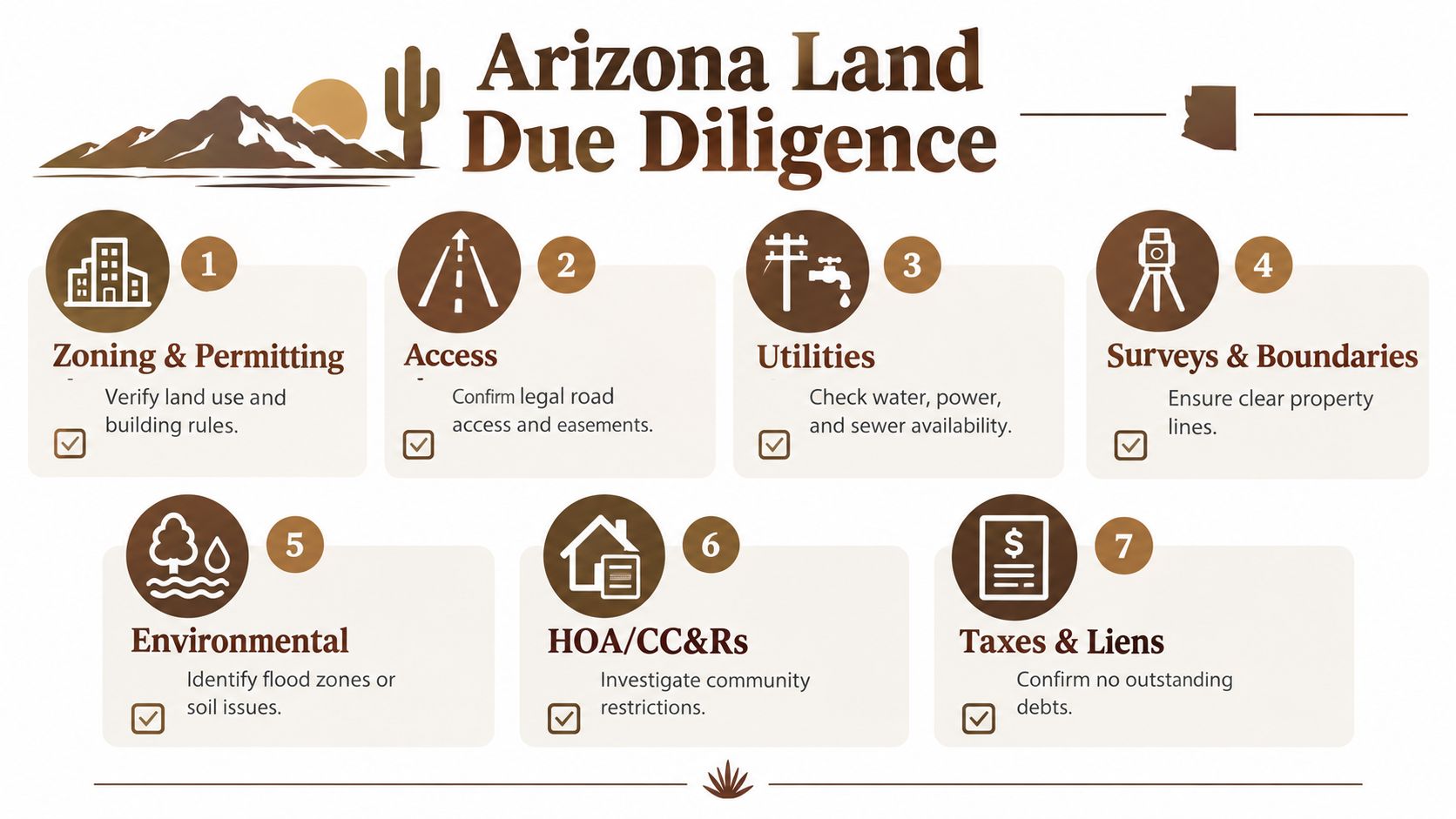
Contact the county planning or zoning department and ask how the parcel is classified. Confirm whether your intended use, such as a homesite, storage, recreation, camping, or RV occupancy, is allowed under current rules.
A residential description does not mean the land is ready for construction. Zoning is one piece of the review. Setbacks, minimum lot requirements, flood regulations, environmental restrictions, building permits, septic rules, and access standards can also affect what you may do there.
Ask this direct question: “What uses are permitted on this parcel, and what approvals would I need for my intended use?”
Confirm access twice
Legal access is a documented right to reach the parcel, often through a public road or recorded easement. Physical access means a route exists on the ground. A visible track may show that vehicles have passed through, but it does not prove that you have the legal right to use it.
Review the parcel map, deed history, and recorded easements. Then compare those records with current conditions. Ask the county or a qualified local professional about the road's status, maintenance, and any limitations that apply in that area.
Access also influences how useful the property will be to you and to a future buyer. Industry guidance distinguishes raw, unimproved, and improved land because roads, utilities, and other improvements can affect how lenders assess collateral and how buyers view a parcel. For that reason, review this overview of land financing considerations before signing.
Investigate utilities and water
Ask whether power, water, sewer, and other services are available at the parcel, nearby, or nowhere on the property. “Nearby” does not mean connected. A utility provider can give you more reliable information than a short listing description.
For water, identify whether the parcel depends on a public connection, a well, hauled water, or another arrangement. For wastewater, ask the relevant county department whether a septic evaluation or approval is required. A low purchase price does not show that bringing in infrastructure will be affordable.
Check boundaries and restrictions
Use the county assessor's parcel map as a starting point, not as a substitute for a professional survey. Compare the legal description with the map, and ask whether monuments, easements, or neighboring claims could reduce the usable area.
Search for HOA or POA obligations, recorded covenants, conditions, and restrictions. Check for rules affecting structures, vehicles, animals, camping, or property maintenance. These requirements can vary by jurisdiction and community, so confirm them for the specific parcel.
If you may hire someone for grading, site work, construction, or other improvements, confirm contractor licensing in Arizona before hiring. Licensing does not establish that the parcel is buildable, but it gives you another way to evaluate the person offering project advice or services.
Verify taxes and recorded obligations
Arizona vacant land is generally assessed for property taxes at 15% of full cash value, compared with the 10% rate often associated with residential property. The cited Arizona property-records guidance supports checking the specific parcel's current tax bill with the county assessor instead of relying on a broad estimate.
Ask whether taxes are current and whether the record shows liens, judgments, easements, or other encumbrances. A title search or recorder review can uncover issues that a marketplace listing does not display.
A cheap parcel is only cheap after you understand the cost of making it usable. Confirm the land's legal and physical realities before concentrating on the payment amount.
For a more detailed research framework, review this land due-diligence resource.
Understanding the Costs and Typical Terms
Finding a listing is only the starting point. Before signing, map the full cost structure so the agreement fits your budget and you can compare parcels on the same basis.
| Cost item | What it means |
|---|---|
| Purchase price | The total agreed price for the parcel. |
| Down payment | The amount paid at the beginning, if required. |
| Document or processing fee | A charge for preparing or administering paperwork, if stated in the agreement. |
| Principal | The portion of payments applied to the unpaid purchase balance. |
| Interest | The financing charge, if the contract includes interest. |
| Taxes and association charges | Ongoing ownership costs that may be billed separately from your payment. |
| Payoff amount | The amount needed to satisfy the remaining balance under the contract at a particular time. |
A monthly payment can hide the total price. Add the down payment, scheduled payments, interest, stated fees, taxes, and any association charges. Keep improvement costs in a separate estimate because they affect your land budget without changing the purchase contract.
Raw land terms often differ from home financing. Undeveloped property may lack buildings, utilities, income, or immediate resale utility that would otherwise support its value. Industry sources report vacant-land terms of 5 to 15 years, rates around 6% to 12%, and down payments of 20% to 50%. Raw land may fall toward the higher end because it presents more uncertainty. This vacant-land payment guidance offers broader context for comparing those terms.
Another industry source reports that traditional financing for raw, unimproved Arizona land often requires 30% to 50% down and terms of 5 to 15 years. Improved land with road access and utility proximity can sometimes receive better terms because fewer development questions remain. The land-financing comparison explains how parcel condition can affect the financing structure.
Ask how payoff works
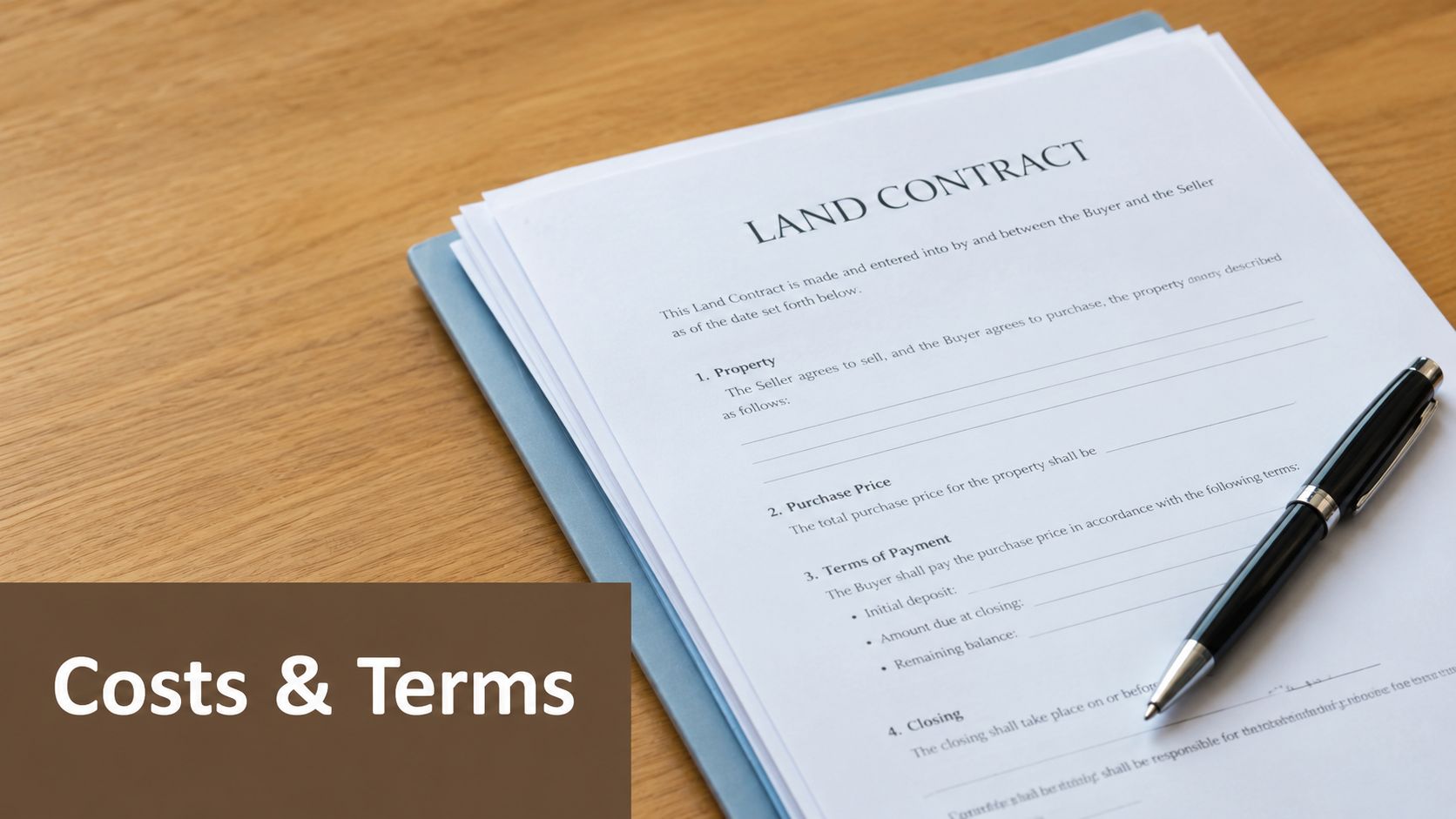
A payoff is not always just the remaining principal. Request a written quote showing the balance, accrued interest, administrative charges, and date through which the amount remains valid. Check whether the contract permits early payoff and whether it adds a fee.
Dollar Land Store offers no-credit-check seller financing on qualifying inventory, but rates, terms, fees, and payment amounts vary by property. Read the actual listing and contract instead of assuming every parcel uses the same schedule. You can also review information about owner-financing rates.
Keep land costs separate from project financing. Someone comparing roof financing options is evaluating a construction expense, not the purchase terms for vacant land. Separate worksheets make the path from listing to ownership easier to track.
The Closing Process and Receiving Your Deed
Closing is the administrative handoff between agreeing to buy and completing the ownership record. Read the documents in order, keep copies, and make sure the parcel's legal description matches across the listing, contract, and deed.
What happens before the first payment
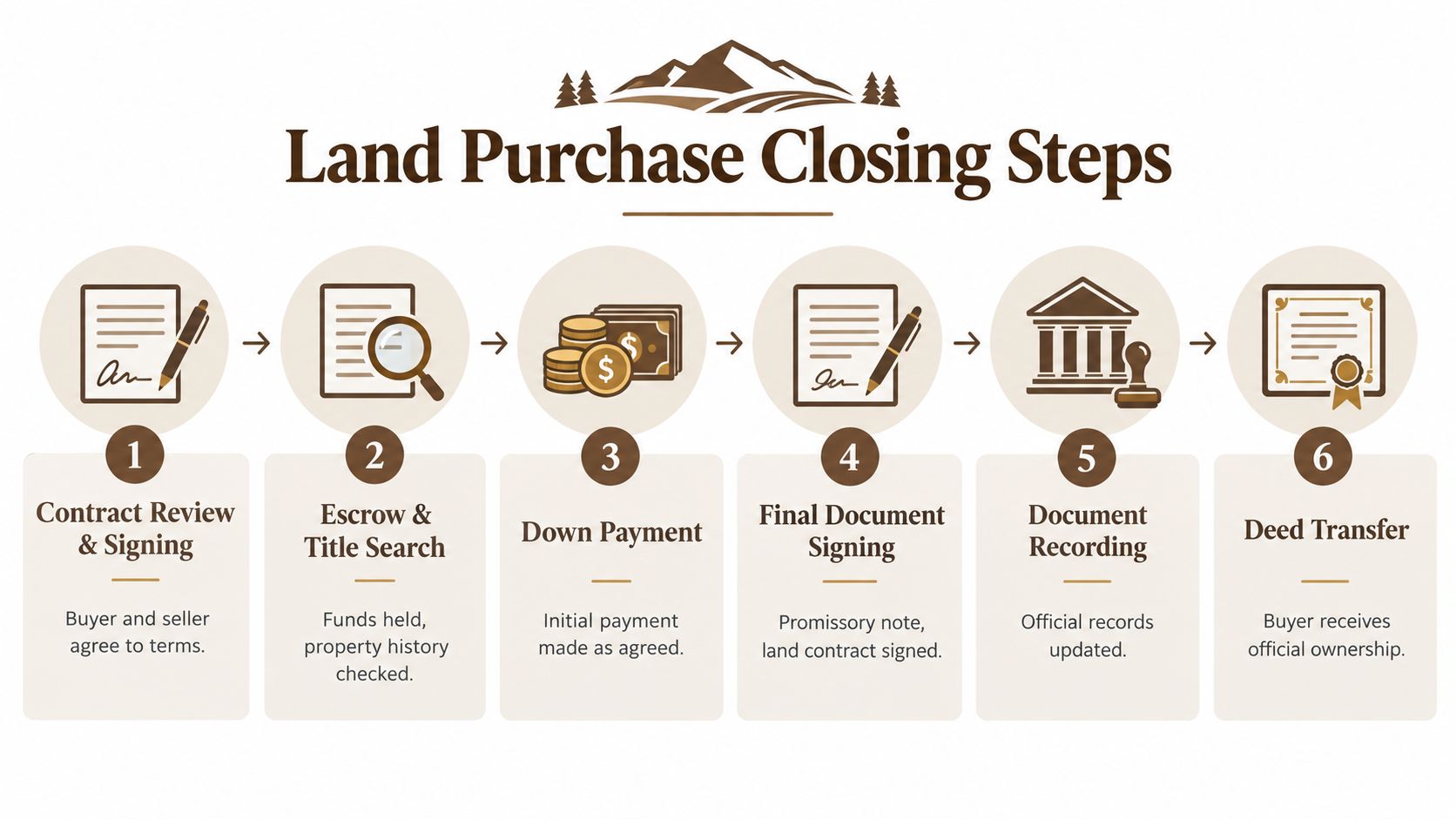
First, review the purchase agreement and any land contract or contract for deed. Confirm the parties' names, parcel number, legal description, price, payment schedule, interest, fees, tax responsibilities, default provisions, and the conditions for payoff and deed delivery.
The transaction may involve escrow, title review, electronic signatures, or direct document handling, depending on the seller's process. Ask who holds funds, who prepares documents, whether a title search is performed, and which party submits documents to the county.
Arizona recording rules include a specific requirement. A signed seller and buyer affidavit of legal value must accompany a deed or real-property sale contract that is submitted for recording. The affidavit includes information such as the parties' names and addresses, legal description, sale date, consideration, down payment, and financing type. Under Arizona Revised Statutes section 11-1133, the county recorder must refuse the transfer if the required affidavit is missing.
What happens after payoff
During the payment period, the seller generally keeps the deed as security. After you make the final payment and satisfy the contract's transfer conditions, the seller generally executes and delivers the deed.
Receiving the deed and recording the deed are separate steps. Possessing a signed deed doesn't automatically mean the county's public records have been updated. The deed must be submitted for recording according to county procedures, along with any required affidavit and fees.
Ask for written confirmation of the payoff, the original or properly executed deed, recording instructions, and confirmation once the county accepts the document. Requirements vary by county, so verify current procedures with the appropriate recorder's office.
For smaller land sales in unincorporated Arizona counties, additional disclosure rules may apply. A seller of five or fewer parcels must provide a written affidavit of disclosure at least seven days before transfer, and the buyer must acknowledge receipt. The executed disclosure affidavit is recorded at the same time as the deed, while the recorder isn't required to verify whether the statements are accurate. This Arizona land-buying explanation describes that process.
How to Get Started with Dollar Land Store
Once you find a listing, slow the process down enough to verify the details that affect your plans. Open the property page, save the legal description and parcel information, and compare the advertised terms with the written agreement. Then contact the relevant county offices about zoning, access, utilities, water, septic, camping, RV use, taxes, and recorded restrictions.
Dollar Land Store operates as a direct seller of vacant land, with seller-financed options and an online buying process. Its inventory covers multiple states, including Arizona, and its educational resources are designed to help first-time buyers understand land ownership, contracts, payments, and due diligence.
A practical purchase sequence
Use this order to keep the decision manageable:
- Choose a parcel that fits your purpose. Decide whether your goal is future construction, recreation, camping, storage, or for owning rural land. A parcel that fits one purpose may not fit another.
- Verify county information. Ask written questions and save the answers. Rules differ by jurisdiction, and county staff may direct you to planning, building, environmental health, assessor, or recorder offices.
- Review the financing terms. Identify every payment, fee, payoff condition, and default provision before signing.
- Confirm the documents. Check the legal description, affidavit requirements, deed process, and recording responsibilities.
- Plan ongoing ownership. Include property taxes and any HOA or POA charges in your budget, even if the monthly seller-financing payment appears affordable.
Camping and RV use require particular care. In Cochise County, an RV may be allowed on property with an existing principal use for up to 6 months in a calendar year with an approved temporary use permit, and RV occupancy may also be allowed while a principal use is being constructed with such a permit. The cited Arizona recorder guidance indicates why buyers should independently verify current county rules. Requirements vary by county, and some parcels may have limitations.
A straightforward process doesn't mean skipping research. It means organizing the research so you know what to ask, where to look, and which answers belong in the contract.
Dollar Land Store offers direct land sales, seller-financed options, no-credit-check financing on qualifying properties, and educational resources for buyers comparing Arizona parcels. Visit Dollar Land Store to browse available land, review property-specific terms, and take the next step only after the parcel's use, access, costs, and closing process make sense for you.