


Liability Insurance for Land: An Informational Guide
Ross AmatoYou've bought a piece of raw land, or you're close to it, and one of the first practical questions shows up fast. If somebody gets hurt out there, who's responsible?
That's a smart question. A lot of first-time buyers think insurance starts when there's a house, a cabin, or a business on the property. With vacant land, the issue is different. The ground itself can create liability if someone enters the property, gets injured, or claims your land caused damage to someone else's property.
For vacant recreational parcels, this gets confusing because most insurance information is written for active farms and ranches. Data shows a critical information gap for vacant land owners; most insurance literature focuses on active farms with livestock or equipment, overlooking the specific liability questions faced by the growing number of people buying raw land for recreation or off-grid living in the Western U.S. (Insurance Information Institute farm insurance overview).
Your Guide to Landowner Liability Insurance
A common scenario looks like this. You close on a rural parcel, pull up the map, maybe visit the lot, and start thinking about normal ownership questions. Is the access clear? What are the county rules? What happens if a neighbor wanders across the line or a guest steps into a washout and gets hurt?
That's where liability insurance for land comes in. It's not an exotic product. It's a practical policy meant to protect a landowner from claims tied to the property itself.
Why this question comes up so often
Many individuals understand car insurance because they use a car every day. Vacant land feels quieter, so it's easy to assume it carries little risk. But open ground still creates real-world situations.
A visitor could trip on uneven terrain. A person cutting across the property could claim an injury. A boundary issue could turn into a property-damage allegation. None of that means a claim will happen. It means the responsibility question is worth thinking through before there's a problem.
Practical rule: If you own land and another person can physically enter it, liability is part of ownership.
Why homeowners insurance usually isn't the answer
Homeowners insurance is built around a residence. Vacant land doesn't fit neatly into that structure-first setup, which is why buyers often need to ask specifically about a land liability policy rather than assume a home policy applies.
That's also why it helps to look at resources focused on landowners instead of broad insurance summaries. If you want a plain-language example of how this type of protection is discussed in practice, landowner insurance through ISU Armac is one useful reference point.
What first-time buyers often misunderstand
The biggest misunderstanding is thinking liability only matters if you're running a farm, hosting events, or actively improving the land. In reality, even a quiet parcel held for privacy, recreation, or long-term flexibility can raise the same basic question. If someone claims your property caused harm, you may need to respond.
That's why this topic matters for first-time buyers. Not because land ownership should feel risky, but because peace of mind usually comes from simple preparation, not from hoping nothing ever happens.
What Liability Insurance for Land Actually Covers
Liability insurance for land is mainly about premises liability. In plain English, that means your responsibility as the owner when an injury or damage claim is tied to the condition or use of your property.
Think of it this way. A homeowners policy is often centered on a house and the activities around it. A land liability policy is centered on the parcel itself.
The core idea behind premises liability
If someone says they were injured on your land, the claim usually starts with the same basic question. Was there a condition on the property, or an issue connected to the property, that led to the injury or damage?
That doesn't automatically mean the landowner is at fault. It does mean the claim has to be dealt with. That's one reason these policies matter. They're not only about paying a settlement if one is owed. They can also help with the cost of defending a claim.
Here's a simple visual summary of the moving parts:
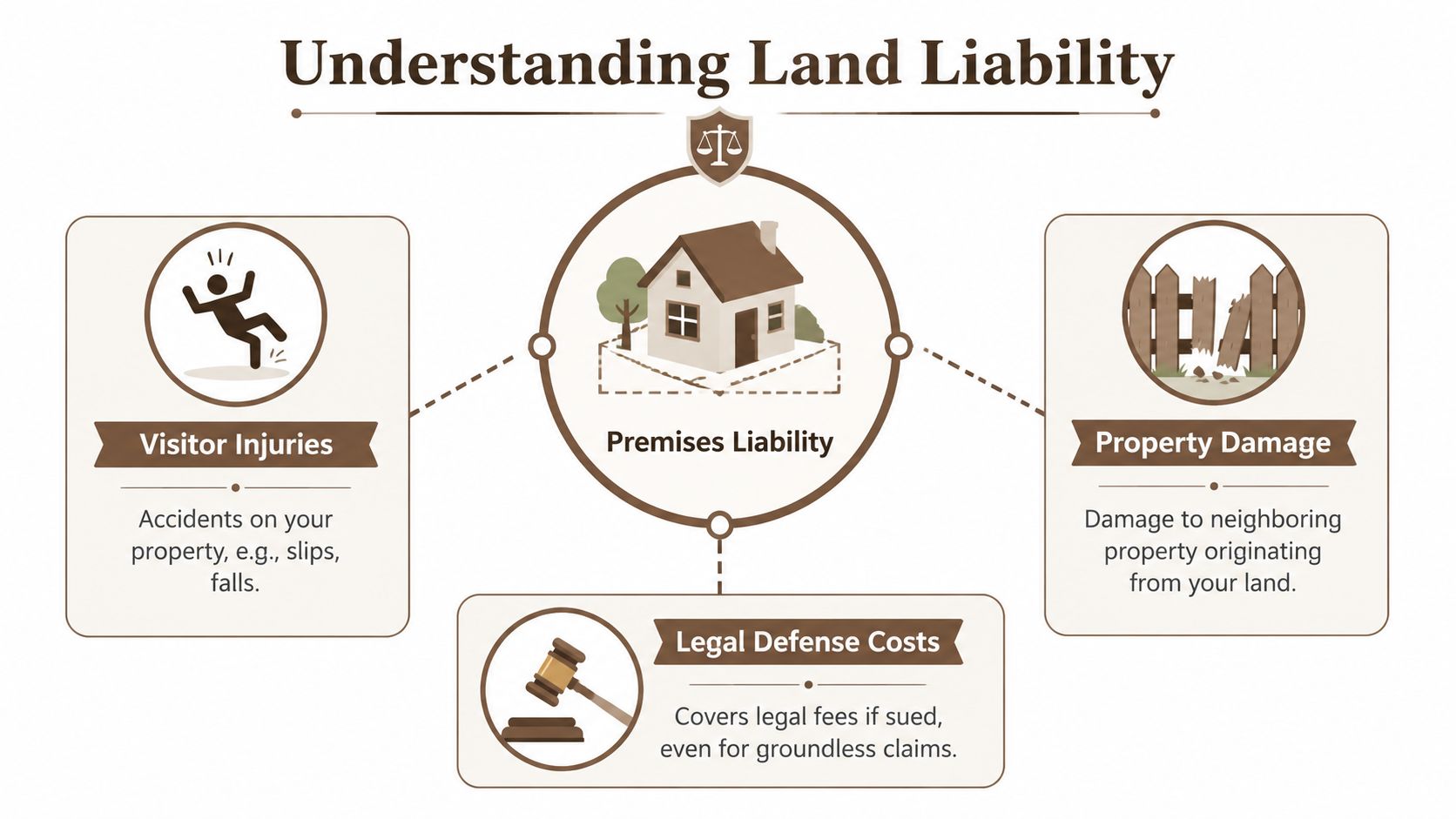
What a vacant land policy may address
Coverage details vary by insurer and by policy form, but buyers usually ask about a few practical categories:
- Visitor injuries: A person slips, falls, twists an ankle, or is injured while on the property.
- Property damage claims: A neighbor says damage originated from your parcel or from something on it.
- Legal defense costs: You may still need legal help even if the claim is weak or disputed.
- Conditions that attract attention: Water features, old debris, unmarked hazards, and similar conditions often lead buyers to ask more detailed coverage questions.
Landowners often focus on whether they would “win” a claim. The more immediate issue is whether they'd have help responding to it.
What this coverage is not
Confusion often arises. Liability insurance for vacant land is not the same thing as title insurance, and it's not the same as professional liability coverage. It also doesn't mean every possible event is covered.
Policies can have exclusions. Intended use matters. Property conditions matter. If the parcel has features that raise special concerns, you want that conversation before binding coverage, not after.
For a simple comparison between public liability and professional indemnity concepts, professional indemnity coverage advice can help clarify why land-related bodily injury and property damage issues are a different insurance category from advice-based claims.
A practical way to think about it
If title insurance protects your ownership record, liability insurance protects your side of the ownership responsibility. One deals with legal ownership history. The other deals with what can happen after you own the land and someone alleges injury or damage.
That distinction matters because many first-time buyers are careful about the purchase itself, but they don't always think about what ownership looks like six months later when the land is just sitting there.
Typical Coverage and Costs for Vacant Land
For most first-time buyers, this is the part that determines whether insurance feels practical or out of reach. The good news is that vacant land liability coverage is often much more approachable than people expect.
Industry pricing data shows that liability insurance for vacant land can start as low as $12 per month for policies with $1,000,000 per occurrence and $2,000,000 aggregate liability limits (vacant land liability insurance pricing). That's the number that makes this topic feel real for a lot of owners. It's not automatically expensive just because the property is rural.
Here's the visual version:
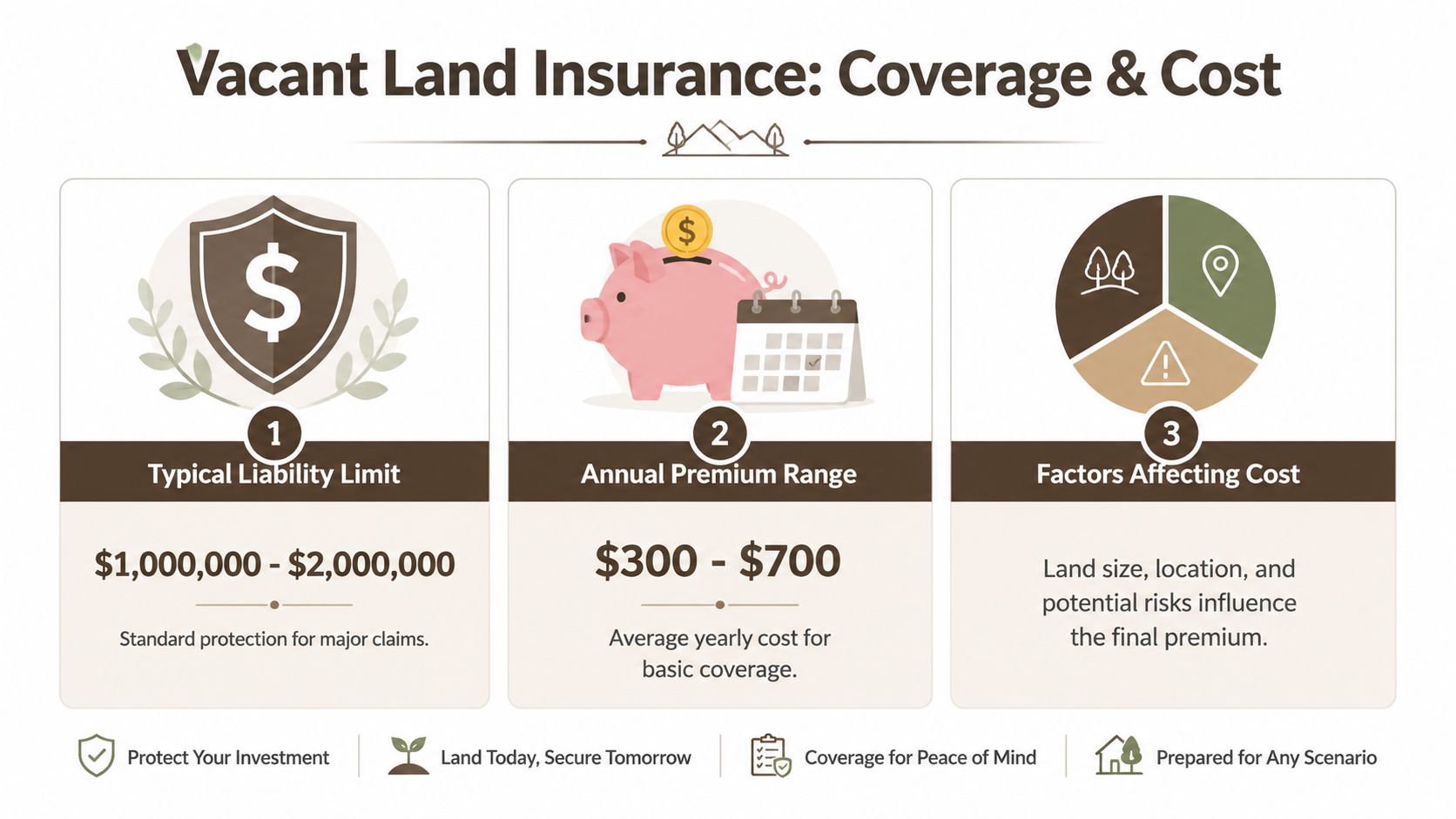
What the common coverage benchmark looks like
A widely used benchmark for foundational land protection is $1,000,000 per occurrence and $2,000,000 aggregate. You'll see that structure come up often because it's a familiar baseline in land-related liability discussions.
That doesn't mean every owner needs the same setup. It means this level is commonly treated as a practical starting point when a buyer wants straightforward protection instead of guessing too low.
Why this usually feels manageable
Vacant land doesn't have the same insurance profile as a full-time residence with structures, personal property, and constant occupancy. For many owners, that means they're looking at a simpler policy whose purpose is narrow and clear.
What moves the quote up or down is usually the character of the parcel and how it may be used. A remote desert lot, a parcel with easy public access, and a creek-side tract can present different underwriting questions even if all three are vacant.
What owners should ask about cost
When you request a quote, keep the conversation practical:
- Ask how the insurer classifies the parcel: Raw land, recreational land, and farm-related land may be treated differently.
- Describe actual use: If the land is being held, say that. If there are known features like water, roads, or neighboring access points, mention them.
- Request the exclusions in plain language: A low premium is only helpful if you understand what the policy leaves out.
A low monthly starting point makes this easier to evaluate as a routine ownership cost, not a major financial hurdle. For a first-time land buyer, that can be the difference between putting insurance off and getting it handled.
Why Western US Landowners Need This Protection
Owning raw land in the West often means owning space. That's a big part of the appeal. You get privacy, distance, open views, and flexibility. It also means your parcel may be unfenced, lightly marked, remote, or easy for others to enter without much effort.
A practical example is a corner of land near a dirt road. A neighbor or passerby cuts across it, gets stuck, and later claims damage or injury. Another example is unauthorized ATV use. The owner didn't invite it, but the property still became part of the story.
The real-world what-ifs that matter
Most vacant land owners aren't running commercial operations. They're holding land for future plans, privacy, occasional visits after payoff, or long-term flexibility. The relevant risks are usually simple and familiar:
- Unmarked boundaries: People may not realize they've crossed onto private property.
- Natural terrain hazards: Washes, rocks, uneven ground, and old site remnants can create injury claims.
- Unauthorized recreation: Dirt bikes, hikers, hunters, or casual explorers sometimes enter rural parcels without permission.
- Neighbor friction: Access routes, dumping, fencing, and vehicle tracks can create disputes that turn into liability questions.
A lot of land claims start small. A wrong turn, a damaged gate area, a twisted ankle, a disagreement about where one parcel ends and another begins.
Why the coverage benchmark matters on rural land
The standard often cited for foundational protection is $1,000,000 per occurrence and $2,000,000 aggregate coverage, and that benchmark is used in farm lease settings because rural accident claims can be expensive. The same guidance notes that damages in rural accident cases can easily exceed $500,000 (farm lease liability insurance guide).
That's useful context even for a non-farm parcel. It shows why landowners often choose a coverage limit that feels larger than the property's simple appearance might suggest.
Simple habits that reduce headaches
Insurance is only one part of smart ownership. A few low-cost habits can make the property easier to manage:
- Post clear signage: “Private Property” or “No Trespassing” may help communicate boundaries.
- Mark boundaries where practical: Even basic boundary awareness reduces confusion.
- Keep a record of property condition: Photos from occasional visits can be useful if there's ever a dispute.
- Pay attention to regional hazards: In many Western markets, wildfire exposure is part of responsible ownership planning. This overview of wildfire risk assessment for rural land is a useful starting point for that side of due diligence.
The point isn't to turn raw land into a management burden. It's to keep ownership organized so a small issue doesn't become a larger one.
How to Get a Vacant Land Liability Policy
Getting a quote is usually more straightforward than first-time buyers expect. You're not building a complicated insurance file. You're helping an agent understand what the parcel is, where it is, and how it's being held or used.
Start with the parcel details
Before you contact an agent, gather the basics in one place:
- APN or parcel number
- County and state
- Acreage
- Whether the land is vacant and undeveloped
- Any notable features, such as water, road frontage, steep terrain, fencing, or visible structures
If you already have closing documents, maps, or listing information, most of this is easy to pull together.
Describe the land plainly
Keep the explanation simple. Tell the agent whether you're holding the parcel long term, planning future use after payoff, or maintaining it as vacant land for now.
If there are any obvious issues, mention them early. For example:
- Access questions: Is the parcel easy to reach, or very remote?
- Known hazards: Are there old materials, wells, or eroded areas?
- Public exposure: Does it sit near a road, trail, or neighboring path people might use?
The best insurance conversations are boring. Clear parcel details, clear intended use, clear questions.
Ask direct questions before accepting a quote
Buyers often help themselves most by not just asking, “How much is it?” Instead, ask what the policy is built to cover.
Useful questions include:
- Does this policy fit vacant recreational land?
- Are trespass-related injuries treated differently?
- Are there exclusions tied to fire, flood, water features, or specific land conditions?
- Does the quote assume the parcel remains undeveloped?
- What information would change the quote later?
If you're also sorting out ownership-protection topics more broadly, this guide to land title insurance helps clarify how title coverage differs from liability coverage.
Review the quote like an owner, not just a shopper
The cheapest quote isn't always the best fit. A useful policy is one you understand. Read the named insured, the property description, the coverage limit, and the exclusions.
If anything sounds vague, ask the agent to restate it in plain English. That isn't being difficult. It's exactly how vacant land owners avoid buying a policy that doesn't match the parcel.
Practical Checklist and Frequently Asked Questions
By this point, the goal is simple. You want to know whether liability insurance for land makes sense for your parcel, and if it does, how to approach it without overcomplicating ownership.
This checklist helps keep the process grounded:
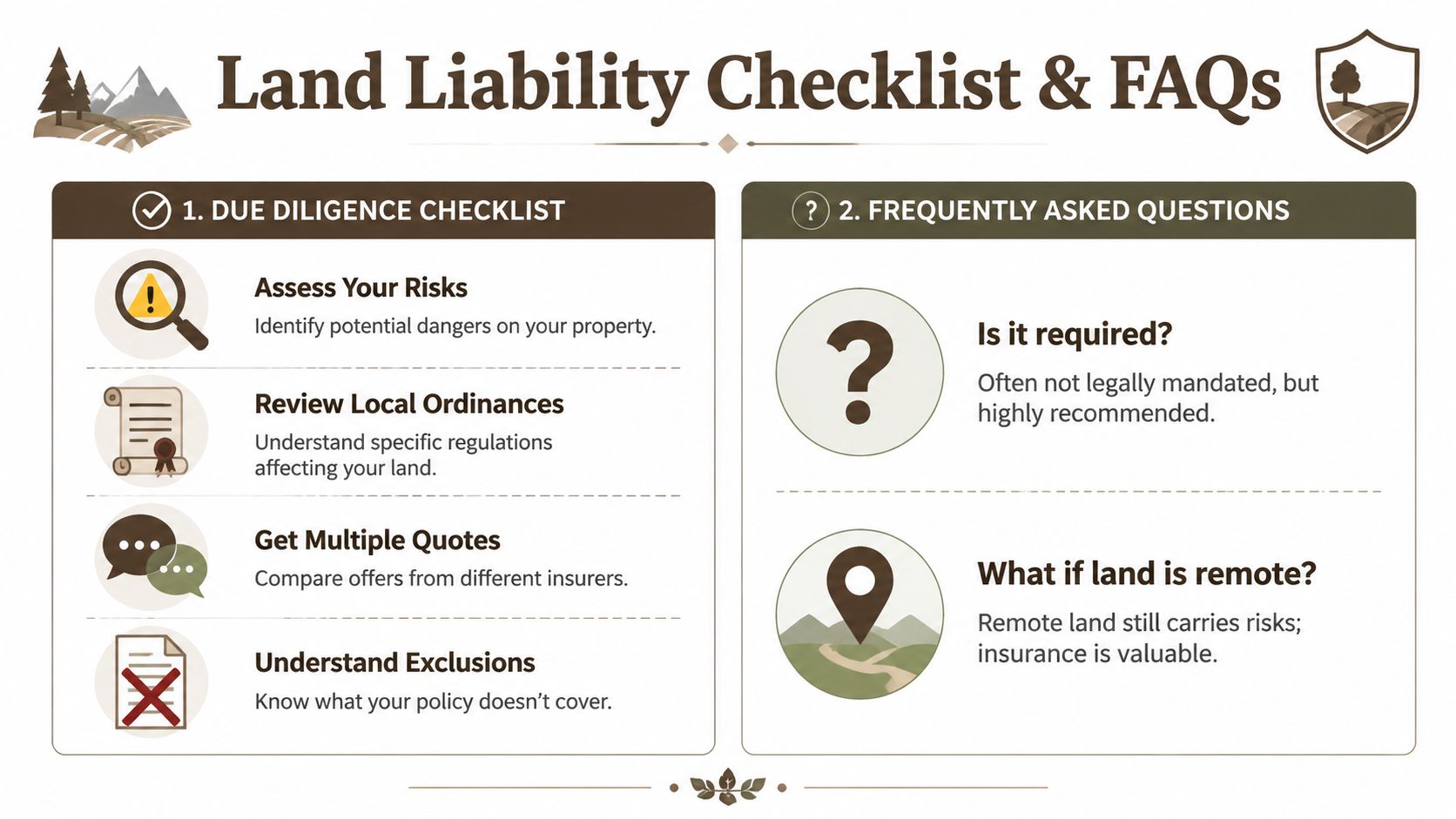
A practical due diligence checklist
- Verify zoning: Rules differ by jurisdiction, so confirm what the county allows.
- Confirm legal access: Make sure you understand how the parcel is reached.
- Review parcel maps: Check shape, boundaries, roads, and nearby parcels.
- Understand restrictions: Some parcels may have limitations tied to use or financing terms.
- Review taxes: Know the ongoing ownership costs.
- Check property condition: Note terrain, water, debris, fencing, or visible hazards.
- Research county requirements: Buyers should independently verify local rules for any future use.
- Prepare insurance details: Have the APN, acreage, county, and intended use ready before calling an agent.
FAQs for Dollar Land Store Buyers
| Question | Answer |
|---|---|
| Do I need liability insurance while I'm still financing vacant land? | Financing terms and use restrictions matter. Dollar Land Store does not allow camping on financed properties, so it does not recommend insurance coverage for camping use during that period. Buyers should stay in compliance with the purchase agreement and local rules. After payoff and deed transfer, they can speak with an insurance agent about vacant-land liability coverage for their intended use. |
| What if I never visit the land? | A parcel can still create liability questions even if the owner rarely goes there. Remote land may still have visitors, neighbors, trespassers, or boundary issues. Insurance is something many owners consider for peace of mind after payoff and deed transfer. |
| Does missing fencing or signage matter? | It can. Missing fencing or signage may create boundary confusion and liability issues. There isn't a verified claim example to share here, but owners can ask their insurer, county, and local professionals whether posting, fencing, or boundary marking makes sense for the parcel. |
| Will a creek-side parcel cost more to insure than a desert lot? | There's no internal premium comparison data to rely on. In general, different parcels raise different insurance questions. A creek-side parcel may involve water-related concerns, while a desert parcel may raise fire, remoteness, or access issues. A licensed insurance agent can evaluate the actual parcel details. |
| What should I give an insurance agent when I ask for a quote? | Start with the APN, location, acreage, terrain, access information, and your intended use after payoff and deed transfer. The clearer the description, the easier it is for an agent to tell you whether the policy fits the land. |
A few short answers buyers usually need
Is land liability insurance legally required
Often, no. But many owners still treat it as a sensible protection step because a claim doesn't become harmless just because coverage wasn't mandatory.
Can I rely on a general assumption about “farm insurance”
Usually not. Much of the insurance language in the market is written for active farms, ranches, or commercial operations. Vacant recreational land owners need to ask whether the policy fits raw land.
Does seller financing change the conversation
It can. For raw land seller financing, interest rates typically range from 8% to 10% annually because the seller takes on lending risk without institutional mortgage funding (seller financing for land overview). Separate from insurance, buyers should read the land contract carefully so they understand use restrictions during the financing period.
What should buyers expect with seller-financed land generally
Seller-financed land deals can look different from home loans. In 2024, the average seller-financed note for land was $271,655, and buyers made an average down payment of about 27% (seller financing data for buyers). That broader context helps first-time buyers see why affordable entry-level vacant land can feel more accessible when terms are simple and clearly stated.
Owning land doesn't have to feel complicated. Most of the time, confidence comes from understanding the parcel, following the agreement, and asking better questions before there's a problem.
If you're researching affordable vacant land and want a straightforward buying process, Dollar Land Store is a practical place to browse available properties, review seller-financed land options, and explore educational resources for first-time buyers.