


New Mexico Land for Sale Owner Financing How It Works
Ross AmatoYou've found a desert parcel that fits your budget, but the listing's low monthly payment raises a harder question: what exactly are you buying, and when do you receive the deed? New Mexico land for sale with owner financing can make raw acreage accessible without a traditional bank loan or credit check where the seller offers those terms, but the monthly payment is only one part of the deal. The contract structure, county recording, access, permitted uses, and total financed cost deserve equal attention.
New Mexico is a large, rural land market. The USDA reports 27,788,220 acres of land in farms and shows a substantial mix of owned and rented farm operations, with 20,234 farms reporting owned land and 24,072 reporting rented land in its 2022 agricultural census materials (USDA New Mexico agricultural census data). That background helps explain why buyers encounter broad desert tracts, ranch country, and low-density parcels rather than conventional suburban lots.
How Owner Financing Works for New Mexico Vacant Land
A buyer searching for affordable desert acreage usually starts with a simple goal, perhaps a weekend retreat, a long-term hold, or a future homesite. With eligible Dollar Land Store properties, the buyer selects a listing, chooses an available payment option, checks out, completes the required purchase documents, and, for financed purchases, sets up payments through ZimpleMoney. Checkout starts the purchase process. It doesn't by itself transfer ownership.
Most vacant parcels are raw and unimproved unless the listing says otherwise. That means a buyer shouldn't assume that a road shown on a map is legally usable, that nearby power can be connected, or that the land is ready for a house, RV, well, or septic system. Owner financing solves the bank-loan problem, not the land-suitability problem.
Practical rule: Treat the payment option as a way to purchase the parcel, not as permission to occupy or develop it.
Where offered, owner financing means the seller receives the down payment and scheduled payments directly rather than sending the buyer through a traditional mortgage lender. The buyer still needs to review the property information, complete the agreement, and understand the difference between the down payment, document fee, monthly payment, and total financed cost.
For a quick look at available purchase paths, start with current New Mexico land listings. Inventory changes, so check current availability rather than relying on an older listing or a remembered payment amount.
The practical buying sequence
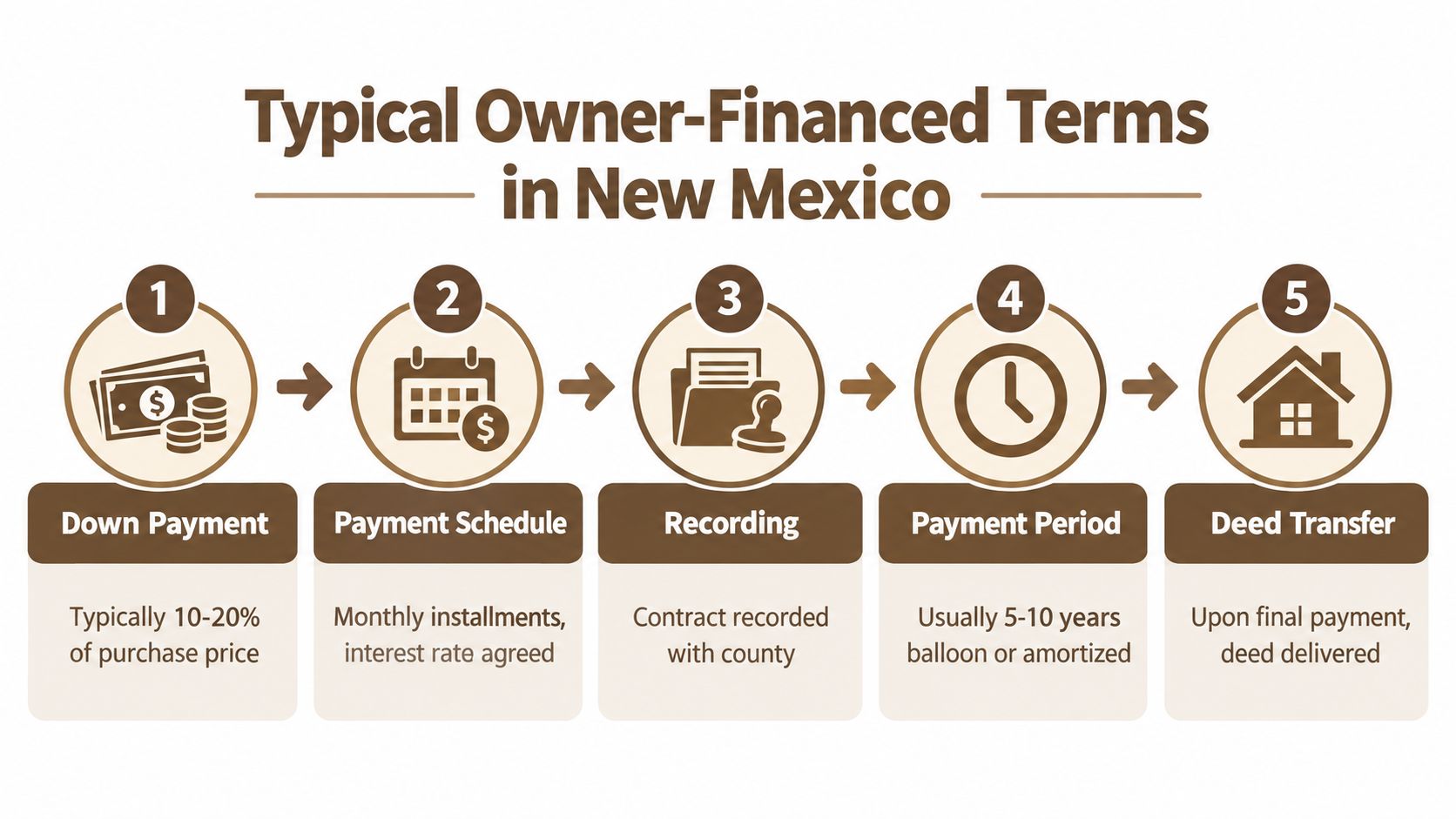
A typical online purchase has several distinct stages:
- Select a parcel. Compare the county, acreage, maps, price, and stated purchase options.
- Begin checkout. Checkout records the buyer's intent and starts the transaction workflow, but ownership still depends on completing the required steps.
- Sign the required documents. The signed agreement controls the transaction, together with applicable law and transaction-specific disclosures.
- Set up servicing. Financed buyers complete ZimpleMoney setup and manage scheduled payments through that system.
- Reach payoff and deed transfer. Dollar Land Store retains legal title for financed purchases until payoff and completion of the deed-transfer requirements.
The broader concept is often called seller financing or land financing. A plain-language overview of that structure is available in this explanation of seller financing in real estate, but New Mexico buyers need to focus on the exact documents for the parcel they're considering.
Understanding Real Estate Contracts and What Ownership Means at Closing
The most important question isn't “How low is the monthly payment?” It's “What legal interest do I receive when I sign?” New Mexico owner-financed land transactions can use different documents, and the difference determines who holds legal title, what the buyer may transfer, and what remedies apply if payments stop.
A common arrangement is a Real Estate Contract, often called an REC or contract for deed. Under this structure, the buyer generally receives possession and equitable interest while the seller keeps legal title until the balance is paid and the deed-transfer requirements are completed. The buyer has a contractual interest in the property, but signing the agreement or paying the down payment doesn't mean the buyer already holds the deed.
A deed of trust or mortgage works differently. In those arrangements, the buyer may receive the deed at closing while the lender receives a security interest. If the buyer defaults, the lender's enforcement rights arise from that security instrument and applicable foreclosure law. The exact document and terms matter more than the casual label “owner financing.”
Why the structure changes the buyer's options
The title distinction affects practical decisions:
- Resale flexibility: A buyer with equitable interest may not be able to resell or assign the contract as freely as a deeded owner. The agreement may require consent or payoff.
- Default rights: An REC and a deed of trust don't create identical enforcement procedures. Buyers should read the default and termination provisions rather than assume ordinary mortgage rules apply.
- Security and notice: Recording a document creates public notice, but recording doesn't turn an installment contract into a deed.
- Final ownership: Under a retained-title structure, legal ownership changes only after the buyer satisfies the payment obligations and the seller completes the required deed transfer.
New Mexico transactions are also governed by the state's Real Estate Contract Act. The law is especially relevant when a seller uses a contract-for-deed model, so buyers should compare the signed agreement with the legal requirements that apply to the transaction.
For plain-language help interpreting the commercial terms, review purchase agreement terms from Dollar Land Store. The agreement for the actual parcel remains controlling.
Cash buyers should keep the timing distinction clear. For a cash purchase, deed preparation begins after payment clears, required documents are signed, and applicable requirements are completed. The buyer ordinarily records the deed with the county, rather than assuming the deed is automatically recorded the moment checkout finishes.
Typical Contract Terms Recording and Payment Setup in New Mexico
Read the financial terms in a fixed order. Start with the cash price, then identify the down payment, any document fee shown at checkout, the monthly payment, and finally the total financed cost. A low monthly figure can look manageable while hiding a higher total cost created by interest, the length of the payment schedule, or other disclosed charges.
Step one is the property tax estimate
New Mexico's Real Estate Contract Act, enacted through SB 449 in 2023, requires a seller using this owner-financing style contract to request an estimated property tax levy from the county assessor before accepting an offer. The estimate uses the listed price as the property value for the calculation, as described in New Mexico contract-for-deed guidance.
That estimate isn't the same thing as a promise about every future tax bill. County assessment practices, later transfers, exemptions, and changes in value can affect the actual obligation. Keep the estimate with the rest of the transaction file and confirm which party is responsible for taxes under the signed agreement.
Step two is recording the right document
New Mexico deeds and other instruments affecting real estate are generally recorded in the county where the land sits. The recorder typically requires an original signed and notarized document with a legal description of the property, and counties may accept certified copies when an original can't be obtained, according to New Mexico recording guidance.
The county clerk treats a document delivered for recording as recorded from the date of delivery, and recording provides public notice of the document's contents under New Mexico recording law. That public notice matters, but it doesn't replace reading the contract or verifying that the legal description matches the parcel you selected.
Recording protects notice. It doesn't answer whether the contract is affordable, whether access is usable, or whether your intended use is allowed.
Step three is payment servicing
Financed buyers must complete ZimpleMoney setup and use the payment system required by the transaction. Buyers may make additional payments or pay off early when the signed agreement permits it, but they should confirm the payoff process and request the applicable payoff information before sending a final payment.
Keep copies of the agreement, payment history, tax information, notices, and correspondence. Those records make it easier to resolve a balance question and to document that the payment obligations have been completed before deed-transfer work begins.
Due Diligence Checklist Before You Sign
A cheap parcel can become an expensive mistake when the buyer verifies only the price. County rules, access rights, utility extensions, water feasibility, and contract permissions can matter more than the photograph.
Check the county, not just the listing
Start with the county planning or community development office for the parcel's actual jurisdiction. Ask about zoning, minimum lot requirements, setbacks, building permits, temporary occupancy, camping, RV storage, manufactured homes, wells, septic systems, and subdivision limits. If the parcel is near a municipality, confirm whether municipal rules or an extraterritorial jurisdiction also applies.
The listing can describe the parcel's location and stated features, but the county decides many land-use questions. A recorded subdivision doesn't guarantee that an individual lot is surveyed, buildable, or served by utilities. “No HOA” doesn't mean “no restrictions,” and acreage doesn't create an automatic right to subdivide.
Verify physical access and services
Use a recorded legal description and county records to investigate access. A visible track, a road label on a satellite map, or tire marks across the desert don't establish a legal easement or guarantee that a vehicle can use the route in every season.
Call utility providers with the parcel information. Nearby electric lines don't guarantee a connection, and a utility map doesn't establish service at the lot. Ask about extension responsibility, connection requirements, water service, and whether the provider serves that location.
- Access: Confirm the recorded route and whether it reaches the parcel.
- Utilities: Ask the provider what service is available and what the buyer must arrange.
- Water and septic: Verify permits, soil requirements, and county approval before treating a future homesite as usable.
- Boundaries: Compare the legal description with maps and any available survey information. Don't treat a map pin as a surveyed boundary.
During financing, don't move onto the property, live there, store an RV or belongings, place structures, build, or make improvements unless the written permission required by Dollar Land Store and applicable rules allow it. A payoff and deed transfer also don't automatically guarantee permission to build, camp, install a mobile home, drill a well, use septic, farm, or subdivide.
A parcel can be legally purchased and still fail your intended use. Verify suitability before you make a non-refundable payment.
For a broader review of parcel checks, use this land due diligence guide. Amounts paid are generally non-refundable, subject to the signed agreement and applicable law, so the verification work belongs before signing whenever possible.
Where to Find Affordable Owner Financed Parcels in New Mexico
New Mexico's appeal comes from scale and land use, not from a single bargain neighborhood. USDA agricultural data places the state among the largest agricultural land bases in the country, while USDA/NASS materials widely cited in the 2024 to 2025 market context put average farmland value at about $725 per acre, described in the referenced summary as the lowest in the nation (USDA New Mexico agricultural statistics). A separate 2026 listing summary reported a median listing price of about $7,000 per acre and an average listing size of 485 acres (New Mexico land market listing summary).
Those figures describe different parts of the market. Agricultural benchmarks don't price every small recreational lot, and listing medians don't determine the value of a particular parcel. They do show why buyers encounter both very large rural tracts and inexpensive desert lots when searching for New Mexico land for sale with owner financing.
Luna County as a practical example
Luna County is a useful place to compare because rural desert parcels can offer meaningful acreage without the pricing pressure found in developed residential markets. Pancho Villa Ranches is an example of the kind of area buyers may encounter, with affordable 10-acre lots, flat desert scrub, mountain views, and low taxes described in the relevant land-market material. Those features don't establish building approval, legal access, utilities, or camping rights, so the parcel-level checks still control.
Use the following table as a screening tool, not as a promise of current inventory or a price quote:
| Parcel Profile | Typical Size and Price Range | Best Fit Use Case | Key Verification Before Buying |
|---|---|---|---|
| Small rural lot | Varies by listing | A low-cost long-term hold or limited recreational interest | Confirm county use rules, access, and restrictions |
| Larger desert parcel | Often meaningful acreage, with price driven by location and improvements | Recreation, privacy, or a future plan | Verify legal access, water feasibility, utilities, and whether the intended use is permitted |
| Agricultural or ranch-oriented land | May span broad acreage | Grazing, agricultural holding, or long-horizon ownership | Confirm water rights, zoning, access, and any agricultural restrictions |
Compare the payment with the land, not just the payment
Pew counted 27,132 land contracts in New Mexico from 2005 through 2024, the eighth-highest total among states even though New Mexico ranked 36th in population (Pew's land-contract analysis). Pew also reported a median land-contract interest rate of 7%, compared with 5.9% for mortgages, and a median down payment of 5.6% of the sales price, compared with 7.9% for mortgage-financed home sales, making those figures useful comparison points rather than default terms for every land listing.
Check current availability in Luna County and compare the acreage, location, stated use, and purchase option. More background on New Mexico land can help frame the search, but the listing and signed documents control the actual parcel.
Completing Your Purchase and Managing Payments With Confidence
The cleanest purchase process is deliberate. Browse current New Mexico listings, compare the parcel facts and purchase options, and perform county-level checks before committing. Then use checkout to begin the transaction, complete the required documents, and set up ZimpleMoney if you're financing.
Dollar Land Store prepares the deed packet after the financed balance is paid and the deed-transfer requirements are complete. The buyer ordinarily records the deed with the county, so keep the final documents and confirm the recording steps for the county where the land is located.
Don't confuse a payment schedule with permission to occupy the property. Follow the agreement during financing, keep payments and records organized, and confirm the payoff balance before sending the final payment. Amounts paid are generally non-refundable, subject to the signed agreement and applicable law.
Dollar Land Store offers vacant New Mexico parcels with cash or owner-financing options where available, including online document completion and ZimpleMoney payment servicing for financed purchases. Visit Dollar Land Store to browse current listings, compare acreage and counties, and choose a parcel whose contract terms and intended use fit your plan.