


Owner Financed Land Arizona: A Practical Buyer's Guide
Ross AmatoYou're scrolling Arizona land listings, seeing low down payments and monthly figures that look easier than a bank loan, and wondering whether the deal is legitimate or hiding a problem. Owner financed land in Arizona can be a practical way to buy raw acreage without a traditional bank or credit check, but the payment is only one part of the transaction. You also need to understand who holds title, what gets recorded, what happens after default, and whether the parcel can support your plans.
Arizona has a broad owner-financed land market. LandSearch's Arizona owner-financing marketplace indexed 1,293 owner-financed properties in Arizona as of September 2026, while another marketplace showed 845 owner-financing listings earlier in 2025. That range reflects a real market structure, not a handful of unusual offers. It also means you'll need to compare contracts and property conditions, not just sort listings by monthly payment.
How Owner Financed Land Works in Arizona
At a high level, the seller takes the place of a bank. You agree on a cash price, down payment, financed balance, payment schedule, and contract terms. You then make payments under the signed agreement until you pay the balance in full or refinance, subject to the structure and requirements in that agreement.
The important distinction is that owner financing doesn't always use the same legal instrument. Arizona transactions commonly use either a promissory note secured by a deed of trust or an Agreement for Sale, also called a contract for deed. Those structures can produce very different results if you miss payments, try to refinance, or discover a lien.
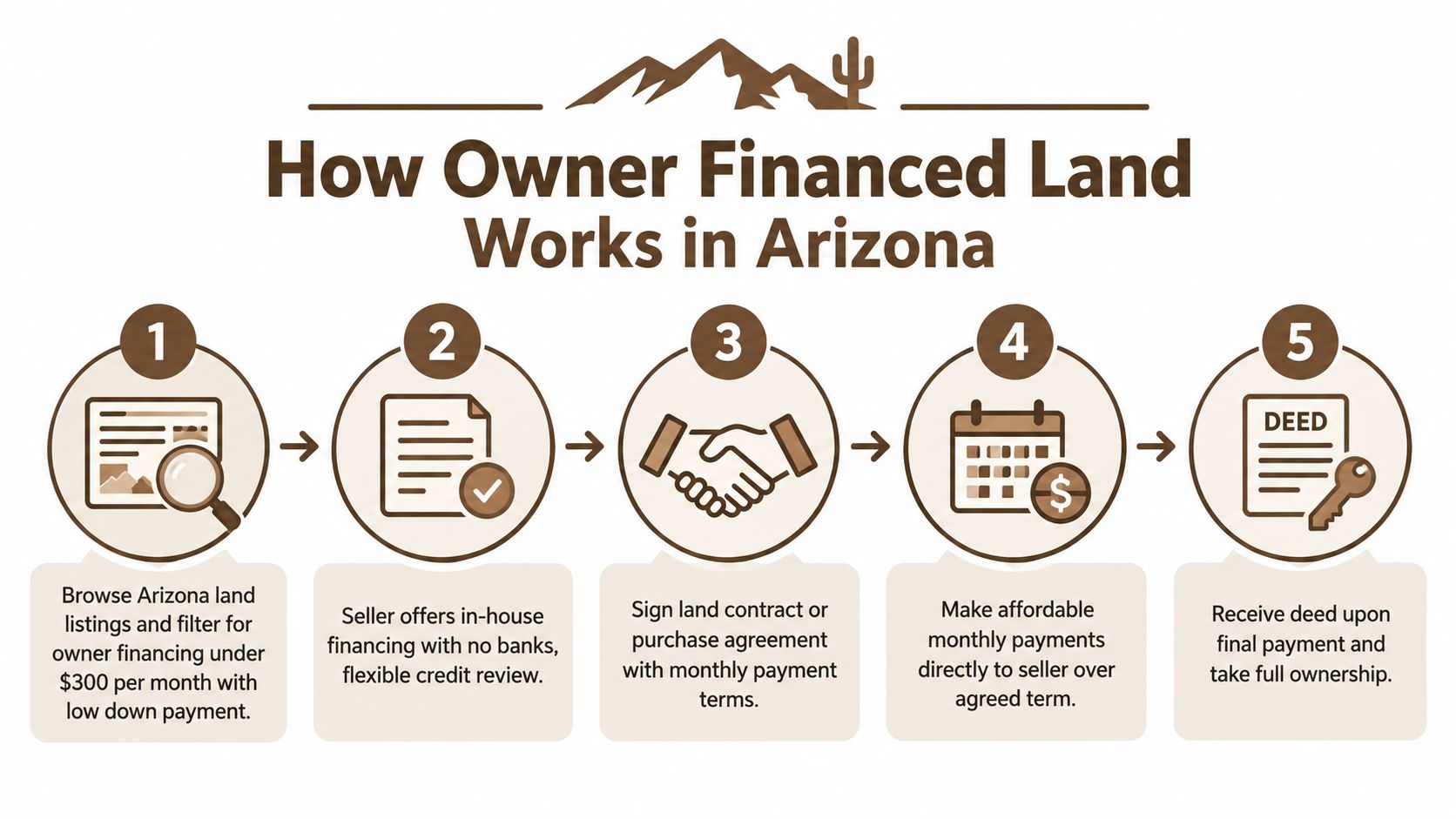
A typical purchase has several moving parts:
- Choose the parcel. Review the listing, maps, legal description, county information, and intended-use restrictions.
- Review the financing terms. Separate the cash price, down payment, document fee, monthly payment, interest, total financed cost, and any payoff or default provisions.
- Sign the required documents. Checkout starts the purchase process, but it doesn't by itself transfer ownership.
- Set up payments. Financed buyers must complete the required documents and establish payments through ZimpleMoney when that service applies.
- Track title and recording. Under some structures, the deed transfers at closing and the seller receives a security interest. Under others, the seller retains legal title until payoff.
Raw land doesn't behave like a house. A bank may have fewer comparable sales, no completed structure to appraise, and more uncertainty around access, water, utilities, and permitted use. That helps explain why seller financing is common for Arizona vacant land and why buyers must perform more of their own investigation.
You can start with Arizona acreage for sale, then move quickly from the advertised payment to the documents behind it. The deal becomes understandable once you identify the financing structure, confirm what gets recorded, and verify that the land fits your actual purpose.
Deed of Trust Versus Agreement for Sale
A seller's ad may show an affordable payment, but owner financing does not identify the legal structure. Before paying a deposit, read the document title and the clauses that control title, default, recording, and payoff. The same seller can use a deed of trust for one parcel and an Agreement for Sale for another.
The deed of trust route
With a deed of trust, the seller generally conveys the deed to the buyer. The buyer signs a promissory note, and the deed of trust secures that debt. To understand what a deed of trust does, focus on the parties' rights after closing. The trustee or beneficiary can enforce the security instrument if the buyer defaults.
Arizona law permits a trustee or beneficiary to begin a trustee's sale under A.R.S. § 33-807, subject to statutory requirements. The buyer usually holds a recorded ownership interest while the seller, or another beneficiary, holds a lien. The signed documents and applicable law determine notice requirements, cure rights, costs, deadlines, and other remedies.
The Agreement for Sale route
An Agreement for Sale works like a contract for deed. The seller keeps legal title while the buyer makes payments and receives the contractual or equitable benefits stated in the agreement. The buyer may have possession without holding a recorded deed.
If the buyer defaults, the seller may pursue forfeiture or other contractual remedies under the agreement and applicable law. That process differs from a trustee's sale against a deed already conveyed to the buyer. Arizona contract-for-deed guidance describes the mechanical difference: the seller retains title until the buyer completes the required payments. Treat possession and accumulated equity as contract rights until the documents confirm otherwise.
| Feature | Deed of Trust | Agreement for Sale |
|---|---|---|
| Legal title | Usually conveyed to the buyer, with the seller or beneficiary holding a security interest | Retained by the seller until the agreement's payoff and transfer conditions are satisfied |
| Buyer's protection | A recorded deed and lien structure can show ownership and security interests in county records | Protection depends heavily on the contract, recording, and any memorandum used |
| Default remedy | May involve a non-judicial trustee's sale | May involve forfeiture or contractual remedies rather than a trustee's sale |
| Refinancing | A lender can evaluate the recorded ownership and lien position | Refinancing can be more complicated while the seller retains title |
| Anti-deficiency analysis | Purchase-money and property-use rules can affect post-sale recovery | The remedy follows the contract and applicable law, but the buyer still needs legal advice on exposure |
| Records search | The deed and deed of trust should be identifiable in county records | The seller may remain the record owner unless the agreement or memorandum is recorded |
Before signing, request the complete agreement, every addendum, the promissory note if one exists, and any proposed deed or memorandum. Confirm who owns the land today, what will be recorded, who acts as trustee, and whether an Affidavit of Disclosure is included for the transaction. Do not rely on the listing's phrase “owner financing.”
The structure also changes your title-search results, your priority against later claims, and the difficulty of refinancing. A seller who will not provide the documents before you pay should lose the deal.
Typical Down Payments and Monthly Terms
Arizona listings show why owner financing attracts first-time land buyers. Recent examples include $100 down plus a $250 document fee, followed by $125 monthly payments for 72 months, while other listings show down payments around $500 to $2,500 and monthly payments of roughly $150 to $500. Those examples appear in Arizona owner-financing listings on Land.com, and they demonstrate the range, not a universal offer.
Some providers describe standard terms lasting 5 to 15 years and state that there's no prepayment penalty. Confirm those points in the property-specific agreement. A listing page isn't a substitute for the documents you'll sign.
| Price | Down Payment | Term | Approx. Rate | Est. Monthly |
|---|---|---|---|---|
| Listing-specific example | $100 plus a $250 document fee | 72 months | Not stated | $125 |
| Other advertised examples | $500 to $2,500 | Varies | Not stated | $150 to $500 |
| Longer-term provider examples | Varies | 5 to 15 years | Not stated | Varies |
Don't calculate affordability from the monthly figure alone. Ask for the total financed cost, including interest and disclosed fees, and determine whether the payment schedule has a final balloon balance. A low entry cost can make a parcel easier to buy, but it doesn't automatically make the transaction inexpensive.
Also separate the cash price from the financing terms. A down payment is not the purchase price. A document fee is not principal. A monthly payment may include principal and interest, but you should verify what the agreement says.
This guide to land down payments can help you frame the conversation, but the property-specific disclosures control. If the seller offers an eligible $1-down financing option, treat that as a financing down payment, not ownership for one dollar. Additional disclosed charges may apply, and monthly payments still follow.
Due Diligence Before You Sign
Treat due diligence as a purchase gate. If you can't confirm the land's legal access, permitted use, water situation, and title condition, you're not ready to sign, regardless of how attractive the monthly payment looks.
Start with the county, not the listing description. Pull the applicable zoning map and contact the planning department about your intended use. Rural, rural-residential, and single-family designations can impose different rules, and a parcel that looks suitable for an RV, manufactured home, or future residence may not permit that use.
Check the parcel as a real place
Use county mapping tools, satellite imagery, and available street-level imagery to inspect the surroundings. A visible dirt track isn't proof of legal access, and a road shown on a map isn't proof that you can drive it year-round. Look for a recorded ingress and egress easement, then confirm its location and practical condition.
Water requires the same discipline. Arizona's well and septic requirements can affect whether rural land is buildable. For a domestic well on a parcel of five or fewer acres, the required notice includes a site plan, parcel number, proposed well location, nearby septic information, and written approval from the county health authority that controls septic installations. Arizona also states that a well generally can't be drilled within 100 feet of a septic tank system or sewage disposal area unless the Director authorizes it in writing. Review the applicable rules through the Arizona well and septic permitting guide, then confirm the current requirements with the responsible county office.
Review documents before money moves
The land's price per acre tells you very little about usability. Values can range from roughly $100 to $2,500 per acre in parts of La Paz and Yuma to $5,000 to $20,000 or more near Maricopa's urban fringe, as described in Arizona land valuation guidance. That spread doesn't tell you whether a particular parcel has water, legal access, or building approval.
Read recorded covenants, conditions, restrictions, subdivision documents, and tax records. Confirm whether water rights are included or separate. Ask for the legal description, survey information if available, flood information, and a title report.
For certain rural transfers, Arizona law requires a written Affidavit of Disclosure. A seller of five or fewer parcels of land, other than subdivided land, in an unincorporated county area must provide the buyer with that affidavit at least seven days before transfer, and the buyer must acknowledge receipt under A.R.S. § 33-422. Get the completed document before you wire funds, then compare it with the agreement and your own county research.
Land due diligence guidance is useful as a checklist, but it doesn't replace verification with the county, utility provider, title company, or a qualified Arizona attorney.
Title, Liens, and the Trustee Sale Process
A seller's assurance that land is clean does not protect you. Title is your practical protection, so request a current preliminary title report or title commitment. Read every exception. “Deeded parcel” does not mean the property is free of liens or other claims.
Match the legal description in the purchase documents to the county assessor's parcel information. Search for unpaid property taxes, recorded deeds of trust, judgment liens, mechanic's liens, federal tax liens, easements, restrictions, and association claims. If a lien appears, require the title company to document the payoff or release plan before closing. Do not send money until you know how that claim will be cleared.
Recording changes your position
With a deed of trust, the deed and security documents should be recorded according to the transaction terms. Recording gives the public notice of the interests stated in those documents. With an Agreement for Sale, the seller may keep legal title. Recording a memorandum of the agreement can help establish the buyer's interest and priority against later purchasers or encumbrances. Ask the title company or Arizona counsel which document should be recorded and when.
The senior-lien issue requires direct answers. If the seller still owes money on an underlying loan and will collect your payments while paying that lender, request the balance, payment status, and written terms. Determine whether the arrangement is a wraparound. A senior lender's foreclosure can threaten your position even when you have paid the seller on time.
Arizona's non-judicial foreclosure process can move quickly. After default, the trustee or beneficiary may have a power of sale under the applicable statute. Practical underwriting often models a trustee sale around 90 days, rather than assuming a lengthy court case. The risk includes a senior lien holder enforcing its rights before you have a meaningful chance to protect your interest.
A trustee's sale also raises deficiency concerns. Arizona's deficiency statute generally gives the creditor 90 days to sue for a deficiency. If no action is filed during that period, the debt is deemed fully satisfied under A.R.S. § 33-814. Anti-deficiency rules may limit recovery for qualifying purchase-money loans secured by property of 2.5 acres or less used as a single one- or two-family dwelling. Intended use and future development therefore matter. Have an Arizona real-estate attorney review the structure if the collateral could become a residence.
Walking Through the Purchase Step by Step
An online purchase should still follow a careful real-estate workflow. The screen where you click checkout is the beginning of the process, not the moment ownership automatically changes hands.
Start with the property and disclosures
Select the parcel and review the listing information, maps, price, financing option, and applicable disclosures. Provide the required buyer information and confirm that the transaction is available under the seller's current process.
Next, read the Affidavit of Disclosure and the purchase agreement together. Confirm that the cash price, down payment, document fee, interest or finance charge, monthly payment, term, payoff provisions, and default language match what you understood. If the documents use an Agreement for Sale rather than a deed of trust, identify that before signing.
Sign, fund, and establish payments
Complete the required electronic documents through the seller's approved process. Keep copies of every signed document, receipt, disclosure, legal description, and payment confirmation in a separate folder.
For Dollar Land Store transactions, eligible buyers may choose Easy Financing or Cash where offered. Financed buyers must complete the required documents and set up payments through ZimpleMoney, as described in the company's financing information. Checkout begins the purchase process, but it doesn't itself complete the transaction or transfer ownership.
For financed purchases, Dollar Land Store retains legal title until payoff and completion of the deed-transfer requirements under the signed agreement. For cash purchases, deed preparation begins after payment clears, required documents are signed, and applicable requirements are completed. The seller prepares the deed packet, while the buyer ordinarily records the deed with the county.
Keep making payments through the approved servicing process and save confirmation records. Additional payments or early payoff may be allowed under the agreement, but verify the procedure rather than sending an unscheduled amount without instructions.
Mistakes First-Time Buyers Should Avoid
The most dangerous mistake is confusing a low monthly payment with a low-cost purchase. A payment can fit your budget while the total financed cost, interest, fees, taxes, road work, water planning, and future improvements make the parcel a poor fit. Run the full payment schedule and identify any balloon or final payoff requirement before you sign.
Five traps deserve a hard look
- Low down payment: A small upfront amount improves access, but it doesn't answer what you'll pay overall or how long the obligation lasts.
- Assumed land use: Camping, RV placement, building, wells, septic systems, farming, and subdivision require separate verification. Paying off the land doesn't automatically create those rights.
- Unclear access: A parcel can appear reachable while lacking a recorded easement or dependable route. Confirm legal access, not just a visible road.
- Unreviewed contract: Look for the financing structure, title provisions, payment dates, default remedies, payoff terms, recording duties, and disclosed charges.
- No exit plan: Decide whether you can hold the parcel, refinance, pay it off, or resell it under realistic market conditions. Don't base the plan on guaranteed appreciation or an effortless resale.
Anti-deficiency exposure is another issue buyers overlook. Arizona's rules can treat purchase-money loans differently from other debt, and protection may depend on acreage, dwelling use, and the way the transaction is structured. A future plan to build a house can change the legal analysis, so ask counsel before relying on assumptions about what happens after a trustee sale.
Finally, verify the seller and payment instructions independently. Obtain a current title commitment, confirm that the seller owns the parcel, and don't wire earnest money or a down payment to an account unless you've independently confirmed the instructions with the title officer or seller through a trusted phone number.
Dollar Land Store offers vacant Arizona land and eligible financing options that let buyers complete required documents online and manage payments through ZimpleMoney, without a traditional bank loan or credit check. Review the property details, confirm the parcel works for your intended use, and visit Dollar Land Store to browse current Arizona listings and compare cash and financing options.