


Vacant Land for Sale in Arizona: What to Check First
Ross AmatoYou've found a parcel with open views, a manageable payment, and a dirt road that seems to lead right to it. Vacant land for sale in Arizona can suit recreation, a long-term hold, or a future homesite, but the parcel you buy is a specific piece of ground, not the surrounding desert. Vacant means undeveloped, not necessarily ready to use.
Where Arizona Vacant Land Sits and How to Start
Start with the county, the parcel identification number, and your intended use, not just the photograph. For an initial search, use Dollar Land Store's Shop Arizona navigation and check current availability. Compare location and purchase options, then investigate whether the land can support your plans.
Arizona's size helps explain why rural listings can look so different from urban building lots. The U.S. Census Bureau records 113,653.42 square miles of land area in 2020. Within that expanse, privately deeded property sits alongside federal, state, tribal, and other land with different ownership and access rules.
A listing near public land or a trailhead doesn't establish permission to cross neighboring property. Nor does an attractive location establish building rights, water service, or lawful overnight use on the parcel.
Match the search to your purpose
First-time buyers, recreation seekers, long-term holders, and future-home planners can all evaluate rural land, but they need different answers. A remote holding might work for someone who doesn't need services soon. Someone planning a residence needs a much more complete development path.
Start with the use: Write down what you want to do, when you want to do it, and which approvals you need before spending money.
Say a buyer sees a road on a map and plans a weekend camp. Further investigation reveals that the route crosses private property without a recorded easement. The photograph wasn't the problem, the assumption was.
Arizona's growth adds context, not a parcel guarantee. The Census Bureau's Arizona state profile shows population rising from 2,718,215 in 1980 to 7,151,502 in 2020, including 11.9% growth from 2010 to 2020. More residents don't make an individual rural lot buildable or connected to infrastructure.
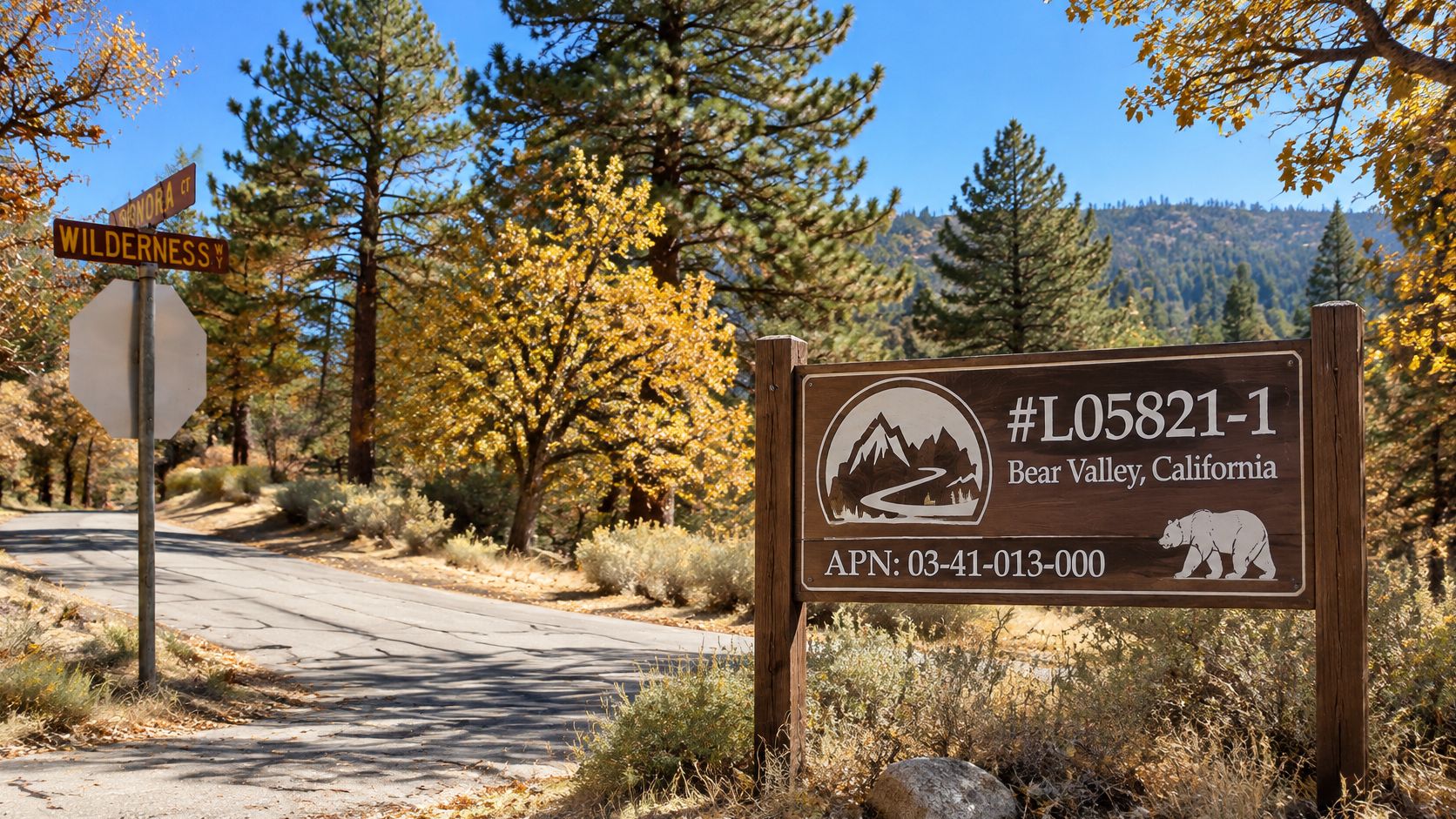
The image below depicts a California property, not Arizona inventory, and shouldn't be used to judge an Arizona parcel's terrain or improvements.
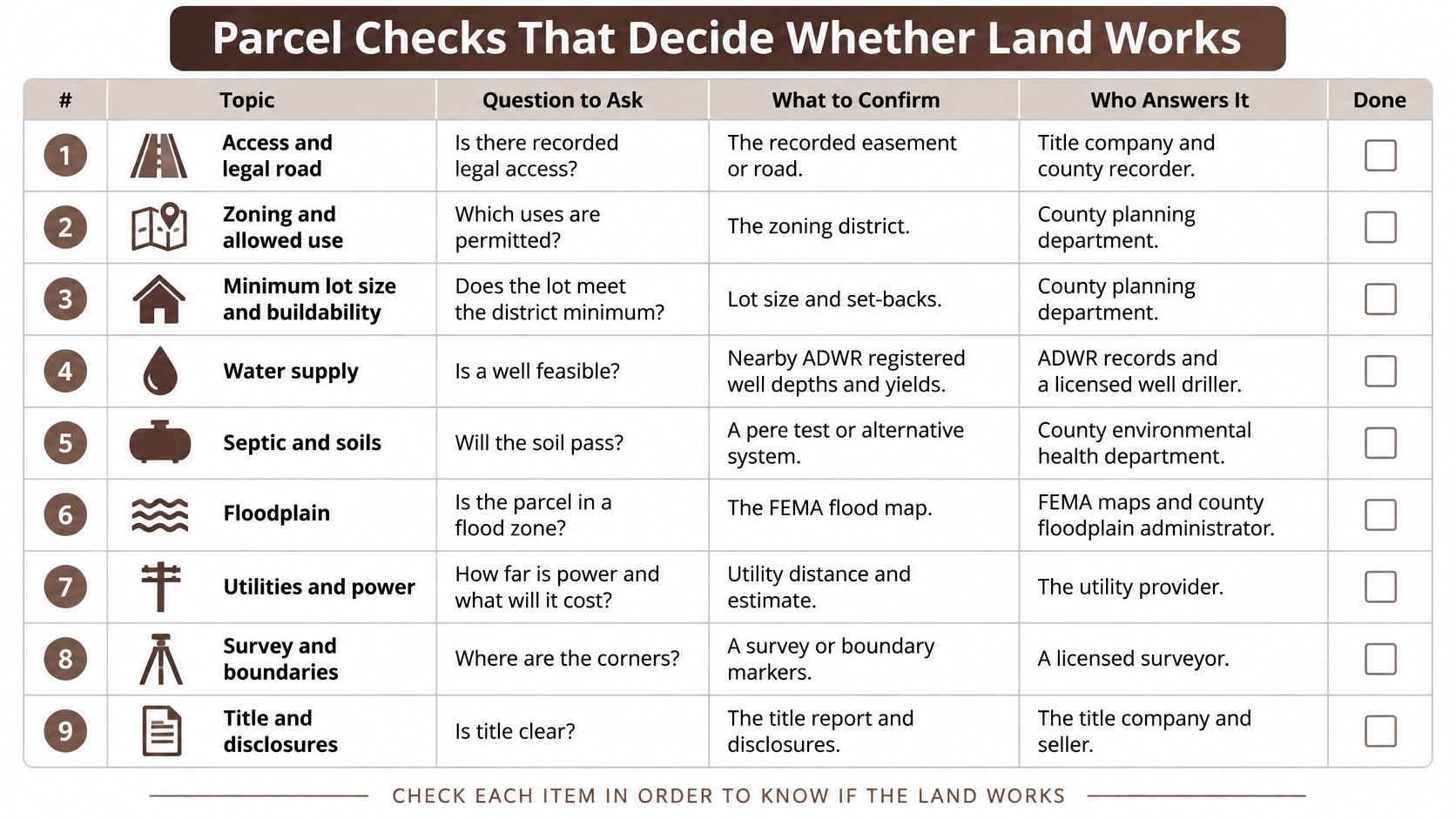
Parcel Checks That Decide Whether Land Works
Use this Arizona parcel checklist as a working file. Mark each answer confirmed in writing, unclear, or missing, and keep the supporting document beside it.
| Check | What to Confirm | Who Answers |
|---|---|---|
| Zoning and permitted use | Whether homes, RVs, camping, or structures are allowed, plus lot-size and setback requirements | County planning and zoning office |
| Legal access | A recorded road or easement, not just a road on a map | County recorder and assessor records, with title review |
| Physical access | Whether a vehicle can reach the parcel during your intended seasons | Site visit and listing maps |
| Utilities | Written availability and connection-cost estimates | Utility provider |
| Septic | Site testing and approval for the proposed use | County environmental health or septic permitting office |
| Water | Nearby well records, depths and yields, and the permit path | Arizona Department of Water Resources and county |
| Floodplain | Whether the parcel sits in a mapped flood or floodplain area | County floodplain office and FEMA maps |
| Survey | Recorded boundaries and whether a recent survey exists | Licensed surveyor |
| Property tax | Valuation and classification for the specific parcel | County assessor |
Separate documents from conditions on the ground
Legal access and physical access are different checks. A visible track may not carry a recorded right to cross another owner's land. Conversely, an easement may exist where the route needs grading, drainage work, or a permitted driveway connection before your vehicle can use it.
Ask for the recorded instrument and have its relationship to the parcel reviewed. On the visit, inspect washes, steep approaches, soft ground, gates, and places where storm runoff crosses the route. Don't treat a successful dry-weather drive as proof of dependable seasonal access.
Nearby power isn't an available connection. Ask the utility provider for written service availability, the proposed connection point, and an estimate identifying extension work. A pole visible from the property may serve another customer without offering a practical connection for yours.
Cochise County's buyer due-diligence guidance warns that nearby utilities don't guarantee availability or affordable connection, and septic approval requires site testing and regulatory approval. Its parcel-level approach also calls for checking zoning, access, terrain, environmental constraints, and floodplain status.
Make the site visit useful
Most of our vacant parcels may not have a recent survey unless explicitly stated. A mapped parcel isn't a surveyed parcel, and approximate GPS points, acreage, and distances aren't substitutes for established corners. Budget for a licensed surveyor when your plans depend on exact boundaries.
Many rural parcels can be inspected independently using listing maps and location information, provided access is lawful. Bring printed county records, save maps offline, and avoid crossing fences or neighboring land without permission. Our land due-diligence guide can help organize the documents.
Local procedures matter. Pinal County's utility and septic guidance directs owners of previously unserved land to the relevant utility provider and requires a septic permit with qualified site inspection where sewer service isn't available. Ask who supplies and extends infrastructure rather than assuming the county will do it.
Proceed only when your intended use has a documented zoning path, legal access, a wastewater solution, and a realistic utility plan.
Before scheduling the visit, ask county planning: Will this parcel allow the use I plan?
Well Water and Septic Rules That Limit Your Plans
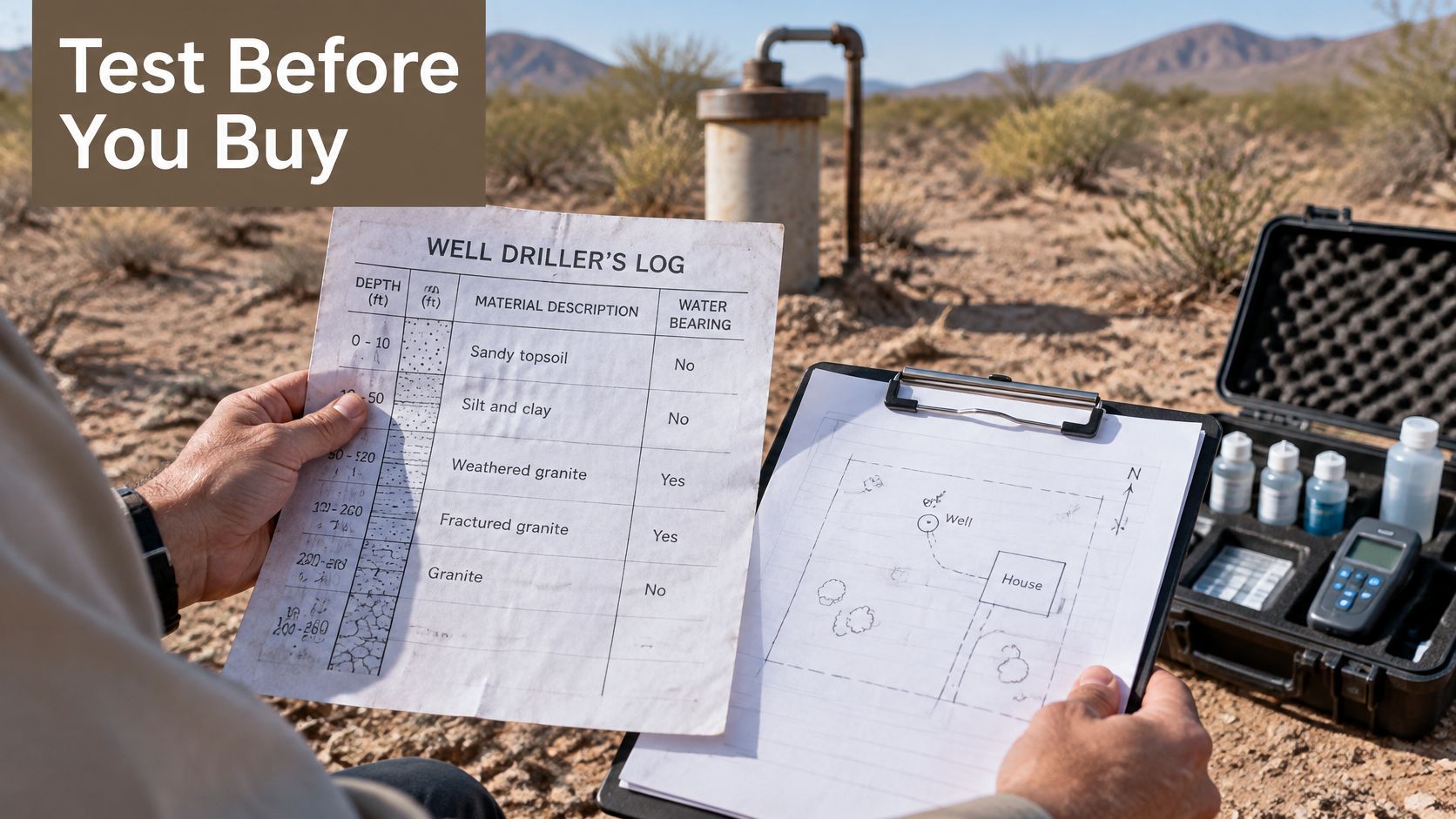
Water is a permitting and engineering question, not a reassuring label in a listing. A well shown on a map might be nearby rather than on the property, and its existence doesn't establish your drilling permission or dependable supply.
Work through the water screen in this order:
- Search registered wells. Review ADWR records for nearby depths, reported yields, and available well logs.
- Sketch the layout. Put the proposed well, wastewater system, access route, and improvements on the parcel map.
- Confirm setbacks. Obtain written confirmation that the proposed locations meet the applicable requirements.
- Price the uncertainty. Ask a licensed well contractor about drilling costs, access for equipment, and the risk of an inadequate result.
The Cochise County well guidance requires a proposed well location at least 5 feet from property lines and 100 feet from every septic-system component; it also describes county review for parcels of five acres or less and ADWR review above that size. New drilling, deepening, or modification requires an ADWR Notice of Intent to Drill and a licensed well contractor.
Check the parcel situation
| Situation | Review or Rule | Where to Check |
|---|---|---|
| Parcel of five acres or less, domestic well | County or local health authority review first, then ADWR | ADWR well-permitting FAQs |
| Parcel above five acres, Cochise County | ADWR review | ADWR |
| Exempt well pump | Pump may not exceed 35 gallons per minute; generally domestic, non-irrigation use | ADWR well terminology |
| Exempt well inside an Active Management Area | Non-irrigation uses other than domestic use or stock watering are capped at 10 acre-feet annually | ADWR |
| Exempt well used to grow crops | Generally cannot irrigate crops on two or more acres | ADWR |
| New exempt well near a designated provider's operating distribution system | Normally cannot be drilled within 100 feet unless a statutory exception applies | ADWR |
| Well and septic setbacks, Cochise County | Property-line and septic-component setbacks must be satisfied | County well-site review |
Groundwater rules are stricter inside Active Management Areas. Outside them, the Adequate Water Supply program applies when land is subdivided into more than five lots, as discussed in ADWR's water-policy information.
Wastewater needs its own approval. A composting toilet doesn't dispose of kitchen and sink wastewater, which may still require septic or another approved system. Use our water-rights explainer to frame your questions, then request parcel-specific well records, water-quality information, and written siting confirmation.
Owner Financing Costs and Use Limits Before Payoff
Compare the separate cost lines, not just the payment displayed most prominently.
| Cost Line | What It Covers | Where to Confirm |
|---|---|---|
| Cash price | Full listed cash purchase price of the parcel | Listing and checkout |
| Down payment | Initial financing payment; promotional down payments apply only to eligible properties | Checkout and signed agreement |
| Document fee | Separately disclosed document charge | Checkout |
| Monthly payment | Recurring agreement payment, using the method and schedule your documents specify | Agreement payment schedule |
| Total financed cost | All payments and disclosed charges over the full term | Signed agreement and disclosures |
An eligible $1-down offer describes a financing down payment, not the purchase price. Additional disclosed charges may apply, and monthly payments follow. A monthly figure includes taxes, servicing charges, and other obligations only where the documents explicitly say so, so read each line before you total anything.
Under our financing information, owner financing works without a traditional bank loan or credit check. Financed buyers sign the required purchase documents, and the agreement lists the payment method and schedule. Additional payments and early payoff follow the agreement's own terms. Review the owner-financing land terms before choosing a payment schedule.
Buying land isn't permission to move onto it
During financing, don't proceed with these activities without the written permission required by Dollar Land Store:
- Occupancy. Living on or otherwise occupying the parcel.
- Storage. Leaving belongings or an RV on the property.
- Development. Placing structures, building, or making improvements.
Limited recreational visits may be possible only where the agreement and local rules allow them. That's not a blanket camping right. Read the applicable terms and conditions alongside your transaction documents.
If your eventual goal is a barndominium, treat construction financing as a separate decision. BarndoBuilderList's explanation of barndominium down payment requirements can help you prepare questions about land equity and construction-loan cash requirements before you approach a lender.
Budget for holding the land
Property taxes are parcel-specific, so the purchase price alone won't tell you the annual bill. The assessor values and classifies property, taxing jurisdictions establish their budgets and rates, and the treasurer collects payment. Check the parcel's current tax records and any outstanding balances before committing.
Cochise County's assessor guidance classifies vacant land as legal class 2, assessed at 15% of full cash value. That assessment ratio is one input in the calculation, not the final tax rate.
Neither paying off the land nor securing a construction loan establishes permission for building, RV use, wells, septic, or subdivision. Those are separate land-use and feasibility questions, confirmed through the county and the relevant approvals rather than assumed as part of the purchase.
How to Close Your Arizona Land Purchase
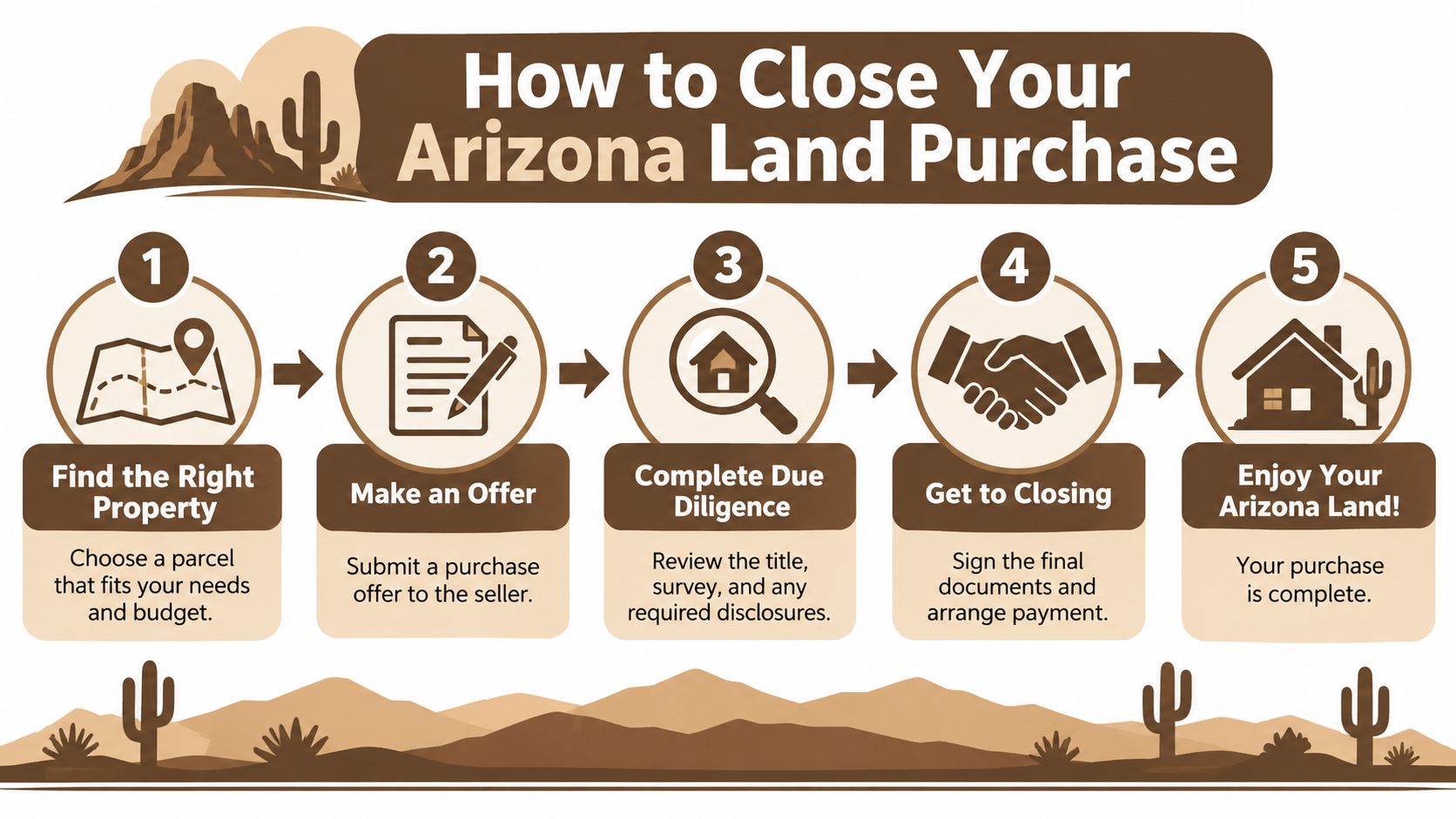
A clean purchase file connects the listing, your intended use, county answers, and the signed agreement. Keep those materials together so a missing approval doesn't get mistaken for a completed check.
Complete the purchase requirements
- Finish the parcel investigation. Get written answers for the activities you intend, including any required local permits. Resolve a missing answer before making a payment rather than planning to investigate afterward.
- Choose the purchase option your listing offers. Read the transaction disclosures and compare the complete obligation under each path. A financed purchase spreads cost into monthly payments; a cash purchase consolidates it. Compare totals, not a financing down payment against a cash purchase price.
- Begin checkout. Checkout begins the purchase; completion depends on the signed documents and payment that follow. The Buying Process page explains the stages so you can distinguish an order confirmation from the remaining requirements.
- Complete the documents and payment setup. Sign the required purchase documents and, for a financed purchase, finish ZimpleMoney setup. Review the parcel description and buyer information carefully before signing so discrepancies can be addressed.
- Make the applicable payments. Follow the transaction instructions for the down payment, document fee, or cash purchase payment. Your agreement specifies which amounts are refundable and under what conditions, so read those terms before paying rather than treating payment as your first due-diligence step.
Understand title and recording
- Meet the deed-transfer requirements. The transaction documents set the conditions for deed preparation: cleared payment, signed documents, and any remaining requirements. For financed purchases, your agreement states when title transfers relative to payoff, so confirm that timing in writing before you plan around a date.
- Handle the recording step. Recording the deed with the county puts the transfer on public record, and your agreement states who prepares the paperwork and who submits it. Use the deed-recording process guide to prepare questions, then confirm the recorder's submission requirements for the county where the property lies.
Keep the evidence: Save county emails, utility estimates, recorded access documents, signed purchase papers, and recording receipts in the same parcel file.
Before submitting a deed, check the names and legal description against the prepared transaction documents. Ask about anything that doesn't match rather than altering the deed yourself. Keep the county recorder's contact information and retain the returned recorded document.
Don't schedule contractors or a move around an assumed deed date. Checkout, payment, document completion, deed preparation, and recording are distinct events, and each one finishes on its own timeline.
Your signed agreement, transaction-specific documents, disclosures, and applicable law control the purchase. Written county answers support your land-use decision, but they don't replace the purchase requirements.
Confirm Your Parcel Before You Commit
Shortlist by intended use. Price comes second. A parcel earns your money when the written evidence supports your plan and the unresolved costs fit your budget. Treat "vacant" as the start of due diligence: a dirt trail across the lot is physical access, while recorded access is a separate question; a power line overhead is nearby power, while an available connection is a separate question; a well marked on a map is a location, while a permitted well is a separate approval.
- Future homesite. Proceed only with written zoning, legal-access, wastewater, utility, and water-path confirmation. Weigh lot size, setbacks, terrain, and floodplain constraints in that decision.
- RV or camping plans. Check the county's RV and camping rules before treating the parcel as a destination, and apply the occupancy and payoff limits set out in the owner financing terms.
- Off-grid improvements. Identify the permit for each proposed installation and secure the written seller permission required before improving a financed parcel.
- Investment holding. Rural acreage resells slowly and to a narrow buyer pool, so budget the carrying costs across a long hold instead of a quick exit.
- Regional recreation. Evaluate nearby public-land opportunities separately from permissions on your own parcel.
Choose one parcel to investigate
Our Arizona offerings include 20-acre listings near Joseph City and Holbrook in northeastern Arizona. Listing #L00334-1 is priced at $14,499.00, with an advertised monthly payment of $164.96 and owner financing available. Confirm current availability and the transaction disclosures; the monthly payment is only part of the total financed cost.
Compare candidates on acreage, location, and purchase options, then commit once the written answers support your plan. If a necessary answer stays unclear, pause or walk away, even when the photographs and the payment look right.
Dollar Land Store sells vacant land online, with cash purchases and owner financing where offered. Visit Dollar Land Store, open Shop Arizona, and check current availability to decide which single parcel earns your county calls and your down payment.