


How to Buy Hawaii Land for Sale Owner Financing
Ross AmatoThe usual advice to start with the lowest down payment gets Hawaii land buying backward. Hawaii land for sale with owner financing is a way to pay for a private vacant parcel over time, not proof that you can build, camp, or move onto it. Start with the lot's legal usability, then decide whether the payment fits.
A wooded parcel on Hawaii Island can look right and still leave unanswered questions about access, wastewater, or permitted use. The sensible purchase is the one that fits both your budget and a documented plan for the land.
What Hawaii Owner-Financed Land Is and Who Holds Title
Owner financing means the seller accepts installment payments under a purchase agreement rather than requiring you to obtain a traditional bank loan. The agreement determines your payment obligations and when title transfers. County approval of your intended use is a separate matter.
Your first job is to identify what ownership interest the seller can convey. For a fee-simple purchase, compare the deed, title report, legal description, and county assessor record. A leasehold interest, cooperative interest, Hawaiian Home Lands interest, or publicly owned parcel isn't interchangeable with privately transferable fee-simple land.
Why Hawaii's ownership pattern matters
The State of Hawaii's land-ownership reporting records approximately 1,590,061 acres in State of Hawaii system ownership statewide in 2022, including about 1,092,263 acres on Hawaii Island and 28,538 acres on Kahoolawe. Those holdings aren't ordinary retail inventory just because they appear on a land map.
Historical ownership figures in the state's archived land statistics reported federal ownership at about 8.6%, state ownership at about 38.4%, large private ownership at roughly 46%, and small landownership at under 7% in 1968, as summarized below. These are historical ownership measures, not counts of parcels available today.
Who holds Hawaii land and what a buyer should not assume
| Holder | Reported figure | Buyer should not assume |
|---|---|---|
| State of Hawaii system, 2022 | About 1,590,061 acres statewide | Public acreage is ordinary owner-financed inventory |
| State land on Hawaii Island, 2022 | About 1,092,263 acres | Large state holdings mean nearby lots are for sale |
| State holdings on Kahoolawe, 2022 | About 28,538 acres | Public island land is a source of private parcels |
| Federal land, 1968 | About 8.6% of statewide land | A federal parcel can be deeded by a private seller |
| State government, 1968 | About 38.4% of statewide land | Government ownership equals a fee-simple sale |
| Large private owners of 1,000+ acres, 1968 | About 46% | Private ownership means small lots are easy to find |
| Small landowners, 1968 | Under 7% | Small holdings are plentiful |
Match the seller to the documents
Ask a title professional to explain discrepancies between the seller's name, the recorded owner, and the proposed agreement. An assessor entry helps identify a property, but it isn't a substitute for reviewing title and recorded claims.
Family ownership deserves particular care when a divorce or disputed authority affects the proposed sale. Olson & Sons' resource on navigating marriage dissolution in Hawaii provides context for that situation; transaction-specific signing authority still needs professional confirmation.
Practical rule: Don't compare monthly payments until you know precisely which parcel and ownership interest the agreement covers.
Once the ownership question is clear, the next decision is whether that particular lot can support your intended use.
Checks That Decide Whether the Lot Is Usable
Before making a down payment, write down what you want to do with the property. “Buy Hawaii land” isn't specific enough. A future permitted dwelling, agricultural use, occasional recreation, and short-term accommodation each raise different questions.
Use the parcel's Tax Map Key, legal description, and recorded documents throughout your inquiries. Save written responses with the parcel identifier so you don't accidentally rely on advice about a neighboring lot.
Start with records, then ask use-specific questions
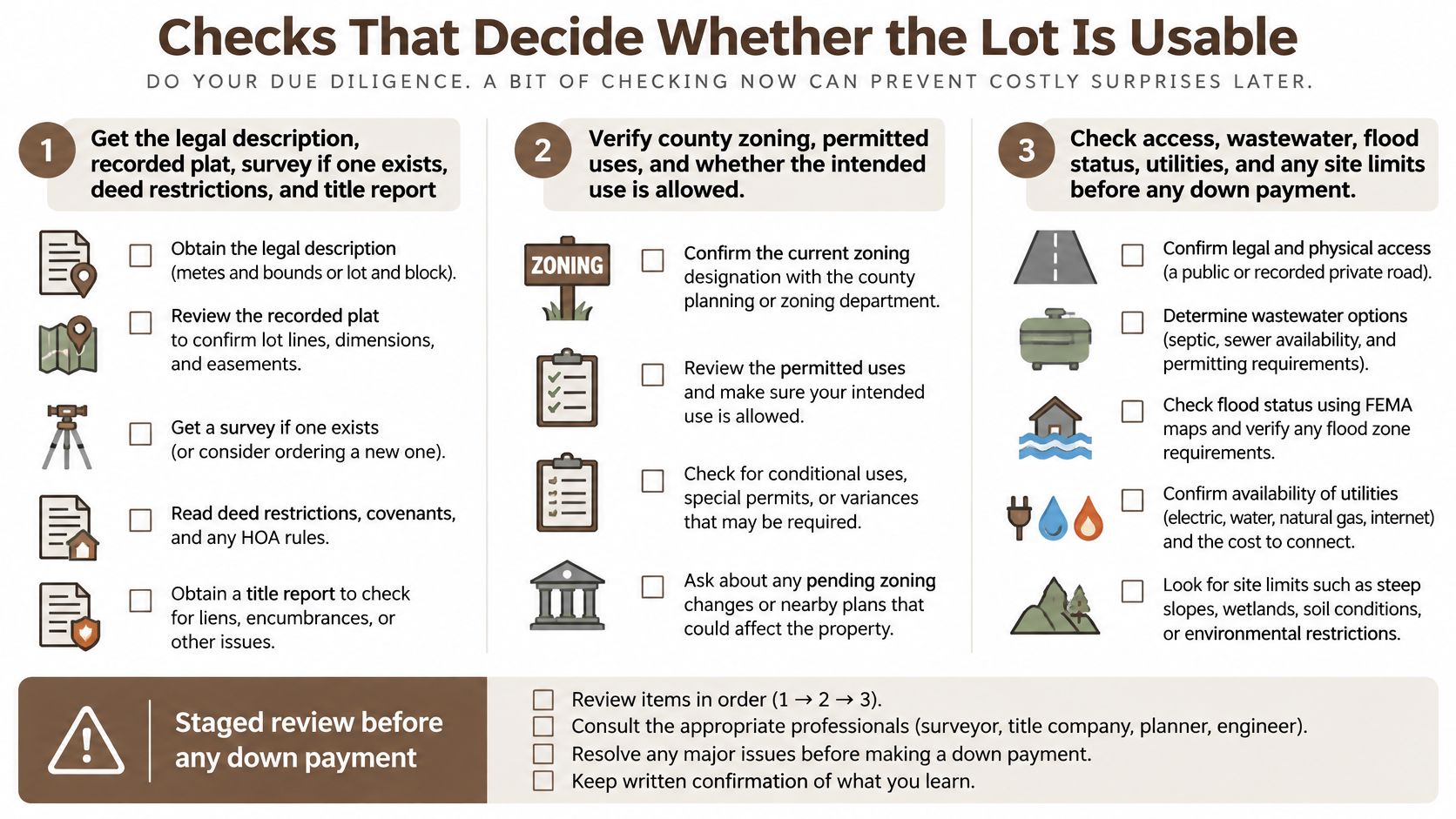
Hawaii's public-property due-diligence checklist calls for the legal description, survey or site plan, plat, zoning and density confirmation, deed restrictions, and other applicable restrictions. That's a useful starting framework for a private buyer, too.
- Collect the property file. Request the deed, recorded plat, survey if one exists, restrictions, and title report. Don't treat a subdivision map as proof that someone recently located the boundaries on the ground.
- Describe the intended use to planning staff. Ask Hawaii County about county zoning, the state land-use district, density, setbacks, and the parcel's legal development status. Ask what approvals your actual proposal would require, not just whether the zoning sounds residential.
- Test site feasibility. Review flood exposure, recorded access, physical road condition, water, electricity, and wastewater options. A favorable zoning answer doesn't settle these physical constraints.
- Resolve material uncertainties before signing. If an agreement will include title or governmental-use contingencies, have them written into the accepted documents. Don't assume you'll receive an investigation period after checkout.
The Honolulu zoning-verification process illustrates the specificity worth requesting: zoning designations, flood zones, development standards, legality of existing uses, and reconstruction eligibility. Honolulu isn't the authority for a Hawaii Island parcel, but its questions are more useful than a vague inquiry about buildability.
Scan the parcel without filling gaps with assumptions
Hawaii lot checks before owner financing
| Check | Where the answer lives | What does not count |
|---|---|---|
| Transferable fee title | Deed, title report, and assessor record | A leasehold, Hawaiian Home Lands interest, or public parcel |
| Zoning, density, and setbacks | Hawaii County planning records | A listing word such as residential, farm, or homesite |
| Flood exposure | County flood information in the permit or zoning file | A photo that looks dry |
| Legal access | Recorded easement or written county confirmation | A road line drawn on a map |
| Wastewater | Hawaii County rules for a non-sewered site, or sewer-connection rules | An assumption that a cabin can use an informal toilet |
| Utilities | The utility provider | Poles or pipes on a neighboring property |
For wastewater, ask a Hawaii-licensed civil engineer to evaluate the proposed dwelling and site before treating a non-sewered parcel as feasible. Ask the county whether an adjacent sewer creates a connection requirement. Get the applicable requirements and design path in writing rather than assuming that a smaller structure avoids the problem.
Water needs the same discipline. WhatsDemand's guide to understanding water delivery with WhatsDemand can help explain supply-system concepts, but only the relevant provider and permitting authorities can confirm a parcel's service options and acceptable installation.
For broader location context, use the guide to land in Hawaii alongside the actual parcel file, not instead of it. Regional descriptions help you narrow a search; they don't establish individual property rights.
Treat buildable as unproven until the written answers support your specific proposal. A failed wastewater or access check can matter more than a payment you can comfortably afford.
Permits and Site Work the Payment Does Not Cover
Say a parcel passes the initial records review, but the access needs work and there's no confirmed household water connection. You haven't found a bad parcel automatically. You've found a parcel whose acquisition budget and development budget need to be evaluated separately.
Most raw land doesn't arrive ready for your plans. Before committing, obtain scope-based estimates that identify both the work and the approvals needed to perform it.
Match the work to the responsible agency
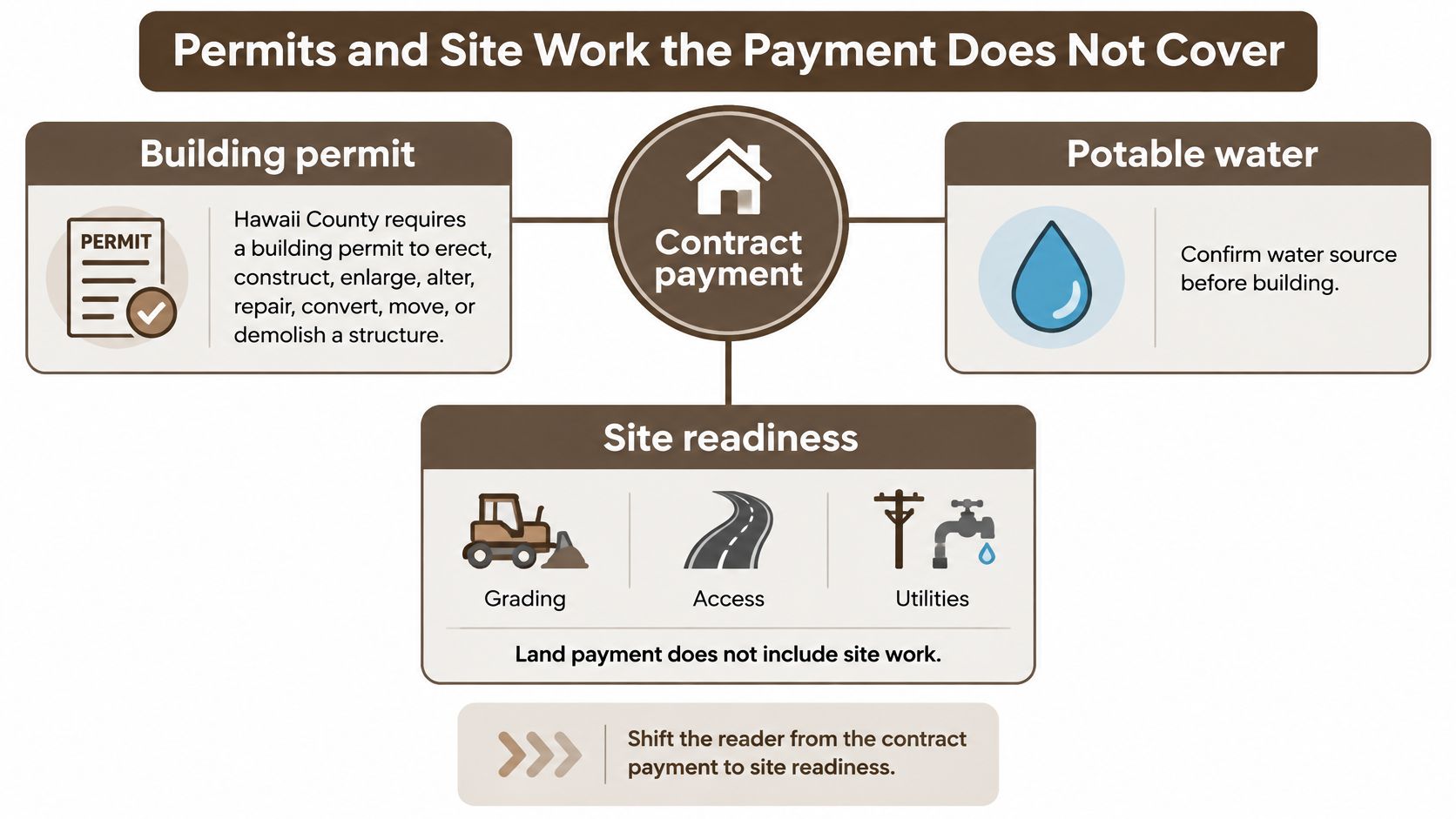
Hawaii County's building-permit guidance requires permits to erect, construct, enlarge, alter, repair, convert, move, or demolish a structure, and requires permits for potable household water tanks or catchment systems regardless of size. The guidance also explains that even when a small non-potable agricultural tank qualifies for a building-permit exemption, electrical or plumbing permits can still apply.
That distinction matters. An exemption for a particular tank isn't a general exemption for a water system, dwelling, or electrical installation.
For Hawaii Island property, start with Hawaii County. Other islands have their own agency workflows: Kauai separates work such as grading, grubbing, stockpiling, driveway approaches, flood-plain review, and water matters, while Honolulu applicants must account for relevant preliminary approvals and environmental review. Don't carry an answer from another county into a Hawaii County project.
A general building-permit requirements guide can help organize questions before contacting the officials responsible for the parcel.
Build a site-readiness budget
Ask contractors and designers to separate these items rather than giving you an unexplained package estimate:
- Survey and layout. Boundary work, proposed improvement locations, and any documents needed for design.
- Access and earthwork. Road-related work, driveway construction, drainage, clearing, and grading.
- Water and wastewater. A permitted water source or catchment arrangement and an approved wastewater solution.
- Power and approvals. Utility connection or solar design, professional services, and permit fees.
Keep acquisition payments outside that list. Unless the transaction documents expressly include improvements, an installment purchases the contractual interest in the land, not a finished road, water system, or construction approval.
Separate future plans from use during financing
During financing, don't live on or occupy the property, store belongings or an RV, place structures, build, or make improvements without the written permission required by the seller's agreement. County approval doesn't replace contractual permission, and seller permission doesn't replace county approval.
Limited recreational visits may be possible only when both the agreement and applicable local rules allow them. That isn't a blanket camping right.
Payoff and deed transfer also don't guarantee permission to build, camp, place an RV or mobile home, drill a well, install septic, farm, or subdivide. Each proposed use still has to meet applicable rules and the parcel's physical limitations.
The land payment covers acquisition. You still need a workable, permitted plan for reaching the site, supplying water, and handling waste.
Property Taxes That Sit Beside the Monthly Bill
A manageable installment doesn't make county property taxes disappear. Build your carrying-cost budget from the parcel's assessment record, not the seller's asking price or a neighboring owner's bill.
For Hawaii Island, start with the Hawaii County Real Property Tax Division: the county assesses real property using fair market value, and taxable real property is generally subject to tax on 100% of market value at the rate established by county ordinance. Review the parcel's current assessment, classification, balance, and payment history.
Compare the right county and classification
The published Honolulu tax-rate schedule lists $3.50 per $1,000 of net taxable value for residential property and $8.50 per $1,000 for vacant agricultural property. Those Honolulu rates do not apply to Hawaii Island parcels, and a listing's description doesn't establish its tax classification.
A Hawaii County audit report on property-tax collections states a late-payment penalty equal to 10% of net taxable value, with interest at 1% per month, or 12% annually. Because that stated penalty base is unusually large compared with a penalty calculated on unpaid tax, confirm the current legal calculation directly with the county before using it in a budget.
Hawaii tax items to verify against the assessment
| Item | Figure or rule | What to verify |
|---|---|---|
| Hawaii County assessment basis | 100% of fair market value at the county ordinance rate | The current assessment on the county record |
| Hawaii County late-payment penalty | 10% of net taxable value, per a county audit report | Confirm the amount and deadline with the county |
| Hawaii County late-payment interest | 1% per month, or 12% a year, per a county audit report | Confirm the calculation with the county |
| Honolulu residential rate | $3.50 per $1,000 of net taxable value | Applies only to Honolulu, not Hawaii Island |
| Honolulu vacant agricultural rate | $8.50 per $1,000 of net taxable value | Whether a parcel is actually in this class |
| Other Hawaii counties | County ordinance rate for the applicable property class | The ordinance rate for that county and class |
Keep separate payment calendars
A current ZimpleMoney account doesn't establish that the county tax bill has been paid. Read the agreement to determine who must pay the tax, whether any collection arrangement applies, and how the parties document payment.
Before signing, request the current tax statement and check for outstanding amounts. Put county deadlines in a calendar separate from the financing schedule, and retain receipts with the property file.
Use the vacant-land property-tax guide to organize those carrying-cost questions. Don't assume a tax bill will remain unchanged because the land remains vacant.
Income-tax treatment is another question entirely. Allied Tax Advisors' explanation of who qualifies for property tax deductions is a starting point for a discussion with your tax adviser, not a promise that your purchase produces a deduction.
Affordability means carrying the land while your plans are still on paper. If the installment leaves no room for taxes, professional review, and necessary maintenance, the budget needs work before the purchase does.
Structure Owner Finance Terms and Decide Whether to Proceed
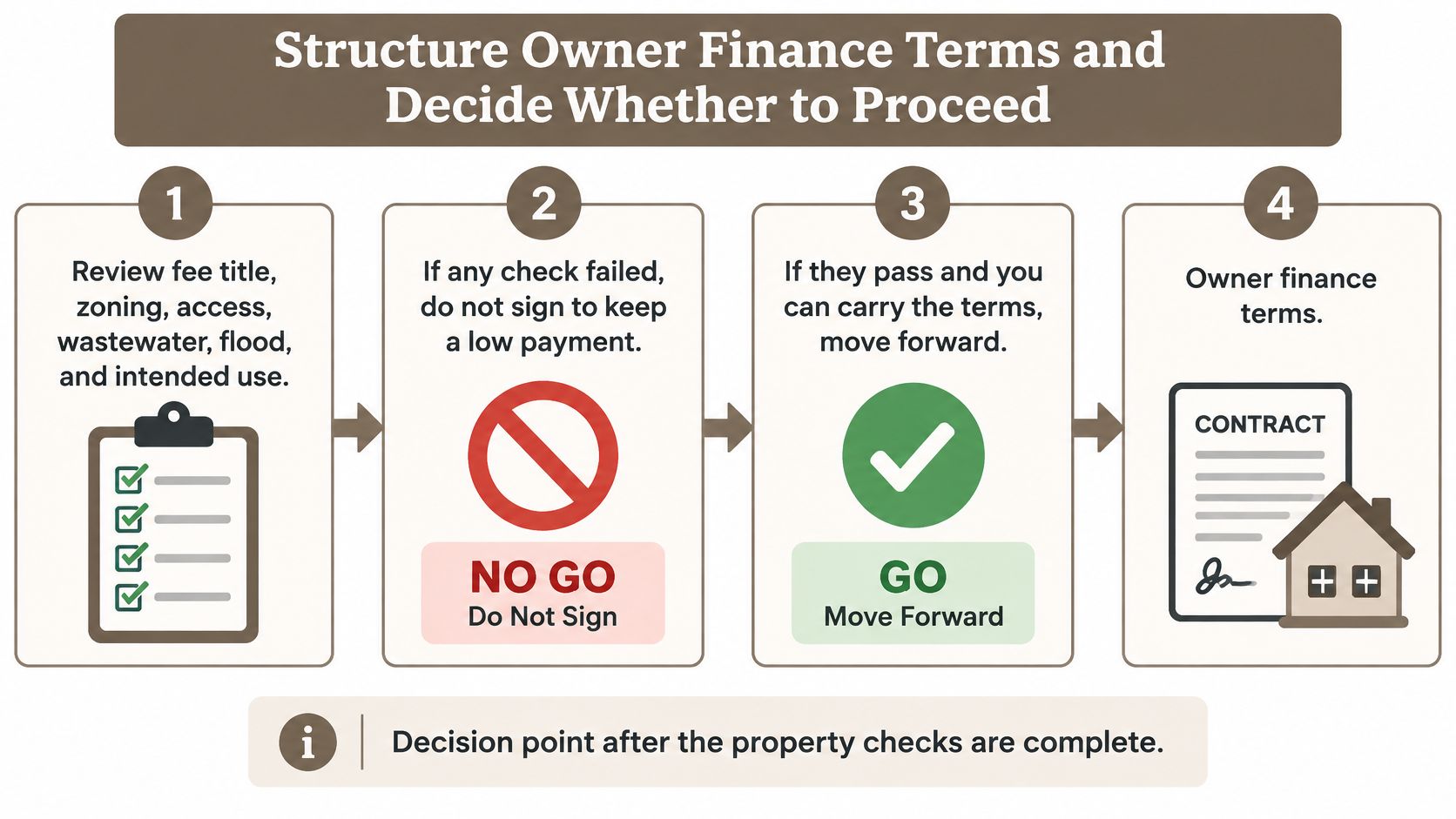
The decision should be straightforward even when the investigation takes effort. Proceed only when the property works for your documented purpose and you can carry the full obligation. Don't sign merely to preserve an attractive payment while hoping a material problem will resolve itself.
A missing answer isn't a passing answer. If legal access, title, wastewater, flood constraints, or intended-use permission remains unresolved, pause the purchase and identify who can supply the missing evidence.
Set a clear go or no-go standard
Use a short decision file rather than relying on memory. Keep the documents, written agency responses, contractor scopes, and proposed agreement together.
- Proceed. The records support the intended use, material restrictions are understood, and you can fund acquisition and carrying costs without assuming immediate development.
- Pause. A provider hasn't confirmed service, an engineer hasn't evaluated wastewater, or an access document needs interpretation.
- Decline. The intended use is prohibited, the seller can't establish the interest being sold, or essential site work exceeds your budget.
A parcel can be legitimate and still be wrong for you. Someone buying a long-term vacant holding may accept limitations that make the same lot unsuitable for a buyer planning a future dwelling.
Decision test: Would you still want this parcel if you evaluated the property first and saw the monthly payment last?
Keep the price components separate
Once the seller's current disclosures are available, distinguish cash price, down payment, document fee, monthly payment, and total financed cost. They answer different questions.
The down payment tells you what starts the financing arrangement. The monthly installment tells you the recurring payment obligation. Neither, by itself, tells you the total acquisition cost.
For eligible properties, a $1-down offer is a financing down payment, not the price of the land; additional disclosed charges may apply and monthly payments follow, as explained in the financing information. Don't assume that offer applies to every parcel.
Read the payment schedule for principal, interest where applicable, payment frequency, and any balloon obligation. Ask how additional payments and early payoff are applied under the agreement. Then compare the full contractual cost with the cash alternative and your independent assessment of the parcel's value.
The guide to owner-financing land terms can help you identify unfamiliar contract language. For transaction-specific questions, have a Hawaii real-estate attorney or title professional review the actual documents.
Hawaii's Division of Financial Institutions mortgage-origination guidance says residential mortgage-loan origination generally requires licensing unless an exemption applies. Don't infer from a vacant-land advertisement that every financing structure has the same legal treatment.
Reconcile the listing before checkout
Compare the displayed offer, checkout disclosures, and proposed agreement. If a product title, page text, or product address contains inconsistent pricing, use neither version until the seller confirms the current terms in writing.
Don't treat regional photographs as parcel photographs. Ask what each image represents, and use the legal description and confirmed boundaries to establish which land you're evaluating.
Check current availability before spending money on a particular offering. An old product page, search result, or saved screenshot doesn't establish that a Hawaii parcel remains available, and nearby rentals don't establish accommodation rights on the lot.
Understand what checkout starts
The Buying Process explains the online purchase steps. Checkout begins the purchase process; it doesn't, by itself, transfer ownership. Buyers must complete the required purchase documents, and financed buyers must also set up payments through ZimpleMoney.
The online seller's Easy Financing option, where offered, doesn't require a traditional bank loan or credit check. That removes a banking step, not your obligation to understand the property, sign documents, and meet the agreement's requirements.
For financed purchases, the seller retains legal title until payoff and completion of deed-transfer requirements. The seller prepares the deed packet, and the buyer ordinarily handles recording through the appropriate recording office. Confirm the correct Hawaii recording procedure rather than assuming another state's county process applies.
For cash purchases, deed preparation begins after payment clears, required documents are signed, and applicable requirements are completed. Neither payment method justifies assuming an immediate deed date.
Review the Terms and Conditions before committing. Amounts paid are generally non-refundable, subject to the signed agreement and applicable law, so finish due diligence before making a down payment.
The right purchase doesn't depend on a sales phrase. It rests on a traceable parcel, a use you can substantiate, and obligations you can meet comfortably.
Dollar Land Store sells vacant land online, with Cash and Easy Financing options where offered. Visit Dollar Land Store to check current availability, compare purchase options, and request the parcel details you need for a Hawaii County usability review before committing.