


How to Calculate Land Contract Payments: A Worked Example
Ross AmatoYou've found the parcel. It's cheap, it's deeded, the listing shows a monthly figure with a comma in it rather than a mortgage statement, and the down payment fits in this month's budget without touching savings. So you open the checkout page and hover over the button.
Stop there for an evening and work the numbers yourself. Not because the seller is hiding something, but because the monthly payment is the least complete number in the entire deal. It doesn't tell you what the land costs by the time you own it, how much is left if you want out early, or what you stand to lose if a payment slips. Those three numbers do, and you can calculate all of them with a calculator and a piece of paper.
Here's the method in one line: build the payment from four inputs, extend it into a schedule, add back everything the monthly figure leaves out, then test the total against what you own before the final payment.
Calculate Your Monthly Payment Step by Step
A land contract payment is the amortized payment on the balance you finance, not on the purchase price. Everything else follows from that one correction. Take the price, subtract the down payment, and you have the amount that earns interest. Then you need three more inputs: the annual rate, the term in years, and the payment frequency, which is almost always monthly.
Say a parcel is priced at $10,000 with $500 down at 8.99 percent over 15 years. That's a hypothetical, but the arithmetic is the same whether your listing is a fifth of an acre or twenty.
The five steps, with the reason for each
- Subtract the down payment to get the financed balance. $10,000 minus $500 leaves $9,500. Interest is charged on this number, never on the sticker price, which is why a bigger down payment shrinks every payment that follows.
- Divide the annual rate by 12 to get the monthly rate. 8.99 percent becomes about 0.007492. Rates are quoted per year and charged per month. Skipping this division is the most common error in the whole calculation, and it fails loudly.
- Multiply the term by 12 to count the payments. 15 years is 180 payments. Do this before you touch the formula, because the count drives the result more than the rate does.
- Run the amortization formula. Payment equals balance times monthly rate, divided by one minus (one plus monthly rate) raised to the negative power of the payment count. With these numbers: 9,500 × 0.007492 ÷ (1 - 1.007492^-180), which comes to about $96.30.
- Check the result against the total. 180 payments of $96.30 is $17,334. Subtract the $9,500 balance and you're paying $7,834 in interest. If that number surprises you, the payment was never the right thing to look at.
Check the rate first: feed 8.99 percent into the formula as if it were a monthly rate and you get a payment near $854 instead of $96.30 on the same $9,500. An error that large usually means the rate wasn't divided by 12.
The formula covers principal and interest only. Your actual payment may also carry a loan servicing fee and a prorated share of property taxes or association dues, so a contract figure above the formula isn't automatically wrong. Rounding differs too, by a few cents, and the signed agreement governs over anything you compute. If you want to see the same arithmetic laid out in a calculator interface, this mortgage payment calculator walkthrough from The Money Maniac shows exactly where each input goes. The formula doesn't change for vacant land, only the rate and term do. Since seller-financed rates move by listing, check current owner financing rates before you assume a figure.
The rate is half the trade-off. Term is the other half, and it's where a comfortable payment gets expensive.
| Term | Monthly payment | Total of payments | Total interest |
|---|---|---|---|
| 10 years (120 payments) | $120.30 | $14,436 | $4,936 |
| 15 years (180 payments) | $96.30 | $17,334 | $7,834 |
| 20 years (240 payments) | $85.42 | $20,501 | $11,001 |
Illustrative values on the same $9,500 balance at 8.99 percent; not a quoted offer.
The 20-year row drops the payment by about $11 and adds more than $3,000 of interest against the 15-year row. That's the trade you accept whenever a monthly figure feels easy.
Build an Amortization Schedule to See Each Payment
A payment is an average. A schedule is what happens. Each row starts with the balance you still owe, charges one month of interest on it, and assigns whatever is left of the payment to principal.
Walk month one on the $9,500 example. Multiply the balance by the monthly rate: 9,500 × 0.007492 is $71.17 of interest. Subtract that from the $96.30 payment and $25.13 goes to principal. The new balance is $9,474.87. Month two charges interest on the smaller balance, so interest dips to $70.98 and principal rises to $25.32. That's the whole mechanism: interest falls, principal climbs, slowly at first and fast near the end.
| Payment number | Payment | Interest | Principal | Remaining balance |
|---|---|---|---|---|
| Month 1 | $96.30 | $71.17 | $25.13 | $9,474.87 |
| Month 2 | $96.30 | $70.98 | $25.32 | $9,449.55 |
| Month 3 | $96.30 | $70.79 | $25.51 | $9,424.04 |
| Month 180 | $96.30 | $0.72 | $95.58 | $0.00 |
Read the schedule from the bottom up before you read it from the top. The balance column should reach exactly zero on the last scheduled payment. If the final row retires the contract with money still owed, that leftover is a balloon, and it's due in one lump.
The Detroit Land Contract Buyer Guide makes this the central warning in its payment discussion: a balloon can be hidden rather than labeled, implied whenever the purchase price exceeds the sum of the regular payments. A buyer can make every advertised monthly payment on time and still fail to finish the purchase, because the last obligation was never in the monthly figure.
Read the last row first. A schedule that lands on zero is a fully amortizing contract. A schedule that ends with a balance is a balloon contract wearing a small monthly payment.
The same table answers a second question. Any row's remaining balance is your payoff figure at that moment, which is the number you need before you plan to clear the land early.
Add the Costs the Monthly Payment Can Hide
Your true price is the down payment, plus every payment you will make, plus one-time fees, plus whatever taxes, association charges and recording costs you carry under the agreement. A buyer who only compares monthly figures will miss most of the line items below.
| Cost item | When it is paid | Inside the monthly payment? |
|---|---|---|
| Down payment | At purchase | No |
| Document fee | At checkout | No |
| Shipping fee | At checkout | No |
| Loan servicing fee | Monthly, for the full loan term | Yes |
| Property tax | Annually, under the agreement | Often, as a prorated share |
| Association (HOA or POA) fees | Per listing and agreement | Often, as a prorated amount |
| County recording fee | After payoff, when the deed is recorded | No |
Read your checkout summary line by line before you pay, and read the signed agreement for everything that isn't on it. Document and shipping fees, where charged, land at checkout. On lot L20149-1, for example, the total due today is $215.00: a $1.00 down payment, a $199.00 document fee and a $15.00 shipping fee. None of that sits in the monthly figure.
Taxes and dues work differently. During owner financing, Dollar Land Store generally pays the annual property taxes when they come due, and the buyer pays a prorated share, which may be collected as part of the monthly payment. You can see this in the financed plans on lot L20149-1, where each monthly figure already carries property tax of $15.74 and HOA fees of $4.17 as separate line items. Get the answer for your parcel in writing so the worksheet carries the right number. More on what to expect is in this breakdown of property taxes on vacant land.
One cost waits at the end. Unless the agreement states otherwise, the buyer records the deed with the county recorder's office and pays the county recording fees after payoff, so budget for it even though it never appears in a monthly line.
Run the total on the example. $500 down plus 180 payments of $96.30 plus a hypothetical $199 document fee comes to about $18,033 before any taxes, association charges or recording costs, against a $10,000 price. The gap between those two numbers is the financing cost, and it's the number to compare when you're deciding between two parcels.
Compare Regular, Extra and Early Payoff Paths
Three paths, same $9,500 balance, very different totals.
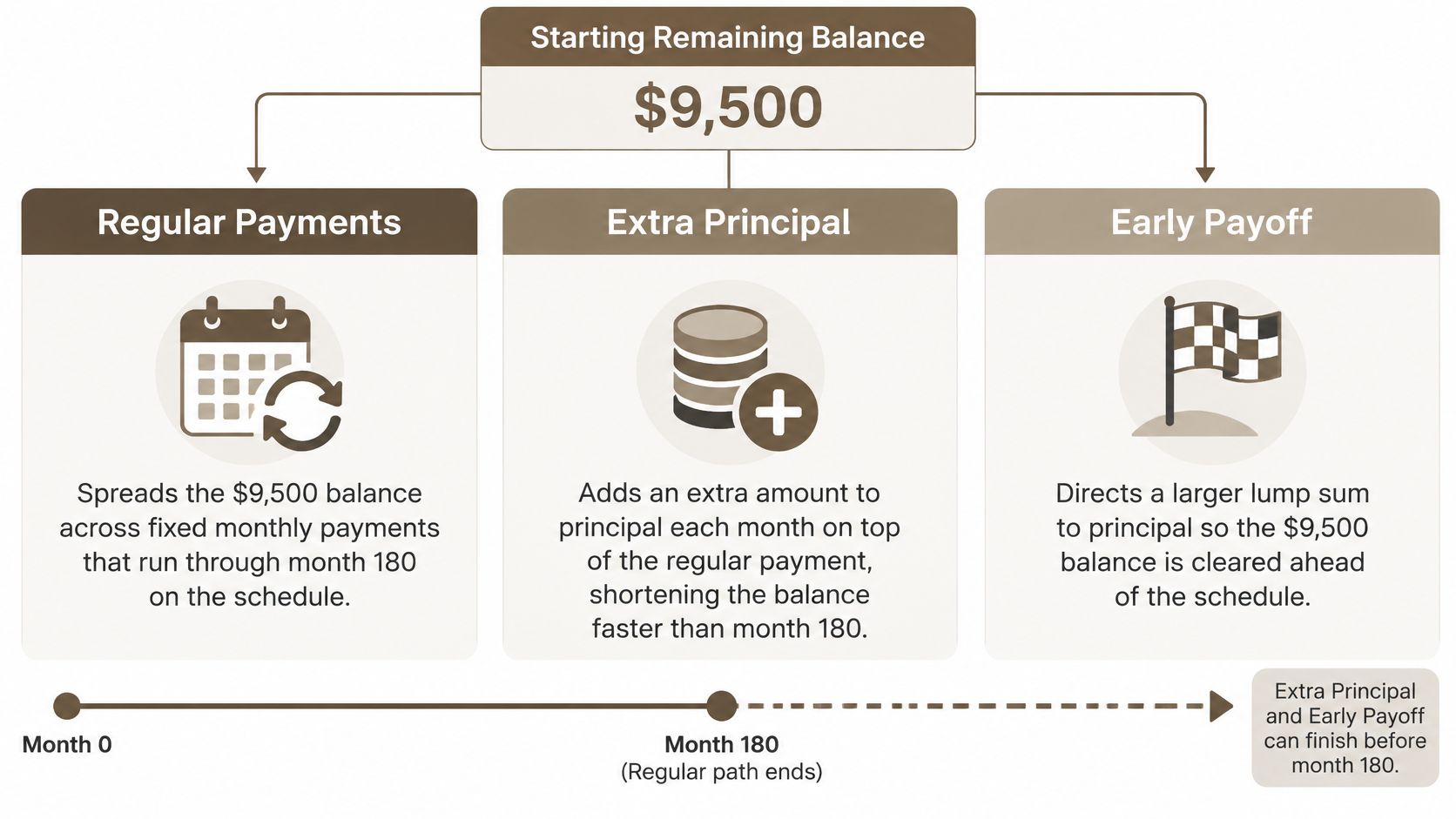
Run the comparison on total cost and remaining exposure side by side.
| Path | What you pay | Where the savings come from |
|---|---|---|
| Regular schedule | 180 payments of $96.30; about $17,334 total, $7,834 of it interest | None; this is the baseline |
| Extra principal | $96.30 plus a set extra each month, such as $25 | Each extra dollar retires principal that stops accruing interest |
| Early payoff | The remaining balance on the payoff month's row, plus any final charges the agreement lists | Every month of interest after the payoff date drops away |
The extra-principal path means rebuilding the schedule at that higher figure instead of guessing at the savings. The term shortens, total interest drops, and the earlier in the schedule you start, the bigger the effect.
Buyers may pay off their land early with no prepayment penalty under Dollar Land Store agreements, so clearing the balance ahead of schedule is an option you can use. The mechanics of doing it well are covered in these strategies to pay off a land loan faster.
Extra principal is worth more here than it would be on a bank loan. The Pew fact sheet on land contracts in Indiana reports that land contracts carried a median interest rate of 7 percent from 2005 through 2024, compared with 6.1 percent for mortgages. At a higher rate, every dollar of principal you retire early stops generating interest immediately.
Two questions decide whether the extra-principal path works as planned. Does an extra payment reduce principal directly, or does it get applied first to fees or past-due amounts? And does early payoff require notice or a minimum amount? For the payoff figure itself, read the remaining balance off the schedule's row for the payoff month, add any final charges the agreement lists, and confirm it against the payoff amount on the payment platform rather than your own arithmetic.
Check Ownership and Default Risk Before You Sign
The worksheet isn't finished until you know what you own while you're paying. In a financed purchase, the property stays in the seller's name during the term. Once the balance is paid in full, Dollar Land Store prepares the deed packet and the deed is recorded, transferring ownership to you. Until that day, you hold a contract right. Title arrives at payoff.
That changes what the payment buys. During the financing term the seller pays the annual property taxes as they come due, and you repay a prorated share, often collected inside the monthly payment. Association dues, maintenance, site work or insurance can sit on your side of the ledger too, so put each item on the worksheet next to the monthly figure and get every answer in writing. A verbal "that's included" will not help you at month 40.
Then ask what happens when a payment is late, and listen for specifics rather than reassurance. The stakes start early: if the first payment is not completed as required, the contract may be considered void and the account cancelled. Later payments deserve the same scrutiny.
- Cure period: how many days before a late payment becomes a default?
- Late charges: how much, and when do they start?
- Cancellation rights: what triggers them, and what notice do you get?
- Payments already made: are they credited to the balance or forfeited?
- Reinstatement: what exact amount puts a defaulted account back in good standing?
A lower payment bought by stretching the term is the same debt carried longer. Moving from the 10-year option at $243.82 a month to the 15-year option at $202.16 saves $41.66 a month and adds five more years in which a default could unwind everything you have paid.
One more question: can you exit cleanly? Transfers or assignments before payoff are considered only with written approval, and the original buyer is not released until the required transfer documents are completed and approved.
Run three checks before you sign: confirm what you own during the term, confirm which costs are yours while the seller holds the deed, and confirm exactly what a missed payment triggers. The full structure of these agreements is spelled out in the owner financing land terms.
Verify Each Number Before You Check Out
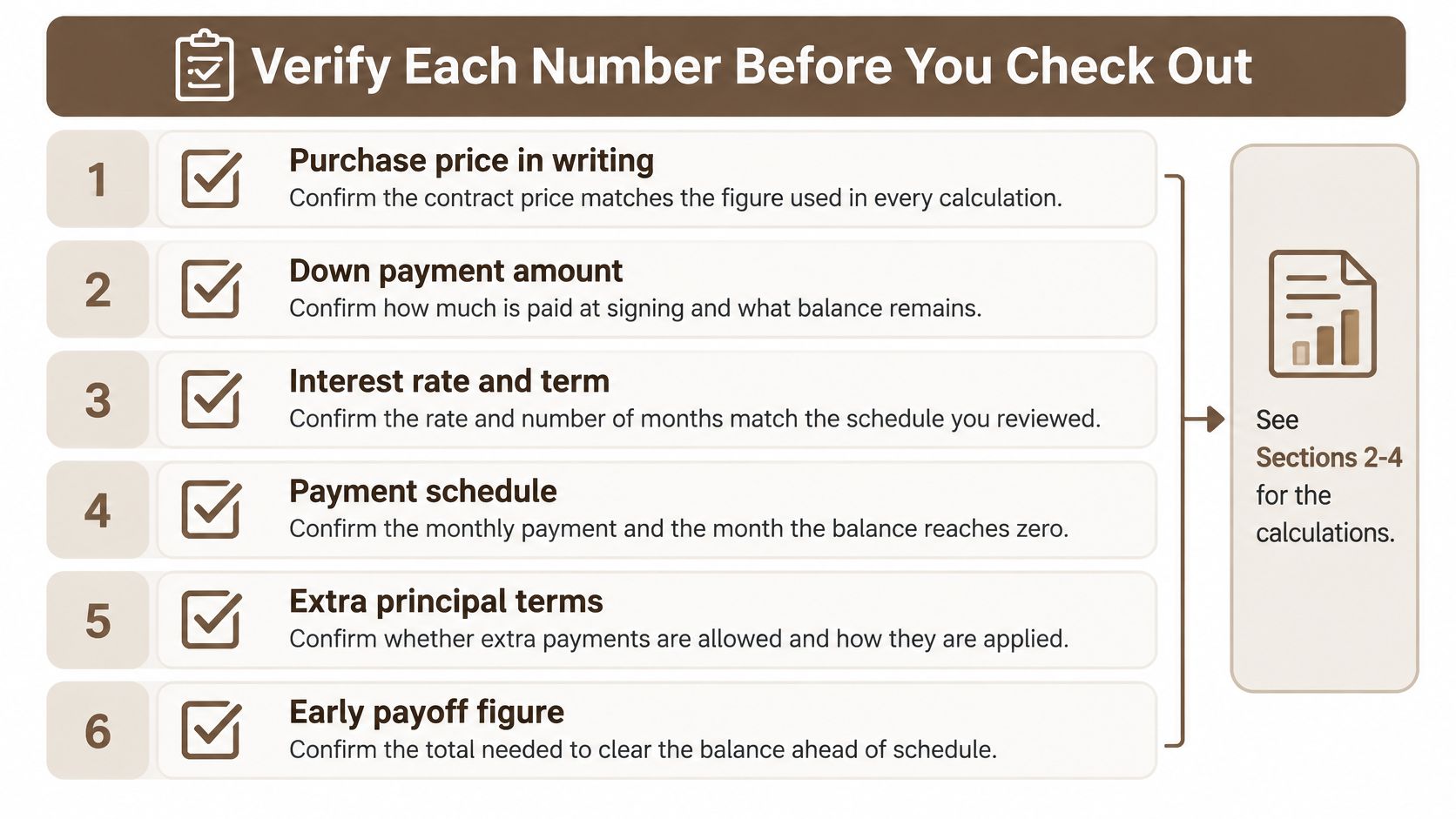
Your monthly figure can pass every calculation in this guide and still sit inside a bad contract. Verification means matching each number on the agreement to the math you already ran, then pinning down the terms a payment calculator never shows you.
Seven checks, each closing a specific gap:
- Purchase price in writing. Confirm the contract price matches the figure you used in every calculation, since a price that moves invalidates the whole schedule.
- Everything due today. Confirm the down payment and each signing charge, including the document fee and any shipping fee, then rebuild the financed balance from what remains after that total.
- The line-item breakdown. Get the monthly figure split in writing: principal and interest, the loan servicing fee, and any prorated property tax or association share collected with the payment.
- First payment date. Confirm exactly when the first installment falls due. The first monthly payment is generally due on the 1st of the month following the down payment when that down payment is made before the 28th of the month.
- First payment consequences. Ask what a failed first payment triggers. If it is not completed as required, the contract may be considered void and the account may be cancelled, which makes the start date as important as the amount.
- Assignment terms. Ask whether you can transfer or assign the contract before payoff. Dollar Land Store considers transfers only with written approval, and the original buyer is not released until the required transfer documents are completed and approved.
- One folder. Save the signed agreement, the payment schedule and the checkout summary together, so any later dispute has a paper trail.
If any answer is vague, treat it as unresolved and walk away from checkout. A low monthly figure built on a long term means a longer exposure and a larger final balance. Total cost, payoff exposure and ownership risk are the numbers worth comparing across parcels, and the monthly payment is only the entry point to all three.
Test a Real Payment Against a Current Listing
Run the whole method on a live listing: #L40047-1 2.06 Acres in Elko County, Nevada $5,999.00 ($78.41/ Month). The listing hands you two of the four inputs: the $5,999.00 price and the advertised $78.41 monthly figure.
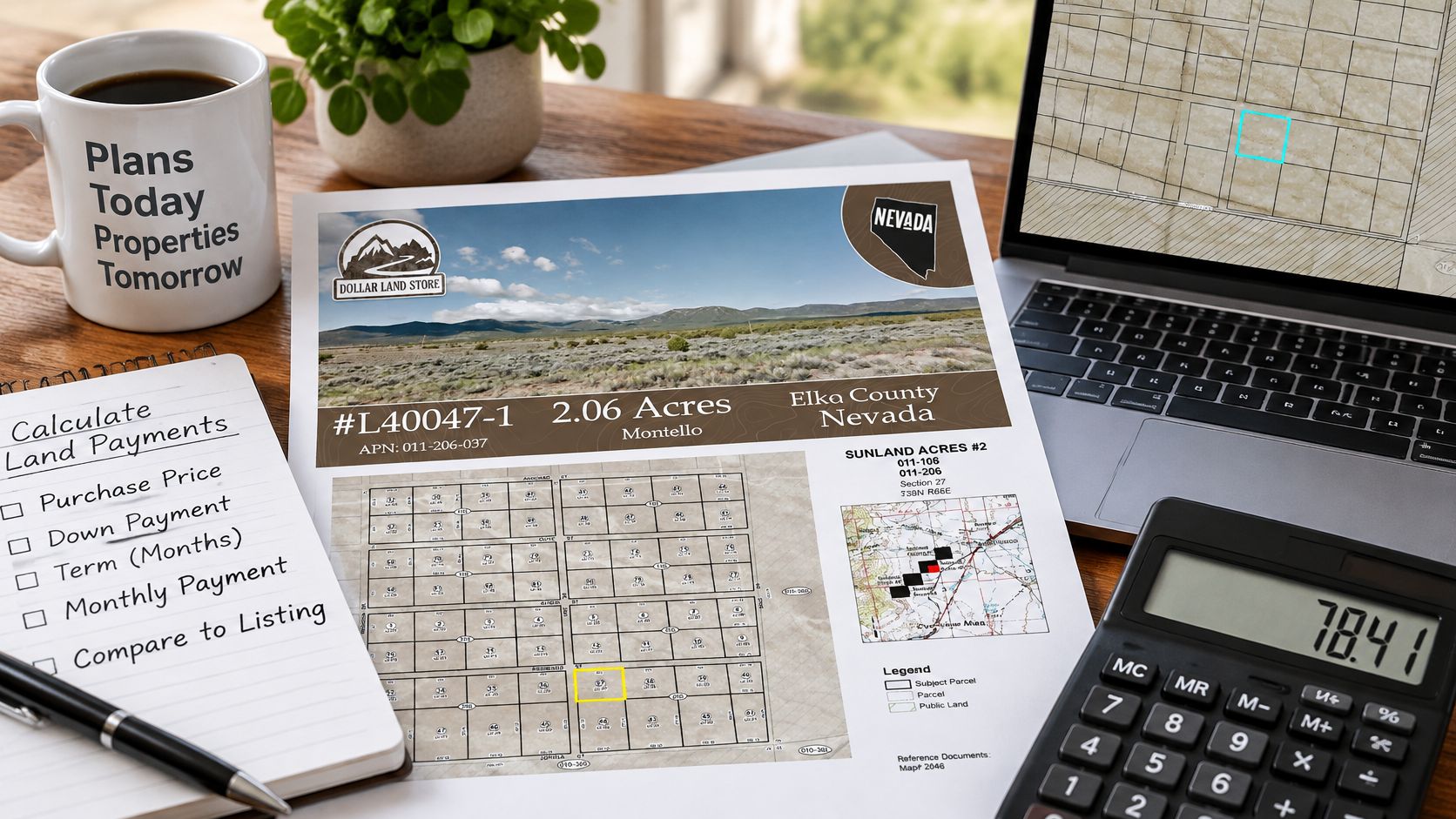
At $1 down plus the document fee shown at checkout, the financed balance starts at $5,998. Pull the interest rate and term from the financing terms at checkout, run the amortization on that balance, and your result should land within cents of $78.41. If your figure comes in lower, the listed payment may fold in a servicing fee or a prorated share of property tax beyond principal and interest. If it comes in higher, the rate or term you entered doesn't match the agreement. Then multiply the confirmed payment by the months in the term. That product is the true cost of the parcel, and it's the figure that tells you whether $78.41 a month is cheap.
Checkout starts the purchase; it doesn't transfer ownership by itself. Financed buyers sign the purchase documents electronically, then view the schedule and submit payments through ZimpleMoney. Here's how the buying process works from checkout to deed. The first monthly payment is generally due on the 1st of the month after your down payment when that payment lands before the 28th, and a first payment that isn't completed as required can leave the contract void and the account cancelled. Catch a bad number before that first debit, not after.
Check the parcel's current availability, then run this same test on any other listing you're weighing before you check out.
Dollar Land Store sells deeded vacant land across Arizona, California, Colorado, Hawaii, Nevada, New Mexico, Oregon and Utah, with owner financing on eligible properties starting at $1 down plus the document fee shown at checkout, then fixed monthly payments you can pay extra on or clear early without a prepayment penalty. You choose Easy Financing or Cash Purchase at checkout, sign your documents electronically, and manage payments online from there. Visit Dollar Land Store and run this calculation on a real parcel before you commit.