


Off Grid Land for Sale in California: A 2026 Guide
Ross AmatoOff-grid land for sale in California is widely available across inland and desert counties, but rules vary county by county. Most buyers verify zoning, water, septic, and access before purchasing because California has no single statewide ban on off-grid living.
You may be comparing a remote desert parcel with a mountain lot, looking at a low monthly payment, or wondering whether an empty parcel can support an RV, cabin, solar system, or future home. The central answer is simple: off-grid ownership can be possible, but the parcel's county, zoning, water source, wastewater options, legal access, and fire requirements determine what you can do.
What Off Grid Land in California Really Looks Like in 2026
A first-time buyer might spend an evening scrolling listings on a laptop, comparing a five-acre parcel in Modoc County with a quarter-acre lot in San Bernardino County. Both may be described as rural or off-grid, yet they can have very different development potential. The difference usually isn't the word “off-grid” in the listing. It's the local rulebook and the physical facts behind the parcel.
California has no single statewide ban on off-grid living. Counties and cities handle permitting and enforcement under statewide building and health rules, so legal occupancy depends heavily on local zoning, water, waste, and fire-safety approvals. Even a remote parcel may need approvals for a solar system, well, or septic system before officials consider it legally habitable. California's off-grid regulations are shaped by local permits and layered county rules.
What the inventory usually includes
Much of the market consists of raw, unimproved land in inland, mountain, and desert counties. A listing may show open ground, a road on a parcel map, and a proposed use, but not a house, utility connection, well, septic system, or finished driveway. That's why a low purchase price doesn't automatically mean low total cost or immediate occupancy.
The state's rural land base is large but under continuing pressure from conversion and development. State reporting identifies roughly 43 million acres used for agriculture, with about 24.2 to 24.5 million acres classified as farmland in more recent reporting, while earlier conversion reporting documented tens of thousands of acres moving to nonagricultural uses. California's farmland conversion reporting helps explain why usable rural acreage can feel both available and limited.
On day one, check four items before getting attached to a listing:
- County zoning: Ask whether the designation permits your intended use.
- Water source: Determine whether the parcel may use a well, hauled water, storage, or another approved source.
- Legal access: Confirm a public road connection or recorded easement, not just a line drawn on a map.
- Camping rules: Find out whether temporary camping, RV stays, or vehicle occupancy is allowed.
For a different California land setting, you can compare the practical considerations in this guide to coastal land for sale in Northern California. The same state contains very different county decisions, road conditions, climates, and development constraints.
Plain English Definition of Off Grid and Vacant Land
Off-grid land is land where the owner handles essential services independently instead of connecting to a municipal water, sewer, or electric system. Power may come from solar and batteries. Water may come from a permitted well, storage, or hauling. Wastewater may require an onsite septic system. Those are possible approaches, not automatic rights attached to every parcel.
Vacant land means the parcel doesn't currently contain a completed home. It may also lack a cabin, well, septic system, driveway, power line, or other infrastructure. Think of it as an empty canvas, but one with planning rules, physical boundaries, and recorded obligations.
Parcel, property, and home are different
A parcel is a defined piece of ground identified by boundaries and a county assessor's parcel number, often called an APN. A deed identifies ownership, while the county's records connect that ownership to the parcel. The APN doesn't prove that the land is buildable, has water, or has legal access. It helps you locate and research the property.
Off-grid describes how you may want to operate on the land. It doesn't change the land's zoning. A rural residential parcel may still need permits for a dwelling, septic system, well, solar array, or driveway. An agricultural parcel may have additional use restrictions. A remote desert parcel may have no nearby utility lines but still be subject to county camping and sanitation rules.
California parcels can sit in rural subdivisions, unincorporated county areas, or remote desert tracts. The county's rules matter more than the label “California off-grid land.” For practical ideas about handling hot water and daily utilities away from municipal systems, going off-grid with boiling taps can provide useful general background, but it doesn't replace county verification.
You can also review what off-grid living means before deciding whether you're looking for recreational land, a future homesite, or a place for a permitted dwelling.
Where Off Grid Parcels Are Found Across California
Off-grid listings tend to appear more often in inland and desert counties than in dense coastal markets. Northern examples include Modoc, Lassen, Siskiyou, Shasta, and Tehama. Southern options include Inyo, Kern, San Bernardino, Riverside, and Imperial. Buyers also look in the western Sierra foothills, including Mariposa, Tuolumne, and Calaveras.
These regions aren't interchangeable. A high-desert parcel may have strong sun exposure but limited groundwater and intense heat. A mountain parcel may offer more vegetation and a different water profile but create steep-road, snow, or wildfire questions. A foothill parcel may sit closer to services while facing more demanding fire-safety conditions.
Why county names matter
California's rules form a patchwork of local decisions. County planning departments interpret zoning, environmental health departments review wells and septic systems, and local officials enforce camping, building, and occupancy requirements. Cities may add another layer when land sits inside an incorporated boundary.
That local variation affects both the buyer's plans and the parcel's practical value. The same acreage can have different minimum lot-size rules, use restrictions, septic feasibility, or temporary occupancy rules depending on its jurisdiction. California's rural land market has developed through decades of county planning, statewide building standards, and environmental regulation, rather than one statewide off-grid category.
How to read a listing
Start with the listing facts, then verify each one through county records:
| Listing detail | Why it matters |
|---|---|
| APN | Lets you search county maps, planning records, taxes, and parcel information |
| Acreage | May affect zoning, camping eligibility, setbacks, and potential uses |
| County and city status | Shows which local government may control planning and enforcement |
| Road description | Helps you investigate public frontage, private roads, and easements |
| Power and water notes | Indicates what the seller says, but doesn't prove utility availability |
| HOA, POA, or CC&Rs | May limit structures, camping, vehicles, or other uses |
Treat phrases such as “unrestricted,” “off-grid,” or “buildable” as prompts for research, not conclusions. Requirements vary by county, and buyers should independently verify current requirements before signing.
Zoning, Water, Septic, and Access Explained
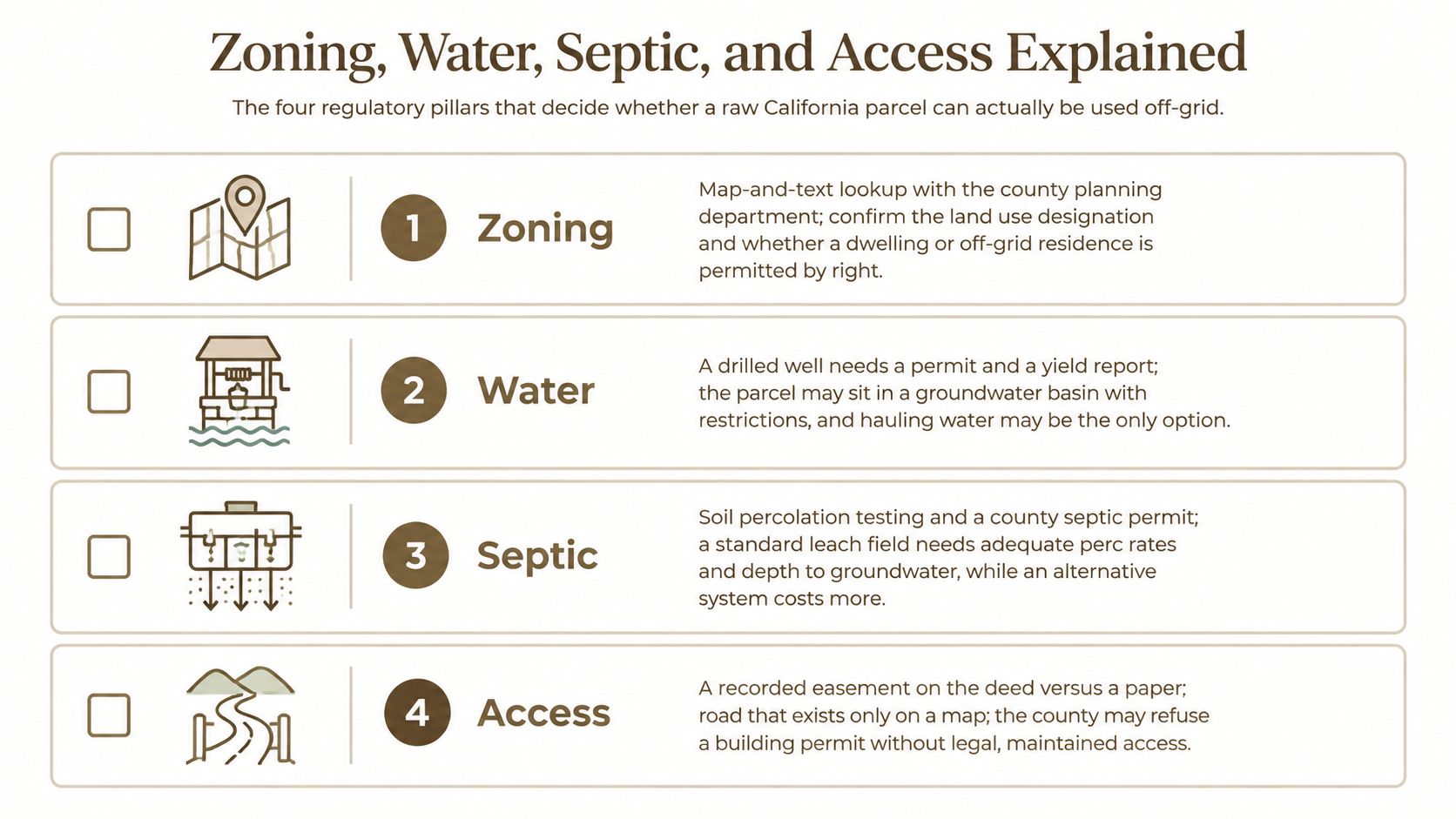
A raw parcel becomes practically useful only when four questions line up: What may be done there? Where will water come from? How will wastewater be handled? Can you legally and physically reach the property?
Zoning comes first
Zoning is the county's land-use rule for the parcel. Rural land may carry an agricultural, rural residential, resource, or similar designation, but the label alone doesn't tell you whether a dwelling, cabin, manufactured home, RV, agricultural structure, or solar installation is allowed.
Ask the planning department for the parcel's exact zoning code and permitted-use table. Confirm whether your intended use is allowed by right, requires a conditional approval, or isn't allowed. Minimum lot size, setbacks, fire access, slope, and environmental overlays may also affect the answer. A plain-English overview of residential zoning can help you understand the terminology before calling the county.
Water is a site question
A parcel inside a water district may have a different process from one that relies on a private well. For a well, investigate the county's permit requirements, nearby well records, local hydrogeology, and whether groundwater restrictions apply. A well isn't guaranteed because neighboring land has one.
California requires county well standards to meet or exceed state Bulletin 74 requirements. Well completion reports must be filed with the Department of Water Resources within 60 days, according to California off-grid water guidance. If groundwater isn't available or protected, you may need hauled water and storage, which changes both operating costs and daily logistics.
Septic determines whether wastewater can be managed
The State Water Resources Control Board regulates septic discharges statewide, while county environmental health departments handle the local approval path. A soil and site evaluation before purchase can show whether a standard onsite wastewater system is feasible.
A passing percolation or soil test may support a standard system. Poor permeability, shallow groundwater, limited setbacks, or difficult terrain may require an engineered design or make full-time occupancy impractical. California septic guidance for off-grid parcels explains why wastewater feasibility should be checked before you close, not after you buy.
Access is more than a visible road
A road can appear on a map without giving you a usable legal route. Review the deed, title documents, subdivision map, and any recorded easement. Then inspect the route itself, including gates, steep grades, seasonal conditions, maintenance responsibilities, and emergency access.
A paved county road and a rough two-track associated with federal land are not equivalent. A building department may ask for legal, maintained access before issuing permits. Don't assume a seller's description proves access, and don't assume a road that reaches the parcel is publicly maintained.
Practical rule: Verify the four pillars with the county and recorded documents before treating a raw parcel as a homesite.
Camping, RVs, Cabins, and Solar on Raw Land
The phrase “use it for camping” sounds simple, but counties often distinguish between temporary recreation and residential occupancy. An owner may be allowed to camp for a defined period in one rural zoning district and prohibited from camping entirely in another. RV use can create another layer when someone sleeps in the vehicle, connects utilities, or remains on the property beyond a temporary stay.
Santa Cruz County offers a clear example. In designated no-camping zones, camping on certain vacant residential parcels is prohibited because of health, sanitation, and fire-safety concerns. The county also says vacant-parcel camping, living in vehicles, tents, yurts, tiny homes, and other non-code-compliant structures isn't allowed under its policy. Santa Cruz County's vacant residential parcel rules also address electric service, including a maximum 125-amp service on some vacant parcels for well-water use, and require a recorded Declaration of Restrictions before zoning approval of an electric permit application.
County examples show why assumptions fail
San Bernardino County permits certain recreational camping uses on properties of five acres or larger in specific rural zoning districts. An existing recreational cabin may be occupied for no more than 14 consecutive days in a 30-day period, while a temporary structure may be used for no more than four consecutive days in a 30-day period, subject to the county's stated conditions. San Bernardino County's code is the controlling reference for that example.
Plumas County takes a different approach. It allows camping on private land for no more than 120 days in a calendar year when health rules are met and the owner agrees. After 17 consecutive days, proper health and sanitation are required, such as RV hookups for well and septic. The county also bans camping in several residential and commercial zones while allowing it in specified rural, agricultural, forest, and industrial zones. Plumas County's camping FAQ demonstrates how much the answer can change by jurisdiction.
Permanent improvements need their own review
A cabin or tiny home isn't automatically legal because it's small. Permanent structures generally require building approval, and occupancy usually depends on code-compliant water and wastewater systems. Fire access, setbacks, foundation requirements, and local zoning can all affect the outcome.
Solar can be a practical off-grid power option, but a ground-mounted array may still need review for setbacks, easements, fire access, grading, and HOA or CC&R restrictions. For vehicle-based systems, you can find solar setups for vans, then separately confirm what the county allows on the parcel. Additional off-grid power considerations are covered in off-grid power guidance.
Seller Financing, $1 Down, and How the Deed Works
Seller financing means the seller accepts payments over time instead of requiring the buyer to pay the full purchase price at closing. The buyer usually provides a down payment, signs a land contract or installment sale agreement, and makes scheduled payments that may include principal and interest. The exact rate, term, fees, payment amount, and property eligibility vary by agreement and parcel.
A common structure marketed by land sellers is $1 down, plus applicable document or transaction fees. That phrase describes the initial amount needed to begin a particular contract. It doesn't mean the land is free, that every buyer receives identical terms, or that the buyer can skip the contract review.
What happens after the initial payment
The process generally looks like this:
- Review the property and agreement. Confirm the APN, legal description, purchase price, payment schedule, late-payment terms, taxes, fees, permitted transfers, and default provisions.
- Pay the required initial amount. Under a $1-down structure, the buyer may pay the small initial amount and any stated fees.
- Sign the land contract or installment agreement. The documents define the parties' rights and responsibilities.
- Make monthly payments. Payments continue until the balance and any required charges are paid according to the agreement.
- Request payoff information. If you want to pay early, ask for a written payoff amount and confirm whether the agreement allows early payoff without a prepayment penalty.
- Complete the deed transfer. After payoff, the seller generally prepares or delivers the deed under the contract's terms.
Seller financing can make raw land easier to consider than a large immediate payment, but it doesn't remove due diligence. You still need to verify zoning, access, water, septic feasibility, taxes, and restrictions. A monthly payment only addresses how you pay for the parcel. It doesn't establish what you can build or how you can occupy it.
Understanding title and recording
During the payment period, the seller may retain legal title, while the buyer receives contractual or equitable rights described in the agreement. The documents should explain whether and how the contract is recorded, what happens if payments stop, and which party pays recording or administrative fees.
After payoff and completion of the transfer process, an owner-financed buyer generally receives the deed. Receiving the deed and recording it with the county are separate steps. The deed must be submitted for county recording according to local requirements so the public land records reflect the transfer. Ask who prepares it, who pays the recording fee, and how you receive confirmation.
For broader planning around land-related cash requirements, how down payments work for barndominiums offers useful general context, although your California land agreement controls your transaction.
Due Diligence Checklist for First-Time Buyers
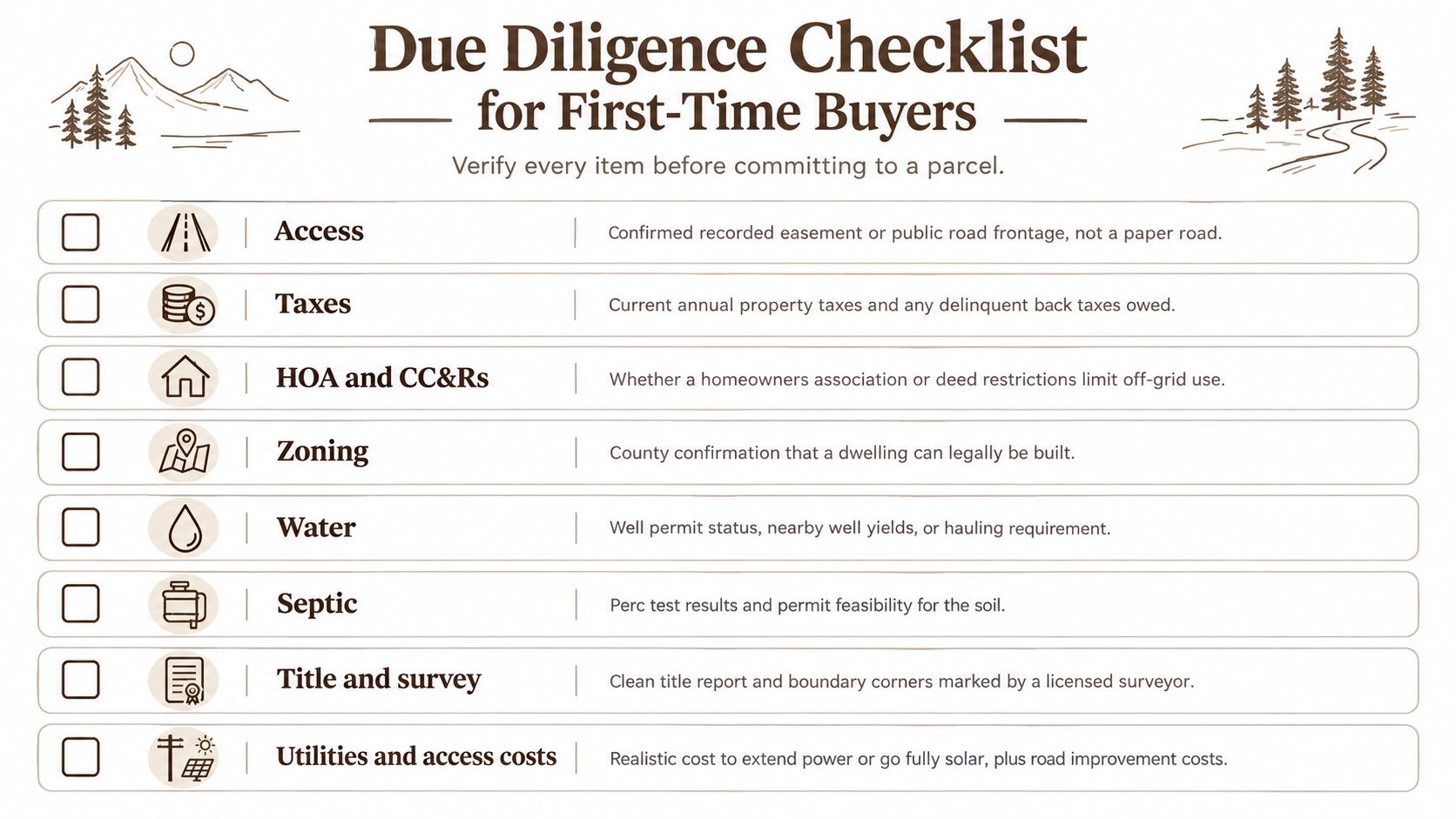
Use one parcel report and one written checklist. Your objective isn't to prove that every parcel is suitable for every purpose. It's to identify what the land supports, what it may support after approval, and what it won't support.
Confirm the legal and financial basics
- Access: Look for a recorded easement or public road frontage. A paper road on a subdivision map may not be a usable route.
- Taxes: Review the current tax bill, annual property taxes, delinquent amounts, and any special assessments.
- HOA and POA fees: Check for an association, road-maintenance obligation, or private restrictions.
- Title: Order a title report through a California title company and review ownership, liens, easements, and exceptions.
- Parcel identity: Match the APN, legal description, county map, and seller's agreement.
Confirm the intended use
Call the county planning office and ask for a written or clearly documented zoning answer. Then review whether the intended dwelling, cabin, RV use, camping, solar system, driveway, or agricultural activity is permitted, conditionally allowed, or restricted.
For utilities, check the proximity of electric and internet service without assuming connection is practical. A parcel may need a fully independent power plan. For water, verify well permit status, nearby well information, or whether hauling and storage are legally workable. For wastewater, obtain available soil or percolation information and ask environmental health whether a septic permit is feasible.
Review physical and environmental constraints
Check fire severity information, defensible-space requirements, road access for emergency response, and FEMA flood-plain mapping. Review CC&Rs, even when there's no active HOA, because recorded restrictions can still affect structures, vehicles, camping, or land use.
Before closing, reread the purchase agreement, payment schedule, payoff language, recording fees, default terms, and deed-transfer process. Buyers should independently verify current requirements with the county and relevant professionals, because some parcels may have limitations that aren't obvious from an online listing.
Bringing It All Together and Next Steps
Buying off-grid land in California is a county-by-county decision, not a single statewide yes-or-no question. The same core checklist applies whether you're considering a small desert lot or a larger mountain parcel: zoning, water, septic, legal access, fire conditions, utilities, taxes, and recorded restrictions.
Seller-financed options with a low initial payment can make the purchase process more approachable for first-time buyers, but financing doesn't replace property research. Review the parcel report and agreement together, then verify the intended use with the county.
To begin, browse available California properties, filter by county and price, and request the parcel information needed for your due diligence.
Dollar Land Store offers direct land sales, seller-financed land options, and practical buyer education for people evaluating rural and off-grid parcels. Visit Dollar Land Store to browse available properties, review payment options, and learn about the buying process before choosing a parcel.