


Unlocking the Tax Benefits of Owning Land
Ross AmatoWhen you buy raw land, you’re not just acquiring a piece of property—you’re also gaining access to significant financial advantages. Many of the best perks are tied directly to the tax benefits of owning land, which are very different from those for a developed property with a house. Raw land typically comes with a much lighter property tax bill, and if you hold it as an investment, it can open the door to valuable deductions and favorable tax rates when you sell.
For first-time buyers, understanding these benefits is a critical step toward making a confident and intelligent purchase. This guide will provide clear, straightforward explanations of the key tax advantages that make vacant land a uniquely affordable and powerful asset.
The Hidden Financial Perks of Owning Raw Land
Most first-time buyers are focused on finding the perfect parcel but often overlook the built-in financial upsides that make land such a smart investment. From day one, an empty plot of land is viewed very differently by a county tax assessor than a property with a house on it. That single difference is where the financial benefits begin.
The most immediate advantage you'll notice is a smaller annual property tax bill. Since tax assessments are based on property value—and raw land has no costly structure on it—the assessed value is naturally lower. This simple fact makes holding onto your land for the long term much more affordable.
But the benefits extend beyond property taxes, depending on how you intend to use the land. Here are a few of the key financial perks you'll want to understand:
- Powerful Deductions: If you hold the land for investment purposes, you can often deduct expenses like property taxes and even the interest you pay on financing.
- Smarter Gains Strategy: When it's time to sell, holding the land for more than a year can qualify you for lower long-term capital gains tax rates, letting you keep more of your profit.
- Unique Opportunities: For certain properties, you can explore advanced strategies like conservation easements, which can lead to substantial income tax deductions.
This quick overview sums up the main financial benefits you can expect from buying land.
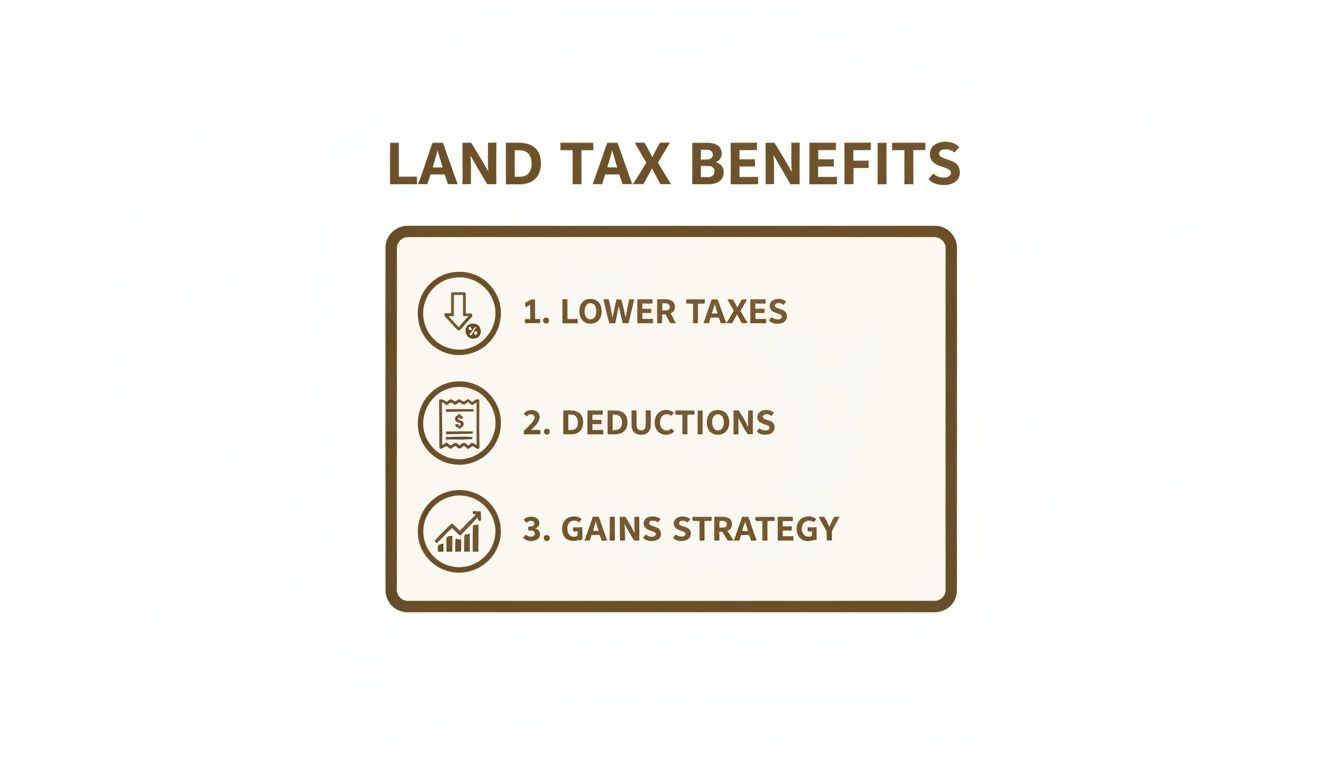
These advantages work together to make your purchase a smart financial move from multiple angles. If you're looking for more ideas on how to get the most out of your parcel, check out our guide on what to do with vacant land. Understanding these financial concepts is the first step toward making a purchase you can feel truly confident about.
Understanding Property Taxes on Vacant Land
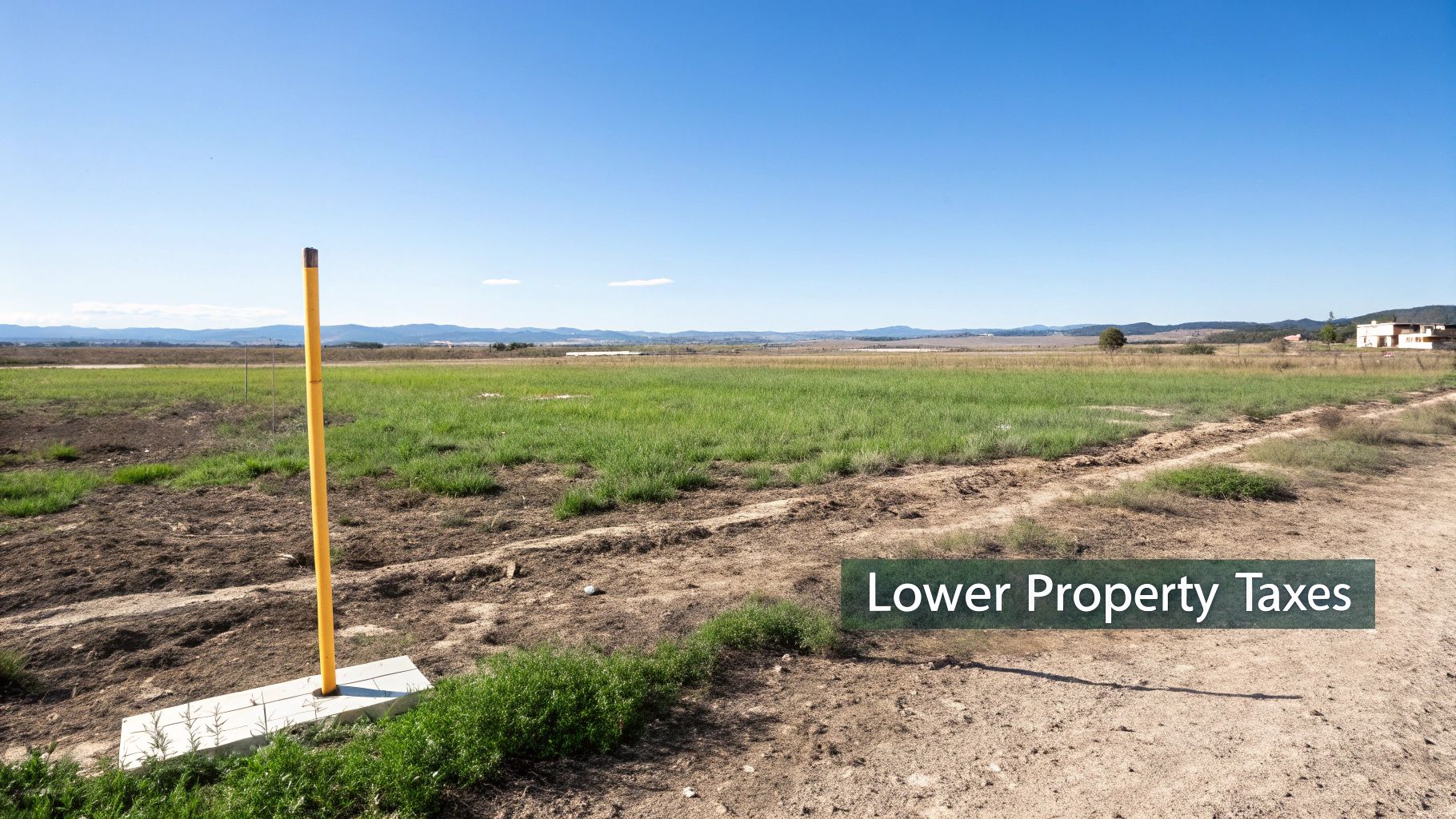
One of the best and most immediate perks of owning raw land is the low annual property tax bill. It's the simplest and most predictable advantage, making vacant land a surprisingly affordable asset to hold for the long term.
Think of it this way: a government taxes a finished painting more than it taxes a blank canvas. Your undeveloped land is that blank canvas.
Local governments—usually at the county level—calculate your property tax by assessing the value of your property. That assessment looks at both the land itself and any structures, or “improvements,” built on it. Since your vacant land doesn't have a house, barn, or shop adding to its value, its assessed value is almost always far lower than a developed lot of the same size.
This low assessment means a much smaller tax bill every year. For land buyers, especially those using seller financing, this keeps your holding costs predictable and manageable. Often, your only recurring expense besides your monthly payment is a modest property tax, letting you hold the land without financial stress while its value appreciates over time.
How Assessments Work in Your Favor
The assessment process is designed to be fair, but it inherently favors undeveloped land. It boils down to a few simple factors:
- No Structural Value: The house or building is the most expensive part of most properties. With raw land, the value of structures is $0.
- Location and Use: Rural, undeveloped land is typically assessed at a lower rate than a suburban lot zoned for immediate housing development.
- Limited Services: A remote parcel doesn't usually require the same public services (like city water, sewers, or paved roads) as a home in a subdivision, which can be reflected in lower tax rates.
Key Takeaway: The lack of buildings is the single biggest reason your property tax bill stays low. Every year, this saves you money and makes raw land a smart, cost-effective investment to own.
Favorable Tax Rates in Western States
The states where Dollar Land Store specializes—like Arizona, Nevada, and Colorado—often have tax structures that are even more favorable for rural landowners. Many counties in these states offer friendly tax rates for land zoned as agricultural, rural, or recreational.
This is especially true for larger parcels in less populated areas. It’s a way to encourage open space and keep land ownership accessible. For example, a 5-acre recreational parcel in rural Nevada will have a much lighter tax burden than a quarter-acre lot in a busy suburb. This reinforces how affordable it can be to secure your own piece of the West.
Globally, many tax systems are set up to encourage land investment by keeping property taxes relatively low. In some places, these taxes only make up 1-2% of the entire GDP, even though real estate holds a massive amount of wealth. If you’re curious, you can learn more about how housing taxation works in OECD countries.
Grasping these basics makes it easy to see why low property taxes are one of the best benefits of owning land, making it a sound and sustainable investment right from day one.
Claiming Deductions on Land Held for Investment
When you buy land with the primary goal of it appreciating in value, the IRS views it differently than a property you buy for personal recreation. This distinction—the difference between "investment intent" and "personal use"—is crucial, as it opens the door to powerful tax deductions.
If your land is an investment, you can often deduct the carrying costs of owning it. This helps offset other investment income you might have, which ultimately means you pay less in taxes. Think of it as the government's acknowledgment that it costs money to maintain and grow a financial asset.
Investment vs. Personal Use: What's the Difference?
How do you know which category your land falls into? It comes down to your primary reason for buying it. If you bought it mainly to sell for a profit down the road, it’s an investment. But if you’re using it for camping, hunting, or family trips, it’s almost always considered personal use, and these deductions generally do not apply.
Your actions should back up your intent. Treating the property like a business asset and keeping excellent records helps establish your case.
Common Deductions for Your Investment Land
Once you’ve established that your land is an investment, a few key expenses can work in your favor at tax time. These are the costs you pay just to hold onto the property.
Here’s a quick rundown of what you may be able to deduct:
- Property Taxes: This is the most common deduction. The annual taxes you pay to the county are almost always deductible for investment land.
- Loan Interest: If you financed your purchase, the interest you pay can be a significant deduction. This applies to traditional loans and, importantly, to seller financing agreements like those offered by Dollar Land Store.
- Basic Maintenance: Sometimes you must spend money to keep the property in good condition. This could include clearing brush to comply with local fire codes or maintaining an access road. These costs can often be deducted.
Important Note: There are limitations. You can generally only deduct these expenses up to the amount of your total net investment income for the year. Always consult with a tax professional to understand how these rules apply to your specific situation.
Keeping good records is essential. Every property tax receipt, loan statement showing interest paid, and maintenance invoice is proof of your investment. It not only solidifies your "investment intent" but also makes tax season much smoother.
For a deeper dive into this approach, check out our guide on how to buy land for investment. A little preparation goes a long way in ensuring you get every financial advantage you’re entitled to.
Navigating Capital Gains When You Sell Your Land
While low property taxes and annual deductions save you money over time, the real financial win often comes when you decide to sell your land. This is where you encounter the capital gains tax—the tax you pay on the profit you make from selling an asset like land. Understanding how this works is key to maximizing your return.
The single most important factor is how long you've owned the property. The IRS draws a line at the one-year mark, and which side of that line you fall on makes a huge difference.
- Short-Term Capital Gains: If you buy land and sell it in less than one year, any profit is taxed as ordinary income. That means it’s taxed at the same high rate as your regular paycheck.
- Long-Term Capital Gains: This is the goal for most land investors. If you hold your land for more than one year, your profit is taxed at the much lower long-term capital gains rate. For most people, that rate is 0%, 15%, or 20%. A little patience can save you thousands of dollars.
Calculating Your Profit the Right Way
Before you can determine the tax, you must know your actual profit. It’s not as simple as subtracting your purchase price from the sale price. To do it correctly, you need to calculate your cost basis.
Your cost basis is your total "all-in" investment in the property. It starts with the purchase price, but you also add other costs from the buying process, like closing fees or survey costs. The higher your cost basis, the lower your taxable profit will be.
Here’s a simple example: You buy a parcel for $10,000 and pay $500 in closing costs. Your cost basis is $10,500. A few years later, you sell it for $18,000. Your taxable long-term capital gain is $7,500 ($18,000 - $10,500), not $8,000.
Advanced Strategy: The 1031 Exchange
For serious investors looking to grow their holdings, a powerful tool called a 1031 exchange allows you to defer paying capital gains tax. In simple terms, this strategy lets you sell one investment property and roll all the proceeds directly into buying a new, "like-kind" property without paying taxes at that time.
This allows your entire investment to keep growing, tax-deferred. The rules and timelines are strict, so professional guidance is necessary, but a 1031 exchange can turn a single land purchase into the foundation of a real estate portfolio. This type of favorable tax treatment for investors isn't just a U.S. concept; you can learn more about how land value is taxed internationally to see how these principles are applied worldwide. Understanding these rules is a core part of enjoying the full tax benefits of owning land.
Using Conservation Easements for Major Tax Savings
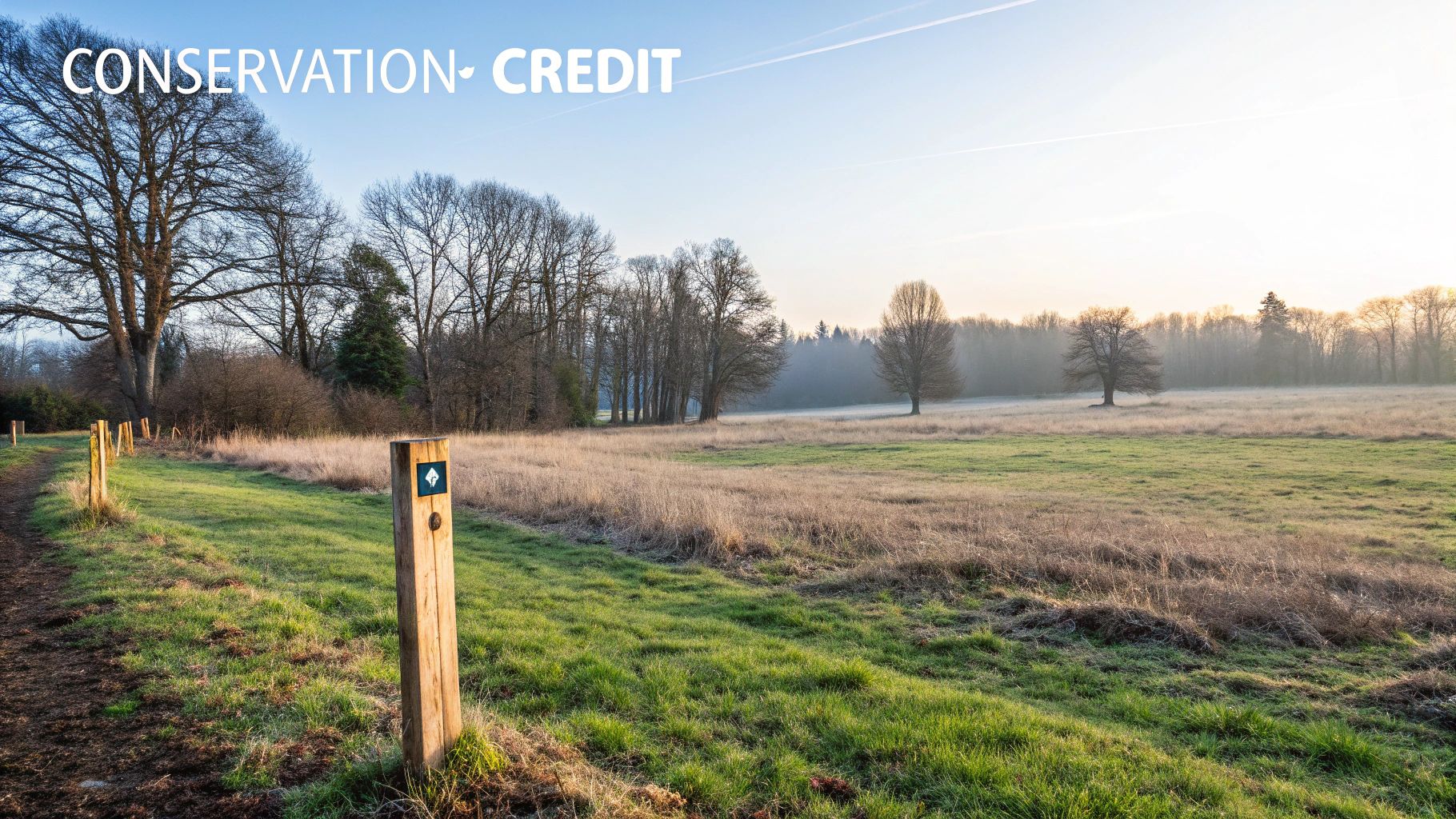
For landowners with large, unique parcels, one of the most powerful tax benefits available is a conservation easement. This is an advanced strategy, but for the right property, it can lead to a massive tax deduction while preserving your land’s natural beauty for generations.
A conservation easement is a voluntary legal agreement between a landowner and a land trust or government agency that permanently limits certain types of development to protect the property's ecological or historical value. In exchange for donating those development rights, the IRS allows you to take a significant federal income tax deduction.
How Does It Work?
The process starts with getting the property appraised twice: once for its full market value (as if it could be developed) and a second time for its value with the new easement restrictions.
The difference between those two values is considered a charitable donation.
For example, if your land is valued at $500,000 but is worth only $200,000 after you agree to restrict development, you have made a $300,000 non-cash charitable contribution. You can then deduct that amount from your income over several years, creating substantial tax savings.
A conservation easement is a powerful tool for landowners who prioritize legacy and preservation over development. It turns your commitment to protecting nature into a tangible financial benefit.
Who Is This For?
This strategy is not for everyone. It’s best suited for owners of larger parcels that have a specific conservation value, such as:
- Critical wildlife habitats
- Scenic views enjoyed by the public
- Land that is important for farming, forestry, or ranching
- Property with significant historical importance
While this path requires specialized legal and financial advice, knowing it exists is crucial. It’s one of the most impactful tax benefits available to landowners, blending financial incentives with a lasting environmental legacy.
What This Means for Buyers
Understanding these tax benefits is empowering, especially for first-time buyers. It transforms a land purchase from a simple transaction into a strategic financial decision.
Here's the takeaway: owning raw land is fundamentally more affordable to hold long-term than developed property. The low annual property taxes mean you won't feel financial pressure year after year. If you treat your land as an investment, you can further reduce your costs by deducting expenses like loan interest and property taxes. Finally, by holding for over a year, you position yourself to keep more of your profits thanks to lower capital gains tax rates.
These combined benefits reduce the risk of buying land and create a clear path to building equity. With the right knowledge, anyone can leverage these advantages to make a smart, sustainable investment.
Why Consider Dollar Land Store?
At Dollar Land Store, we specialize in making land ownership accessible and transparent, helping buyers take advantage of these financial perks from day one. Our entire process is designed for beginners and experienced investors alike, removing the typical barriers to entry.
Here’s how we help:
- Affordable Land & Low Payments: We offer land at low entry costs with manageable monthly payments, making it easy to get started.
- Simple Owner Financing: Our seller financing is straightforward, with no credit checks required. This opens the door for buyers who may not qualify for traditional loans.
- Transparent Terms: All terms are clearly stated in our contracts. There are no hidden fees or middlemen, so you know exactly what you’re agreeing to.
- Broad Inventory: We have a wide selection of rural land parcels across several states, giving you plenty of options to find the right fit.
- Fast & Simple Process: We handle the paperwork and can have contracts ready quickly, simplifying your purchase from start to finish.
The interest paid on our seller financing can often be a deductible expense for investment properties, adding another layer of financial benefit. Our goal is to provide a trustworthy and direct path to land ownership, empowering you to build your assets confidently.
Next Steps for a Smart Land Purchase
Reading about the tax benefits of owning land is the first step. Putting that knowledge into practice is how you start building real wealth. The move from curious reader to confident landowner begins with a few simple actions.
1. Browse Available Land
The easiest way to see just how affordable land can be is to look at real-world listings. As you browse, keep an eye on the estimated annual property taxes. You’ll quickly notice how low this cost typically is for vacant land, which drives home its value as a manageable, long-term asset. This connects the concept of low assessed value to a real number you can fit into your budget.
2. Do Your Due Diligence
Before you commit to a parcel, it's essential to do your homework. While our listings provide a great starting point, remember that tax rates are set at the local level and can change.
Crucial Tip: Always call the county assessor’s office to verify the exact tax rates for any property you’re serious about. This simple phone call prevents surprises and gives you the hard numbers needed to plan your finances accurately.
3. Talk to a Professional
This guide is designed to give you a solid foundation in the tax side of land ownership. However, it is not a substitute for professional advice. We always recommend consulting a qualified tax professional before you buy. They can analyze your personal financial situation and help you build a strategy that aligns with your goals, ensuring you don’t miss any deductions or benefits you’re entitled to.
Combining an affordable purchase from a trusted seller like Dollar Land Store with expert financial advice is the surest way to make a smart, confident, and profitable land investment.
Conclusion
The tax benefits of owning land are clear, powerful, and accessible. From significantly lower property taxes and valuable deductions for investment properties to favorable long-term capital gains rates, raw land is structured to be a cost-effective and rewarding asset. By understanding these advantages, you can move forward with the confidence that your purchase is not just about acquiring a piece of the American landscape, but also about making a sound financial decision for your future.
Ready to take the next step? Browse available land at DollarLandStore.com or contact us with any questions you have about buying raw land.