


Vacant Land for Sale New Mexico: A Buyer's Guide
Ross AmatoYou've found a desert parcel with an appealing price, a map pin, and enough room for your plans. Vacant land for sale in New Mexico includes privately deeded acreage with cash and owner-financing options, but the useful comparison isn't just price per acre. It's whether you can legally reach the property, obtain enough water, and carry out your intended use.
A low purchase price can make sense when you understand what's missing. It becomes a problem when you mistake open countryside for available land, a road for legal access, or a well permit for a dependable water supply.
Where to Find Vacant Land for Sale in New Mexico
Start with listings that identify an actual privately owned parcel, its county, and the interest being sold. Rural acreage deserves a closer look, but undeveloped property alone tells you nothing about whether the land is available to purchase.
The federal government owned 24,581,379 acres in New Mexico, or 31.6% of the state, according to the Congressional Research Service's federal land ownership report. That statewide figure provides context, not a parcel-level ownership determination.
A concrete starting point in Luna County
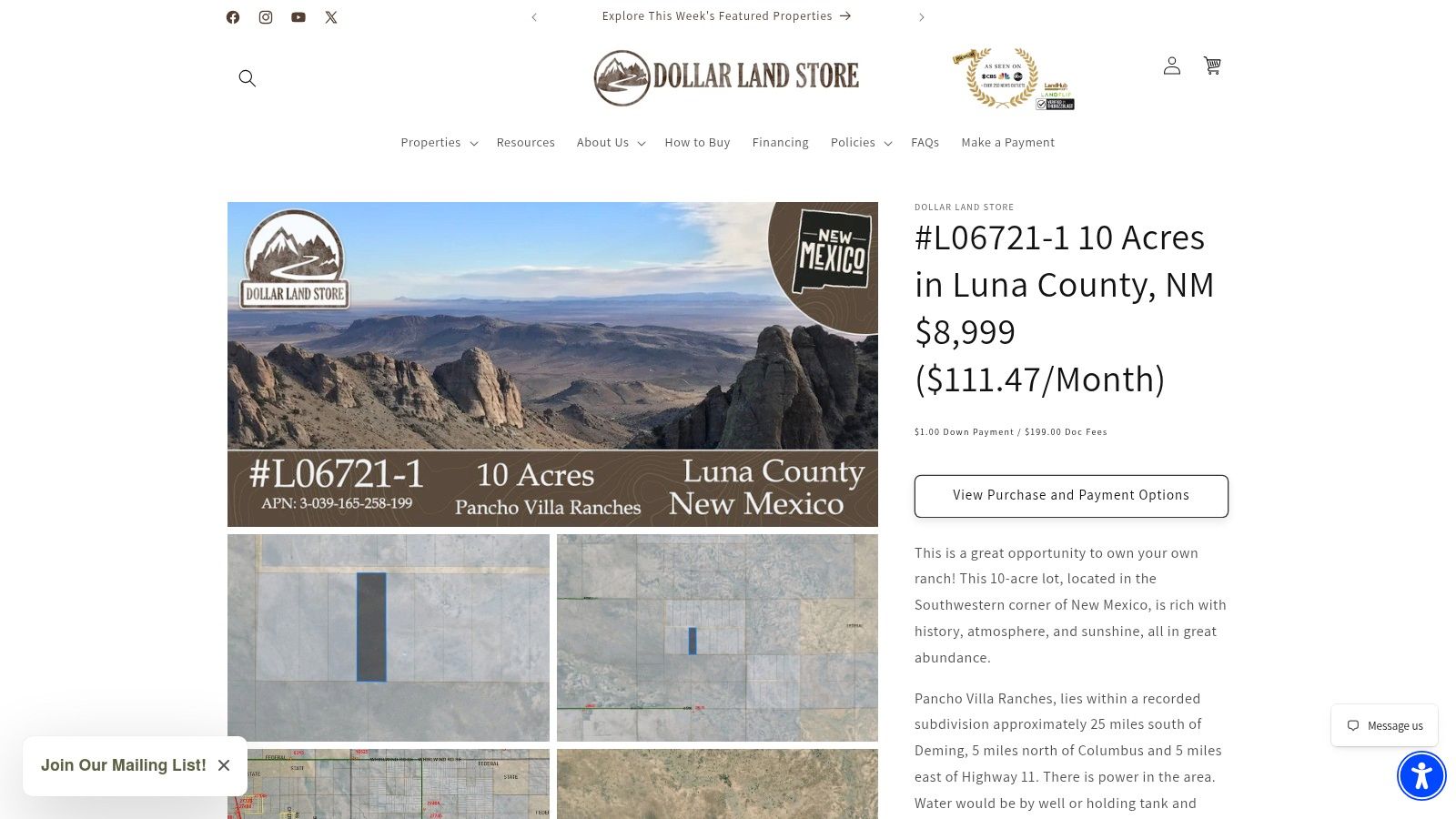
Pancho Villa Ranches offers an example of the desert acreage buyers encounter in southwestern New Mexico. These catalog listings describe approximately sized parcels within a recorded subdivision, with views toward the Florida Mountains and Tres Hermanas Mountains:
- #L06721-1, approximately 10 acres in Luna County has an advertised price of $8,999, with a listed financing payment of $111.47 per month, a $1 down payment, and a $199 document fee.
- #L06748-1, approximately 10 acres in Luna County has an advertised price of $8,999, with a listed financing payment of $111.54 per month, a $1 down payment, and a $199 document fee.
Those amounts describe different parts of the purchase, not interchangeable prices. The down payment isn't the purchase price or total financed cost, additional disclosed charges may apply, and current checkout disclosures and the signed agreement control. Check current availability and confirm the applicable cash price and complete financing terms before proceeding.
Separate ordinary listings from other sale formats
Keep public-sale notices in a separate research folder from seller listings. If your search brings up Water Filter Advisor's notice concerning the N Hwy sale, examine the notice itself rather than assuming its property, procedure, or terms apply to New Mexico acreage elsewhere.
Practical rule: Start with the parcel's legal identity, not the scenery surrounding it.
For either a seller listing or a public notice, request the legal description and compare it with ownership records. Identify neighboring ownership too, particularly where private land meets federal, tribal, or state land. Nearby public acreage doesn't establish access rights across it or expand what you're buying.
Evaluating a Parcel Before You Buy
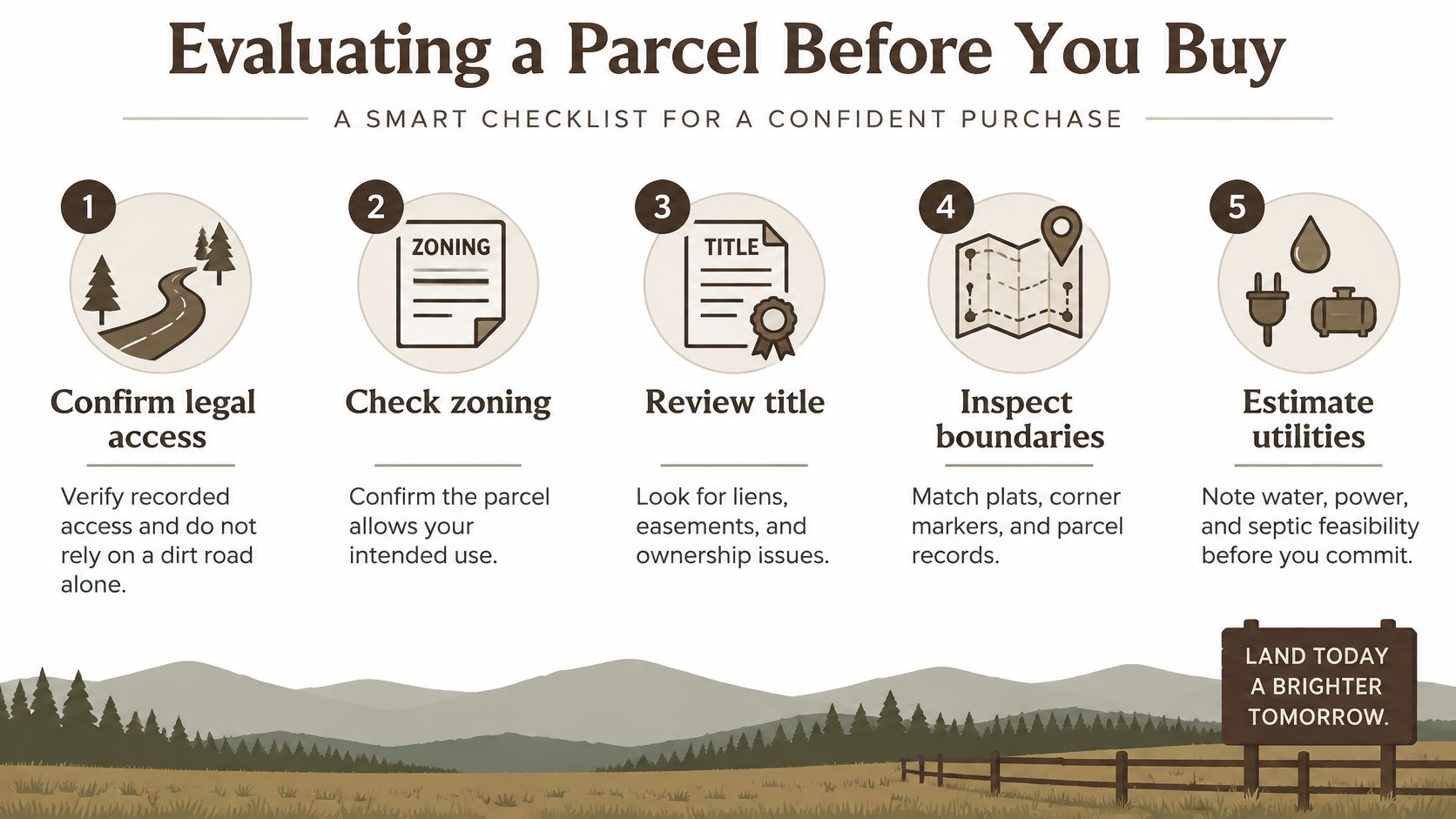
A map is useful for narrowing your search. It isn't enough to commit money. Begin with questions that could stop the purchase entirely, then spend time on the details that affect your budget.
Check access and intended use first
- Confirm legal access. Request the recorded documents establishing access to the parcel. A visible dirt track may cross someone else's property, and legal access still needs a separate assessment of physical usability.
- Ask planning staff about your actual proposal. Describe the intended home, mobile home, recreational use, or other activity. Ask which zoning, permits, recorded restrictions, and municipal rules apply to that parcel.
- Match the property records. Compare the legal description, plat, assessor record, and any survey. A recorded subdivision isn't proof that someone has recently surveyed the particular lot or located its corners.
- Inspect the practical route. Consider whether the road can accommodate your vehicle, a well driller, or installation equipment. Don't assume conditions during a dry-weather visit represent every season.
Use county GIS tools, including the Luna County GIS Map System when applicable, for orientation. Ask a surveyor to resolve boundary questions rather than treating an online outline or a convenient fence as definitive.
Give title research room in the schedule
New Mexico's ownership history includes grants issued under Spanish authority between 1598 and 1821 and Mexican authority from 1821 to 1846, as documented by the New Mexico State Records Center and Archives' land-grant history. That history is a reason to examine the chain of title carefully, not evidence that a particular property has a defect.
Ask a qualified title professional to investigate ownership, recorded easements, liens, and exceptions affecting the parcel. Where older descriptions or grant boundaries raise questions, resolve them before relying on a modern listing summary.
Keep a simple purchase file containing the legal description, access documents, planning responses, title findings, and boundary information. Record who answered each question and what documents support the answer. A verbal assurance that a parcel is “fine” won't tell your contractor where to build or explain which easement you can use.
Finish these checks before paying, not after deciding you can sort them out later.
Verifying Water Rights and Well Access
For a proposed home, garden, or livestock use, ask a narrower question than “Does it have water?” Ask whether this specific parcel has a lawful, physically workable supply sufficient for the use you have in mind.
A drilling authorization, an existing borehole, and usable household water are different things. Treat each as a separate verification task.
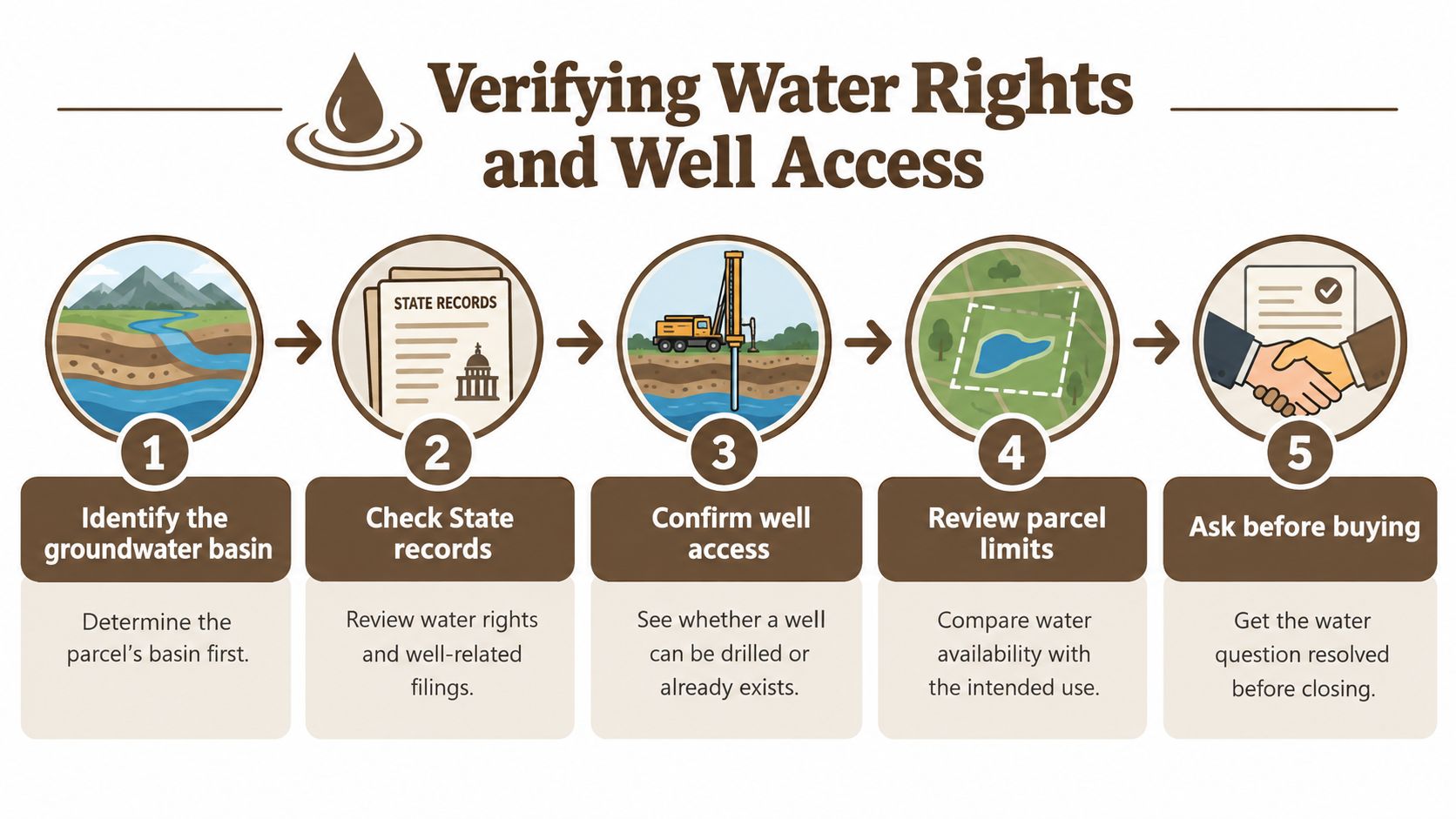
Follow the parcel's water records
Begin by identifying the groundwater basin and the relevant State Engineer district. Then search permit and adjudication records, connect any advertised permit to the parcel, investigate transfer requirements, and obtain written confirmation of the authorized use through the New Mexico Office of the State Engineer's water-rights resources.
Your inquiry should establish:
- The permit's identity. Match the permit, well location, ownership information, and parcel records rather than accepting a nearby well as evidence.
- The permitted purpose. Explain whether you're planning household use, stock watering, irrigation, or another activity.
- The transfer requirements. Confirm what ownership-change documentation must be completed before diversion is allowed.
- The physical supply. Investigate well records, depth history, actual yield, water quality, and the equipment needed to deliver water.
Compare permitted volume with your plans
Under New Mexico's domestic-well regulations, a single-household domestic well is generally limited to 1.0 acre-foot annually; some hydrologic units may allow up to 3.0 acre-feet with a non-impairment demonstration, while domestic-well management-area rules can reduce the maximum diversion to 0.25 acre-foot annually. Don't use the largest figure as your assumption. Have the applicable authorization and restrictions confirmed for the parcel.
Municipal rules need attention too. New Mexico legislation concerning municipal domestic-well restrictions allows restrictions by ordinance where qualifying non-agricultural property lies within a municipality and within 300 feet of municipal distribution lines.
For background terminology, the guide to what water rights mean can help you prepare questions. It doesn't replace a parcel-specific determination.
“Well permitted,” “well drilled,” “water rights conveyed,” and “water available at the house” are separate conclusions. Verify each one.
A higher-priced lot near a usable utility connection may fit your budget better than cheaper acreage requiring uncertain drilling and extensive equipment. Compare the complete water solution, not just the land price.
Checking Septic, Utilities, and Buildability
A parcel can pass the ownership and access checks yet still fail your proposed site layout. The practical test is whether the house, wastewater system, water supply, driveway, and required separations can fit together.
“Septic available” isn't a permit. The New Mexico Environment Department's liquid-waste permit application guidance calls for parcel plat or survey information and a scaled site diagram showing relevant boundaries, structures, wells, systems, and setbacks.
Put the proposed layout on paper
Have a qualified evaluator complete the required soil and site assessment. Then ask the appropriate permitting authority whether the proposed layout is acceptable or whether an alternative system needs consideration.
A useful working file includes:
- A base drawing. Show the parcel boundaries and proposed improvements on a consistent scale.
- Site constraints. Identify applicable setbacks, flood constraints, well locations, and the usable installation route.
- Wastewater findings. Obtain written approval or a documented explanation of what remains unresolved.
- An installation estimate. Ask contractors to assess the actual site, not an assumed standard installation.
The explanation of what a perc test means for land provides background, but don't reduce the decision to whether the soil absorbs water. Access, layout, and the permitted system matter too.
Translate utility shorthand into actual work
“Power in the area” doesn't identify a connection point, available capacity, an easement, or the cost of extending service. Give the utility provider the parcel information and proposed load, then request its requirements and an estimate.
Likewise, “water by well or holding tank” describes a possible responsibility for the buyer, not an installed supply. “Sewer by septic” doesn't establish that a permitted wastewater system exists.
Budget check: Price the missing infrastructure before deciding the parcel is inexpensive.
For the featured desert acreage, treat listing descriptions of potential building, mobile-home, or camping uses as starting points for questions. Obtain current parcel-specific answers from county planning and any other authority with jurisdiction.
Even after payoff and deed transfer, those uses aren't automatically approved. During financing, occupancy, RV storage, structures, and improvements also require the written permission specified by the purchase agreement. Don't schedule delivery or construction around an assumption.
Comparing Cash and Owner Financing Options
Choose a payment method after you understand the parcel's limitations and likely setup costs. A manageable payment doesn't make an unsuitable property workable, and using all your available cash can leave nothing for necessary investigations or infrastructure.
Three Ways to Pay for New Mexico Land
| Financing Path | Upfront Cost | Credit Check | How Ownership Works |
|---|---|---|---|
| Traditional land loan | Lender-required down payment and disclosed transaction costs | Confirm the lender's underwriting requirements | Deed and security arrangements follow the loan and closing documents |
| Cash purchase | Applicable cash price and disclosed charges | No owner-financing credit application | Deed preparation follows cleared payment, signed documents, and completion of applicable requirements |
| DLS owner financing | Disclosed down payment, document fee, and any other applicable charges | No traditional bank loan or credit check | DLS retains legal title until payoff and completion of deed-transfer requirements |
Ask a prospective bank lender whether it finances the parcel type before preparing a full application. Get its down-payment, collateral, and underwriting requirements directly rather than assuming a conventional home-loan process applies.
Cash avoids a continuing seller-financing balance, but it doesn't remove the need for documents or due diligence. Owner financing can preserve cash for other needs, provided you're comfortable with the payment obligation and the agreement's restrictions.
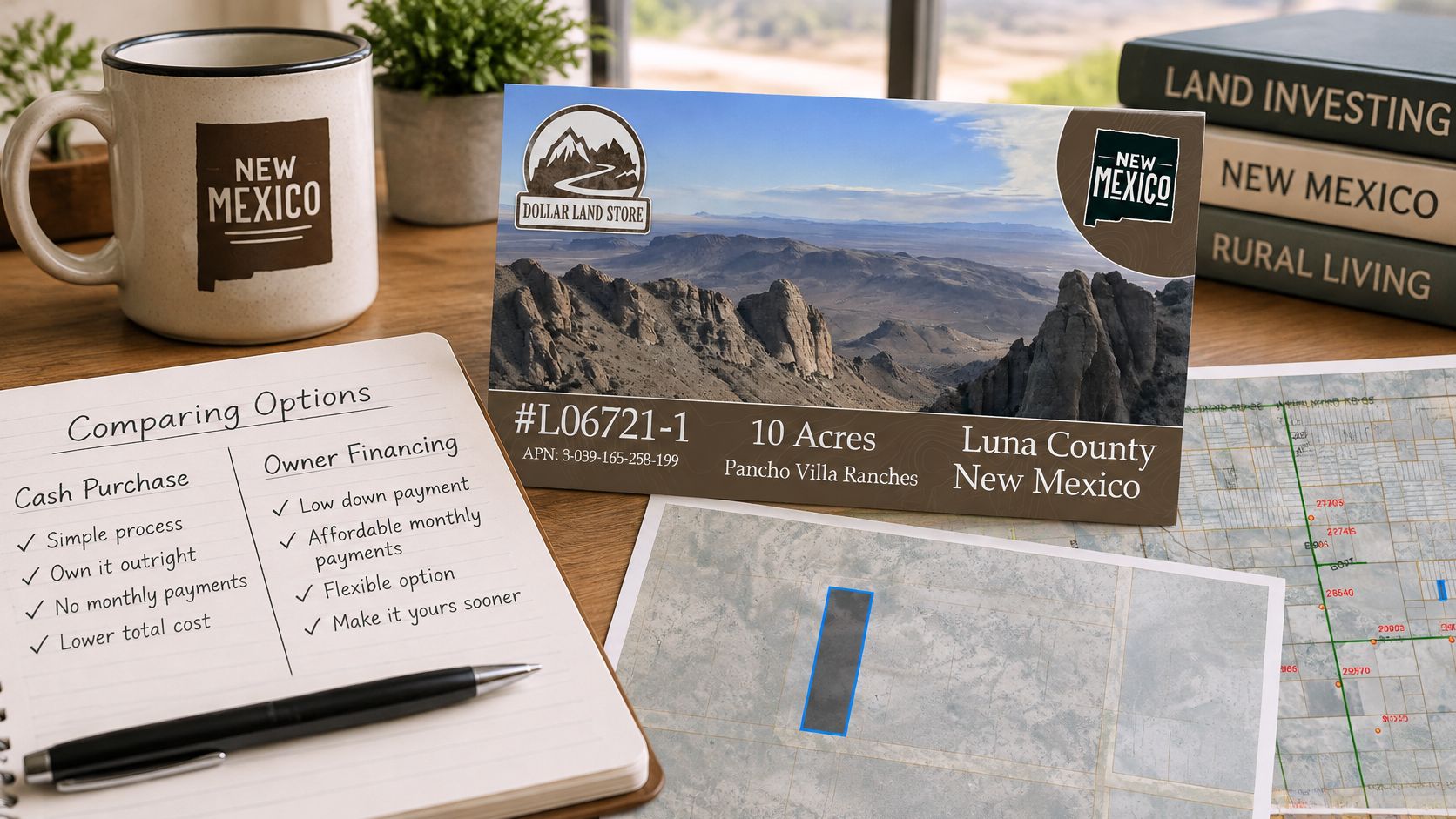
The catalog reference above belongs with its listing, not with an assumed utility connection or approved development plan. Check the live disclosures rather than treating an image as a complete financing offer.
Compare the whole obligation
Keep these entries separate in your own comparison:
- Cash price. Confirm the amount applicable to a cash transaction.
- Down payment and document fee. Identify what each initial charge covers.
- Monthly payment. Check the scheduled obligation and servicing setup.
- Total financed cost. Review the entire payment schedule and additional disclosed charges.
The financing information explains the purchase option, including required ZimpleMoney setup. Buyers may make additional payments or pay off early under their agreement; the signed terms control how those payments are handled.
The guide to New Mexico land with owner financing offers additional context for comparing this route with cash and lender financing. Use it to prepare questions, then make the decision from the actual transaction documents.
Handling Taxes, Title, and Closing
Property expenses don't end with the advertised purchase price. Before committing, establish who assesses the parcel, who collects its taxes, and whether any balance remains unpaid.
New Mexico's county assessors assess residential and non-residential property, while county treasurers collect the resulting taxes under state oversight, according to the Property Tax Division. Check the actual parcel record rather than applying a statewide estimate.
Confirm the carrying costs
Request the current valuation and tax status using the parcel's identifying information. If a listing describes taxes as current, verify that statement with the treasurer close to the transaction date.
Also ask how the purchase agreement allocates tax responsibilities. A seller's past tax bill and your contractual payment obligation are separate questions.
The discussion of property taxes on vacant land can help organize that review. Retain the county response with your other purchase records.
Follow the transaction through recording
Checkout starts the purchase process. It doesn't itself transfer ownership. The buying process should be read alongside the documents for the particular transaction.
The sequence depends on the purchase method:
- Complete the documents. Review the legal description, selected payment option, disclosures, and required signatures.
- Complete payment requirements. Financed buyers also establish ZimpleMoney payments. Cash buyers must have cleared funds and satisfy applicable requirements before deed preparation begins.
- Reach deed-transfer eligibility. For financing, legal title remains with DLS until payoff and completion of the required transfer steps.
- Handle county recording. DLS prepares the deed packet; the buyer ordinarily records the deed with the county. Confirm the county's submission requirements and retain the recorded document.
Don't confuse a welcome packet, payment confirmation, or signed installment agreement with a recorded deed in your name. Ask which document you should expect at each stage and what action remains yours.
Amounts paid are generally non-refundable, subject to the signed agreement and applicable law. Review the terms and conditions before paying, and use the sample land purchase agreement for preparation rather than as a substitute for your executed documents.
That's why unresolved access, water, or use questions belong before checkout. Don't make a payment hoping the answer will become more favorable afterward.
Your Next Steps for Buying New Mexico Land
Choose a region based on how you expect to use the property, not just where the lowest advertised payment appears. A future homesite, occasional recreation parcel, and undeveloped long-term holding call for different practical compromises.
Set a budget that leaves room for investigation and any necessary site work. If your plans depend on something you haven't confirmed, keep that item marked unresolved rather than assigning it an optimistic cost.
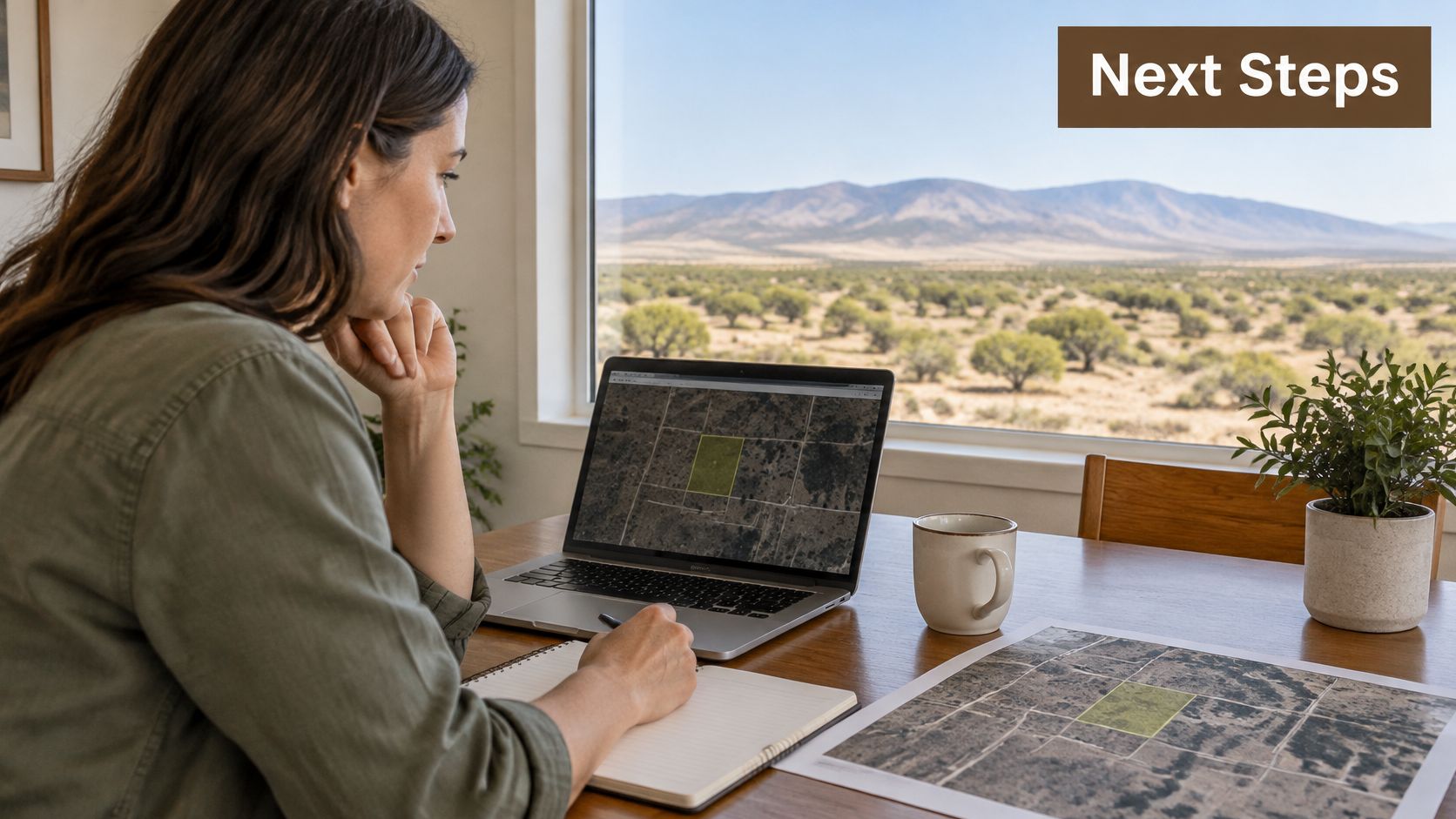
Turn your shortlist into a decision file
- Choose the region and spending limit. Decide which conveniences you need and which missing improvements you can reasonably address.
- Shortlist identifiable private parcels. Save the listing and request the legal description and relevant documents.
- Resolve the stop signs. Complete the access, intended-use, boundary, and title checks before becoming attached to a particular property.
- Test the physical plan. Obtain parcel-specific water and wastewater answers, plus utility and installation estimates where needed.
- Select the purchase method. Compare cash with the full financed obligation, not just the initial payment.
- Complete the transaction. Follow the required documents, payment arrangements, and eventual deed-recording steps.
Keep your final questions specific
Ask officials and providers about the actual parcel, not whether people generally build or camp nearby. Keep written answers, and note any conditions that must be satisfied before an approval can be issued.
Treat the listing as an introduction to the property, not a warranty of every future use. If an important answer remains unclear, pause and get the appropriate professional involved.
The Luna County parcels introduced above are concrete places to begin comparing acreage, setting, and payment options. Reopen their listings to check current availability, then use the purchase and financing resources already linked to evaluate the next step without rushing it.
Dollar Land Store sells vacant land online, with cash and owner-financing options where offered. Visit Dollar Land Store to check current New Mexico inventory and compare acreage, location, and purchase options, then complete your parcel-specific checks before paying.