


What Is a Quitclaim Deed and When Is It Used?
Ross AmatoWhen you're buying land, the legal document that officially transfers ownership to you is called a deed. But a critical fact many first-time buyers don't realize is that not all deeds are the same. Understanding the difference is one of the most important steps you can take to protect your investment.
A quitclaim deed is a legal instrument that transfers one person's interest in a property to someone else. The key detail to remember is that it comes with zero guarantees or warranties. It simply transfers whatever ownership interest the seller (known as the grantor) might have—which could be full ownership, partial ownership, or even none at all.
For a land buyer, this is a crucial distinction. This guide will explain what a quitclaim deed is, how it differs from a more secure warranty deed, and what it means for your land-buying journey.
What It Is: A Closer Look at Quitclaim Deeds
Think of a deed as the seller handing you a set of keys to a vacant lot. With a quitclaim deed, the seller is essentially saying, "Here are all the keys I have for this land. I am not promising they are the right keys, that they are the only keys, or even that they will unlock the gate." You are accepting their claim to the property without any legal promises from them to back it up.
This is fundamentally different from other deeds, like a warranty deed, which is the standard for most real estate sales. A warranty deed includes legally binding promises that the seller owns the property free and clear of any hidden claims or problems. Because a quitclaim deed offers none of that protection, it places all the risk squarely on you, the buyer.
Key Characteristics of a Quitclaim Deed
For a beginner, the most critical concept to grasp is this lack of buyer protection. It is why banks and traditional lenders almost never approve a mortgage on a property being sold with a quitclaim deed.
Here are the main traits of a quitclaim deed:
- No Title Warranty: The seller does not legally guarantee they own the property or that the title is clean.
- Transfers Only Current Interest: The deed only passes along whatever slice of ownership the seller currently holds—if any.
- High Risk for Buyers: The buyer assumes all the risk for any past title issues. This could include old liens from contractors, boundary line disputes with neighbors, or even a previous owner appearing with a valid claim.
To make this clear, here’s a summary of the core concepts.
| Characteristic | What It Means for a Land Buyer |
|---|---|
| "As-Is" Transfer | You receive the property title with any and all potential defects, whether they are known or unknown. |
| No Guarantees | The seller is not legally responsible if a title problem appears after the sale. |
| Transfers a Claim | The deed moves the seller’s claim of ownership to you, not proven and guaranteed ownership itself. |
| Buyer Beware | The responsibility to research the property's history falls entirely on your shoulders. |
Understanding these points is the first step in protecting yourself.
A quitclaim deed doesn’t prove ownership; it only transfers the claim of ownership from one party to another. The responsibility for verifying that claim falls entirely on the buyer.
Before you consider moving forward with a land purchase, you must know what kind of deed is involved. For a deeper dive into all the things you should be checking, our guide on what to look for when buying land is a helpful resource. This knowledge is your best defense against a poor investment.
Quitclaim Deeds vs. Warranty Deeds: Why It Matters
When buying vacant land, the type of deed you receive is just as important as the property itself. While a quitclaim deed is a simple transfer of whatever interest a seller might have, a General Warranty Deed offers the strongest protection a buyer can get. Knowing the difference is key to a secure purchase.
A warranty deed is a legally binding promise from the seller to you. It contains several guarantees, called covenants, that assure you the title is clean. The seller is legally obligated to defend your ownership against any future claims. It’s like receiving a certified, insured package—the seller vouches for its contents and is responsible if something is wrong.
This diagram illustrates how simple—and risky—the logic of a quitclaim deed is.
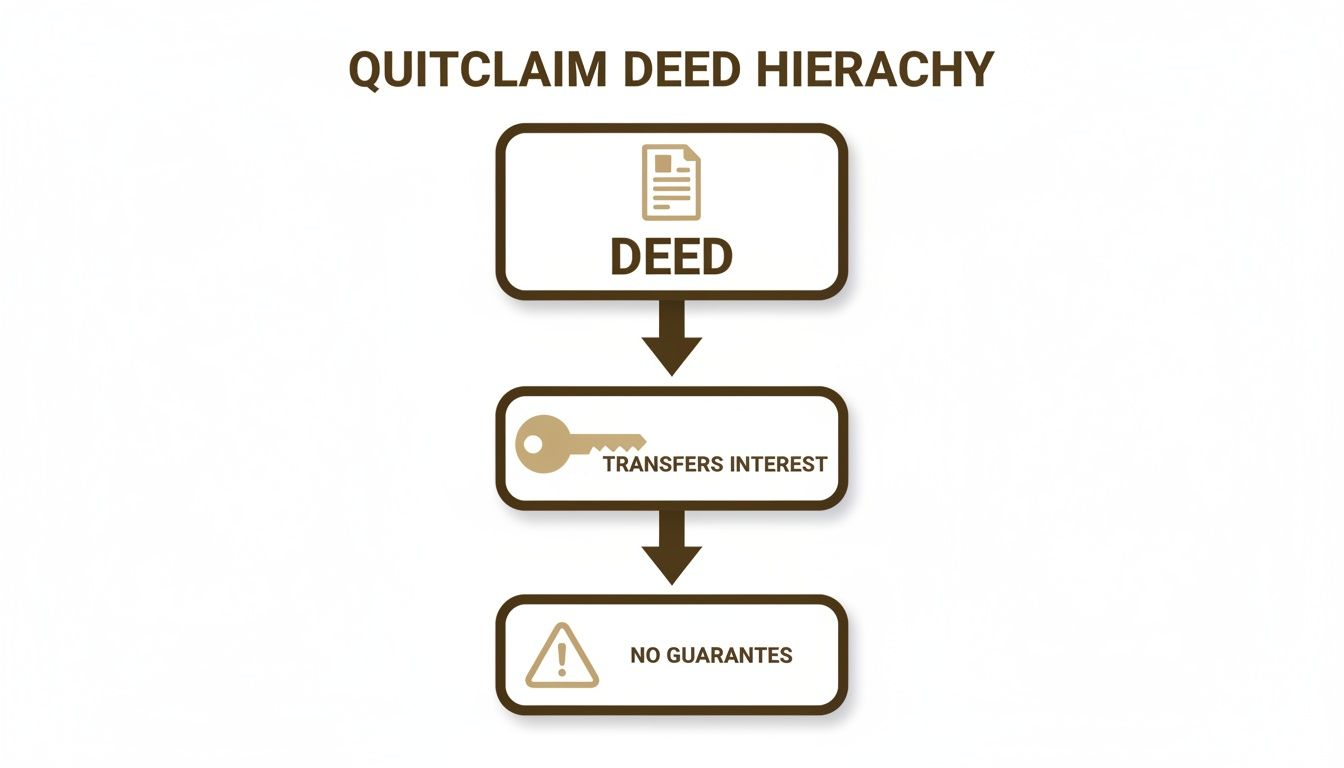
It is a direct transfer of interest but comes with no guarantees, putting all the risk on your shoulders.
Key Protections in a Warranty Deed
A warranty deed includes a safety net of legally enforceable promises—all of which are missing from a quitclaim deed.
The most common covenants include:
- Covenant of Seisin: A promise that the seller actually owns the property and has the legal right to sell it.
- Covenant Against Encumbrances: A guarantee that the property is free from liens or other claims, unless specifically stated in the deed.
- Covenant of Quiet Enjoyment: An assurance that your ownership won’t be challenged by someone else with a superior legal claim.
- Covenant of Warranty: The seller's promise to defend your title against any claims from anyone.
A quitclaim deed offers none of these protections. The seller is simply “quitting” their claim to the property and handing it to you.
Why the Difference is Critical for Land Buyers
This isn't just legal jargon; it has real-world consequences. A warranty deed provides a clear, defensible title, making it the standard required by banks, mortgage lenders, and title insurance companies. No lender will finance a land purchase based on a quitclaim deed because there is no proof the borrower will actually own the property free and clear.
Accepting a quitclaim deed is like buying a car without a title or a vehicle history report. You might get a great price, or you might be buying someone else’s problems. A warranty deed is like getting a certified pre-owned car with a full inspection report and a guarantee.
This side-by-side comparison makes the distinction clear.
Quitclaim Deed vs. General Warranty Deed Comparison
| Feature | Quitclaim Deed | General Warranty Deed |
|---|---|---|
| Title Guarantee | None. The buyer gets the title "as-is" with all potential problems. | Full. The seller guarantees a clear title and will defend it against all claims. |
| Seller's Liability | None. The seller has no future legal responsibility for title issues. | High. The seller is legally liable for title defects, even from past owners. |
| Buyer Protection | None. All risk of a bad title falls on the buyer. | Maximum. The buyer is protected by the seller's legally binding covenants. |
| Use in Financing | Rarely accepted by traditional lenders or for obtaining title insurance. | Standard requirement for securing a mortgage and title insurance. |
For anyone buying land, especially for the first time, the message is simple: the type of deed you receive is a direct reflection of how secure your purchase is.
Pros and Cons: When Does a Quitclaim Deed Make Sense?
Given the risks, you might wonder why quitclaim deeds exist. They are useful tools in specific, low-risk situations where trust is high and a formal title guarantee isn't necessary. These scenarios almost always involve property transfers where money is not changing hands in a typical sale.
A quitclaim deed is designed for speed and simplicity, not buyer protection.
Common Uses (Pros)
- Transfers Between Family Members: This is the most common use. For example, a parent gifting land to a child or siblings settling an inheritance. Trust between the parties replaces the need for legal warranties.
- Adding or Removing a Spouse from a Title: After a marriage or divorce, a quitclaim deed is a simple way to add a new spouse to a property title or sign over one's interest to an ex-spouse as part of a settlement.
- Fixing Minor Title Issues: A quitclaim deed can be used to clear up a "cloud on the title," such as a misspelled name on a previous deed. A person with a potential minor claim can sign a quitclaim deed to formally relinquish any interest, clarifying the title for the true owner.
- transferring property to a trust for estate planning. This is an internal transfer, not a sale.
The Risks for Land Buyers (Cons)
The dangers for a buyer in a standard sale are significant. A quitclaim deed provides no protection against title issues.
A "cloud on the title" is any lingering claim, lien, or error that could threaten your ownership. With a quitclaim deed, you inherit all of them. Common examples include:
- Outstanding Liens: Unpaid property taxes or a contractor's lien from years ago can become your responsibility.
- An Undisclosed Heir: A previous owner's relative could emerge with a valid legal claim to the land you just bought.
- Boundary Disputes: A survey might reveal a neighbor's fence has been on your property for years. A quitclaim deed offers no help in resolving this. It's critical to know how to survey your own property to verify boundaries independently.
- Errors in Public Records: A simple typo in a county clerk's office from decades ago can jeopardize your ownership.
With a warranty deed, the seller is legally obligated to help resolve these issues. With a quitclaim deed, you are on your own. You could spend thousands on legal fees defending your title or lose the property entirely with no recourse to recover your payment from the seller.
What This Means for Buyers
For a first-time land buyer, understanding the function of a quitclaim deed is essential for protecting your investment. If a seller in a standard market transaction offers you a quitclaim deed instead of a warranty deed, it should be treated as a major red flag.
Accepting a quitclaim deed means you are shouldering every potential risk from the property's entire history. While it might seem like a simple and inexpensive way to complete a transaction, the hidden dangers can be financially devastating. Your goal is to acquire clear and undisputed ownership, and a quitclaim deed rarely provides that security.
Practical Steps for Your Land Search
When evaluating properties, especially when buying directly from an individual, be proactive.
- Ask About the Deed Type Early: One of your first questions should be, "What type of deed will be used for the transfer?" A seller with a clear title should have no issue providing a General Warranty Deed.
- Consider the True Cost: The purchase price is just the beginning. The potential cost of hiring attorneys to defend a problematic title can easily exceed any savings you might have gained on the purchase price.
- Prioritize a Clean Title: Your primary objective is to own your land free and clear. A quitclaim deed can leave a permanent "cloud" on the title, making the property difficult to finance, insure, or sell in the future.
For a first-time buyer, the peace of mind that comes with a guaranteed, insurable title is invaluable. The risks of a quitclaim deed in a standard purchase almost always outweigh the perceived benefit of a quick transfer.
Why Consider Dollar Land Store?
Understanding the complexities of property deeds helps clarify why Dollar Land Store prioritizes secure and transparent transactions. Our process is designed to avoid the risks associated with quitclaim deeds by using a warranty deed or another secure transfer document for our properties whenever possible.
This is a core part of our commitment to ensuring you receive a marketable title backed by a real guarantee.

A Process Built on Transparency and Accessibility
Our entire process was created to provide peace of mind, especially for first-time land buyers. We aim to remove the uncertainty that often accompanies private land deals that rely on quitclaim deeds.
Here is what this means for you:
- Secure Contracts: We manage all paperwork to ensure the terms are clear and the ownership transfer is properly executed and recorded.
- Simple Seller Financing: Our seller financing has clear terms and no credit checks, making land ownership accessible. We explain all terms upfront.
- Guaranteed Title: By using warranty deeds, we legally stand behind the title we convey. This protects you from historical claims or defects. As part of our process, we verify ownership before we even list a property for sale.
We manage the entire transaction with professional oversight because we believe land ownership should be a safe and achievable goal.
We provide a clear path to owning land. We do not think buying an affordable property should require you to gamble on the security of your title. By avoiding the quitclaim deed trap in sales, we help ensure your purchase is a solid foundation for the future. You can learn more about our simple process and what seller financing is in real estate on our blog.
Buyer Guidance / Next Steps
Now that you understand what a quitclaim deed is—and its risks—you can move forward in your land search with greater confidence. The most important takeaway is to always know what kind of deed is being used in a sale and to prioritize sellers who offer a clear, guaranteed title. A little due diligence upfront is the best way to protect your investment.
Beyond the deed, new buyers must research the property itself. This includes verifying essentials like road access. A property might appear accessible on a map, but if it's landlocked, its value and usability are significantly reduced. It is worthwhile to understand your options and learn how to access landlocked property before committing to a purchase.
Your goal is to buy a piece of land, not someone else’s problems. This means being prepared to ask the right questions and being willing to walk away from a deal that feels uncertain or relies on a risky document like a quitclaim deed.
To ensure you have covered all your bases, consider these next steps:
- Ask About the Deed First: Make this one of the first questions you ask a seller. A transparent seller will be upfront about using a warranty deed.
- Perform Your Own Research: Do not just take the seller's word for it. Contact the county recorder’s office to verify property details yourself.
- Insist on a Clear Title: For any serious, long-term investment, the security that comes from a guaranteed, insurable title is non-negotiable.
Conclusion
Understanding the difference between a quitclaim deed and a warranty deed is one of the most powerful tools a land buyer can have. A quitclaim deed offers a fast and simple way to transfer a claim to a property but provides zero protection for the buyer, making it unsuitable for most land sales. A warranty deed, on the other hand, provides a legal guarantee of clear ownership and protects your investment.
By prioritizing transactions that use a warranty deed and conducting thorough due diligence, you can confidently navigate the land-buying process and secure a property that serves as a solid asset for years to come.
Before you finalize any purchase, be prepared. For a helpful checklist, read our guide on what to ask when buying land.
If you’re ready to look for land with a straightforward and secure purchase process, a great next step is to see what’s available. Browse available land at DollarLandStore.com.