


Land for Sale: How to Find Vacant Parcels
Ross AmatoWhat makes a vacant lot look cheap, and what makes it usable? With land for sale listings, those are usually two different questions, and the second one matters more. The smartest buyers read each listing as a feasibility check, not just a price tag, because access, utilities, zoning, and buildability can turn an attractive parcel into an expensive project.
That gap shows up in the market itself. In the first quarter of 2026, there were 426,986 land listings for sale in the U.S., with a median price per acre of $62,365. Inventory was 23.6% below the first quarter of 2019, while land prices per acre were 76.6% higher over the same period, which is a good reminder that scarcity and price pressure can sit right under a plain-looking listing (Realtor.com land price study).
What Land for Sale Listings Actually Reveal
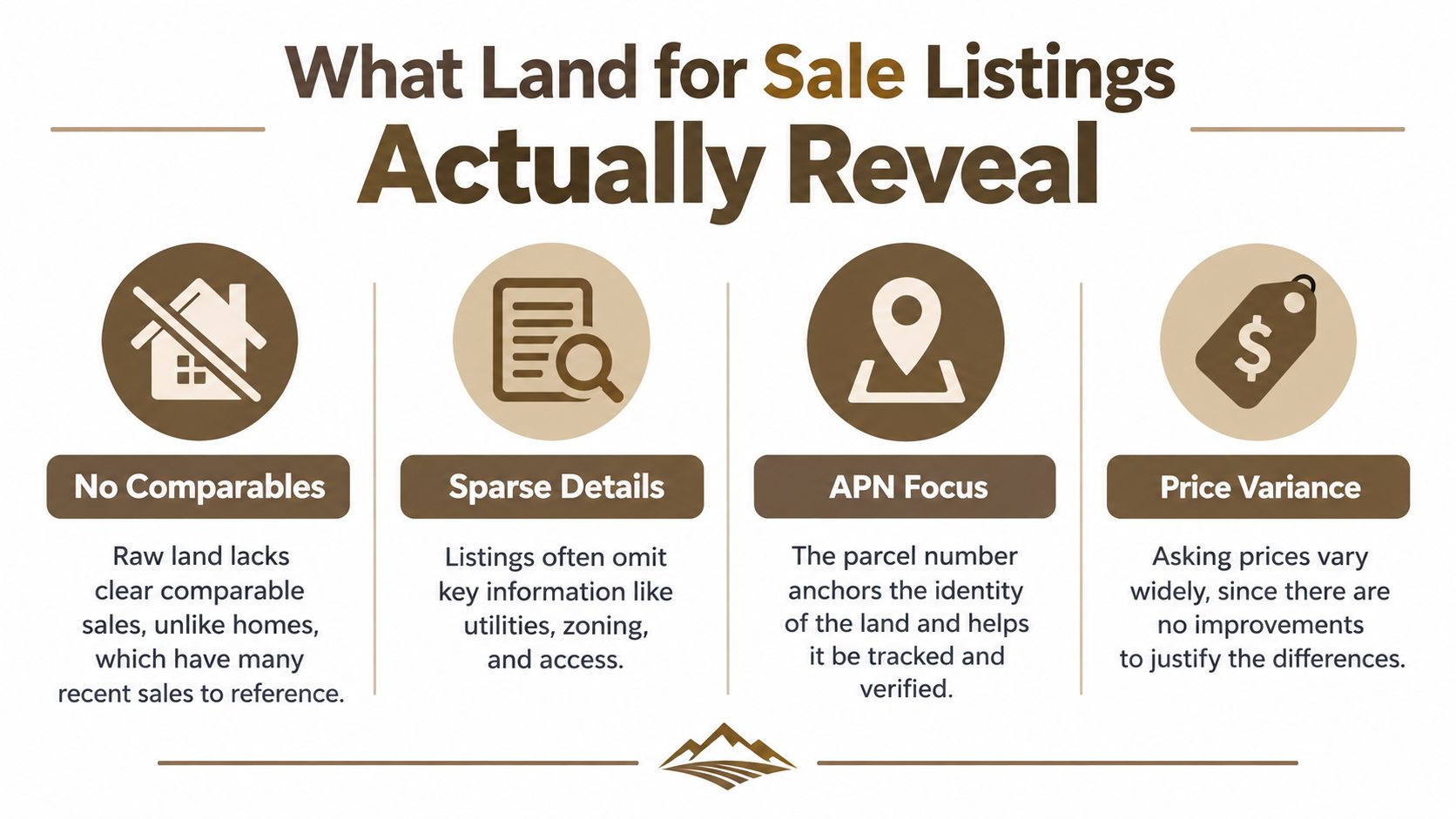
A vacant-land listing rarely gives you the same clarity you'd expect from a house listing. Homes usually come with a tighter set of comparables, visible improvements, and a more standardized pricing logic. Raw land often leans on per-acre or per-lot judgment, with broad county descriptions and uneven detail, so the listing is only the starting point.
Why the same price can mean very different things
Two parcels can look similar on paper and still have wildly different values. A property with recorded road access, verified utility availability, and a clear permitted use can command a materially higher price than a superficially similar lot that lacks those features. That's because vacant land pricing is usually tied to the parcel's feasibility, not just its acreage.
A broad U.S. market snapshot helps show the structure underneath the listings. The dataset reported 678,477 properties for sale covering 16,781,310 acres, with a median lot size of 30.8 acres, a median list price of $546,000, an average list price of $1,290,874, a median price per acre of $14,101, and a median days on market of 86 days (Land.com market insights). Those figures point to a market with large parcels, wide pricing dispersion, and enough time on market to reward careful reading.
Practical rule: if a listing feels unusually affordable, assume the missing cost is somewhere else until you verify it.
The listing is a clue, not a conclusion
That's why the best buyers treat a listing as a clue set. The APN, acreage, map pin, and description all matter, but none of them settle the question of whether the parcel fits the plan. A good listing starts the process. It doesn't end it.
For a broader overview of how parcels are presented online, this land-for-sale guide is worth a look alongside active listings.
How to Read a Land Listing Before You Filter
Start with the fields that identify the parcel, not the fields that market it. The APN, legal description, acreage, and county matter because they tell you whether the listing is pointing to a real record or just a sales summary. County parcel systems commonly let users search by address, parcel ID, owner name, or legal description, which is why those identifiers are the backbone of due diligence (OpenDataPhilly parcel records).
What to trust first
A listing's most useful fields are usually the boring ones. If the APN matches county records, the acreage is stated clearly, and the map reference is consistent with the parcel shape, you've got a workable starting point. If those basics don't line up, slow down.
- Parcel identity: Match the APN and legal description against county records before you get attached to the photos.
- Acreage accuracy: Treat acreage as a screening field, not a guarantee, until it lines up with the recorded parcel.
- Map references: Use the map pin to orient yourself, but don't assume it proves access or boundaries.
- Location notes: Read county and subdivision references as context, not as permission.
What needs outside confirmation
Photos and area descriptions are directional. They can show terrain, tree cover, or nearby roads, but they don't prove that the lot has usable access, available utilities, or the exact use you want. The same caution applies to phrases like “near power” or “close to town.” Those are marketing shortcuts, not utility commitments or legal use approvals.
Buyer habit that saves time: read every listing as if it were a draft until the parcel record, county zoning, and utility status confirm it.
The best quick visual aid for parcel-reading is a survey map, especially when the listing includes corners, boundary lines, or road frontage references. This survey map guide pairs well with that step because it helps you separate shape from sales language.
Best Filters for Land Searches and What They Really Mean
Filters help you narrow the field, but they're only useful if you know what they leave out. Price, acreage, state, zoning, utilities, and access are all common search dimensions, yet each one can hide a separate verification job. A low price and a large lot may still be a poor fit if access is uncertain or the utility bill will be heavy.
Compare the filter to the real-world question
| Land Search Filter Priority | What it suggests | What to verify outside the listing |
|---|---|---|
| Price | A budget range you can work with | Hidden infrastructure costs, document fees, and whether the parcel is actually usable |
| Acreage | Parcel size and potential space | Boundaries, terrain, setbacks, and whether the acreage supports the intended use |
| State or county | Broad location preference | Local rules, climate realities, and whether the county allows your planned use |
| Zoning | Possible use category | Specific permitted uses, overlays, and subdivision restrictions |
| Utilities | Convenience or future service potential | Written confirmation of availability, extension costs, and service conditions |
| Access | Road or entry possibility | Legal access, physical access, and recorded easements |
Why access and utilities deserve extra attention
Access is not just about a road on a map. A parcel can sit next to a visible lane and still lack legal or physical access. That's a major issue because landlocked, utility-limited, or zoning-constrained parcels tend to be less liquid and slower to resell, since those factors shrink the number of feasible uses (land due diligence checklist).
Utilities deserve the same skepticism. Nearby power doesn't mean a connection is available, and “water nearby” doesn't mean the lot can be served without expense. Low asking prices often hide road work, water, septic, and power costs, so the cheapest listing is not always the cheapest parcel in the end. The market survey language on active land sales and large, fragmented databases points to exactly that kind of fragmented pricing reality (RLI Land Market Survey).
A simple comparison that matters
A 5-acre parcel with road access, known utility status, and straightforward zoning can be a cleaner purchase than a similar-sized lot that needs easement work and utility extensions. Same acreage, same sticker price, very different total effort. The filter tells you where to look. The verification tells you what it will take.
Owner Financing versus Cash Purchases for Land
Cash buying keeps the transaction simple. You're comparing the asking price, the closing steps, and the local costs of getting the parcel into your name. Owner financing changes the timing and the paperwork, which can help buyers who want to avoid the traditional bank route.
Owner-financed land deals are commonly documented with a promissory note plus a land sale contract or purchase agreement, and the seller often prepares the paperwork for electronic signature (Landmodo owner-financed land). In that setup, the buyer makes a down payment and then pays the seller directly in monthly installments rather than going through a bank.
What the note should spell out
A buyer should read the promissory note for the items that change the deal: purchase price, down payment amount, interest rate, monthly repayment schedule, balloon terms, late-payment consequences, and whether prepayment penalties apply. Industry guidance notes that many notes do not include prepayment penalties, but that term still needs to be checked explicitly because it isn't universal (Bankrate owner financing).
That distinction matters because financing terms affect total cost, not just the entry point. A lower upfront number can still be a poor fit if the monthly structure or document charges don't match your budget.
How fees usually show up in practice
Document and closing fees can be itemized separately from the down payment in seller-financed land sales. One published FAQ states buyers are required to pay a $250 document fee covering preparation of purchase agreements, deeds, recording costs, notary fees, transfer tax, and other miscellaneous expenses, while monthly payments may be collected by ACH from checking or savings accounts (LandDiscounts FAQ). That kind of itemization is useful because it forces the buyer to separate down payment, document fee, monthly payment, and total financed cost.
A practical comparison helps here. Cash purchases are cleaner on timing. Owner financing can be more accessible, but the paperwork matters more, and the buyer should verify every fee and payment term before signing. If you want a plain-language overview of seller financing mechanics, this financing explainer is a good companion read.
Due Diligence Checklist for Vacant Land Buyers
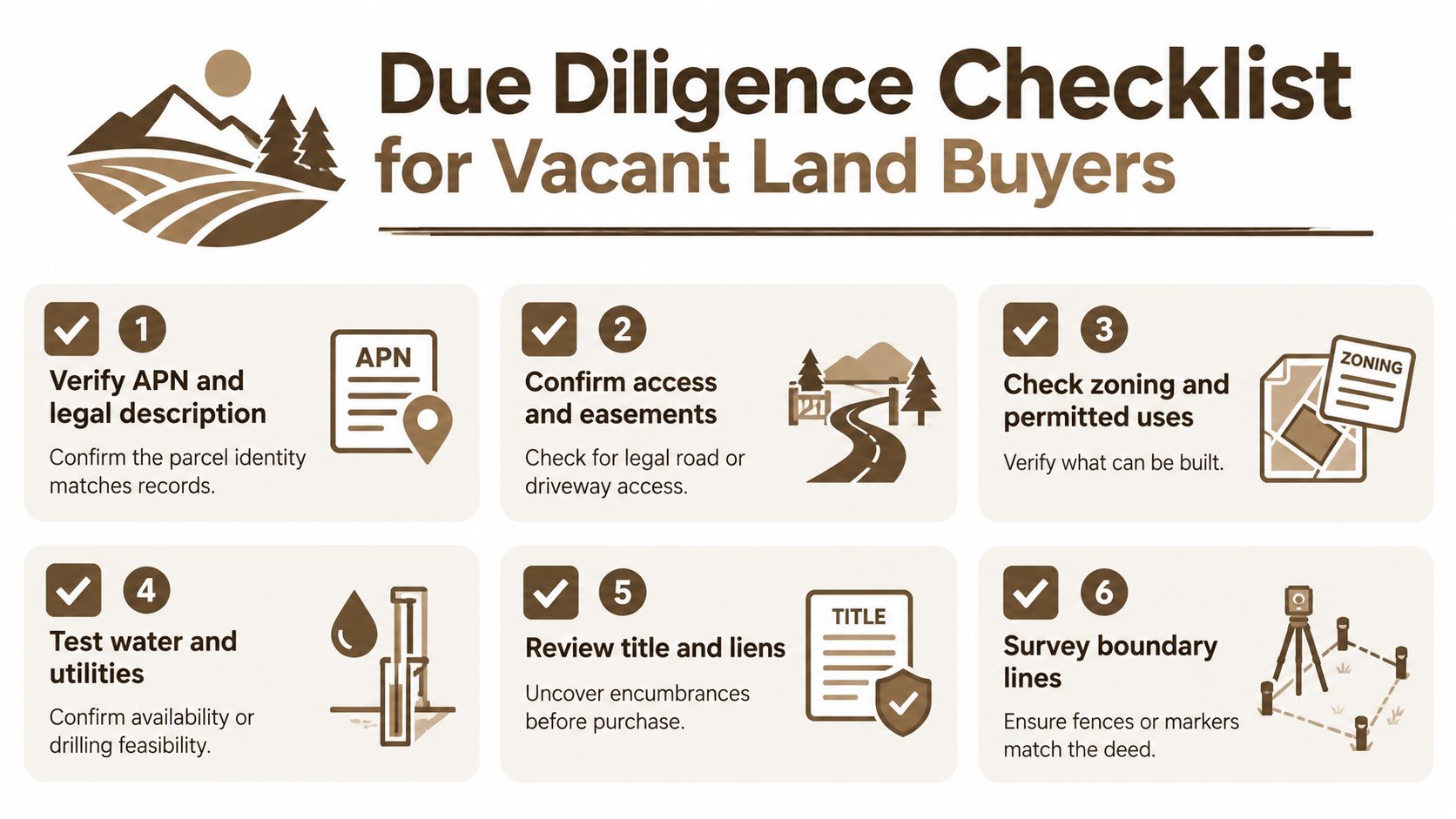
The most expensive listing mistakes are usually factual, not cosmetic. A pretty photo doesn't matter if the parcel identity is off, access is missing, or the lot can't support the intended use. That's why due diligence needs to happen before the money moves.
The high-risk checks
- Verify APN and legal description: Confirm the parcel identity matches county records, not just the listing language.
- Confirm access and easements: Check for both legal and physical access, because one without the other can still leave you stuck.
- Check zoning and permitted uses: Review what the county allows before assuming the parcel fits your plan.
- Test water and utilities: Get written confirmation of availability or drilling feasibility rather than relying on a map pin or a seller note.
- Review title and liens: Look for encumbrances that can complicate or delay the purchase.
- Survey boundary lines: Make sure fences, markers, and the deed description line up.
What these checks are really protecting you from
Independent buyer guides keep coming back to the same point. A cheap lot can be effectively unbuildable, or very expensive to improve, if it has legal access issues, zoning limits, wetlands or floodplain constraints, or soil and percolation problems (questions to ask when buying land). Those details are often buried below the listing surface, which is why the buyer has to pull them up before closing.
Direct advice: if a seller statement sounds helpful but isn't written down in a county, utility, or title record, treat it as unconfirmed.
That's also why raw land requires more than just price comparison. The field with the smallest number on it can still carry the biggest hidden cost. If you want a more detailed verification workflow, this due diligence guide is a practical next stop.
Using Land Listings for Off-Grid, Recreational, and Investment Goals
The same listing can serve very different buyers. Someone looking for an off-grid setup cares about access, utilities, and permitted use. A recreational buyer may care more about terrain and surrounding public land. An investor may focus on scarcity, liquidity, and the cost of making the parcel marketable later.
That's where listing reading becomes a feasibility skill instead of a browsing habit. Nearby hiking, camping, or public land does not create rights on the parcel itself. You still need the parcel's own legal access, zoning clarity, and utility reality before you can assume what's possible.
Match the listing to the use case
A recreational buyer can accept more roughness if the parcel fits the intended pastime and the local rules support it. An off-grid buyer may accept limited infrastructure, but only if the utility story and access story are both clear. An investment buyer has to think one step ahead, because resale usually depends on the same issues that matter at purchase.
Owner-financed land can widen the pool of eligible buyers, but it doesn't change parcel rules. During financing, you still can't assume you can live on the property, store equipment, build structures, or make improvements without the written permission required by the seller and the local approvals that apply. Future use and current permission are separate questions.
If you're comparing lifestyle-driven parcels across regions, compare homesteading locations alongside county rules and listing details. That kind of side-by-side reading helps keep the dream grounded in what the land allows.
One listing, three different readings
A buyer wanting a weekend getaway reads the listing for access and legal use. A buyer wanting a future homesite reads it for buildability and utility burden. An investor reads it for friction, because friction often predicts holding time and resale effort. The parcel doesn't change, but the decision criteria do.
Next Steps After You Find the Right Land for Sale Listing
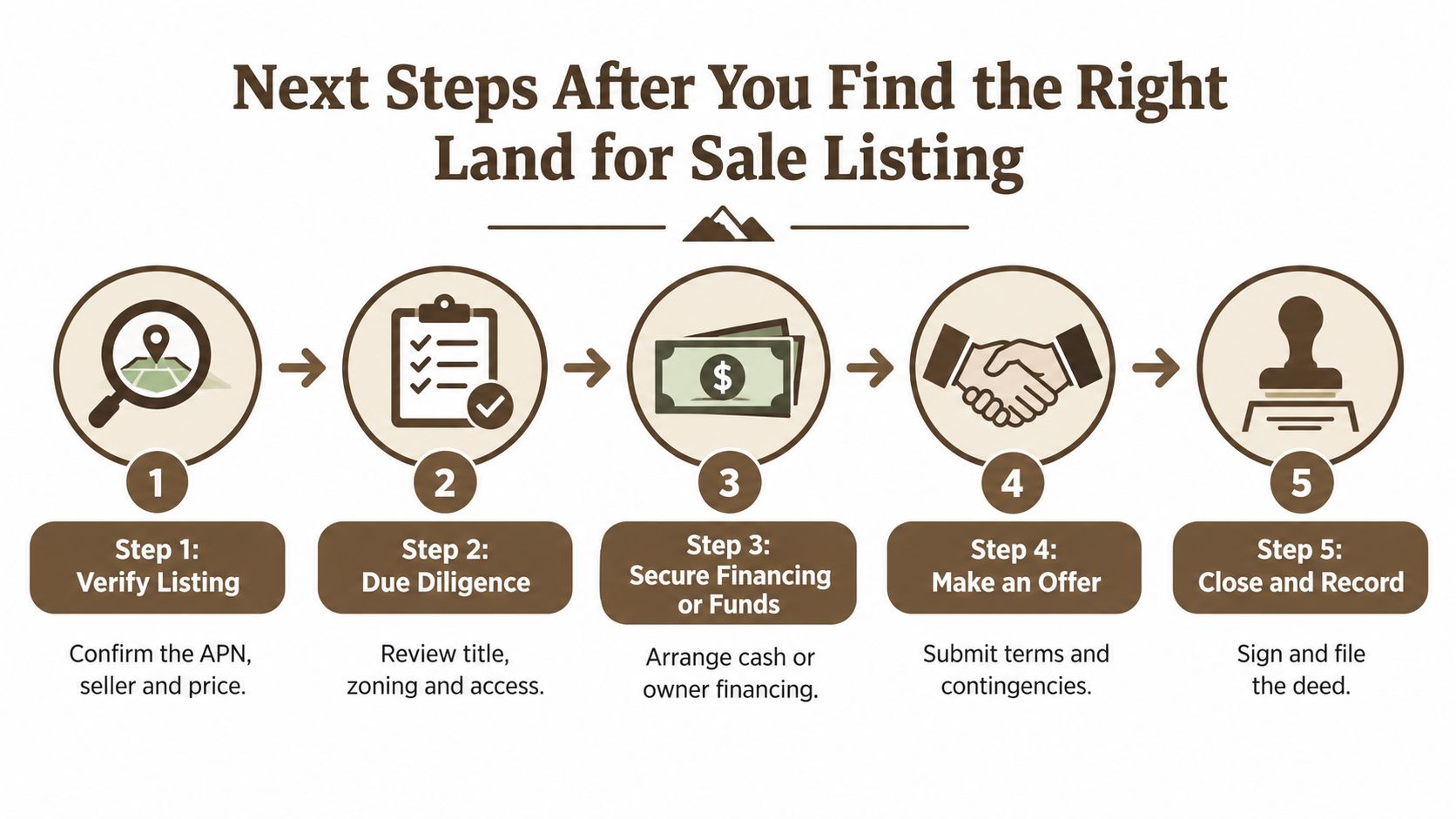
What happens after a parcel clears the first checks? The next move is to verify the details that affect closing, then choose the purchase path that matches the land and your budget.
A clean buying sequence
Start with the required documents. Review the purchase agreement, title or deed details, parcel number, and any seller terms that affect access, use, or payment.
Then choose cash or financing. Cash purchases usually move through payment, signed documents, and deed preparation. Financed purchases use the seller's servicing setup, so the note and payment terms control the schedule and any special conditions. In both cases, the seller prepares the deed packet, and the buyer normally records the deed with the county.
That sequence keeps the deal tied to records instead of assumptions. It also makes ownership, payment, and legal transfer easier to separate, which matters on vacant land.
A practical example of the final step
A buyer finds a parcel that fits the plan, confirms the APN, checks county records, and reads the purchase agreement before paying. If the terms line up, the buyer completes checkout, signs the paperwork, and follows the payment or closing instructions in the agreement.
Owner financing can help when bank hurdles would slow the purchase, but it does not change the parcel rules. A note can make the payment structure easier to handle, while zoning, access, and permitted use still control what you can do with the land.
A cash buyer has a different trade-off. The closing path is usually simpler, but the buyer still has to confirm the deed process, payment confirmation, and recording steps before treating the parcel as theirs.
At this stage, the useful question is whether you have confirmed enough to move forward without guessing. If you have, keep comparing current inventory and read the terms carefully.